Alarm Shelving vs Suppression: When to Use Each

Key Highlights
- Alarm shelving is a temporary, manual action used by control room operators for nuisance alarms.
- Suppression is broader and includes shelving, designed suppression, and out of service states in process industries.
- Use alarm shelving when a specific alarm is distracting now, but still needs later review.
- Use suppression when alarms become irrelevant because of equipment state or a known common cause.
- Good alarm management protects the control room from alarm floods and keeps focus on the most important alarms.
- Clear governance, time limits, and review prevent misuse of shelving and suppression.
Introduction
In any process automation system, the real goal of alarm management is not simply to cut the number of alarms. It is to help control room operators see what matters most and act in time. That is where alarm shelving and suppression become useful. Both reduce distraction, but they solve different problems. If you choose the wrong one, you can hide needed information or leave operators buried in noise. The next sections explain the difference and show when each tactic fits best.
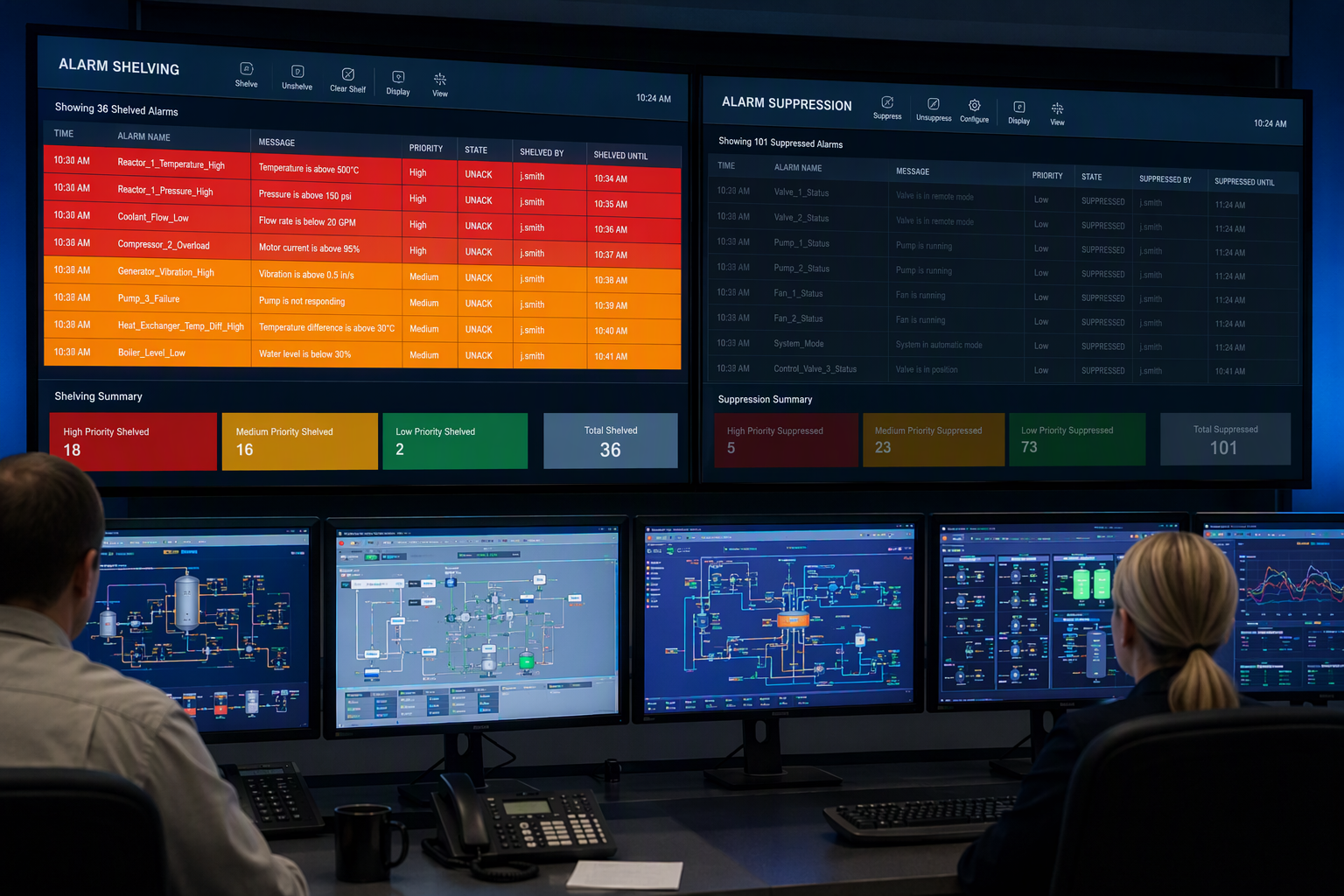
Understanding Alarm Shelving and Suppression in Industrial Automation
In industrial automation, alarm shelving and alarm suppression both reduce distraction in the alarm system. Still, they are not the same. Alarm shelving is a temporary manual step taken by an operator to mute a troublesome alarm for a period of time.
Alarm suppression is a wider concept. It includes system-driven methods that stop alarms from appearing when they are not useful, plus cases where a portion of the equipment is out of service. This distinction matters when nuisance alarms start affecting response quality. To make that clearer, the core terms and differences come first.
Key Definitions and Core Differences
Start with the simple view. Alarm shelving is when an operator manually suppresses an alarm temporarily. It is meant for a short-term issue, usually when a known alarm is active but not helpful right now. The key point is that a person decides to shelve it.
By contrast, suppression types cover more ground. ANSI/ISA-18.2 defines shelving, designed suppression, and out of service. Designed suppression happens when the process automation system blocks an alarm based on a specific set of conditions. Out of service applies when a portion of the equipment is shut down for maintenance or another reason.
Designed suppression is often split into static suppression and dynamic suppression. Static suppression depends on the state of the process or equipment, such as unit startup. Dynamic suppression is more advanced. It uses rules and correct sensors to keep the most important alarms visible while filtering irrelevant alarms during complicated scenarios.
How Both Tactics Address Nuisance Alarms
When nuisance alarms keep repeating, operators lose focus. That is the problem both shelving and suppression try to solve. Shelving helps by removing a single distracting alarm from view for a limited time. Suppression helps by preventing alarms that are not useful under current conditions from ever reaching the operator.
The difference shows up during alarm floods. If one known issue creates many follow-on alerts, suppression can stop the cascade. If one bad actor is simply noisy, shelving can give the operator room to work.
- Shelving is useful for isolated nuisance alarms or false alarms that need temporary relief.
- Suppression is useful when many alarms become irrelevant because of process state or a common cause.
- Both methods protect situational awareness by reducing alarm floods and clutter.
Used well, these tactics do not just reduce noise. They help operators see what deserves action. That leads naturally to the cases where shelving is the right first move.
When to Apply Alarm Shelving in Process Operations
Some process operations create short-lived alarm problems that do not need a permanent design change. In those moments, alarm shelving gives the control room a practical way to quiet one distracting alarm while the situation is understood or corrected.
You should think of shelved alarms as temporary exceptions, not a normal operating method. They help when a specific alarm is known, active, and unhelpful for a short period. The next two sections break down the common use cases, then weigh the benefits and limitations.
Common Use Cases for Alarm Shelving
Alarm shelving fits best when control room operators need temporary relief from specific alarms, not broad logic changes. In process industries, that usually means an alarm is understood, repetitive, and briefly not useful, yet it still belongs in the alarm system for normal operation.
For example, a single alarm may keep returning while the team works around a known instrument issue or a temporary condition. In that case, shelving can reduce distraction without changing the underlying alarm design. The operator makes a deliberate, time-bound choice.
- Use alarm shelving for a known nuisance alarm affecting one point.
- Use it when the condition is temporary and expected to clear soon.
- Use it when a manual operator decision is appropriate in the control room.
If many related alarms are expected because of process state, shelving is usually too narrow. That is when suppression becomes the better tool.
Benefits and Limitations of Alarm Shelving
One clear benefit of alarm shelving is speed. Operators can quickly reduce distraction from a troublesome alarm and focus on response. It is a practical feature when the alarm system contains a temporary nuisance that does not justify immediate redesign. That supports better situational awareness in the moment.
Still, there are limitations. Shelving is manual, temporary, and narrow. It does not address common-cause events or broad alarm floods. It also depends on operator judgment, so overuse can hide information that should stay visible, especially if the alarm supports an important safety function.
- Benefit: fast relief from a single distracting alarm.
- Limitation: does not solve system-wide alarm interactions.
- Risk: poor discipline can turn shelved alarms into hidden exposure.
That is why shelving needs rules, time limits, and review. If the problem is driven by process logic, not operator burden alone, suppression is usually the stronger answer.
Deciding When Alarm Suppression Is the Better Option
Alarm suppression becomes the better option when alarms are not just annoying but irrelevant under known conditions. In those cases, the process automation system should decide which alarms matter, instead of expecting operators to mute them one by one.
This is where suppression types matter. Static suppression works from process or equipment state, while dynamic suppression handles more complex upset conditions. Both can reduce overload far better than manual action alone. The following sections show the typical scenarios, then cover governance, risks, and best practices.
Typical Scenarios Calling for Alarm Suppression
Alarm suppression is the right choice when alarms become predictable but irrelevant because of context. A common example is state-based operation. Some alarms only matter during unit startup, while others should be quiet outside that condition. This is one of the most common forms of alarm suppression.
The stronger case appears during complicated scenarios and upsets. If one common cause, such as loss of an air compressor, creates many downstream device alarms, operators do not need every follow-on alert. They need the root cause and the most important alarms.
- Use static suppression when equipment state makes certain alarms inapplicable.
- Use dynamic suppression to reduce alarm floods during upset conditions.
- Use suppression when many alarms turn irrelevant alarms after a known common cause.
When the issue is broad, system logic beats manual shelving. That said, suppression must be controlled carefully, because poor logic can hide what operators truly need.
Governance, Risks, and Best Practices for Suppression
Suppression should not be added casually. ANSI/ISA-18.2 gives a framework for alarm management in the process industries, and it is widely treated as recognized good engineering practice. That matters because alarm choices affect human response, not just software behavior.
The main risk is simple: suppression can hide alarms that should remain visible. Dynamic suppression is especially demanding because it needs sound rules, correct sensors, and careful thinking about what operators must know in each state of the process. In some cases, this can be as challenging as work around a safety system or safety function.
- Define clear governance for each suppression rule.
- Validate the specific set of conditions that triggers suppression.
- Review whether the operator can still see the most important alarms.
Good best practices include building from a clear philosophy, rationalizing alarms carefully, and maintaining the logic over time. Once you have that discipline, a direct comparison between shelving and suppression becomes easier.
Side-by-Side Comparison: Shelving vs Suppression
If you need a fast rule, think of shelving as operator-controlled and local, while suppression is logic-driven and broader. In alarm management, both reduce burden in the control room, but they do so for different reasons. Shelving helps with a temporary nuisance. Suppression protects operators by making sure only the most important alarms appear when process context changes.
| Feature | Shelving | Suppression |
|---|---|---|
| How it starts | Manual operator action | Automatic or defined by system logic |
| Main purpose | Temporary relief from one alarm | Remove irrelevant alarms based on conditions |
| Typical scope | Single alarm | Multiple alarms or alarm groups |
| Best fit | Short-term nuisance alarms | State-based or common-cause situations |
| Key drawback | Can be overused manually | Poor rules can hide needed alarms |
This quick table helps, but the safest choice still depends on a few decision questions in the control room.
A Decision Checklist for the Control Room
Before acting, ask what kind of problem you are facing. Is one alarm distracting the team, or is the alarm system producing many messages because the process automation system has entered a known state? That simple question often separates shelving from suppression.
Use this checklist to guide the decision and improve notification quality in the control room:
- Is this a single known alarm that is temporarily noisy, or a larger pattern?
- Can an operator safely make a short-term manual decision, or should the system handle it?
- Has the state of the process made certain alarms irrelevant by design?
- Will this action preserve visibility of alarms that still require response?
If the answer points to one temporary point, shelving may fit. If it points to logic, equipment state, or recurring patterns, suppression is usually the smarter path. After the decision, audit results so exceptions do not become routine.
Auditing Shelved and Suppressed Alarms
Auditing is what keeps temporary actions from becoming permanent blind spots. Shelved alarms and suppressed alarms should be reviewed against the state of the process, operator needs, and the original reason they were created. If an alarm is repeatedly shelved, that is often a sign that rationalization or redesign is needed.
A useful auditing routine asks a few direct questions. Was the alarm truly a nuisance, or was it warning of a real developing problem? Did suppression rules match actual operating conditions? Did the logic still allow the most important alarms to reach operators during an upset? Strong auditing closes the loop between philosophy, implementation, and maintenance. It also supports continuous improvement without adding more noise back into the system.
Conclusion
Shelving and suppression are both useful, but they answer different questions. Shelving asks whether one alarm can be set aside for a short time while the team deals with a known problem. Suppression asks whether a group of alarms should appear at all under a given process state or common cause. When teams confuse the two, they either waste operator effort on manual work the system should handle, or they hide alarms behind logic no one has reviewed. The checklist and comparison in this guide are meant to keep that choice deliberate, not habitual.
Good governance is what separates a controlled tool from a bad habit. Every shelved alarm should carry a reason, a time limit, and an owner who will review it before the limit expires. Every suppression rule should carry a tested condition, a named approver, and a review date. Operators should always be able to see that something is shelved or suppressed, and they should know how to bring it back into view. If a rule cannot be explained in plain language, or if its effect cannot be checked in the alarm history, it is not ready for the control room.
Start with the worst offenders. Pull a month of alarm history, list the points that were shelved most often, and check whether each one still needs to exist in its current form. Many chronic shelving cases turn out to be badly set limits, faulty instruments, or alarms that no longer match how the unit runs. Fixing those root causes reduces the need for shelving far more reliably than adding more manual workarounds. Record each decision, so the next shift does not have to guess why an alarm was hidden.
Finally, treat shelving and suppression as part of the wider alarm management lifecycle, not as shortcuts around it. A written philosophy sets the rules, rationalization tests each alarm against them, and regular audit checks whether practice still matches the document. When those pieces work together, operators get fewer distractions, clearer priorities, and more trust in the alarms that do appear. That is the real goal: an alarm system that helps the control room act, rather than one the control room has to work around.
A practical next step is to review your current shelved and suppressed lists this week. Count how many alarms are shelved right now, how long each one has been shelved, and whether the original reason still holds. Do the same for suppression rules, and check that each rule still matches current operating states and equipment lineups. Bring the results to operations, maintenance, and controls together, and agree on expiry dates for anything that no longer has a clear justification. Then repeat the review every month, and track whether the count of shelved alarms is falling. A falling count usually means the underlying problems are being fixed, while a rising count is a warning that the team is relying on hiding alarms instead of solving them. Use the checklist above before every shelving decision, and document the outcome. Small, steady discipline here pays off on every shift. Over time, that discipline is what turns a noisy alarm system into a trusted one.
Frequently Asked Questions
What visual indicators show if an alarm is shelved or suppressed?
In HMI systems, visual indicators should clearly show whether alarm shelving or suppression is active so the control room is not guessing. The exact display varies, but the purpose is consistent: operators need an obvious indication that an alarm is hidden temporarily or by logic, not simply gone.
How do industry standards guide shelving and suppression decisions?
ISA and ANSI guidance, especially ANSI/ISA-18.2, helps define alarm shelving, suppression, and the broader alarm management life cycle. These industry standards matter because they support recognized good engineering practice and help plants choose methods that preserve operator action, visibility, and process safety.
How can operators avoid misuse of alarm shelving features?
Operators avoid misuse of alarm shelving by treating it as a temporary exception, not a routine fix. Strong governance, time limits, clear notification, and review of repeated shelving events help prevent bad habits. If the same alarm keeps getting shelved, the design likely needs correction rather than another manual action.
You might also like