AGVs Explained: What You Need to Know Today
AGVs Explained: What You Need to Know Today
Key Highlights
Here are the key takeaways you need to know about Automated Guided Vehicles (AGVs):
- An automated guided vehicle (AGV) is a mobile robot that transports materials without a human operator.
- AGVs navigate using various systems, including magnetic tape, lasers, and vision technology, to follow predetermined paths.
- Implementing an AGV system boosts efficiency, improves workplace safety, and lowers long-term labor costs in material handling.
- Common types include tow vehicles, unit load carriers, and automated forklifts, each suited for different warehouse operations.
- AGVs are different from AMRs, as they follow fixed routes while AMRs navigate dynamically.
Introduction
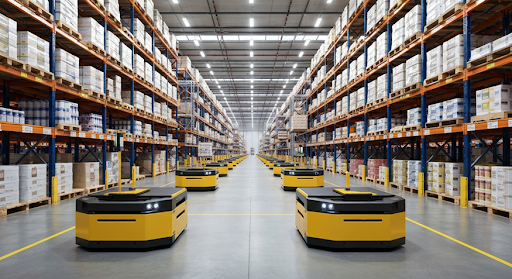
In today's fast-paced industrial world, businesses are always looking for ways to become more efficient. Enter the automated guided vehicle (AGV). These self-driving vehicles are changing the game in material handling by transporting goods autonomously. You can find them in warehouses, distribution centers, and manufacturing facilities, where they ensure a steady flow of materials to and from production lines. If you're curious about how this technology can streamline operations, you've come to the right place.
Understanding Automated Guided Vehicles (AGVs)
So, what exactly is an automated guided vehicle? Think of it as a self-driving transport system for industrial settings. These vehicles move goods and materials from one point to another without needing a driver, relying on a combination of software and navigation systems to guide their way. They are a core component of modern automation in material handling.
To truly grasp how they work, it's helpful to explore their core concepts and see how they stack up against traditional equipment. We will look at what defines an AGV and how it differs from the manual tools you might be used to seeing.
Defining Automated Guided Vehicles: Core Concepts
At its core, an automated guided vehicle is a mobile robot designed to automate material handling tasks. Instead of a human operator, it uses a combination of sensors, software, and navigation technology to move along preset paths. This is similar to how a train follows a fixed track, ensuring predictable and reliable movement.
An AGV system is more than just a single vehicle. It includes the entire infrastructure needed to manage a fleet of these mobile robots. This often involves a central control system that assigns tasks and coordinates movement, ensuring all vehicles work together efficiently.
This system can be integrated with other facility software, like a Warehouse Management System (WMS). This integration allows the AGVs to receive instructions seamlessly, making them a smart and connected part of your operations.
How AGVs Differ from Traditional Material Handling Equipment
The biggest difference between an automated guided vehicle and traditional equipment like forklifts or conveyor belts is automation. AGVs operate without a human driver, which sets them apart from tools that require manual handling and constant supervision. This automation brings several advantages for material transport.
Unlike fixed conveyor belts, these mobile robots offer more flexibility in their routes and can be reprogrammed if your facility layout changes. While conveyors are great for a continuous flow, AGVs can navigate more freely around a facility, making them adaptable to different needs.
Compared to manual carts and forklifts, AGVs offer:
- Autonomous operation without a human operator.
- Increased safety through advanced sensors and predictable movement.
- Continuous operation, 24/7, without breaks or shift changes.
- Reduced risk of human error in repetitive tasks.
How AGVs Operate in Modern Facilities
An automated guided vehicle operates by following predefined paths within a facility. These routes are established using various guidance technologies, from simple magnetic tape on the floor to more advanced methods like laser navigation. The AGV uses its onboard sensors to detect these paths and move along them accurately.
To understand how these vehicles function safely and efficiently, it's important to look at their key operational components. Let's examine the different navigation systems that guide them and the safety mechanisms that prevent accidents.
Navigation Systems: From Wired to Laser and Beyond
AGVs use a variety of navigation systems to find their way around a facility. The chosen navigation method often depends on the complexity of the environment and the specific needs of the operation. Early forms of guidance relied on physical markers, but technology has since evolved.
Some common navigation methods include:
- Magnetic Tape or Wire: The AGV follows a path defined by magnetic tape on the floor or a wire embedded within it. This is a reliable form of magnetic navigation for simple, fixed routes.
- Laser Navigation: This method uses laser scanners on the AGV that detect reflective targets placed around the facility. The vehicle calculates its position based on the reflected laser beams.
- Optical Navigation: Similar to magnetic guidance, this involves the AGV following visual markers or lines painted on the floor.
- Inertial Navigation: AGVs use gyroscopes and accelerometers to track their movement from a known starting point, allowing them to navigate without external markers.
Each of these systems offers a different level of flexibility and precision, allowing businesses to choose the best fit for their operational workflow.
Obstacle Avoidance and Safety Mechanisms in AGVs
Safety is a top priority in any automated system, and AGVs are no exception. They are equipped with robust safety systems designed for collision avoidance and the protection of both personnel and products. These features allow them to operate safely alongside human workers and other equipment.
AGVs use a network of sensors, such as laser sensors and ultrasonic detectors, to identify obstacles in their path. When an object is detected, the vehicle can automatically slow down or come to a complete stop to prevent an accident. This constant environmental scanning is key to their safe operation.
In addition to automated detection, most AGVs include physical bumpers that trigger an emergency stop upon contact. Manual emergency stop buttons are also installed on the vehicles, allowing a human to halt the AGV instantly if needed. These layers of protection ensure safe and reliable performance.
Key Types of AGVs in Industrial and Commercial Use
Not all AGVs are the same. There are various types of these mobile robots available, each designed for specific material handling tasks. From automated carts that carry small parts to heavy-duty tuggers that pull large loads, the right AGV depends entirely on your operational needs. Some common examples include unit load AGVs and forklift AGVs.
Understanding the different types of AGVs can help you identify which solution might be the best fit for your facility. Let's explore some of the most common models used in industrial and commercial settings today.
Tow Vehicles and Tuggers
A tow vehicle, also known as a tugger, is an AGV designed to pull one or more non-powered carts, trailers, or other wheeled devices. This guided vehicle system operates like a small, autonomous train, making it perfect for moving multiple loads simultaneously across a large facility.
These AGVs are equipped with a hitch or coupling mechanism to connect to the carts they are towing. They excel at repetitive transport tasks, such as delivering raw materials to production lines or transferring finished goods from assembly to a storage area.
By using a single tow vehicle to handle several loads at once, companies can significantly streamline their material transport processes. This reduces traffic in aisles and increases the overall efficiency of moving items over long distances within a warehouse or factory floor.
Unit Load AGVs and Pallet Movers
Unit load AGVs are designed to transport individual, large loads such as pallets, containers, or large racks. They typically feature a platform or forks that can lift and carry the unit load from one location to another. This makes them a popular choice for automating pallet handling tasks.
These vehicles are commonly found in warehouse operations and distribution centers where the primary task is material movement. They can autonomously pick up a pallet from a receiving area, transport it to a designated storage location, and even place it on a rack.
By automating the movement of unit loads, these AGVs help ensure a smooth and consistent flow of goods throughout a facility. This reduces the need for manual forklift operators and minimizes the risk of product damage during transport.
Automated Forklift Trucks and Carts
Automated forklift trucks, or forklift AGVs, are designed to perform the functions of a traditional forklift but without a human operator. Equipped with forks, they can lift, stack, and retrieve pallets from various heights, making them ideal for warehouse environments that involve vertical storage.
Another common type is the automated guided cart (AGC). These are simpler, more compact versions of an automated guided vehicle, designed to transport smaller loads like bins, totes, or tools. Their small size allows them to navigate tight spaces easily, making them perfect for assembly line support.
Both forklift AGVs and AGCs bring automation to specific tasks. Whether it's complex pallet handling or moving small components between workstations, these vehicles offer a flexible and efficient solution for various industrial needs.
Main Applications and Use Cases for AGVs
The versatility of the automated guided vehicle makes it suitable for a wide range of applications. In logistics and manufacturing, AGVs are often used for tasks that would otherwise require forklifts, manual carts, or conveyor systems. They play a crucial role in optimizing the supply chain by automating material handling in warehouses and distribution centers.
From moving raw materials to supporting order fulfillment, AGVs can handle many different jobs. Let's look at some of the most popular use cases, including warehouse material handling, production line support, and automated storage scenarios.
Material Handling in Warehouses
In warehouse operations, AGVs are instrumental in creating an efficient material flow. They can autonomously handle inbound and outbound goods, transporting items from receiving docks to storage areas or from storage to shipping zones. This automation streamlines processes that are often labor-intensive.
A guided vehicle system can also be used for stock replenishment and to support order picking. For instance, an AGV can move pallets of goods from long-term storage to forward picking locations, ensuring that popular items are always readily available for fulfillment.
Some AGVs can even function as a flexible automated storage and retrieval system (AS/RS). By automating the transport of goods, they reduce the need for manual material handling, which helps minimize errors, increase speed, and improve overall warehouse productivity.
Production Line Support and Just-in-Time Delivery
In manufacturing, AGVs are essential for supporting production lines. They are often used to transport raw materials like plastics, metals, or chemicals from storage areas directly to the assembly lines where they are needed. This ensures a consistent and reliable supply, preventing costly production delays.
AGVs also handle the movement of work-in-process (WIP) goods between different stages of production. By transporting partially completed products from one workstation to another, they help maintain a smooth and uninterrupted manufacturing process, which is a key principle of just-in-time (JIT) delivery.
This continuous movement optimizes the flow of goods through the factory, increasing productivity and reducing the likelihood of bottlenecks. Automating this step frees up human workers to focus on more complex tasks that require their skills and judgment.
Automated Storage and Retrieval Scenarios
AGVs play a significant role in automated storage and retrieval systems by handling the physical material movement. After the manufacturing process is complete, AGVs can transport finished goods from the production line to a designated storage area or directly to shipping docks for outbound delivery.
In some warehouses, collaborative mobile robots, a subset of AGVs, work alongside human pickers. These robots can guide workers through picking tasks and then transport the picked orders to packing and shipping stations. This collaboration helps speed up the order fulfillment process.
By integrating with warehouse management systems (WMS), AGVs can receive real-time instructions for storage and retrieval tasks. This connection ensures that goods are stored correctly and retrieved efficiently, minimizing the risk of damage and preparing them for timely distribution.
Industry Sectors Embracing AGV Technology
The benefits of AGV technology are recognized across many industry sectors. While manufacturing facilities and distribution centers are the most common adopters, the use of these automated vehicles is expanding into other areas as well. Any industry that relies on the repetitive movement of materials can find value in automation.
From automotive plants to e-commerce warehouses and even healthcare, AGVs are making a significant impact. Let's explore some of the key industries that are successfully implementing this technology to improve their operations.
Manufacturing and Automotive Industries
The manufacturing and automotive industries are among the largest users of AGVs, holding a majority of the market. In these fast-paced environments, AGVs are critical for creating "smart factories" where automation drives productivity and optimizes the supply chain.
In automotive manufacturing facilities, for example, AGVs are used to deliver parts to production lines, transport vehicle bodies between assembly stations, and move finished vehicles off the line. This automation helps reduce congestion on the factory floor and allows employees to focus on higher-value tasks.
Key applications in these sectors include:
- Transporting raw materials and components.
- Moving work-in-progress goods along assembly lines.
- Delivering finished products to storage or shipping.
- Handling bulk materials in general assembly.
Logistics, Distribution, and E-Commerce Warehouses
In the world of logistics and e-commerce, speed and accuracy are everything. Distribution centers and warehouse systems rely heavily on AGVs to keep up with the high demand for rapid order fulfillment. These vehicles automate many of the core tasks involved in running a modern warehouse.
AGVs are used for a variety of material transport duties, including unloading inbound shipments, moving inventory into storage, and transporting picked orders to packing and shipping stations. In large e-commerce warehouses, fleets of AGVs work around the clock to ensure orders are processed quickly.
By automating these repetitive tasks, logistics companies can significantly enhance their workflows. This leads to faster order picking, more accurate inventory management, and a more efficient overall operation, which is crucial for meeting customer expectations.
Healthcare and Pharmaceutical Facilities
The healthcare and pharmaceutical sectors are also adopting automated guided vehicle technology to improve efficiency and safety. In these sensitive environments, AGVs provide a reliable and sterile solution for material handling, reducing the need for human contact with potentially contaminated items.
In hospitals, AGVs can be used to transport meals, linens, medical supplies, and waste. This frees up staff to focus on patient care rather than logistical tasks. In pharmaceutical facilities, AGVs can move sensitive materials and finished products while maintaining strict environmental controls.
The use of an automated guided vehicle in these settings not only improves operational efficiency but also enhances safety and cleanliness. By automating the transport of goods, these facilities can ensure that materials are moved securely and without contamination.
Benefits of Implementing AGVs for Material Handling
Why should you consider implementing an automated guided vehicle for your material handling needs? The advantages are compelling and can have a major impact on your bottom line. Key benefits include increased efficiency, improved safety, and lower costs over the long term.
By taking over repetitive and physically demanding tasks, AGVs can transform your operations. Let's dive into how they boost productivity while reducing labor costs and how they create a safer work environment for everyone.
Efficiency, Productivity, and Reduced Labor Costs
One of the most significant benefits of AGVs is the dramatic boost in efficiency and productivity. Unlike human workers, AGVs can perform their tasks with high precision and consistency, which reduces errors associated with fatigue or oversight. This leads to a more reliable and predictable workflow.
Furthermore, AGVs enable continuous operation. They can run 24 hours a day, 7 days a week, without needing breaks, vacations, or shift changes. This round-the-clock productivity ensures a steady flow of operations and can significantly increase your facility's output.
While the initial investment in AGVs can be substantial, the reduction in labor costs over time leads to considerable savings. By automating routine tasks, you can lower expenses related to salaries, benefits, and other human resource needs, delivering a strong return on investment.
Enhanced Workplace Safety and Accident Prevention
Improving workplace safety is another key advantage of using an automated guided vehicle. Industrial environments can be hazardous, but AGVs are designed with advanced safety systems that significantly reduce the risk of accidents and contribute to accident prevention.
These vehicles can take over tasks that may be dangerous for human workers, such as operating in extreme temperatures or handling hazardous materials. Their movements are controlled and predictable, which minimizes the chances of collisions with people, equipment, or products.
Modern AGVs come equipped with multiple safety features, including:
- Advanced sensors for obstacle detection.
- Collision avoidance systems that automatically stop the vehicle.
- Physical bumpers for an extra layer of protection.
- Emergency stop buttons for immediate manual intervention.
By implementing these features, AGVs create a much safer environment for your entire team.
Integration of AGVs into Existing Operations
Adopting AGV solutions doesn't have to mean overhauling your entire facility. A crucial step for success is the thoughtful integration of AGVs into your existing operations. This involves connecting the AGV control system with your current software, such as warehouse management systems (WMS), to ensure seamless communication.
Proper planning is key to a smooth transition. Let's review the steps involved in deploying AGVs into your workflows and discuss how they achieve compatibility with the management systems that run your warehouse.
Steps for AGV Deployment in Workflows
A successful automated guided vehicle deployment requires a structured approach. The process begins with a thorough analysis of your current workflow to identify where automation can provide the most benefit. This helps ensure that the integration is aligned with your business goals.
Once you've identified the right tasks for automation, the next step is to plan the AGV routes and configure the system. This might involve installing guidance markers like magnetic tape or setting up laser reflectors. The goal is to create an efficient path that avoids congestion and integrates smoothly with human activity.
The final phase involves testing and refinement. Running trials allows you to optimize the AGV workflow, address any unforeseen challenges, and train your employees on how to work alongside the new system. A typical deployment plan includes these key stages:
| Stage | Description |
|---|---|
| Analysis & Planning | Assess current operations, identify tasks for automation, and define project goals. |
| System Design | Design AGV routes, select the appropriate vehicle types, and plan for infrastructure needs. |
| Installation & Setup | Install guidance systems, configure the control software, and integrate with WMS. |
| Testing & Training | Run system tests, optimize workflows, and train employees on the new processes. |
| Go-Live & Support | Launch the system into full operation and provide ongoing monitoring and maintenance. |
AGV Compatibility with Warehouse Management Systems (WMS)
For an automated guided vehicle system to function effectively, it must communicate seamlessly with your warehouse management systems (WMS). This integration allows the central control system to manage the AGV fleet in real time, assigning tasks and coordinating movements based on the overall needs of the warehouse.
When an order needs to be picked or a pallet needs to be moved, the WMS sends a task directly to the AGV control system. The control system then dispatches the nearest available AGV to complete the job, providing updates back to the WMS as the task progresses.
This two-way communication ensures that your entire operation is synchronized. Your WMS has full visibility into the material handling process, and your AGVs always have the most up-to-date instructions. This level of compatibility is essential for achieving maximum efficiency and operational transparency.
AGVs vs. Autonomous Mobile Robots (AMRs): Key Differences
You might have heard the term autonomous mobile robots (AMRs) used alongside AGVs. While both are used for material handling, there's a key difference in their navigation technology. An automated guided vehicle typically follows fixed, predetermined paths, much like a train on a track.
AMRs, on the other hand, are more flexible. They use advanced sensors and onboard maps to navigate dynamically, allowing them to maneuver around obstacles. Let's explore the technical variations between these two types of robots and help you decide which is right for your business.
Technical Variations and Decision Criteria
The primary technical variation between AGVs and AMRs lies in their navigation technology. AGVs rely on a guided vehicle system to follow predefined routes. This guidance can come from physical markers like magnetic tape, wires in the floor, or painted lines.
AMRs, in contrast, navigate using onboard sensors and software to create a map of their surroundings. They can understand their environment in real time and make independent decisions about the best route to their destination. This allows them to navigate safely in dynamic environments where obstacles may appear unexpectedly.
When deciding between the two, consider these points:
- Environment: AGVs excel in controlled environments with fixed, repetitive tasks.
- Flexibility: AMRs are better suited for dynamic environments that change frequently.
- Infrastructure: AGVs often require physical infrastructure for guidance, while AMRs do not.
- Rerouting: AMRs can dynamically reroute around obstacles, whereas an AGV will typically stop and wait for the path to be cleared.
Choosing the Right Solution for Your Business
Choosing between AGVs and AMRs comes down to your specific business needs and the nature of your operating environment. There is no one-size-fits-all answer, so it's important to assess your goals carefully. Are you looking to automate a highly repetitive task on a fixed route? An AGV is likely the most cost-effective solution.
However, if your facility has a constantly changing layout or requires robots to navigate around people and other equipment, an AMR might be the better choice. Its ability to find the best route on its own provides the flexibility needed for more complex and dynamic settings.
To make the right decision, consider working with a trusted partner who specializes in automation. They can help you analyze your workflow, evaluate different AGV solutions, and recommend the technology that will deliver the best results for your unique business needs.
Suitability of AGVs for Different Business Sizes
Is AGV technology only for large corporations with massive warehouses? Not at all. As AGV solutions become more accessible and varied, businesses of all sizes can benefit from automated material handling. The key is to find a system that matches your scale and budget.
Whether you're a small enterprise looking to automate a single task or a large-scale operation needing a full fleet, there's an AGV solution that can help you lower costs and boost efficiency. Let's look at the considerations for different business sizes.
Considerations for Small and Medium-Sized Enterprises
For a small enterprise, the initial cost of AGV technology can seem daunting. However, the long-term benefits of lower costs in labor and increased efficiency often provide a strong return on investment. The key is to start small and focus on a specific, high-impact area of your operation.
Instead of deploying a large fleet, a small or medium-sized business might begin with one or two AGVs to handle a particularly repetitive or strenuous task. This allows you to experience the benefits of automation without a massive upfront investment.
When considering AGVs, a small enterprise should think about:
- Starting Small: Begin with a pilot program to test the technology.
- Focusing on ROI: Target tasks where automation will deliver the quickest payback.
- Scalability: Choose a system that can grow with your business needs.
- Flexibility: Look for AGV solutions that can be easily reprogrammed for different tasks.
Scaling AGV Solutions for Large-Scale Operations
For large-scale operations with complex environments, scalable solutions are essential. An automated guided vehicle system for a large warehouse or manufacturing plant needs to be robust enough to manage a large fleet and sophisticated enough to handle intricate workflows.
The modularity of modern AGV systems makes them highly scalable. A business can start with a certain number of vehicles and easily add more to the fleet as demand grows. The central control system is designed to manage this expansion, ensuring that all vehicles continue to work together seamlessly.
In large, complex environments, the ability to coordinate dozens or even hundreds of AGVs is crucial. Advanced traffic control software prevents congestion and optimizes routes, ensuring that the entire automated guided vehicle fleet operates at peak efficiency, even as the operation expands.
Advanced Safety Features in Modern AGV Systems
As AGV technology has evolved, so have its safety systems. Modern AGVs go beyond basic bumpers and warning lights, incorporating advanced sensors and intelligent software to create an exceptionally safe operating environment. Features like predictive monitoring and sophisticated obstacle detection are now standard.
These advanced safety features not only protect your employees and assets but also ensure reliable and uninterrupted operation. Let's explore the specific technologies that make modern AGVs so safe and discuss the importance of complying with industry standards.
Sensors, Emergency Stops, and Predictive Monitoring
Modern AGVs are equipped with a suite of advanced sensors, such as lidar, which creates detailed 3D maps of the vehicle's surroundings. This allows the AGV to detect obstacles with incredible accuracy and make instant decisions to avoid collisions, even in busy environments.
The classic emergency stop button remains a critical safety feature, providing an immediate manual override for any situation. This ensures that human operators can intervene instantly if they spot a potential hazard that the automated system might not have detected.
Beyond real-time safety, many AGVs now include predictive monitoring. This technology continuously analyzes data on the vehicle's condition, such as motor temperature and battery health. By predicting potential issues before they cause a failure, predictive monitoring helps minimize unplanned downtime and improves overall system reliability, including proactive battery management.
Compliance with Industry Safety Standards
To ensure the highest level of safety, every automated guided vehicle must adhere to strict industry standards. Compliance is not optional; it's a fundamental requirement for deploying AGVs in any work environment, especially those where they operate alongside people.
These standards dictate the requirements for all safety systems, from obstacle detection sensors to emergency stop mechanisms. Before an AGV can be put into service, it must undergo rigorous testing to verify that all its safety features perform as expected under a wide range of conditions.
By choosing an AGV that meets or exceeds these industry standards, you can have confidence in its reliability and safety. This compliance ensures that the vehicle has been thoroughly vetted and is designed to protect your workers, your products, and your facility.
Frequently Asked Questions (FAQ)
Understanding AGVs can raise several questions. Commonly asked queries include how these automated guided vehicles navigate their environment. Many utilize advanced navigation systems, such as laser navigation or magnetic strips, to find the best route while ensuring collision avoidance. Users often wonder about their applications in manufacturing facilities and distribution centers, particularly regarding material handling tasks. Additionally, concerns about battery management and emergency stop features are essential for safe operation. Remember, whether it’s for repetitive transport tasks or complex environments, AGVs are designed to streamline material flow efficiently.
Can AGVs be customized for unique business needs?
Yes, absolutely. Many AGV solutions offer a high degree of flexibility and can be customized to meet unique business needs. This can include adapting the vehicle's size, payload capacity, or attachments. This customization is key to applying automation effectively to specialized material handling challenges.
What is the typical return on investment for AGVs?
The return on investment for an automated guided vehicle is typically strong. While there is an upfront cost, the long-term savings from lower labor costs, increased efficiency, and higher productivity often result in a payback period of one to three years, making it a financially sound investment.
How future-proof are AGV systems with evolving technology?
Modern AGV systems are designed with scalability and future technology in mind. Many systems are modular, allowing for upgrades to navigation technology or software as it evolves. This ensures your AGV system can adapt to future needs and provide continuous operation for years to come.
Conclusion
In summary, Automated Guided Vehicles (AGVs) are revolutionizing material handling across various industries by enhancing efficiency, safety, and productivity. As businesses continue to embrace the benefits of AGV technology, understanding their operational mechanisms and applications becomes crucial. By integrating AGVs into your workflows, you can significantly reduce labor costs while ensuring a safer working environment. Whether you’re in manufacturing, logistics, or healthcare, there’s a suitable AGV solution for your needs. If you’re ready to explore how AGVs can transform your operations, don’t hesitate to reach out for a free consultation today!
You might also like