Top Benefits of Integrating AGVs in Your Business
Top Benefits of Integrating AGVs in Your Business
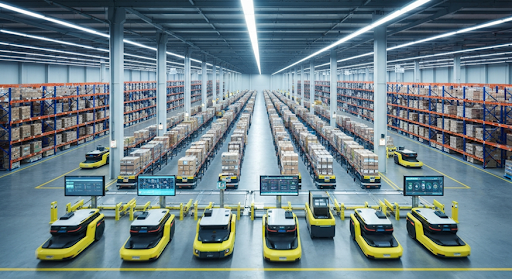
Key Highlights
- An automated guided vehicle (AGV) is a mobile robot used to automate material handling in warehouses and factories.
- AGV technology relies on advanced navigation systems to follow predefined paths for safe and efficient transport.
- Integrating AGVs boosts productivity, enhances workplace safety, and helps lower long-term operational costs.
- Key types include tow vehicles, unit load carriers, and automated forklifts, each designed for specific tasks.
- AGVs optimize warehouse operations by ensuring a consistent flow of materials from receiving to shipping.
- These vehicles are transforming industries like manufacturing, automotive, and food by streamlining complex logistics.
Introduction
Are you looking for ways to make your business operations more efficient? The automated guided vehicle (AGV) is changing the game in modern logistics, manufacturing, and warehousing. These smart vehicles are becoming essential tools for automating material handling and optimizing the material flow within a facility. By taking over repetitive transport tasks, AGVs allow your team to focus on more valuable work, boosting productivity and streamlining your entire workflow from start to finish.
Understanding Automated Guided Vehicles (AGVs)
So, what exactly is an automated guided vehicle? Think of it as a self-driving vehicle designed to transport materials within your facility without needing a human operator. AGVs use a combination of software, sensors, and navigation systems to move along predetermined routes.
An entire network of these vehicles is known as an AGV system. This system manages and coordinates multiple AGVs, often integrating with your existing warehouse management software to receive tasks and report progress. This integration creates a seamless and automated environment. Now, let's explore what defines an AGV and how it operates.
What Defines an AGV?
An automated guided vehicle is essentially a mobile robot that follows a fixed path. Unlike a person driving a forklift, an AGV doesn't make independent decisions about its route. Instead, it relies on guidance technology like magnetic tape, painted lines, or lasers to navigate. This makes its movement predictable and reliable.
The core of AGV technology is its control system. This central brain directs the vehicle, processes information from its sensors, and ensures it stays on its designated path. The system tells the AGV where to go, when to start, and when to stop, automating tasks that would otherwise require manual effort.
By removing the need for a human operator, these vehicles can work around the clock with consistent precision. This ability to perform repetitive tasks without fatigue or error is what makes the automated guided vehicle a powerful tool for modern industries seeking to improve efficiency and consistency in their operations.
How Do AGVs Operate in Modern Facilities?
In a modern facility, AGVs function like a highly disciplined transport team. They operate by following predefined paths that guide them from one point to another. These paths can be marked by physical lines on the floor or managed by more advanced navigation systems that use lasers and reflectors. This allows them to move seamlessly between different areas.
A common application is moving materials between production lines. For example, an AGV can pick up raw materials from a storage area and deliver them directly to an assembly station, ensuring the line never runs out of components. This creates a steady and uninterrupted workflow, which is crucial for maintaining high productivity levels.
Ultimately, AGVs are programmed to handle specific material handling tasks. Whether it's transporting finished goods to the shipping dock or moving parts between workstations, their operation is designed to be efficient and dependable. They receive instructions from a central controller and execute their tasks with precision, making them a reliable part of the production process.
Main Types of AGVs Used in Business Operations
Not all AGVs are created equal. There are many different types of AGVs, each designed for specific material transport needs. Your choice depends on the kind of loads you need to move, the environment they will operate in, and the tasks they need to perform.
From towing heavy carts to lifting pallets onto racks, each guided vehicle system offers unique capabilities. Understanding the main categories can help you identify the right solution for your business. Let’s look at some of the most common types of AGVs you’ll find in today's facilities.
Tow Vehicles and Tuggers
Towing AGVs, also known as tuggers, are the workhorses of material movement. These vehicles are designed to pull a train of carts or trailers, making them perfect for transporting multiple loads at once. Think of them as an automated locomotive for your warehouse floor, capable of hauling thousands of pounds in a single trip.
Their primary function is to handle repetitive transport tasks over long distances. Instead of using multiple vehicles or manual carts to move supplies, a single tugger can deliver materials to various points along an assembly line or across a large facility. This is especially useful for:
- Delivering supplies to production lines
- Transporting finished goods to storage
- Moving waste and recycling materials
Because tow vehicles can handle heavy loads and move them efficiently, they are a popular choice for large-scale manufacturing and distribution centers. They streamline the flow of goods, reduce congestion in aisles, and free up your employees to focus on tasks that require human skill and judgment.
Unit Load and Pallet Trucks
When your operations involve moving single, heavy items like pallets or large containers, unit load AGVs are the ideal solution. These vehicles are specifically designed to pick up, transport, and drop off individual loads. They often feature a platform or forks to carry items securely from one location to another.
Unit load AGVs are a cornerstone of automated pallet handling. They can be programmed to retrieve pallets from receiving docks, place them in storage racks, or move them to outbound shipping areas. This capability makes them incredibly valuable in warehouses and distribution centers. Common tasks include:
- Loading and unloading trucks
- Stacking and retrieving pallets from racks
- Transporting goods between different warehouse zones
By integrating with warehouse management systems (WMS), these AGVs can receive real-time instructions for their tasks. This connection ensures that goods are moved accurately and efficiently, minimizing errors and keeping your inventory management system up to date without manual data entry.
Automated Forklifts and Custom AGVs
Automated forklifts are a type of automatic guided vehicle that mimics the functionality of a traditional forklift but without a human driver. Equipped with forks, they can lift, move, and stack pallets at various heights. This makes them perfect for warehouses where goods are stored vertically on racks, as they can automate stacking and retrieval tasks.
For businesses with unique challenges, custom AGVs offer a tailored solution. These vehicles are designed from the ground up to meet specific requirements that standard models can't address. This might involve a special size, a higher payload capacity, or unique attachments for handling non-standard materials. For example, custom AGVs are used for:
- Transporting large assembly components
- Handling heavy coils or castings
- Navigating through exceptionally tight spaces
Whether you need an automated guided vehicle to perform standard forklift duties or a highly specialized machine for a unique application, these advanced options provide flexibility. They allow businesses to automate even the most complex material handling workflows, boosting efficiency and adapting to specific operational needs.
Core Benefits of Integrating AGVs
Integrating AGVs into your business operations can lead to significant improvements across the board. The primary advantages revolve around boosting efficiency and creating a safer, more cost-effective workplace. By automating repetitive material transport, you can achieve higher throughput and a more predictable workflow.
The ability to maintain continuous operation, 24/7, without breaks or shift changes is a major plus. This leads to increased productivity and lower costs over time. Let's examine some of the core benefits in more detail, starting with how AGVs can enhance your team's output.
Increased Productivity and Throughput
One of the most immediate benefits of adopting AGVs is a significant boost in productivity. These vehicles are designed for continuous operation, meaning they can work around the clock without needing breaks, vacations, or shift changes. This ensures that your material handling processes never have to stop.
This nonstop capability creates a consistent and reliable flow of goods throughout your facility. AGVs can keep production lines supplied with materials and move finished products to storage or shipping areas without delay. This eliminates bottlenecks that often occur with manual transport, leading to higher overall throughput.
Imagine a workflow where materials arrive at workstations exactly when they are needed, and finished items are cleared away instantly. By automating these movements, AGVs reduce idle time for both machinery and employees. This allows your team to focus on value-added tasks instead of waiting for materials, maximizing the efficiency of your entire operation.
Enhanced Workplace Safety
Creating a safer work environment is a top priority for any business, and AGVs can play a crucial role in achieving that goal. Unlike human-operated vehicles, which are prone to accidents caused by fatigue or distraction, AGVs are equipped with advanced safety systems that help prevent incidents before they happen.
These vehicles use a network of sensors for collision avoidance. They can detect people, obstacles, and other vehicles in their path and are programmed to slow down or stop to avoid a collision. This predictable behavior reduces the risk of accidents in busy warehouse aisles and on crowded factory floors.
Furthermore, most AGVs are fitted with physical bumpers and an emergency stop button. If an AGV does come into contact with an object, the bumper will trigger an immediate halt. The emergency stop function also allows any nearby worker to stop the vehicle instantly if they notice a potential hazard. These features work together to create a much safer environment for your employees.
Reduced Operational Costs
While there is an initial investment, integrating an automated guided vehicle into your operations can lead to significant long-term savings. One of the biggest areas of cost reduction is in labor. AGVs take over the repetitive and physically demanding tasks of material transport, reducing your reliance on manual labor for these roles.
This automation helps you achieve lower costs associated with salaries, benefits, training, and recruitment for material handling positions. It also minimizes the costs related to human error, such as damage to products or equipment, which can add up over time. With AGVs, you get consistent and predictable performance day in and day out.
Moreover, AGVs can operate in environments that might be challenging or hazardous for human workers, like extreme temperatures or areas with poor lighting. By handling these tasks, they reduce the risk of workplace injuries and associated costs. Over their lifespan, AGVs provide a strong return on investment by optimizing workflows and cutting down on recurring expenses.
Industry Applications for AGVs
The use of AGVs isn't limited to just one or two sectors. In fact, a wide range of industry applications benefit from automated material handling. From raw material delivery to finished product transport, AGVs are streamlining tasks at nearly every stage of the supply chain.
Any business that involves moving goods within a controlled environment can likely find a use for AGVs. Their versatility allows them to be adapted for different needs, making them a valuable asset in many fields. Let's look at some of the key industries where AGVs are making a big impact.
Manufacturing and Assembly Environments
Manufacturing facilities are one of the primary environments where AGVs have become indispensable. These automated vehicles are perfect for the structured and repetitive tasks common in production settings. They ensure that assembly lines are consistently supplied with the necessary components, preventing costly downtime.
A typical use case involves the transport of raw materials from the receiving dock or storage area directly to the point of use on the factory floor. AGVs can be programmed to make these deliveries on a precise schedule, ensuring that production never has to wait for parts. This creates a just-in-time flow that maximizes efficiency.
Once products are partially or fully assembled, AGVs can also move them between different workstations or take finished goods to quality control or packaging areas. By automating the movement of work-in-progress, manufacturing facilities can maintain a smooth and continuous production cycle, boosting output and reducing manual handling errors.
Warehousing and Distribution Centers
In the fast-paced world of warehousing and distribution centers, efficiency is everything. AGVs are transforming warehouse operations by automating the movement of goods from receiving to shipping. They handle tasks that are often repetitive and physically demanding, such as transporting pallets, bins, and cartons.
These vehicles integrate seamlessly with modern warehouse systems, including Warehouse Management Systems (WMS). This connection allows the WMS to dispatch AGVs automatically for tasks like stock replenishment, order picking support, and moving picked orders to packing stations. This level of automation reduces human error and increases order fulfillment speed.
By taking over the heavy lifting and long-distance travel within a warehouse, AGVs allow employees to focus on more complex tasks like packing, quality control, and customer service. This not only improves productivity but also creates a more ergonomic and safer work environment in busy distribution centers.
Automotive, Food, and Healthcare Sectors
The benefits of AGVs extend to highly specialized industries like automotive, food, and healthcare. In the automotive sector, AGVs are used to deliver parts to assembly lines with precise timing, a critical component of modern vehicle manufacturing. They help reduce congestion on the factory floor and ensure a steady production pace.
The food and beverage industry also leverages AGVs to move raw ingredients, packaging materials, and finished products. In these environments, hygiene and traceability are key, and automated systems help minimize contamination risks associated with manual handling. They ensure a smooth flow through the supply chain, from production to cold storage.
In healthcare, AGVs are used in hospitals to transport meals, linens, medical supplies, and waste. This frees up nurses and other clinical staff to focus on patient care. By automating these logistical tasks, AGVs improve efficiency and help maintain a clean and organized healthcare environment.
AGV Navigation and Obstacle Avoidance
Have you ever wondered how AGVs move around without a driver? The magic is in their navigation systems. These systems act as the vehicle's eyes and ears, guiding it along its path and helping it react to its surroundings. This technology is what allows AGVs to operate safely and efficiently.
There are several navigation methods available, each with its own strengths. In addition to guidance, these systems are equipped with features for collision avoidance to ensure the safety of people and property. Let's explore the technologies that make autonomous movement possible.
Modern Navigation Technologies Used in AGVs
Modern AGVs use a variety of sophisticated technologies to find their way around a facility. One of the most common methods is laser navigation. With this approach, the AGV has a rotating laser scanner that detects reflective targets placed on walls or columns. By measuring the distance and angle to these reflectors, the vehicle can calculate its exact position in real time.
Another popular method is magnetic navigation. This involves laying down magnetic tape or embedding wires in the floor to create a fixed path. The AGV is equipped with sensors that detect the magnetic field and follow it precisely. This method is reliable and easy to install or modify. Other common navigation technologies include:
- Inertial Navigation: Uses gyroscopes and accelerometers to track movement from a known starting point.
- Optical Navigation: Follows painted lines or visual markers on the floor.
- Vision-based Navigation: Uses cameras to identify features in the environment and create a map.
Each of these navigation technologies offers a different balance of flexibility, precision, and cost, allowing businesses to choose the best fit for their specific operational environment and needs.
How AGVs Detect and Bypass Obstacles
Safety is paramount, and a key part of an AGV's design is its ability to detect and avoid obstacles. This capability, known as collision avoidance, relies on a suite of advanced sensors that constantly scan the vehicle's surroundings. These sensors act as the AGV's senses, alerting it to any potential hazards in its path.
The most common types of sensors used for this purpose are laser sensors (like LiDAR) and ultrasonic sensors. Laser sensors create a detailed 3D map of the environment, allowing the AGV to spot obstacles from a distance and plan its response, which is usually to slow down or stop. Ultrasonic sensors work similarly but use sound waves to detect objects.
In addition to these, AGVs may use other types of sensors to ensure safe operation. The combination of these technologies provides multiple layers of protection, enabling the AGV to navigate busy environments without incident.
| Sensor Type | How It Works |
|---|---|
| Laser Sensors | Emits laser beams to create a 360-degree map of surroundings, detecting objects with high precision. |
| Ultrasonic Sensors | Uses high-frequency sound waves to detect objects in the AGV's immediate path. |
| Vision Sensors | Cameras capture real-time video, and software analyzes it to identify obstacles, people, or path markers. |
| Physical Bumpers | A contact sensor that triggers an emergency stop if the AGV physically touches an object. |
AGVs vs. Autonomous Mobile Robots (AMRs)
As you explore automation, you might come across another term: autonomous mobile robots (AMRs). While both AGVs and AMRs are types of mobile robots used for material transport, they operate in fundamentally different ways. Understanding this distinction is key to choosing the right technology for your facility.
AGV systems are designed to follow fixed, predefined paths. AMRs, on the other hand, are more flexible and can navigate dynamically. Let’s break down the key differences between these two powerful automation tools to see which one might be better suited for your needs.
Key Differences in Capabilities and Use Cases
The primary difference between AGVs and AMRs lies in their navigation technology. AGVs are like trains on a track; they follow a predetermined path marked by wires, magnetic tape, or lasers aimed at reflectors. If an obstacle blocks their path, they simply stop and wait for it to be removed.
In contrast, AMRs are more like a car with GPS. These mobile robots use advanced technologies like LiDAR and cameras to create a map of their surroundings and navigate freely. If an AMR encounters an obstacle, it can intelligently find a new route to get around it. This makes them ideal for dynamic environments where layouts can change. Key differences include:
- Navigation: AGVs follow fixed paths, while AMRs navigate dynamically.
- Flexibility: AMRs can adapt to changes and obstacles, while AGVs require a clear path.
- Implementation: AGVs often require infrastructure changes (like laying tape), while AMRs can be deployed more quickly.
Because of these differences, AGVs are best suited for simple, repetitive tasks in a controlled environment. AMRs excel in more complex, fast-paced settings where they need to work alongside people and navigate around unpredictable obstacles.
Choosing the Right Solution for Your Business
Deciding between AGVs and AMRs depends entirely on your operational needs and environment. If your facility has a static layout and you need to automate simple, repetitive point-to-point transport, AGV solutions are often a cost-effective and reliable choice. Their reliance on fixed paths ensures predictable and consistent performance.
However, if your warehouse or factory is a dynamic space with frequent changes, moving obstacles, or shared pathways with employees, an AMR might be the better option. Its ability to navigate intelligently and adapt to its surroundings provides a level of flexibility that AGVs cannot match. The best route for your business is the one that fits your workflow.
To make the right decision, it's often helpful to work with a trusted partner who specializes in automation. They can analyze your processes, understand your goals, and recommend the AGV or AMR solution that will deliver the best results. A successful integration starts with a clear understanding of what you want to achieve and which technology will get you there.
FAQs (Frequently Asked Questions)
Curious about automated guided vehicles? Many wonder how they navigate complex environments. AGVs typically use advanced navigation methods like magnetic strips and laser sensors, ensuring safe operation while transporting materials. A common concern involves their ability to work alongside human workers. In reality, these vehicles are designed with safety systems and collision avoidance technology to facilitate cooperation. Those considering the investment often ask about cost savings. Utilizing AGVs can lead to lower operational costs through efficient material transport and reduced manual labor expenses, making them a trusted partner in enhancing warehouse operations.
Are AGVs Suitable for Small and Medium Businesses?
Yes, absolutely! While once seen as a tool for large corporations, AGV systems are becoming more accessible and scalable. For small and medium businesses, AGVs can automate material handling, streamline the supply chain, and help you compete with larger players by boosting efficiency without a massive investment in labor.
What Safety Features Do Modern AGVs Offer?
Modern AGVs are packed with safety systems to ensure safe operation. They include advanced sensors for collision avoidance, which allow them to detect and react to obstacles. Other features include physical bumpers, audible alarms, warning lights, and an emergency stop button that allows anyone to halt the vehicle instantly.
How Can Companies Successfully Integrate AGVs into Existing Operations?
Successful integration starts with careful planning. Work with a trusted partner to map out AGV navigation routes and identify tasks for the automatic guided vehicle. It's important to ensure the AGV can communicate with existing warehouse systems and that production lines are prepared for automated delivery and pickup.
Conclusion
In conclusion, integrating Automated Guided Vehicles (AGVs) into your business offers a plethora of benefits that can transform your operations. From increasing productivity and enhancing workplace safety to reducing operational costs, AGVs are becoming indispensable in various industries. As technology advances, these innovations make it easier to navigate and optimize workflows, ensuring that your company stays competitive in the ever-evolving market landscape. If you're considering how AGVs can benefit your specific business needs, don’t hesitate to reach out for a free consultation. Embrace the future of automation and watch your business thrive!
You might also like