AGVs in Action: Success Stories from Leading Industries
AGVs in Action: Success Stories from Leading Industries
Key Highlights
- An automated guided vehicle (AGV) is a driverless robot that automates material handling tasks in industrial settings.
- AGVs navigate using technologies like laser navigation or magnetic tape, following predefined paths to transport goods.
- Implementing AGVs enhances safety on production lines and in distribution centers by reducing human error and workplace accidents.
- These mobile robots boost efficiency by enabling continuous operation and streamlining warehouse automation.
- Leading industries, including automotive and logistics, use different types of AGVs to optimize their supply chain and lower costs.
Introduction
In today's fast-paced industrial world, companies are constantly looking for ways to work smarter, not harder. This is where the automated guided vehicle (AGV) comes in. These incredible mobile robots are changing the game in manufacturing facilities and warehouses across the globe. By automating the movement of materials, AGVs are helping businesses increase efficiency, improve safety, and free up their employees for more important tasks. Ready to see how they do it?
Understanding Automated Guided Vehicles (AGVs) in Modern Industry
An automated guided vehicle is essentially a self-driving vehicle designed for industrial environments. Think of it as a smart, robotic helper that specializes in material handling. Instead of relying on a human operator, these vehicles follow set paths to move goods from point A to point B, taking over repetitive transportation tasks.
This technology is becoming a cornerstone of modern logistics. By automating the flow of materials, you can create more stable and predictable processes, which is a huge advantage in any busy facility. Let's explore what an AGV is and the technology that powers it.
What Defines an AGV and How It Works
So, what is an automated guided vehicle (AGV) and how does it work? At its core, an AGV is a driverless robot that automates material transport. Its main job is to move items around a facility, such as a warehouse or factory, without needing a person to steer it. This helps streamline operations by handling the non-value-adding task of moving things around.
These vehicles operate by following predetermined routes. Depending on the technology, this could be a physical line on the floor or a digitally mapped path. The AGV uses its onboard navigation system to follow this route precisely, picking up, transporting, and dropping off loads as instructed by a central control system.
This level of automation makes processes incredibly reliable. By taking human intervention out of simple transport tasks, AGVs reduce the chance of errors and ensure that materials get where they need to go, on time, every time. This consistency is key in busy industrial environments.
Core Technologies Behind AGV Navigation and Control
Have you ever wondered what technology is used to guide AGVs along their routes? It all comes down to a sophisticated navigation system. One common method is using physical guides, like magnetic tape on the floor. The AGV is equipped with sensors that detect the magnetic field and follow the path precisely. While effective, this method requires careful planning, as changing the routes later can be costly.
A more flexible approach is natural feature navigation, which often uses laser navigation. With this method, the AGV uses laser sensors to scan its surroundings, recognizing the natural features of the building—like walls, racks, and columns—to determine its position. This means no physical infrastructure like tape or reflectors is needed on the factory floor.
Behind the scenes, intelligent software powered by artificial intelligence acts as the brain of the operation. This system coordinates the routes and speeds of all vehicles in the fleet, preventing traffic jams and ensuring a smooth, efficient flow of goods throughout the facility.
Types of AGVs Used in Leading Industries
Not all AGVs are created equal. Just as you have different tools for different jobs, there are different types of AGVs designed for specific material handling tasks. Whether you need to move small parts, heavy pallets, or multiple carts at once, there's a specialized AGV ready to help optimize your supply chain.
The type of AGV you choose depends entirely on your operational needs, from the weight of the loads to the complexity of the transport route. Let's look at some of the most common models being used in leading industries today.
Unit Load AGVs: Streamlining Material Handling
Unit load AGVs are the workhorses of the AGV world. These vehicles are designed specifically for handling and transporting single, large items like pallets, bins, or rolls of material. If you need to move heavy loads consistently, unit load AGVs are an excellent solution for your material handling needs.
These AGVs typically carry their load directly on their back, functioning like a mobile conveyor belt. They can pick up a pallet from a stationary rack or conveyor and transport it to another station within the facility. This is one of the most common types of AGVs commonly used in industry.
You'll often find unit load AGVs in manufacturing and warehousing settings, where they bridge the gap between production lines and storage areas. By automating the movement of finished goods or raw materials, they create a seamless flow in demanding industrial environments.
Forklift AGVs for Automated Pallet Movement
Imagine a forklift that can operate on its own. That's exactly what forklift AGVs are. These automated vehicles are designed for pallet handling, capable of lifting, moving, and stacking pallets just like their manual counterparts. They are perfect for warehouse operations where goods need to be stored on high racks or moved between the floor and production lines.
These AGVs come in various forms, including automated counterbalanced trucks, reach trucks, and even very narrow aisle (VNA) trucks for high-density storage. This versatility makes them one of the most useful types of AGVs commonly used in industry. They can interact with existing racking systems, making integration relatively simple.
Using forklift AGVs for repetitive stacking and retrieval tasks frees up skilled human operators to focus on more complex jobs. This not only improves efficiency but also reduces the risk of accidents and damage associated with manual pallet handling.
Towing AGVs and Automated Guided Carts Explained
Towing AGVs, also known as tuggers, are designed to pull a train of non-powered carts. Think of them as a small, autonomous locomotive for your warehouse floor. This type of automated guided vehicle is ideal for transporting multiple loads at once over longer distances, which significantly improves material flow.
These vehicles are often used to transport goods from a central storage area to various points along an assembly line or to deliver supplies to different workstations. One towing AGV can move a load that would otherwise require several trips with a standard forklift, making them highly efficient.
Automated guided carts (AGCs) are a similar but more compact solution. They are designed to transport smaller loads, often by driving underneath a stationary cart and lifting it for transport. They are particularly useful in tight spaces where larger vehicles can't operate, providing a flexible way to move materials.
Comparing AGVs and Autonomous Mobile Robots (AMRs)
You might have heard the terms automated guided vehicle (AGV) and autonomous mobile robots (AMRs) used interchangeably, but they are actually quite different. Both are designed to move materials, but they go about it in fundamentally different ways. Understanding this distinction is key to choosing the right solution for your facility.
The main difference lies in their navigation capabilities and flexibility. An AGV typically follows a fixed path, while an AMR system is more dynamic. Let’s break down their functional differences and see which might be a better fit for specific industrial needs.
Functional Differences: AGVs vs AMRs
So, how do AGVs differ from autonomous mobile robots (AMRs)? The main difference is how they navigate. AGVs are like a train on a track; they follow simple, predetermined routes guided by wires, magnetic strips, or lasers pointed at reflectors. If an obstacle blocks their path, they stop and wait for it to be removed.
AMRs, on the other hand, are more like a car with a GPS. These mobile robots use advanced technologies like lidar and cameras to build a map of the facility and navigate dynamically. Their navigation system allows them to detect obstacles and find a way around them, enabling more flexible movement and better collision avoidance.
Here is a simple breakdown of their differences:
| Feature | Automated Guided Vehicle (AGV) | Autonomous Mobile Robot (AMR) |
|---|---|---|
| Navigation | Follows fixed, predefined paths (magnetic tape, wires, lasers). | Navigates dynamically using onboard maps and sensors (lidar, cameras). |
| Flexibility | Less flexible; requires infrastructure changes to alter routes. | Highly flexible; can adapt to new layouts and find alternate routes. |
| Obstacle Response | Stops and waits for the obstacle to be cleared. | Navigates around obstacles, improving workflow continuity. |
| Implementation | Can be more disruptive to install due to infrastructure needs. | Faster and easier to deploy, as it maps the existing environment. |
Which Solution Suits Specific Industrial Needs?
Now for the big question: which solution suits specific industrial needs? The best choice really depends on your facility's environment and workflow. AGVs are an excellent fit for highly structured and repetitive processes where the material flow doesn't change. If you have a simple, A-to-B transport task that needs to be performed over and over, an AGV is a reliable and cost-effective solution.
However, if you operate in more dynamic environments where layouts might change or where there's a lot of human and vehicle traffic, an AMR might be the better option. AMRs offer flexible automation solutions that can easily adapt to new tasks and changing surroundings without requiring major infrastructure updates.
Ultimately, you should consider your specific handling requirements. For stable, predictable industrial environments, AGVs provide unmatched consistency. For complex and ever-changing spaces, the intelligence and adaptability of AMRs are invaluable.
Key Benefits of AGVs in Warehouse Automation
Integrating AGVs into your warehouse automation strategy brings a host of powerful benefits. These smart vehicles are more than just a way to move goods; they are a tool for creating a safer, more efficient, and more reliable operation. From enabling continuous operation to delivering significant cost reductions, AGVs are a game-changer.
By taking over repetitive and physically demanding tasks, AGVs allow your team to focus on work that adds more value. Let’s explore some of the key advantages, including improved safety, operational consistency, and lower costs.
Boosting Safety and Reducing Workplace Accidents
One of the most significant benefits of using AGVs in warehouse automation is the improvement in workplace safety. Manual material handling can be a major source of injuries, but AGVs minimize the risk of accidents by automating these tasks. Their movements are controlled and predictable, reducing the chance of collisions with people, infrastructure, or products.
AGVs are equipped with advanced sensors and safety systems designed for collision avoidance. These features allow the vehicle to detect obstacles in its path and stop or slow down to prevent an accident. This makes the work environment safer for everyone.
Key safety features commonly found on AGVs include:
- 360-degree laser scanners to monitor the surrounding area.
- Curtain lasers to detect overhanging obstacles.
- Emergency stop buttons for immediate shutdown.
- Visual and audible warning signals to alert nearby workers.
Achieving Consistent Operations and Efficiency
AGVs are champions of consistency. Unlike human workers, they don't get tired or distracted, allowing them to perform repetitive tasks with the same level of precision every time. This reliability is crucial for maintaining a smooth and predictable workflow in busy warehouse operations.
A major advantage is their ability to provide continuous operation. AGVs can run 24/7, only stopping for charging. This dramatically increases your handling capacity and overall efficiency without being limited by shift schedules. Your operation can keep moving, day and night.
By automating routine transport routes, you can optimize your entire material flow. This leads to fewer bottlenecks, reduced wait times, and a significant boost in productivity. AGVs ensure that materials are always where they need to be, exactly when they need to be there.
Cost Savings Versus Manual Material Handling
So, how does the cost of implementing AGVs compare to manual transport solutions? While there is an upfront investment in the vehicles and system integration, AGVs deliver substantial long-term cost savings. The most significant savings come from reduced reliance on manual labor for material handling tasks.
With manual operations, staffing can account for a large portion of your overall costs. By automating these roles, you can reallocate your workforce to more value-added activities and achieve lower costs over time. This makes AGVs a smart financial investment that typically pays for itself relatively quickly.
Additionally, AGVs help reduce costs associated with product and infrastructure damage. Their precise navigation and safety features minimize accidents, leading to fewer damaged goods and repair bills. The combination of reduced labor costs and fewer damages makes a compelling case for automation.
Technological Foundations of AGVs
The magic of AGVs lies in their sophisticated technology. These vehicles are packed with advanced systems that allow them to navigate, communicate, and operate autonomously with incredible precision. The core of this technology is the navigation system, which acts as the vehicle's eyes and ears.
Combined with advanced sensors and intelligent software, these systems enable AGVs to move safely and efficiently through complex environments. Let's take a closer look at the key technologies, from laser navigation to seamless integration with warehouse management systems.
Laser, Magnetic, and Vision-Based Navigation Systems
What technology is used to guide AGVs along their routes? There are several methods, each with its own strengths. The most common navigation systems rely on lasers, magnets, or vision to guide the vehicle.
Laser navigation is a highly flexible method where the AGV uses laser scanners to identify its position based on the natural features of the building. Magnetic navigation involves following a path laid out with magnetic tape or dots on the floor. The AGV's sensors detect the magnetic field and follow it precisely. Vision-based navigation uses cameras to identify lines or other visual markers on the floor to follow a path.
Here are the primary navigation types:
- Laser Navigation: Uses laser beams to map the surroundings for guidance.
- Magnetic Tape Navigation: Follows a physical magnetic track on the floor.
- Vision-Based Navigation: Uses cameras to follow painted lines or other visual cues.
- Geoguidance: Relies on GPS and detailed digital maps for positioning.
Real-Time Communication and Route Adaptation
For a fleet of AGVs to work together seamlessly, real-time communication is essential. Each vehicle is wirelessly connected to a central control system, often called a fleet manager. This system acts as a traffic control tower, coordinating the movements of all AGVs in the facility.
This constant communication allows for dynamic route adaptation. If an AGV's path is blocked or a more urgent task arises, the control system can instantly reroute the vehicle to find the best route. This ensures that traffic flows smoothly and efficiently, without creating bottlenecks or delays.
The intelligent software can also manage vehicle speeds and intersections, preventing collisions and optimizing the overall material flow. This level of coordination is what makes an AGV system so powerful and efficient, allowing multiple vehicles to operate in the same space without issues.
Integrating AGVs with Warehouse Management Systems
Can AGVs be integrated with existing warehouse management systems? Absolutely! In fact, this integration is key to unlocking the full potential of automation. By connecting your AGV fleet to your Warehouse Management System (WMS) or Enterprise Resource Planning (ERP) system, you can create a fully networked and intelligent operation.
This connection allows the WMS to automatically send transport orders directly to the AGVs. For example, when an order is ready to be moved from production to storage, the WMS can dispatch an AGV to complete the task without any human input. This creates a seamless link between your inventory data and your physical material handling systems.
This integration ensures that your warehouse systems are always in sync with the real-time movement of goods. It improves accuracy, boosts efficiency, and provides complete visibility over your entire material flow, from receiving to shipping.
Leading Industries Leveraging AGVs for Success
The use of AGVs is not limited to just one or two sectors. Today, various industries are discovering the benefits of automating their material transport. From bustling manufacturing plants to sterile healthcare environments, AGVs are helping companies across the board optimize their supply chain and improve their bottom line.
These driverless vehicles are proving to be a versatile solution for a wide range of applications, demonstrating their value in many different operational contexts. Here are a few examples of leading industries that are successfully leveraging AGVs.
Automotive Manufacturing: Optimizing Production Lines
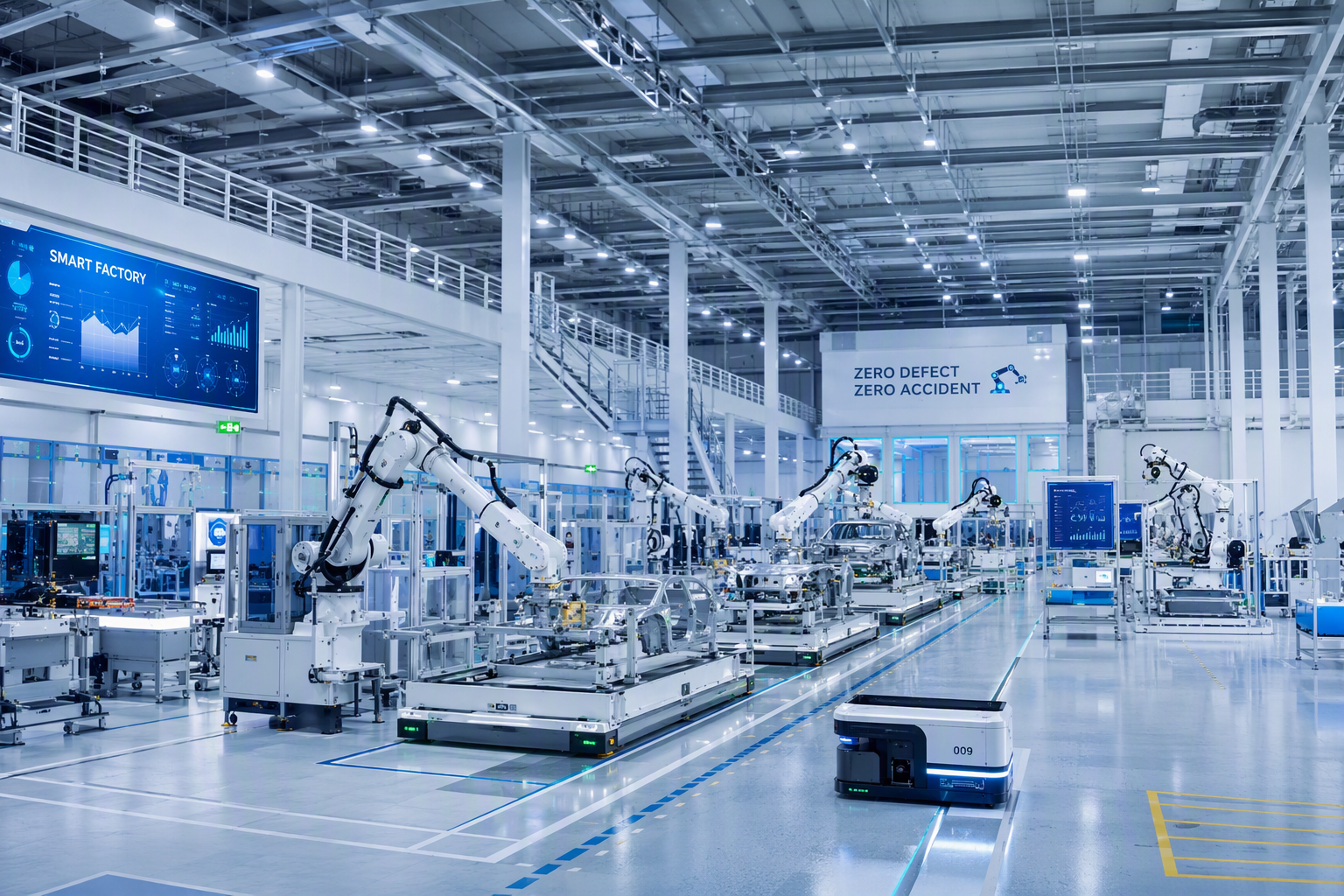
The automotive industry has long been a pioneer in automation, so it's no surprise that it's one of the industries that most commonly use AGVs for material handling. In automotive manufacturing, AGVs are essential for keeping assembly lines moving. They deliver parts and components to workstations with perfect timing, a process known as line-side feeding.
An AGV system ensures that the right parts arrive at the right station at the right moment, which is critical in a fast-paced production environment. This just-in-time delivery minimizes line-side inventory and prevents costly production stoppages.
From transporting large body panels to delivering small components in sequence, AGVs handle a wide variety of tasks on the factory floor. By automating these repetitive transport jobs, car manufacturers can improve the efficiency of their production lines and reallocate workers to more complex assembly tasks.
Warehousing and Distribution: Speeding Up Logistics
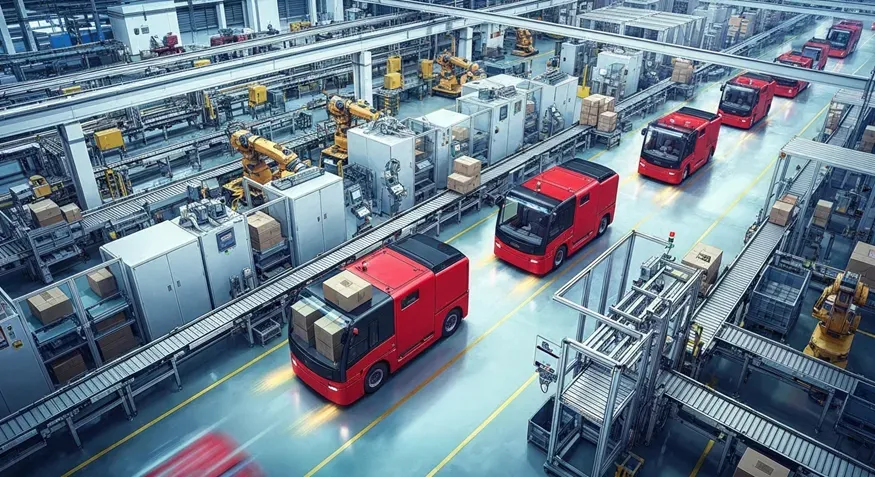
In the world of warehousing and logistics, speed and accuracy are everything. This is another area where the automated guided vehicle shines. In large distribution centers, AGVs are used to automate the movement of goods from receiving to storage, and from picking areas to the shipping dock.
These vehicles are perfect for handling repetitive, long-distance transport tasks that are common in warehouse operations. For example, an AGV can be tasked with moving pallets of incoming goods to their designated storage racks or transporting picked orders to a consolidation point for packing.
By automating these processes, distribution centers can speed up their logistics, reduce order fulfillment times, and minimize handling errors. This leads to higher throughput and greater customer satisfaction, which are crucial for success in the competitive e-commerce landscape. This is why warehousing is one of the industries that most commonly use AGVs for material handling.
Food and Beverage: Enhancing Hygiene and Workflow
In the food and beverage industry, hygiene and consistency are paramount. AGVs offer a significant advantage by reducing human contact with products, which helps maintain a clean and sanitary environment. This is especially important in facilities that handle perishable goods.
AGVs are used to automate repetitive tasks like transporting raw materials to production lines or moving finished goods from packaging to cold storage. This automation in the food industry ensures a smooth and consistent material flow, which is essential for maintaining product quality and maximizing shelf life.
By taking over the heavy lifting and long-distance transport, AGVs also improve ergonomics and safety for employees. This allows workers to focus on quality control and other skilled tasks, making the entire operation more efficient and reliable.
Healthcare: Safe Transport in Hospitals
Hospitals are complex environments where the timely and safe transport of goods is critical. AGVs are increasingly being used in healthcare settings to handle the delivery of meals, linens, medical supplies, and waste. This automation helps ensure that essential items reach their destination efficiently and without delay.
Safety is a top priority in a hospital environment, and AGVs are designed to operate safely alongside patients, staff, and visitors. Their predictable movements and advanced safety features help prevent accidents and disruptions in busy corridors.
By automating routine transport tasks, AGVs allow clinical staff to spend more time on patient care rather than logistics. This improves overall hospital efficiency and allows healthcare professionals to focus on what they do best. The use of AGVs for these tasks is a perfect example of how automation can support critical services.
Notable AGV Success Stories from Industry Leaders
The best way to understand the impact of AGVs is to look at real-world success stories. Across leading industries, companies are achieving remarkable results by integrating AGVs into their material handling operations. These examples show how an AGV system can solve specific challenges, from increasing throughput in manufacturing to streamlining fulfillment in e-commerce.
These stories highlight the tangible benefits of automation, such as improved efficiency, enhanced safety, and better inventory management. They demonstrate that with the right strategy, implementing an AGV system can lead to a significant return on investment and a major competitive advantage. Let's look at a few examples of companies that have transformed their operations with AGVs.
A Global Manufacturer Achieves Efficient Throughput
A leading global manufacturer of fans and motors, ebm-papst, wanted to improve its dispatch logistics. The company decided to fully automate one of its material flow processes, and the results were outstanding. The new system exceeded all expectations for transport volumes.
By automating the movement of goods from the end of the production lines to the shipping area, the company significantly increased its throughput. The AGVs ensured a continuous and reliable flow, eliminating the bottlenecks that had previously slowed down the manufacturing process.
This project was so successful that it has become a model for further automation within the company. It showcased how a well-planned AGV implementation can not only boost efficiency but also provide the scalability needed to handle growing demand, from production to final quality control.
Streamlining E-Commerce Fulfillment with AGVs
For FIEGE, a leading European contract logistics company, automation is a key part of their business. To handle the demands of e-commerce, the company partnered with Linde Material Handling to implement automated reach trucks in one of its warehouses. This project focused on automating storage and retrieval in wide aisles.
The automated guided vehicle fleet now handles the movement of goods within the warehouse, a critical part of the order processing workflow. This has helped the company streamline its e-commerce fulfillment operations, making them faster and more accurate.
By automating these key tasks, FIEGE can better manage fluctuating order volumes and meet tight delivery deadlines. This success story demonstrates how AGVs can be a powerful tool for logistics providers looking to gain an edge in the fast-paced world of online retail.
Improved Inventory Management in Pharmaceutical Warehouses
In the pharmaceutical sector, accuracy and traceability are non-negotiable. At HOLTER, an Austrian sanitary equipment specialist, AGVs were introduced to manage the material flow between the warehouse and dispatch areas. Two automated pallet stackers now handle the transport of goods, freeing up human workers for value-adding tasks like order picking.
This automation has led to significant improvements in inventory management. The AGVs ensure that every pallet movement is tracked and recorded accurately, providing real-time visibility into stock levels. This level of precision is critical in a regulated industry like pharmaceuticals, where every item must be accounted for.
By creating a more reliable and transparent material flow, the company has enhanced its warehouse operations. This example shows how AGVs can improve not just efficiency but also the quality and control of inventory processes in highly sensitive environments.
Conclusion
In summary, Automated Guided Vehicles (AGVs) are revolutionizing how industries operate by enhancing efficiency, safety, and productivity. From automotive manufacturing to healthcare, the benefits of AGVs are evident through numerous success stories that showcase their capabilities in streamlining operations and reducing costs. As businesses continue to embrace automation, understanding the various types of AGVs and their applications will be crucial for staying competitive. Whether you're considering AGVs for your own industry or simply curious about their impact, it's clear that these innovative solutions are paving the way for a more efficient future. If you're ready to explore how AGVs can transform your operations, reach out today for a consultation!
Frequently Asked Questions
Are AGVs suitable for smaller businesses, or only large enterprises?
AGVs are suitable for businesses of all sizes, not just large enterprises. The key factor is having standardized and repetitive transport tasks. For small businesses looking for flexible automation solutions to reduce reliance on manual labor, an automated guided vehicle can be a highly cost-effective and scalable investment.
What key safety systems do AGVs typically include?
AGVs come equipped with multiple safety features to protect human operators and prevent accidents. These typically include advanced sensors and laser scanners for 360-degree obstacle detection, a robust collision avoidance system, and emergency stop buttons. Their predictable navigation system also contributes to a safer work environment.
How do AGV implementation costs compare to traditional manual transport?
While implementation costs for AGVs require an initial investment, they offer significant long-term cost savings compared to manual labor. By automating material handling, you reduce staffing needs, minimize product damage, and increase operational efficiency, leading to lower costs and a strong return on investment over time.
You might also like