How AGVs Are Revolutionizing Supply Chain Operations
How AGVs Are Revolutionizing Supply Chain Operations
Key Highlights
- An automated guided vehicle (AGV) is a mobile robot that transports materials without a human operator, transforming supply chain logistics.
- AGVs enhance material handling by reducing labor costs, minimizing human error, and increasing workplace safety.
- Different types of AGVs exist, including forklift, tugger, and unit load models, each designed for specific tasks.
- AGVs navigate using various technologies, from simple magnetic tape to advanced laser or vision-based navigation system options.
- Implementing AGVs boosts workflow efficiency with 24/7 operation and provides scalable solutions for growing businesses.
Introduction
Are you looking for ways to make your warehouse operations more efficient? The modern supply chain is evolving rapidly, and staying competitive means embracing automation. An automated guided vehicle (AGV) is a key technology revolutionizing material handling in warehouses and manufacturing facilities. These self-guided robots automate repetitive transport tasks, boosting productivity, improving safety, and ensuring a smoother flow of goods from point A to point B without needing a human driver.
Understanding Automated Guided Vehicles (AGVs) in Modern Supply Chains
An automated guided vehicle is a self-operating machine designed to move goods within a controlled environment, such as a warehouse or factory. As a core part of a modern supply chain, it replaces manual carts and forklifts, creating a more reliable and efficient material flow.
This automated system operates without a driver, following programmed instructions to perform its duties. To better understand how AGVs are transforming workplaces, it's helpful to look at their core functions, how they navigate, and how they differ from other mobile robots.
Defining AGVs and Their Core Functions
So, what exactly is an automated guided vehicle? Think of it as a mobile robot created to handle transportation without direct human intervention. Its primary purpose is to automate material handling tasks that would otherwise be done by people using forklifts or carts. This technology has been around since the first AGV was developed in the 1950s and has advanced significantly since.
The core functions of an AGV revolve around moving items from one location to another. These self-guided vehicles transport raw materials, work-in-process goods, or finished products within a facility. By automating this movement, you can create a more predictable and consistent material flow.
Ultimately, an AGV’s job is to ensure that the right materials get to the right place at the right time. This helps eliminate delays, reduce the risk of product damage, and free up your employees to focus on more complex tasks, boosting overall productivity.
How AGVs Operate Within Facility Environments
AGV solutions are designed to navigate through facilities by following predefined paths. These paths are established using different types of guidance technologies, communicating with a central control system that directs their movements and assigns tasks. This system ensures all vehicles work together efficiently.
The navigation system is the "brain" of the AGV. Simpler systems might use magnetic tape or wires embedded in the floor for the vehicle to follow. More advanced AGVs use laser navigation, where the vehicle uses reflectors placed around the facility to calculate its position and navigate its route accurately.
These vehicles are an integral part of a larger automated system. They communicate wirelessly with warehouse management systems (WMS) or other control software to receive instructions. This integration allows for coordinated movements, real-time tracking, and seamless operation alongside other automated equipment and human workers.
Key Differences Between AGVs and Autonomous Mobile Robots (AMRs)
Automated guided vehicles (AGVs) and autonomous mobile robots (AMRs) each serve distinct purposes in material handling. AGVs typically follow predetermined paths, often utilizing magnetic tape for navigation, making them reliable for transporting heavy loads in structured environments like warehouses. In contrast, AMRs boast advanced sensors and smart navigation technologies, allowing them to adapt to dynamic surroundings and manage tasks without strict pathways. This flexibility enables AMRs to navigate tight spaces and perform various functions beyond simple transport, enhancing operational efficiency in various industries.
Key Types of Automated Guided Vehicles
Not all AGVs are created equal. There are many different types of these mobile robots available, each designed to handle specific tasks and environments. Choosing the right one for your facility depends entirely on what you need to move, how heavy it is, and what your operational workflow looks like.
From simple carts that carry small parts to heavy-duty carriers for large assemblies, the various types of AGV offer unique capabilities. Let’s explore some of the most common models you’ll find in warehouses and factories today.
Automated Guided Carts and Tuggers
Automated guided carts (AGCs) are one of the simplest forms of AGVs. These vehicles are designed to transport smaller loads like totes, bins, or individual parts. They typically follow magnetic tape on the floor, making them a straightforward and cost-effective option for automating simple material handling tasks.
AGCs are often used on assembly lines to deliver components to workstations or in sorting applications. Because their paths can be reconfigured by just moving the tape, they offer a flexible solution that can adapt as your production needs change.
Similarly, tugger AGVs, also known as towing AGVs, are designed to pull a train of non-automated carts. This is an efficient way to move multiple loads at once. Tugger AGVs are popular in large facilities for delivering materials to different points along a production line or moving goods across a large warehouse floor.
Forklift AGVs and Pallet Movers
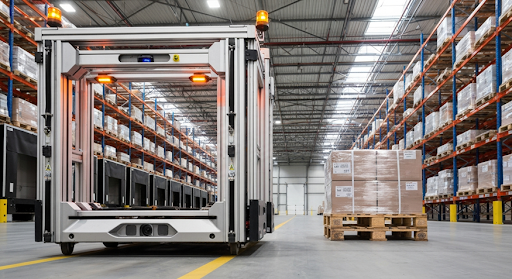
For tasks involving stacking and retrieving palletized goods, forklift AGVs are an ideal solution. These vehicles are designed to replicate the functions of a traditional forklift but without the need for a human operator. They are equipped with forks to lift and place heavy loads at various heights.
Forklift AGVs are widely used in warehouse systems for moving pallets from receiving to storage, replenishing picking locations, or loading and unloading trucks. They can handle heavy loads safely and efficiently, reducing the risk of accidents and product damage associated with manual forklifts.
Alongside them, automated pallet movers are specialized for transporting pallets at the floor level. These vehicles slide their forks under a pallet, lift it slightly, and transport it to its destination. They are perfect for repetitive, point-to-point transfers of full pallets within a warehouse or distribution center.
Unit Load AGVs and Specialized Carriers
Unit load AGVs are designed to transport individual, large-volume loads such as pallets, containers, or large racks. These vehicles often feature a platform or conveyor top that allows for the automatic transfer of goods. Their main function is to transport goods between different parts of a facility, like from the end of a production line to a storage area.
This type of automated guided vehicle is extremely common in warehousing and manufacturing. They excel at repetitive, high-volume transfers and can be integrated with other automated systems, such as conveyor belts or storage and retrieval systems, for a fully automated workflow.
For the most demanding jobs, specialized carriers are available. These heavy-duty AGVs are built to handle exceptionally large or heavy items, such as automotive chassis, large coils of metal, or aerospace components. They can be custom-designed to manage specific industrial applications and navigate tight spaces despite their size.
Advanced Navigation Technologies Used in AGVs
An AGV’s ability to move autonomously depends entirely on its navigation system. These systems range from simple, fixed-path methods to highly advanced technologies that allow for more flexibility. The choice of navigation often depends on the complexity of the environment and the tasks the AGV needs to perform.
Some of the most common methods include following physical markers like magnetic tape or wires. More sophisticated options include laser navigation and vision-based navigation, which give the AGV more freedom to operate. Let's look at how these different technologies work.
Magnetic Tape and Wired Guidance
One of the most traditional and straightforward navigation technologies for AGVs is magnetic tape guidance. With this method, a magnetic strip is laid on the floor of the facility to create a defined path. The AGV is equipped with a sensor that detects the magnetic field from the tape and follows it precisely.
This approach is popular because it is relatively inexpensive to install and easy to modify. If you need to change the route, you can simply pull up the old magnetic tape and lay down a new path. This makes it a flexible choice for warehouse management environments where workflows might evolve.
Similarly, wired guidance systems use a wire embedded in the floor that transmits a radio signal. An AGV sensor follows this signal to stay on course. While very reliable, this method is less flexible than tape because changing the path requires cutting into the floor, making it a more permanent installation.
Laser, Optical, and Vision-Based Navigation
For more flexibility, many modern AGVs use laser navigation. This technology relies on a laser scanner mounted on the vehicle that spins and emits laser beams. These beams bounce off reflectors placed at specific points around the facility, such as on walls or racking. The AGV calculates its exact position based on the angle and distance to these reflectors.
This method allows for more complex routes and doesn't require physical paths on the floor, making it a cleaner solution. It is also highly accurate and reliable, though it requires a clear line of sight to the reflectors.
Other advanced sensors enable optical and vision systems. Optical navigation involves the AGV following a painted line on the floor, while vision-based navigation uses cameras to identify features in the environment to determine its location. These vision systems are great for dynamic environments where AGVs need to adapt to slight changes.
Natural Feature and Geoguidance Systems
The most advanced navigation methods available today allow AGVs to operate without any installed infrastructure like tape or reflectors. Natural feature guidance, also known as Simultaneous Localization and Mapping (SLAM), is one such technology. AGVs using SLAM create a digital map of the facility by recognizing and recording permanent features like walls, racks, and columns.
As the vehicle moves, it continuously updates its position on this map in real time. This allows it to navigate freely and even adjust its path dynamically to avoid obstacles, making it one of the most flexible navigation methods. It's ideal for complex and changing environments.
For outdoor applications, geoguidance systems can be used. These AGVs rely on technologies like the Global Positioning System (GPS) to navigate large, open areas. While less common for indoor use due to signal limitations, it is a viable option for moving materials between buildings or across large industrial sites.
Typical Applications of AGVs in Supply Chain Operations
The use of AGVs has become widespread across the supply chain, from manufacturing floors to massive distribution facilities. Their versatility allows them to handle a wide range of tasks that were once performed manually, leading to significant gains in efficiency and safety. Common AGV applications focus on automating repetitive material transport.
Understanding the typical use-cases for these vehicles can help you see where they might fit into your own operations. Let's explore how AGVs are put to work in raw material transport, assembly line support, and finished goods handling.
Raw Material Transport in Manufacturing Plants
In manufacturing plants, a steady supply of raw materials is crucial to keep production running smoothly. AGVs are frequently used to automate the movement of these materials from receiving docks to storage areas or directly to the production line. This ensures a consistent and reliable supply, eliminating delays.
For example, an AGV can be programmed to pick up a pallet of plastic, metal, or paper and deliver it to a specific machine or workstation just in time for it to be used. This automates a key material handling step, freeing up employees from having to operate forklifts for this purpose.
This application is common in many industries, including automotive assembly plants and general manufacturing. By taking over the repetitive task of moving raw materials, AGVs help streamline the entire production process from the very beginning, enhancing overall efficiency and reducing the chance of production stoppages.
Work-in-Process Movement and Assembly Line Support
AGVs play a vital role in moving partially completed goods, known as work-in-process (WIP), between different stages of production. In a manufacturing environment, they transport components or subassemblies from one workstation to another, ensuring a continuous and optimized material flow through the facility.
This is especially useful on assembly lines. An AGV can be synchronized with the production schedule to deliver the exact parts needed at the precise moment they are required. This "just-in-time" delivery minimizes clutter around workstations and reduces the amount of inventory that needs to be stored on the factory floor.
By automating this movement, you not only increase productivity but also improve workplace safety. AGVs move along predictable paths and are equipped with safety sensors, reducing the risk of collisions and accidents that can occur with manual transport methods in busy production areas.
Finished Goods Handling, Warehousing, and Distribution
Once products are complete, AGVs are used to transport these finished goods from the end of the production line to their next destination. This could be a long-term storage area within the warehouse, a quality control station, or directly to the shipping docks for outbound delivery.
In large distribution centers, AGVs are essential for efficient warehouse management. They can automate the put-away process by taking newly received goods from the receiving area to their designated storage locations. Forklift AGVs are particularly useful here, as they can place pallets onto high racks.
When it's time to ship orders, AGVs can retrieve finished goods from storage areas and transport them to packing stations or outbound staging lanes. This automated handling minimizes the risk of damage to products and ensures they are ready for distribution in a timely manner, speeding up order fulfillment.
How AGVs Enhance Material Handling and Workflow Efficiency
The adoption of AGVs brings a host of benefits that directly impact your bottom line. By automating repetitive transport tasks, these vehicles significantly improve material handling and workflow efficiency. This leads to greater productivity, improved safety, and ultimately, lower costs.
Implementing AGVs helps streamline operations in several key ways. They reduce reliance on manual labor, increase the speed and accuracy of transport, and can operate around the clock. Let's look closer at how these advantages contribute to better operational efficiency.
Reducing Manual Labor and Human Error
One of the most significant benefits of AGVs is the reduction in manual labor. By taking over repetitive and physically demanding transport tasks, AGVs allow you to reallocate your employees to more value-added roles that require human problem-solving and critical thinking.
This directly translates to lower labor costs. Over time, the savings on salaries, benefits, and training can be substantial, helping to offset the initial investment in the AGV system. Reducing the need for manual material handlers also minimizes the risk of ergonomic injuries associated with lifting and moving heavy items.
Furthermore, automation greatly reduces the chance of human error. Mistakes caused by fatigue or distraction can lead to misplaced inventory, incorrect shipments, or damaged products. AGVs follow their programmed instructions with precision every time, increasing accuracy and contributing to higher operational efficiency.
Improving Speed, Reliability, and Productivity
AGVs are designed to work consistently and predictably, which significantly enhances the speed and reliability of your material handling processes. Unlike human workers, AGVs don't get tired or distracted, ensuring that materials are moved at a steady, optimized pace throughout the day.
This reliability means you can count on a consistent flow of goods through your supply chain. There are no unexpected delays due to breaks or shift changes, which helps maintain a smooth and uninterrupted production or fulfillment process. This predictability allows for better planning and scheduling across your entire operation.
The combination of increased speed and unwavering reliability naturally leads to a boost in productivity. Because AGVs can move materials faster and more consistently than manual methods, your facility can handle a higher volume of goods in the same amount of time. This increased throughput is a major competitive advantage in today's fast-paced market.
24/7 Autonomous Operation and Scalability Benefits
One of the standout advantages of AGVs is their ability to provide continuous operation. These autonomous vehicles can run 24 hours a day, 7 days a week, with pauses only for battery charging or maintenance. This allows your facility to operate around the clock, dramatically increasing output without needing multiple shifts of human workers for transport tasks.
Modern AGVs often feature automated battery charging or quick-swap systems, minimizing downtime and ensuring they are always ready to work. This nonstop performance is a game-changer for businesses looking to maximize their productivity and meet growing customer demands.
AGVs also offer impressive scalability. As your business grows, you can easily add more vehicles to your fleet to handle the increased volume. This provides a flexible solution that can adapt to your changing needs without requiring a major overhaul of your facility's infrastructure. This makes it easier to scale your operations up or down based on demand.
Factors to Consider When Choosing an AGV System
Selecting the right AGV system is a critical decision that requires careful planning. To ensure a successful implementation, you need to evaluate several key factors related to your specific operational needs and environment. Making the wrong choice can lead to inefficiencies and a poor return on investment.
You'll need to consider everything from the loads your AGVs will carry to the layout of your building. Important considerations include the type of AGV, load capacity, facility layout, and essential safety features. Let's examine these factors more closely.
Load Capacity and Vehicle Type Selection
The first step in vehicle selection is to define what you will be moving. You need to assess the maximum weight, dimensions, and shape of the items the AGV will transport. This will determine whether you need a vehicle designed for small totes, standard pallets, or custom heavy loads.
Once you understand your load requirements, you can explore the different types of AGV available. A forklift AGV is ideal for stacking pallets, while a tugger AGV is better for pulling multiple carts. For moving single large items, a unit load carrier might be the best fit. Matching the vehicle to the material handling task is essential.
When making your selection, consider the following:
- Maximum Payload: What is the heaviest weight the AGV will need to carry?
- Load Dimensions: What are the length, width, and height of your typical load?
- Load Type: Are you moving pallets, totes, rolls, or something custom?
- Handling Needs: Does the load need to be lifted, towed, or carried on a conveyor?
Facility Layout and Integration Requirements
Your facility layout plays a huge role in determining which AGV system will work for you. You must consider factors like aisle widths, turning radii, floor conditions, and the presence of any ramps or elevators. Some AGVs require wider aisles to maneuver, while others are designed for tight spaces.
The condition of your floors is also important. Smooth, level surfaces are ideal for most AGVs, especially those using certain navigation types. Any cracks, bumps, or debris could interfere with their operation and sensor accuracy.
Beyond the physical space, you need to plan for software integration. Your AGV system will need to communicate with your existing warehouse management system (WMS) or enterprise resource planning (ERP) software. Ensuring seamless integration is crucial for coordinating tasks, managing inventory, and optimizing the flow of information across your operation.
Safety Features and Regulatory Compliance
Safety is the top priority when introducing autonomous vehicles into an environment with human workers. Modern AGVs are equipped with a range of safety features to prevent collisions and ensure workplace safety. These include laser scanners, ultrasonic sensors, and LiDAR for 360-degree obstacle detection.
When an AGV detects a person or object in its path, it will automatically slow down or come to a complete stop to avoid contact. Most vehicles are also equipped with physical safety bumpers that trigger an emergency stop if they make contact with anything, as well as audible alarms and warning lights to alert nearby workers.
It is also essential to ensure that the AGV system you choose complies with industry safety standards, such as ANSI/ITSDF B56.5 in the United States. Adhering to regulatory compliance guidelines is crucial for protecting your employees and avoiding potential liability issues.
Leading AGV Manufacturers and Solution Providers in the United States
Once you've decided to implement AGVs, the next step is to find the right company to partner with. The market for AGV solutions is filled with experienced manufacturers and integrators who can help design and deploy a system tailored to your needs. Choosing a trusted partner is key to a successful project.
These companies offer a wide range of vehicles, navigation technologies, and software platforms. Finding a provider that offers excellent products and reliable support will ensure your automation goals are met. Let's review some major suppliers and what to look for in a manufacturer.
Overview of Major AGV Suppliers
The United States is home to a number of major suppliers of AGV solutions. These companies range from those who invented the technology to modern innovators specializing in custom designs. Finding a trusted partner among these providers is crucial for getting the right system and long-term support.
Some well-known names have been in the industry for decades, offering a wide range of standard and customizable AGVs. Others focus on specific applications, such as heavy-burden carriers or solutions for assembly line integration. Researching these major suppliers will help you find a company with expertise in your industry.
Here are a few examples of leading AGV manufacturers in the U.S.:
| Manufacturer | Specialty |
|---|---|
| Savant Automation, Inc. | Invented the AGV; offers affordable and versatile AGV capabilities. |
| Oceaneering Mobile Robotics | Deploys mobile robotics worldwide, focusing on low total cost of ownership. |
| RedViking | Specializes in user-friendly AGVs and full custom design tooling. |
| Invio Automation | A leading integrator for heavyweight and assembly line applications. |
Criteria for Selecting the Right Manufacturer
When you're ready to choose a solution provider, it's important to look beyond just the price tag. Your selection criteria should include the manufacturer's experience, reputation, and the quality of their AGV technology. A good partner will have a proven track record of successful installations in your industry.
Ask potential providers for case studies or customer references. This will give you insight into their reliability and the performance of their systems in real-world applications. You should also evaluate their level of innovation. Are they keeping up with the latest advancements in navigation, safety, and software?
Finally, consider the level of collaboration and support they offer during the planning and implementation phases. A manufacturer that works closely with you to understand your unique challenges and goals is more likely to deliver a solution that provides a strong return on investment.
Support, Maintenance, and Service Offerings
The long-term success of your AGV system depends heavily on the quality of post-purchase support. Before making a final decision, carefully evaluate the maintenance, service, and support offerings from each potential vendor. A reliable AGV is one that is well-maintained.
Look for a provider that offers comprehensive service plans, including preventative maintenance schedules to keep your fleet in top condition and minimize unexpected downtime. Ask about their response times for on-site service and the availability of spare parts. Quick and effective support is crucial for keeping your operations running smoothly.
Additionally, inquire about training programs for your employees. Proper training will ensure your team knows how to operate the AGV system safely and efficiently. A strong support package, from initial training to ongoing maintenance, is a key indicator of a manufacturer's commitment to your success.
Frequently Asked Questions (FAQ)
Curious about automated guided vehicles? Here are some common questions answered. AGVs primarily operate in environments such as manufacturing facilities and distribution centers, performing material handling tasks with impressive efficiency. Many types, like tugger AGVs and forklift AGVs, exist to transport goods safely while reducing labor costs and the risk of workplace accidents. With advanced sensors and navigation technologies, including laser guidance and magnetic tape, these vehicles enhance material flow and ensure smooth operations. Companies adopting AGV solutions typically see improvements in safety and productivity. Feel free to reach out for more specific inquiries!
What are the main cost components of implementing AGVs?
The main costs of an AGV system include the initial purchase price of the vehicles, software, and any necessary facility modifications for implementation. Ongoing expenses include routine maintenance, service contracts, and potential software updates. These costs are often offset by long-term savings in labor costs and increased productivity.
What recent innovations are shaping the future of AGVs?
Recent innovations in AGV technology are centered on artificial intelligence and enhanced autonomy. This includes AI-driven decision-making for dynamic route planning, the use of advanced sensors like LiDAR and 3D cameras for better environmental awareness, and more sophisticated navigation system options that allow these autonomous vehicles to operate without any infrastructure.
In which industries are AGVs having the biggest impact?
AGVs are making a significant impact in various industries, especially manufacturing facilities, automotive assembly plants, and e-commerce distribution centers. They are also crucial in healthcare for material transport and in the food and beverage industry. Their role in warehouse management is transforming the entire supply chain.
Conclusion
In conclusion, Automated Guided Vehicles (AGVs) are transforming supply chain operations by enhancing efficiency and reliability. With their ability to streamline material handling and reduce human error, AGVs offer significant advantages to modern businesses. From manufacturing plants to warehouses, these innovative vehicles are redefining how products are moved and processed, ultimately leading to improved productivity and operational costs. As you consider integrating AGVs into your supply chain, keep in mind factors like load capacity, facility layout, and safety features to ensure a successful implementation. If you're ready to revolutionize your supply chain operations, don't hesitate to reach out for assistance on choosing the right AGV system for your needs.
You might also like