Industry 4.0 Examples
Key Highlights
- The fourth industrial revolution connects people, machines, and software through the industrial internet of things.
- A smart factory uses sensors, robotics, and big data analytics to improve output and reduce delays.
- Predictive maintenance helps companies catch equipment issues before they stop production lines.
- Real-world examples include connected automotive plants, warehouse automation, and cold chain tracking.
- Digital transformation now reaches healthcare, logistics, agriculture, and construction, not only manufacturing.
- Companies gain faster decisions, better visibility, and stronger operational efficiency.
Introduction
The fourth industrial revolution is changing how businesses run daily work, especially across manufacturing processes. Instead of relying on disconnected systems and manual checks, companies now use digital transformation to connect equipment, software, and teams in smarter ways. You can see this shift in factories, warehouses, hospitals, and supply networks. From better data use to faster decisions, Industry 4.0 gives organizations practical new ways to improve output, reduce downtime, and modernize how work gets done.
Defining Industry 4.0: What Sets This Revolution Apart?
At its core, the fourth industrial revolution is the merging of industrial work with digital technologies. It connects machines, systems, and people so they can share data and respond faster. This includes the industrial internet of things, cloud platforms, robotics, and data analytics. In simple terms, Industry 4.0 helps businesses move from reactive work to smarter, connected operations.
What makes it different is the scale and speed of decision-making. Instead of using isolated tools, companies use big data and connected systems to monitor performance in real time. A practical example is a factory that uses sensors to track machine health, then schedules service before a breakdown happens. Another is a warehouse that uses RFID and automation to manage inventory more accurately. These examples show how connected data creates measurable improvements.
Core Characteristics of Industry 4.0
One clear feature of Industry 4.0 is connected automation. Machines, software, and workers interact through shared systems instead of operating in silos. This supports digital transformation and allows faster responses when conditions change on the shop floor or across the supply chain.
Another defining trait is the use of big data analytics in real time. Businesses collect volumes of data from equipment, inventory systems, and operations, then turn that information into practical actions. That is how smart manufacturing becomes more flexible and efficient.
Key characteristics include:
- Real time visibility into equipment, inventory, and workflows
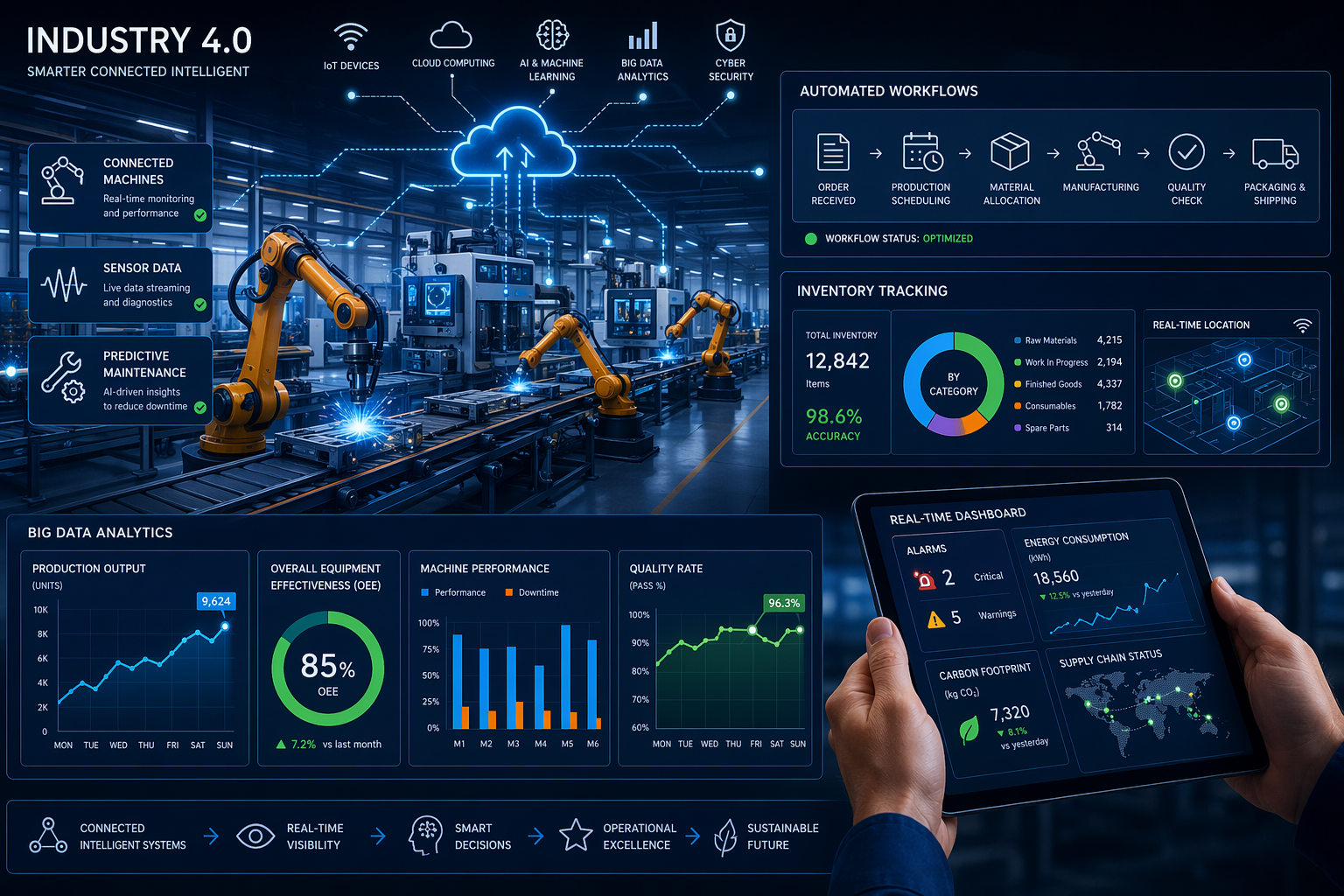
- Automation that reduces repetitive manual work
- Advanced technologies that connect physical and digital systems
- Big data analytics that support faster decisions and fewer disruptions
Key Technologies Powering Industry 4.0
Industry 4.0 runs on a mix of connected tools that work together. The internet of things gathers data from machines and assets, while cloud computing stores and organizes that information at scale. These systems give businesses a better view of performance across production facilities and support faster action.
At the same time, artificial intelligence and machine learning help companies spot patterns, predict issues, and improve decisions. Edge computing adds speed by processing certain data closer to the source, which matters when operations depend on immediate responses.
Common technologies include:
- Internet of things devices and iot sensors for data collection
- Cloud computing for storage and shared access
- Artificial intelligence for smarter decision support
- Machine learning for predictive analytics and pattern detection
- Edge computing for quicker local processing
Real-World Examples of Industry 4.0 in Manufacturing
Manufacturing offers some of the clearest Industry 4.0 use cases. In smart manufacturing, companies place iot sensors across production lines to monitor machine condition, cycle times, and output. That data supports better scheduling, fewer interruptions, and stronger product quality.
You can also see digital manufacturing in automated warehouse management, robotics, and predictive service models. Audi uses data from its production environment to improve efficiency and quality, while Bosch connects machinery to track bottlenecks in real time. These examples show how practical and measurable Industry 4.0 can be.
Smart Factories and Connected Production Lines
A smart factory brings together machines, software, and workers in one connected environment. Instead of checking each step manually, manufacturers use shared systems to monitor manufacturing processes continuously. This creates faster feedback and better control across the floor.
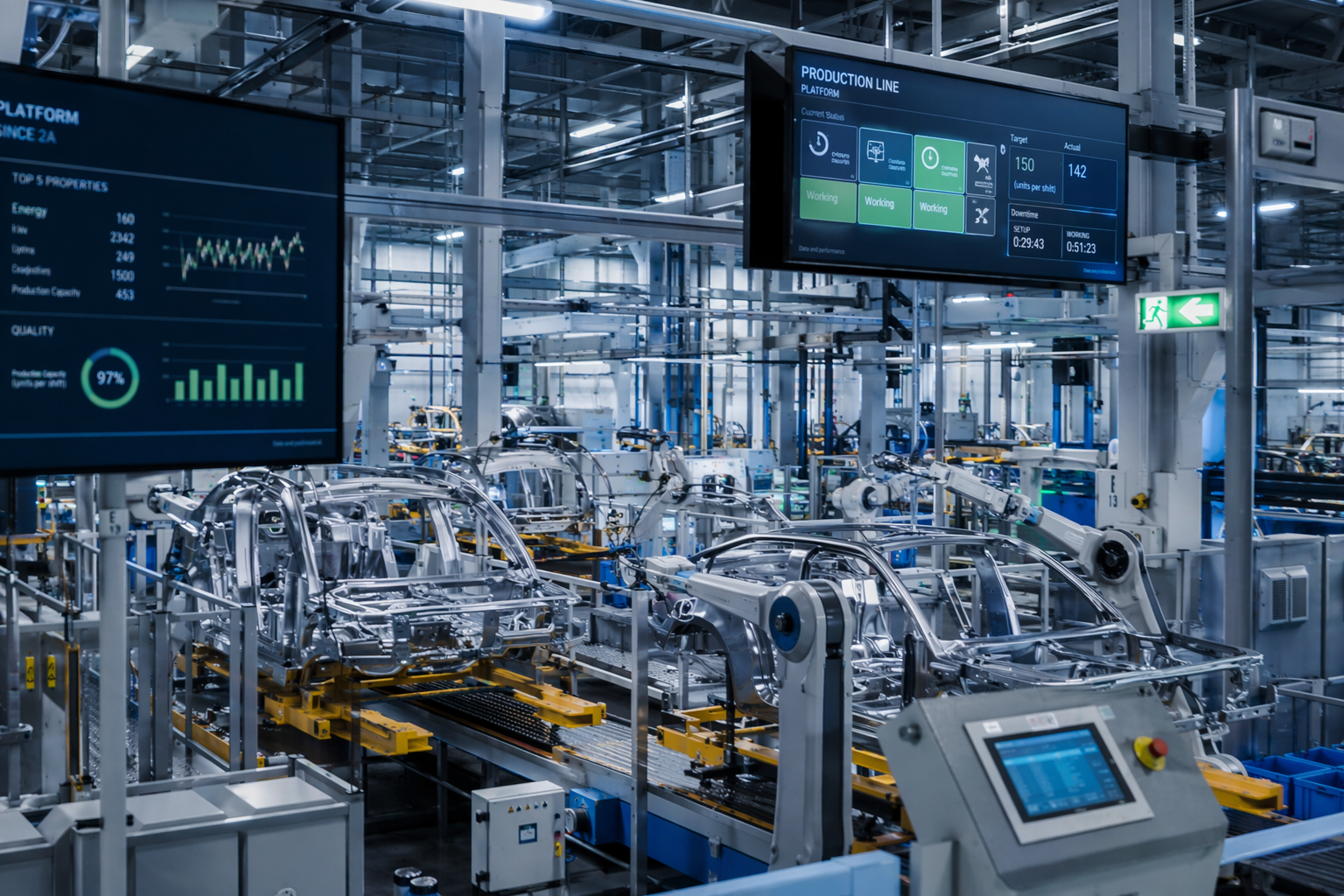
For many companies, connected production lines are the starting point for digital transformation. Sensors on machines track cycle time, output, and equipment condition. Data then moves to centralized systems where teams can spot delays, quality issues, or maintenance needs before they grow into larger problems.
Audi shows this in practice. The company collects and analyzes data from production lines to understand efficiency, quality, and resource use. That approach supports predictive maintenance and keeps machinery running closer to peak performance. As a result, manufacturers can improve consistency, reduce downtime, and make better decisions using live operational insight.
Predictive Maintenance with IoT Sensors
Predictive maintenance is one of the most useful Industry 4.0 applications because it solves a costly problem: unexpected downtime. Instead of waiting for equipment to fail, businesses use iot sensors to watch temperature, pressure, cycle time, and other signals that show machine health.
Once that information is captured, data analytics tools process big data in real time. Teams can then see early warning signs and schedule service before a stoppage affects production. This creates a smoother workflow and protects both output and delivery schedules.
Bosch’s automotive factory in China is a strong example. Sensors embedded in machinery collect operational data and advanced systems analyze it to identify bottlenecks or likely failures. That process helped the plant raise output in certain areas while also improving decision-making. For manufacturers, this means less waste, fewer emergency repairs, and more stable operations.
Notable Industry 4.0 Case Studies in the United States
Several United States case study examples show how manufacturing companies are using Industry 4.0 in practical ways. Ford has expanded robotics and automation in its manufacturing plant operations, while General Electric has tested wearable tools and digital systems to improve worker performance and equipment support.
Another standout example is the digital twin approach used by Team Penske with Siemens. Advanced data analytics and sensor-fed models help engineers test design changes before physical builds. These cases show that Industry 4.0 is not theory. It is already shaping decisions, speed, and efficiency in real business environments.
Ford’s Advanced Robotics and Automation Initiatives
The automotive industry has been one of the fastest adopters of Industry 4.0, and Ford fits that pattern. In this sector, robotics and automation help manufacturers handle repetitive work, improve consistency, and increase speed across the manufacturing plant.
A major shift has been the rise of collaborative robots and other advanced robotic systems. These tools are built to work more closely with people and can support tasks that need precision, repeatability, or safer handling. They reduce strain on workers while keeping production moving.
This wider robotics trend is visible across automotive manufacturing, where connected machines and sensors support more flexible operations. The compiled examples show that modern robotics can recognize conditions, respond to information, and assist in complex operations. For companies like Ford, that means better throughput, less manual bottleneck risk, and a stronger path toward scalable automation.
General Electric’s Digital Twin Applications
General Electric has explored several Industry 4.0 tools, including augmented reality in jet engine manufacturing. In the broader context of digital manufacturing, GE also reflects how connected systems support operational efficiency through data-guided work and faster access to instructions.
A digital twin follows the same logic. It creates a virtual model of a machine, part, or process using live operational inputs. With big data analytics and predictive analytics, businesses can test conditions, study performance, and catch issues before they become expensive failures.
| Application Area | How It Supports Results |
|---|---|
| Equipment modeling | A digital twin mirrors a real asset using sensor-fed data |
| Performance analysis | Teams review conditions and identify weak points faster |
| Predictive analytics | Companies forecast issues before breakdowns happen |
| Digital manufacturing | Virtual testing reduces waste and supports better planning |
| Operational efficiency | Better insight helps improve uptime and service timing |
How Leading Industries Are Adopting Industry 4.0
Industry 4.0 adoption is no longer limited to factories. Various sectors now use connected systems, automation, and data tools to improve speed, accuracy, and visibility. As growing demand pushes organizations to do more with fewer delays, many are reworking business models around smarter operations.
You can see this in automotive production, healthcare supply tracking, logistics planning, agriculture, and construction. These industries are investing in innovative technologies because they create measurable gains. The next examples show how different sectors are applying Industry 4.0 in ways that fit their own daily challenges.
Automotive Innovations with Data Analytics
The automotive industry depends on precision, speed, and repeatable quality, which makes it a strong match for Industry 4.0. In the manufacturing industry, companies use data analytics to understand what is happening at every stage of the production process.
Bosch provides a useful example. At its automotive diesel system factory in China, the company connects machines with sensors to collect data on condition and cycle time. Advanced tools then analyze that information in real time and alert workers when bottlenecks appear. This helps staff act earlier and keep production moving.
Volkswagen shows another side of digital transformation. Its Automotive Cloud was created to support connected car services such as predictive maintenance, updates, and smart digital features. Together, these examples show how automakers use data-driven systems both inside plants and in the products they deliver to customers.
Healthcare Advancements Through Smart Devices
Healthcare providers are using Industry 4.0 to improve both patient care and supply management. Smart devices and connected systems support data collection for inventory, equipment location, and treatment planning. This helps hospitals and clinics respond faster when timing matters most.
One practical example comes from supply tracking. BJC HealthCare uses RFID technology to manage medical supplies across multiple hospitals. Before that shift, inventory checks required more manual effort and created room for waste or stock problems. After implementation, the organization reduced on-site stock levels and expected major annual savings.
The patient side is changing too. Connected records and devices give healthcare professionals faster access to patient data, which supports more coordinated care. Advanced analysis can also help predict risks and tailor treatment plans. For you, that means healthcare becomes more responsive, informed, and personalized.
Industry 4.0 Applications Beyond Manufacturing
Industry 4.0 reaches far beyond factory walls. Companies now use advanced technologies to improve the supply chain, field operations, healthcare inventory, transportation, and construction planning. These tools help organizations automate repetitive work, track assets, and make faster choices based on live data.
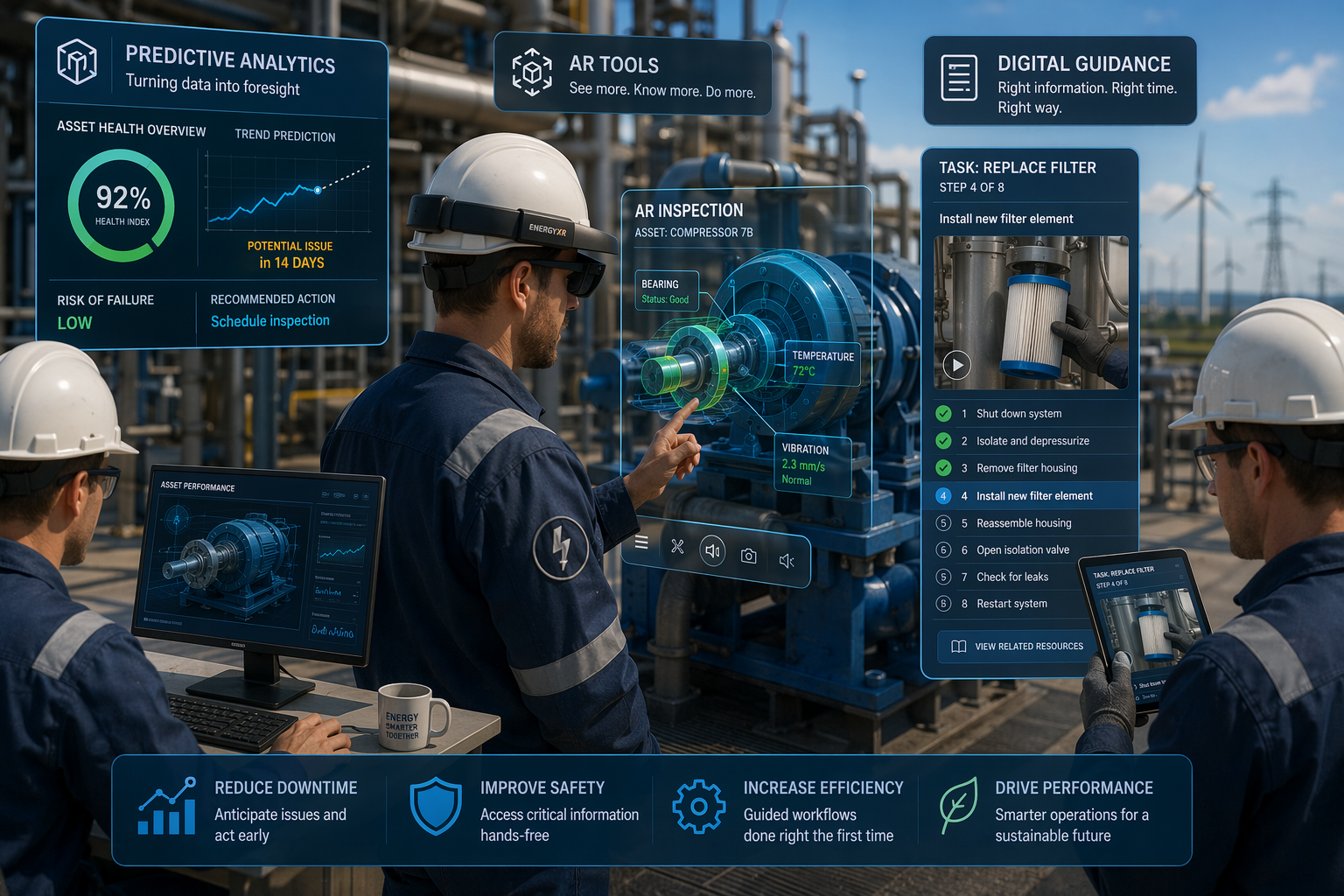
In logistics, connected tracking improves shipment visibility. In agriculture, cloud platforms and sensors support crop decisions. In fieldwork, teams use sensors and AR to improve inspections. These examples show that workflow automation and connected intelligence now shape many types of daily operations.
Supply Chain Optimization and Logistics
In logistics, Industry 4.0 improves visibility from storage to delivery. Companies use connected systems to strengthen supply chain management, reduce waste, and respond faster when shipping conditions or inventory levels change. This matters because delays and stock errors can quickly affect customer service and cost.
Warehouse management is one of the clearest examples. Sensors, smart tracking, and automation help businesses monitor goods movement in real time. RFID technology is especially useful because it reduces manual checks and makes inventory data easier to trust.
Key logistics applications include:
- RFID technology for tracking stock and medical supplies
- Real time shipment and condition monitoring during transit
- Warehouse management systems linked to smart shelves and sensors
- Predictive analytics for supply chain management risk planning
These tools help businesses build more resilient logistics operations while also improving speed and accuracy.
Energy and Utility Sector Transformations
The utility sector is also being shaped by Industry 4.0, especially through sensor-based monitoring and connected fieldwork. Smart devices collect information on environmental and operating conditions, helping organizations track performance and respond more effectively in remote or complex settings.
This approach supports operational efficiency because teams no longer need to rely only on periodic inspections. Instead, they can use data to monitor changing conditions and identify issues earlier. In field environments, sensors help gather details on air quality, water quality, biodiversity, and climate conditions, which supports more informed action.
Predictive analytics strengthens this model by helping teams anticipate maintenance needs or usage shifts. The compiled information also highlights how AR tools support inspections and repairs by showing digital guidance in the field. Together, these technologies create safer, more informed, and more efficient operations across energy-related work.
Benefits Companies Experience with Industry 4.0 Solutions
Companies adopt Industry 4.0 because the gains are practical. Better visibility leads to faster action, while automation and connected systems improve operational efficiency. Businesses also report cost savings from lower downtime, tighter inventory control, and fewer manual errors.
The impact can also reshape business models. Digital tools support more flexible production, smarter service planning, and stronger product quality. Whether the goal is higher output, better customization, or improved supply tracking, Industry 4.0 gives companies a clearer way to run operations with less waste and more precision.
Enhanced Productivity and Efficiency Gains
One of the biggest reasons companies invest in Industry 4.0 is improved productivity. When systems are connected, teams can see issues earlier, react faster, and keep operations moving with less disruption. That directly supports operational efficiency across manufacturing processes.
Real time visibility is a major part of this shift. Bosch used machine data and analytics to identify bottlenecks and improve output in certain areas by more than 10 percent. GE also reported productivity gains during its AR glasses pilot, where workers received instructions in their field of view instead of stopping to consult manuals.
These examples show how digital transformation improves daily work. Instead of relying on guesswork or delayed reports, teams make decisions using live operational information. Over time, that means better equipment uptime, smoother workflows, and stronger use of labor and resources across production environments.
Improved Quality Control and Customization
Industry 4.0 also helps manufacturing companies improve quality control. Connected machines, sensors, and software make it easier to detect process issues before they affect finished goods. That matters when even small production errors can increase waste or delay delivery.
Data analysis and big data analytics support this improvement by showing patterns that people might miss. Audi, for example, uses production data to understand efficiency, quality, and resource use. In retail and product design settings, businesses also study customer behavior and production data to support more personalized designs and better inventory choices.
Customization becomes easier when digital systems support flexible production. Additive manufacturing, CAD, 3D modeling, and virtual tools make it possible to test and refine products faster. This shortens product development cycles, reduces physical prototyping needs, and helps companies deliver goods that better match customer expectations.
Implementing Industry 4.0: Steps for Businesses
If you are planning Industry 4.0 adoption, start with clear business goals. The compiled guidance stresses that companies should identify the technologies they truly need instead of chasing every trend. A focused plan makes digital transformation easier to manage and ties investments to specific business models, such as better maintenance, smarter inventory, or improved production visibility.
The next step is building connected systems that can handle shared data across operations. After that, it helps to develop an MVP so you can test performance before expanding. Strong project management also matters because implementation challenges often involve integration, security, and workforce readiness. Businesses should also apply cybersecurity controls, test systems carefully, and maintain them over time to keep results stable and scalable.
Overcoming Common Implementation Challenges
Many businesses want Industry 4.0 results, but the move is rarely simple. Common challenges of industry include integrating new tools with legacy systems, finding skilled talent, and funding large-scale upgrades. These issues affect various sectors, from manufacturing to healthcare and logistics.
Project management becomes critical because companies must balance technology rollout, daily operations, and long-term value. Security also needs attention, since connected systems create more points that must be protected. In some industries, regulatory compliance adds another layer of planning.
Typical challenges include:
- Legacy system modernization and integration complexity
- Limited access to skilled data, AI, and technical talent
- Higher upfront costs and slow investment decisions
- Cybersecurity and regulatory compliance requirements
The good news is that these obstacles are manageable when businesses start small, set priorities, and build carefully.
Strategies for Successful Digital Transformation
Successful digital transformation starts with a practical roadmap. Businesses should define clear targets first, such as improving uptime, reducing stock waste, or speeding order handling. That keeps advanced technologies tied to measurable outcomes instead of scattered experiments.
Next, create connected systems that allow data to move smoothly across functions. A centralized platform for data analytics helps teams gather information from machines, inventory tools, and operational software in one place. This makes it easier to turn raw inputs into useful action.
It also helps to begin with an MVP. The compiled guidance recommends starting with core features like real time equipment monitoring, predictive maintenance, and inventory tracking before expanding into more advanced functions. Add strong security, test thoroughly, and refine in stages. That step-by-step approach lowers risk and gives teams time to learn what works best.
Future Trends in Industry 4.0 Adoption
Future trends in Industry 4.0 point toward deeper use of machine learning, stronger artificial intelligence, and more connected operations. Businesses are moving beyond simple monitoring and toward systems that can recommend actions, support design choices, and improve maintenance timing with less manual effort.
Another major direction is the rise of sustainable smart factories. Companies are paying closer attention to energy use, waste reduction, and resource optimization. As Industry 4.0 matures, performance and sustainability are becoming part of the same strategy.
Artificial Intelligence and Machine Learning Integration
Artificial intelligence and machine learning are becoming more central to Industry 4.0 because they help businesses act on large amounts of operational information. Instead of only collecting data, companies can use these systems to identify patterns, forecast outcomes, and support faster decisions.
This matters in areas like maintenance, supply planning, and design improvement. Machine learning models strengthen data analysis by processing large data sets that would be difficult to interpret manually. The compiled information highlights this value in manufacturing, healthcare, and logistics, where connected systems already generate huge volumes of data.
As advanced technologies become more accessible, AI will likely support even more automation and smarter recommendations. Businesses that combine sensors, cloud platforms, and analytics tools are in a better position to use these capabilities well. The result is a more responsive, efficient, and informed operating model across digital environments.
The Rise of Sustainable Smart Factories
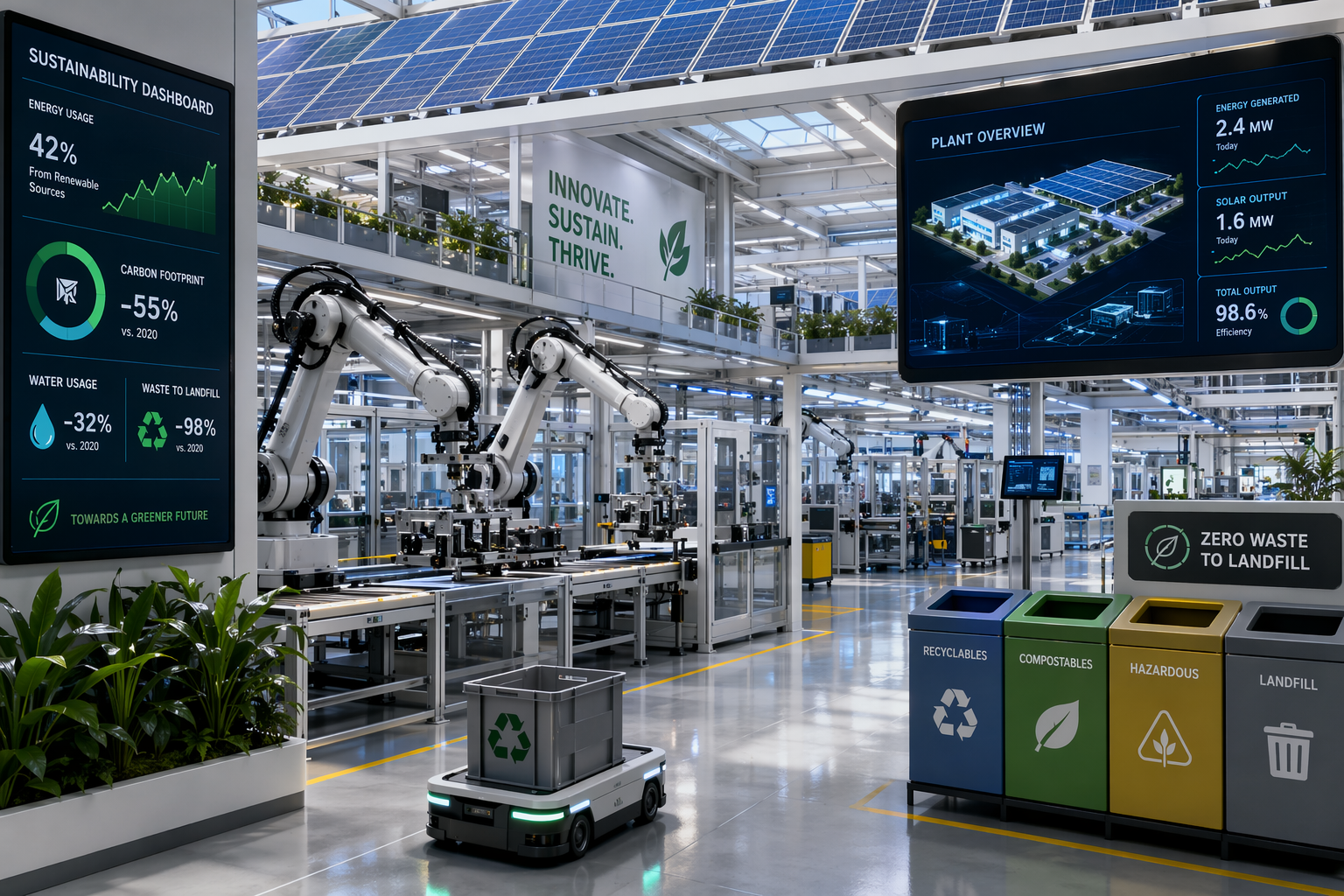
Sustainability is becoming a bigger part of Industry 4.0 because connected systems can reveal where resources are being wasted. In sustainable smart factories, businesses use data to manage energy consumption, reduce material waste, and improve planning across production facilities.
Digital manufacturing plays a major role here. When companies use virtual models, connected monitoring, and better scheduling, they can avoid unnecessary production steps and use raw materials more efficiently. Additive manufacturing and virtual inventories also support this shift by reducing storage needs and cutting transportation demands in some cases.
The compiled examples also show sustainability outside factories. IoT sensors help track environmental conditions in agriculture and fieldwork, while analytics support better resource optimization. As businesses aim for greener operations, Industry 4.0 gives them practical tools to improve performance and environmental outcomes at the same time.
Conclusion
In conclusion, Industry 4.0 represents a transformative shift in how businesses operate, leveraging advanced technologies to improve efficiency and productivity across various sectors. As we've explored through real-world examples and notable case studies, the integration of IoT, AI, and smart manufacturing practices is not just a trend, but a necessity for staying competitive. Companies that embrace this digital revolution are already witnessing significant gains in quality control and customization. As you consider your path forward, remember that taking proactive steps towards implementing Industry 4.0 solutions can lead to substantial benefits. If you're ready to dive deeper into this transformation, reach out for a free consultation with our experts to better understand how to harness these innovations for your business success.
Frequently Asked Questions
What is a simple explanation of Industry 4.0 with an example?
The fourth industrial revolution is the use of digital technologies to connect machines, people, and systems. In the manufacturing industry, one example is using sensors and data analytics to monitor equipment and schedule maintenance before a breakdown. That kind of digital transformation improves uptime, quality, and decision-making.
How do smart factories use Industry 4.0 technologies?
A smart factory uses the internet of things, automation, and continuous data collection to monitor production lines. Sensors capture machine and process information, then connected systems help workers respond faster to problems. This setup improves visibility, reduces delays, and supports more consistent output across operations.
Which industries are leading the way with Industry 4.0 examples?
The automotive industry is a leading adopter, with manufacturing companies using robotics, analytics, and connected systems in production. Healthcare providers are also advancing through smart inventory and patient data tools. Supply chain and logistics operations are close behind, using advanced technologies for tracking, forecasting, and warehouse efficiency.
You might also like