Industrial Automation Solutions: A Comprehensive Guide
Key Highlights
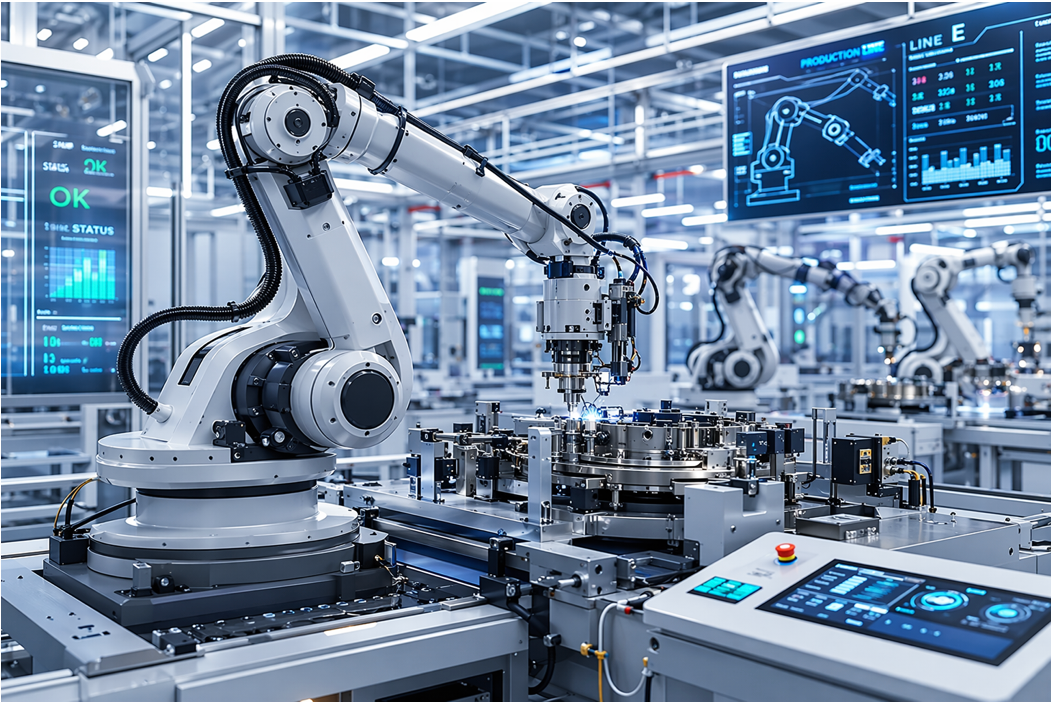
- Industrial Automation Solutions uses it to improve the manufacturing process with less manual work.
- It helps factories handle repetitive tasks faster, with better accuracy across production lines.
- Common systems include fixed, programmable automation, flexible automation, and integrated setups.
- Core tools include control systems, sensors, PLCs, industrial robots, and material handling equipment.
- Businesses gain operational efficiency, better product quality, lower labor costs, and safer workflows.
- Industries like automotive, food, and pharmaceuticals rely on automation every day.
Introduction
Industrial Automation Solutions has become a practical part of modern production, not a future idea. It uses machines, software, and control systems to run parts of the manufacturing process with less direct human input. For many businesses, that means faster output, steadier quality, and safer operations. You also get better visibility into what is happening on the floor. To understand why this matters so much, it helps to look at what these systems are, how they work, and where they fit best.
Understanding Industrial Automation Solutions
Industrial Automation Solutions refers to using advanced machines, software, and connected equipment to handle industrial tasks with less human intervention. These Industrial Automation Solutions support processes across production, material flow, and quality-focused work.
For manufacturing companies, the value is clear. Industrial Automation Solutions can raise output, improve consistency, reduce errors, and make dangerous jobs safer. It also helps businesses lower waste, respond faster to changes, and improve performance across the plant. The next sections explain the idea in more detail.
Defining Industrial Automation Solutions in Modern Manufacturing
At its core, Industrial Automation Solutions is the use of computer-controlled equipment, software, and machinery to run industrial tasks with minimal manual effort. In modern manufacturing, machines do more than repeat motion. They monitor conditions, respond to signals, and support decision-making inside the production environment.
An automated system usually combines sensors, controllers, robots, and software. Together, they create a feedback loop. Sensors detect what is happening, controllers process the information, and machines or actuators carry out the next step. This allows work to continue in real time with more stability and less interruption.
For manufacturers, the benefit is practical. It helps improve output, reduce human error, and create more predictable results. It also supports safer workflows by shifting dangerous or tiring work away from people and into reliable automated systems.
Core Principles of Automation Systems
Every automation setup depends on a simple idea: detect, decide, and act. Control systems gather information from the floor, interpret it, and trigger the right response. This loop keeps production lines moving with less waiting and less need for constant human intervention.
In practice, several principles support operational efficiency:
- Sensors detect changes in machines, materials, or line conditions.
- Controllers make decisions based on incoming signals and preset logic.
- Actuators, motors, or robots perform the physical task.
- Industrial networks keep devices connected and synchronized.
When these parts work together, you get a process that is faster, steadier, and easier to scale. Instead of relying on workers to monitor every step, the system handles routine corrections automatically. That is why automated systems are so effective in busy factory settings.
The Evolution of Industrial Automation Technologies
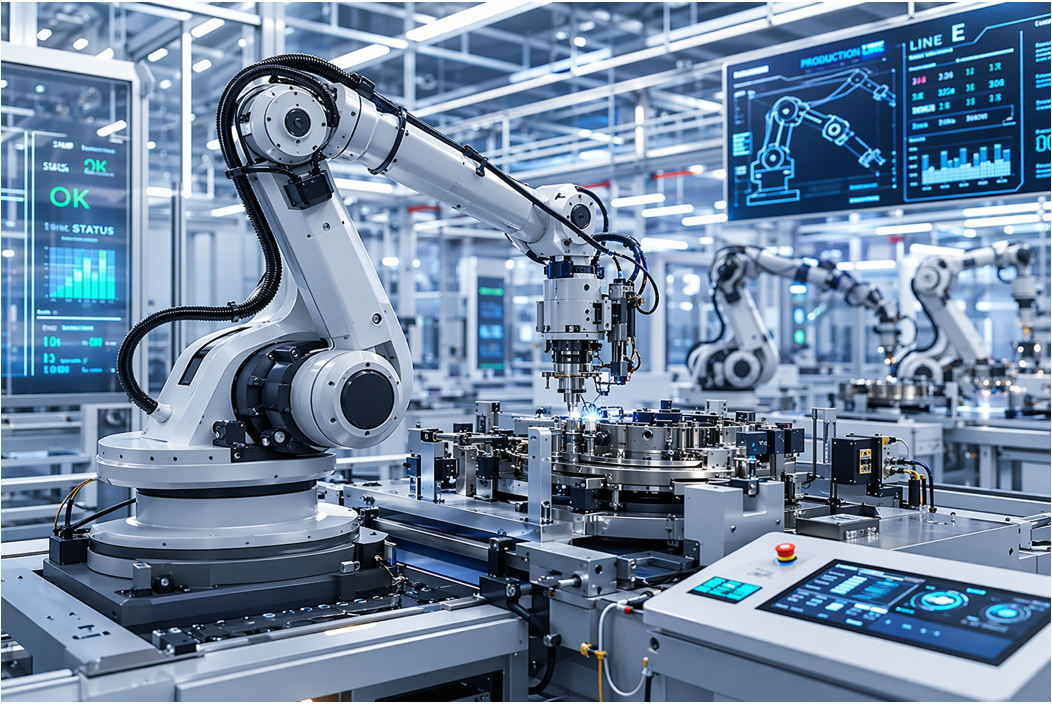
Industrial Automation Solutions started with basic mechanization for repetitive work, especially on assembly-focused operations. Over time, that early automated technology developed into more sophisticated systems that could do far more than repeat one motion. Factories began using computer-controlled equipment to improve speed, precision, and consistency.
As automated solutions advanced, businesses added robotics, machine intelligence, and connected software. New tools now support monitoring, prediction, and coordinated control across many steps of production. This shift has made automation more flexible and more useful in changing operating conditions.
Today, advanced technologies sit at the center of digital transformation in manufacturing. Companies use them to improve scheduling, track equipment health, optimize workflows, and respond faster to demand changes. What began as simple machine support has become a major driver of modern industrial performance.
Main Types of Industrial Automation Systems
Factories use several types of Industrial Automation Solutions, and each one fits a different production need. The main categories are fixed, programmable automation, flexible, and integrated systems. Every automated system is built around output goals, changeover needs, and product variety.
In the manufacturing industry, choosing the right setup depends on whether you need steady high-volume production or frequent adjustments. Some systems are best for one repeated task, while others support different products with less downtime. The following sections break down these common approaches.
Fixed Automation for High-Volume Production
Fixed automation is designed for one set of repeated actions. It uses specialized equipment to perform the same job again and again with little variation. This makes it a strong fit for mass production, where speed and consistency matter most.
You often see fixed automation on assembly lines. In automotive plants, for example, different machines handle specific stages such as welding or painting. Each station supports industrial processes that rarely change, which keeps production moving quickly and efficiently.
Key features of fixed automation include:
- High output for large production volumes
- Equipment built for specific tasks
- Limited flexibility after installation
- Strong performance in stable, repeatable operations
If your process stays the same over long periods, fixed automation can deliver excellent efficiency. The tradeoff is adaptability. Once installed, these systems are not easily reprogrammed for new products or major process changes.
Programmable Automation and Its Flexibility
Programmable automation gives manufacturers more room to adjust operations. Unlike fixed systems, it can be reprogrammed to perform different tasks. That makes it useful for batch production, where product designs or output requirements change from time to time.
This approach works well when companies produce several product versions in lower volumes. A machine can finish one run, then switch instructions for the next. That added flexibility helps reduce setup limitations, even though reprogramming still takes some production time between batches.
Programmable automation sits between fixed systems and fully flexible automation. It offers more adaptability than a dedicated line, but it is not as instant to change as highly advanced reconfigurable systems. For factories balancing variety and efficiency, it remains a practical and widely used option.
Flexible and Integrated Automation Solutions
Flexible automation is built for fast change. These systems can handle different products and production requirements with far less delay than fixed or basic programmable setups. That is why they are useful in environments where customer demand shifts often or customization matters.
In a flexible automation system, robots, software, and reconfigurable hardware work together to adapt workflows. Many of these setups operate with minimal human intervention during changeovers. This helps plants maintain flow while still supporting variety, which can improve both responsiveness and product quality.
Integrated automation takes things a step further. It connects fixed, programmable, and flexible tools into one coordinated platform. Machines, conveyors, software, and control layers all work together as a unified system. In smart factories, this combination helps improve visibility, consistency, and overall production control.
Key Components in Industrial Automation Solutions
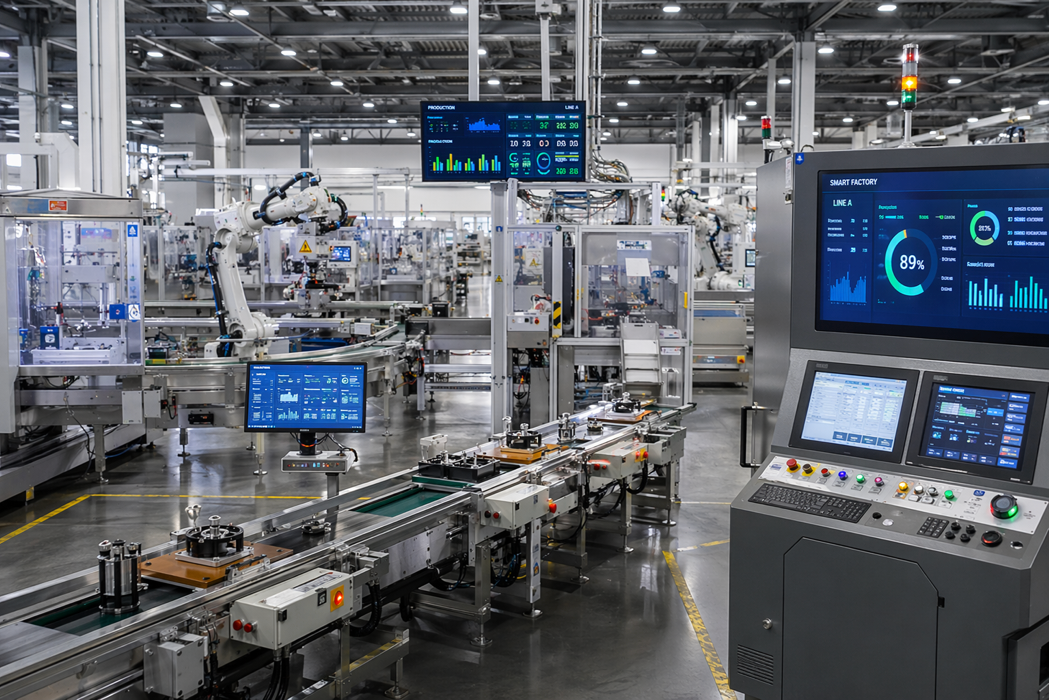
Strong automated solutions depend on several connected parts working as one. Industrial robots, control systems, sensors, and software each play a role in keeping tasks accurate and consistent. You also see technology used heavily in material handling and machine coordination.
Alongside industrial machinery, these components help factories reduce delays, improve visibility, and support safer production. When combined well, they create a reliable system that can monitor conditions, make decisions, and act quickly. Let’s look at the main building blocks behind that performance.
Role of Robots, Cobots, and Automated Machinery
Industrial robots are a major part of modern production. They handle repeated motion with speed and precision, which makes them useful for welding, packaging, moving items, and other routine operations. By taking on these jobs, automated machinery helps improve consistency and reduce strain on workers.
Collaborative robots, often called cobots, are designed to work alongside people. They support tasks that still need human oversight but benefit from machine assistance. This is especially useful when companies want to reduce human error without removing workers from the process completely.
Common advantages include:
- Taking over hazardous tasks in risky areas
- Reducing fatigue from repetitive motion
- Supporting steady output and accuracy
- Improving safety while people focus on higher-value work
Together, industrial robots, collaborative robots, and other automated machinery help create safer, more reliable production environments. They are especially useful where dangerous tasks or constant repetition can affect performance and morale.
Programmable Logic Controllers (PLCs) and Their Importance
Programmable logic controllers are one of the most important parts of any automated system. PLCs receive signals from sensors, process the information, and send commands to machines. In simple terms, they act like the decision engine that keeps automated operations moving.
Because PLCs work in real time, they are ideal for fast industrial settings. They can monitor machine status, react to changes, and control sequences without delay. That is why they are widely used across production lines where timing, consistency, and quick response matter every minute.
PLCs also support flexibility. Manufacturers can update the programming when a process changes or when a new product is introduced. This makes them especially useful in environments that need efficiency but also want room to adapt. Without programmable logic controllers, many modern factory systems would not function smoothly.
Sensors, Actuators, and Communication Networks
Sensors, actuators, and communication networks form the connection layer of Industrial Automation Solutions. Sensors gather information from machines and processes. Actuators turn digital instructions into physical action. Communication networks make sure every device can share information across the system.
These elements support data acquisition and better visibility. When a machine starts running too hot or slowing down, sensors can capture that change right away. The system can then respond quickly, helping teams track equipment health and avoid larger production issues.
Their main roles include:
- Sensors detect pressure, speed, temperature, or position
- Actuators move, lift, open, close, or adjust equipment
- Communication networks connect machines and software
- Data acquisition supports monitoring and decision-making
Without these components, it would be blind and disconnected. With them, manufacturers gain the real-time awareness needed to maintain stable performance and more reliable operations.
Popular Industrial Automation Technologies
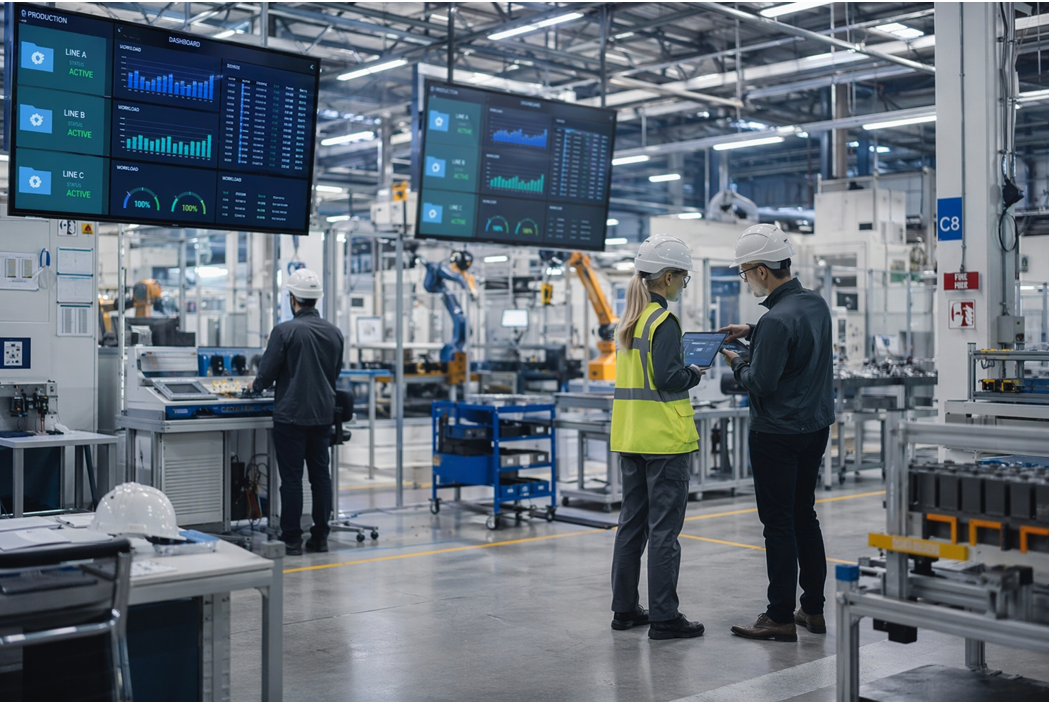
Automation technology has moved well beyond basic machine control. Today, advanced technologies such as artificial intelligence, machine learning, the industrial internet of things, and digital twins are reshaping how factories operate and improve.
These tools help businesses monitor production, predict problems, and test changes before making them on the floor. They also support smarter decisions with better data and stronger coordination across systems. To see how this works in practice, it helps to look at each technology on its own.
Artificial Intelligence and Machine Learning
Artificial intelligence and machine learning are driving a new stage of industrial performance. These systems learn from data, recognize patterns, and help machines respond more effectively to changing conditions. In manufacturing, that means better decisions without waiting for a person to step in every time.
One major use is quality control. AI-based systems can help detect issues faster and support more consistent output. They can also improve planning by spotting trends that affect scheduling, throughput, or process stability. This makes production more responsive and more precise.
Another important use is predictive maintenance. Machine learning models can monitor performance signals and identify early signs of trouble before equipment fails. That helps companies reduce unplanned downtime, protect equipment life, and maintain steadier operations. As a result, AI is becoming a practical tool, not just a future concept.
Industrial Internet of Things (IIoT)
The industrial internet of things connects machines, sensors, and systems so they can share information continuously. This industrial version of the internet of things gives manufacturers a clearer view of what is happening across the floor, often in real time.
With stronger data acquisition, teams can track machine status, output levels, and changing conditions more closely. That visibility supports faster decisions and better process control. In smart factories, IIoT helps connect isolated equipment into one more intelligent operating environment.
IIoT commonly helps by:
- Collecting live performance data from equipment
- Supporting real time monitoring across operations
- Improving visibility for planning and maintenance
- Connecting systems inside smart factories
As more devices become connected, the industrial internet of things makes automation more informed and more responsive. It turns raw machine signals into usable insight that supports daily production improvement.
SCADA, Digital Twins, and Cloud Computing Integration
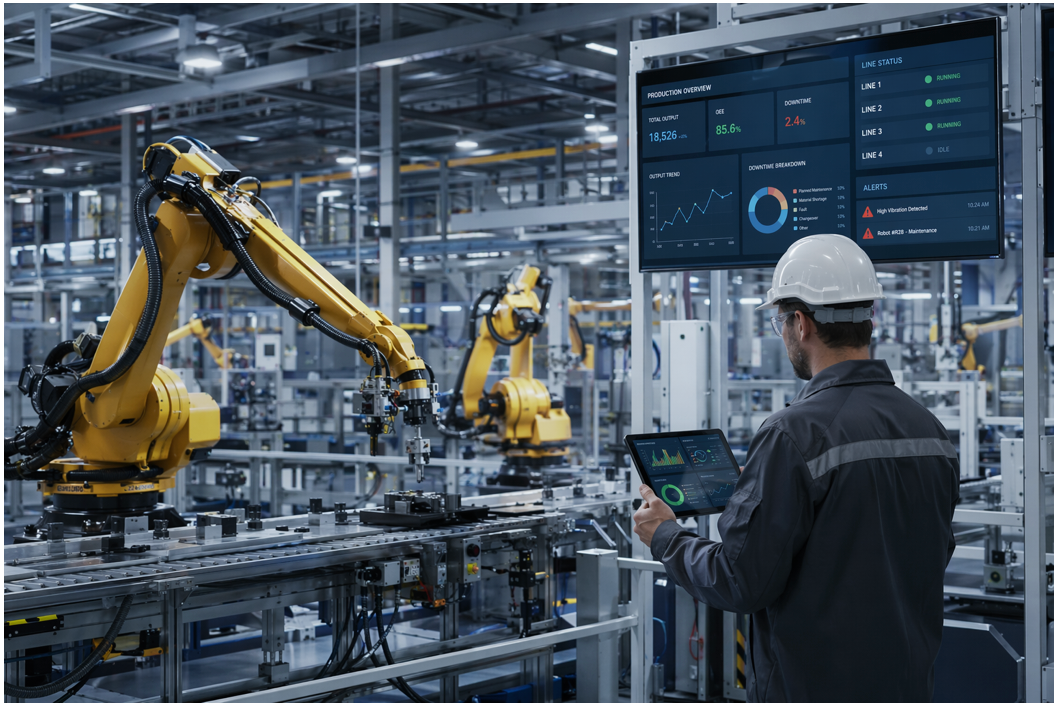
SCADA systems help manufacturers supervise and control operations from a central interface. They give operators a real-time view of equipment, alarms, and performance trends. This makes it easier to manage production processes and respond quickly when conditions change.
Digital twins add another layer of value. A digital twin is a virtual model of a physical asset or process. Companies can use it to simulate changes, test scenarios, and understand how adjustments may affect output before making those changes in the plant.
Cloud computing helps tie these automation solutions together by making data easier to access and analyze across locations. When SCADA, digital twins, and cloud platforms work together, businesses gain stronger oversight, better planning, and more flexible ways to improve performance without disrupting active production.
Advantages of Industrial Automation for Businesses
For many businesses, automation improves daily operations in ways that are easy to measure. It supports operational efficiency, shortens production time, and takes repetitive tasks off workers’ shoulders. That often leads to cost savings and more stable output.
It also helps reduce labor costs, limit human error, support quality standards, and improve workplace safety. These gains matter whether a company wants higher throughput, better consistency, or fewer disruptions. The following sections explain the main business benefits in more detail.
Boosting Productivity and Efficiency
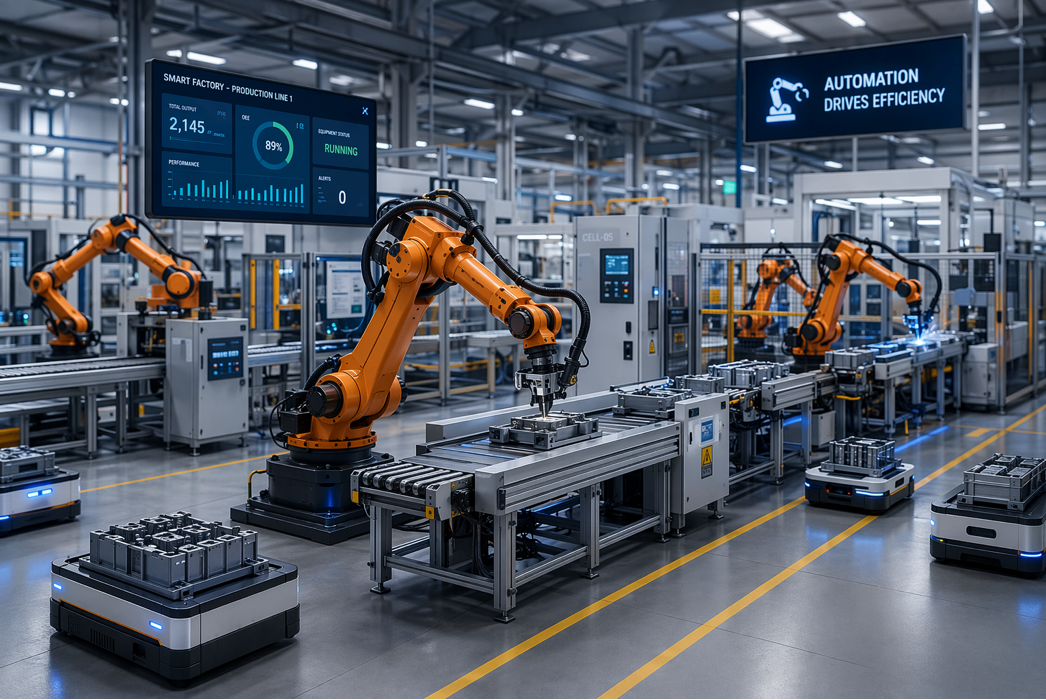
One of the clearest benefits of automation is higher productivity. Machines can run longer, work faster on repeated actions, and keep tasks moving with less delay. That improves operational efficiency across production lines and helps facilities meet output goals more consistently.
Process automation also reduces dependence on manual effort for low-value tasks. When workers no longer spend time on constant transport, repetitive checks, or routine handling, the whole operation can move more smoothly. That shift often helps businesses manage labor costs while increasing throughput.
Productivity gains often come from:
- Faster cycle times on repeated work
- Better flow across production lines
- Fewer stops caused by manual handling
- More output without adding comparable labor costs
In many factories, this means more work gets done in the same amount of time. For leaders focused on efficiency, automation offers a direct path to stronger plant performance.
Improving Product Quality and Consistency
Manual production can lead to variation. Fatigue, distractions, and small mistakes make it harder to hold the same result over long runs. Process automation helps solve that by repeating tasks with the same motion, timing, and settings every time.
This steady performance supports stronger product quality and makes it easier to meet quality standards. Automated equipment can maintain a constant rate and reduce variation between units. In industries where precision matters, that consistency becomes a major advantage.
Vision systems add even more control. They help detect defects, verify placement, and support inspection with greater speed than manual checking alone. When automation and vision systems work together, manufacturers can catch issues earlier and keep output aligned with the standards their customers expect.
Enhancing Safety and Reducing Operational Risks
Safety is one of the strongest reasons to automate. Many facilities still include heavy lifting, moving vehicles, hot surfaces, and other hazardous tasks that put workers at risk. Automation helps by moving people away from those conditions and letting machines handle the danger.
Reducing human intervention in risky areas can lower accident exposure and improve day-to-day confidence on the floor. This matters in warehouses, production cells, and transport routes where slips, collisions, or fatigue-related mistakes can create serious problems. A safer setup also supports better worker retention.
Collaborative robots can improve workplace safety in another way. They assist employees with demanding or repetitive jobs instead of replacing every touchpoint. This creates a more balanced environment where people focus on oversight and problem-solving while machines support the physically difficult work.
Promoting Sustainability and Resource Optimization
Automation can support sustainability by helping manufacturers use resources more carefully. Better control over processes often means less waste, fewer material losses, and steadier energy use. That makes resource optimization a practical business benefit, not just an environmental goal.
These improvements can also lead to lower costs. When machines perform with more precision, companies often reduce excess raw material use and avoid avoidable rework. Better monitoring can also cut unplanned downtime, which helps prevent waste tied to stopped lines, damaged goods, or rushed recovery efforts.
The environmental benefits come from doing more with less. Efficient systems help reduce waste output while keeping production strong. For businesses under pressure to improve both performance and responsibility, automation offers a useful way to support sustainability without sacrificing operational results.
Key Industries Utilizing Industrial Automation Solutions
Industrial Automation Solutions is used across a wide range of sectors, but some industries rely on it more heavily than others. Manufacturing automation plays a major role in automotive, food production, chemicals, pharmaceuticals, logistics, and consumer goods operations.
These industries often need speed, consistency, strong supply chain control, and efficient material handling. They also face pressure to improve safety and quality while keeping costs under control. Looking at a few major sectors shows how automation supports different production needs in the real world.
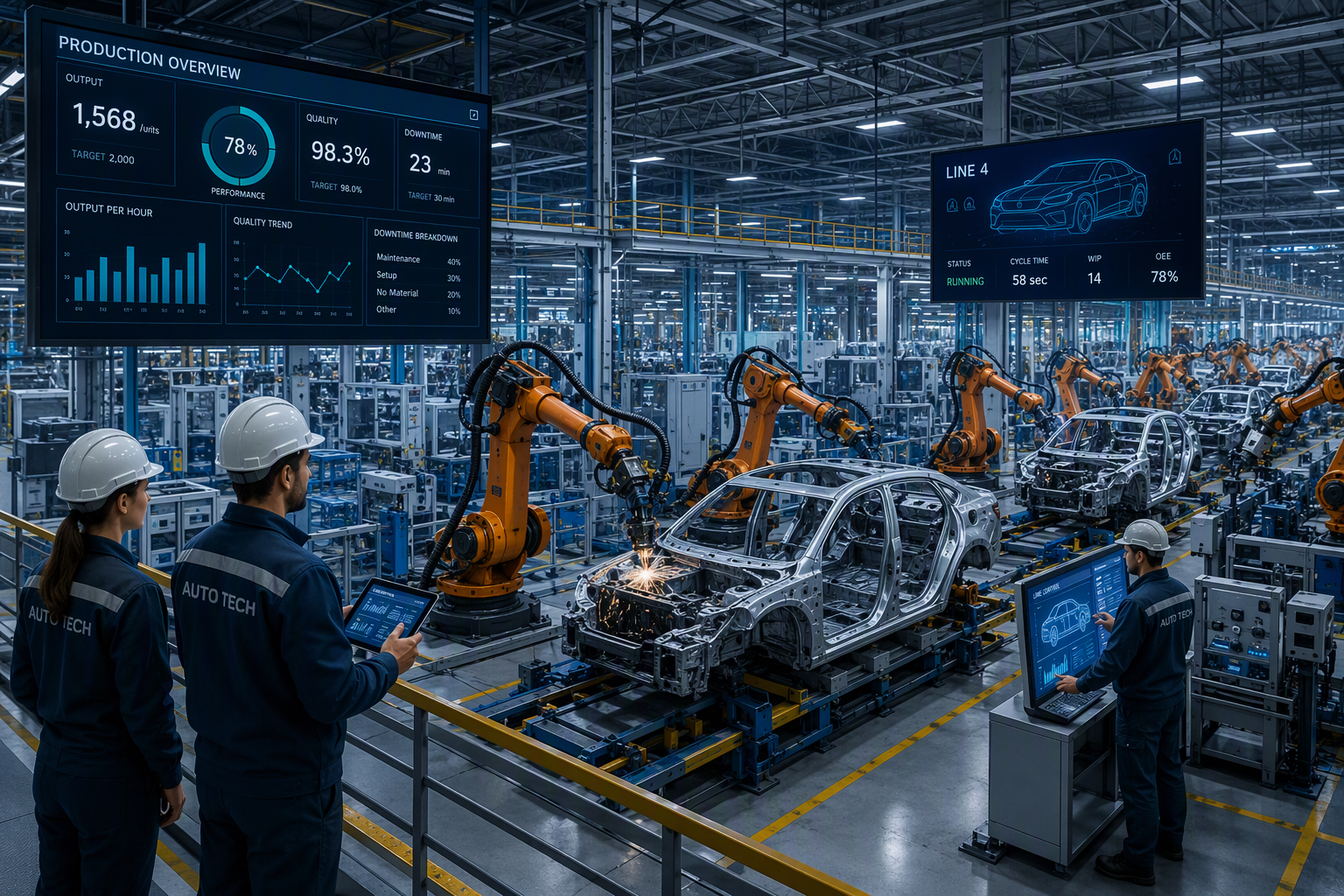
Automation in Automobile Manufacturing
Automobile manufacturing has long been one of the clearest examples of automation in action. Large plants use robotic automation across assembly lines to handle repeated, high-precision tasks such as welding, painting, and part installation. This helps reduce production time while keeping output steady.
Because vehicle building involves many linked stages, automation supports smoother production processes from one station to the next. Specialized machines complete set tasks in sequence, which is why this sector remains closely associated with fixed and integrated automated systems.
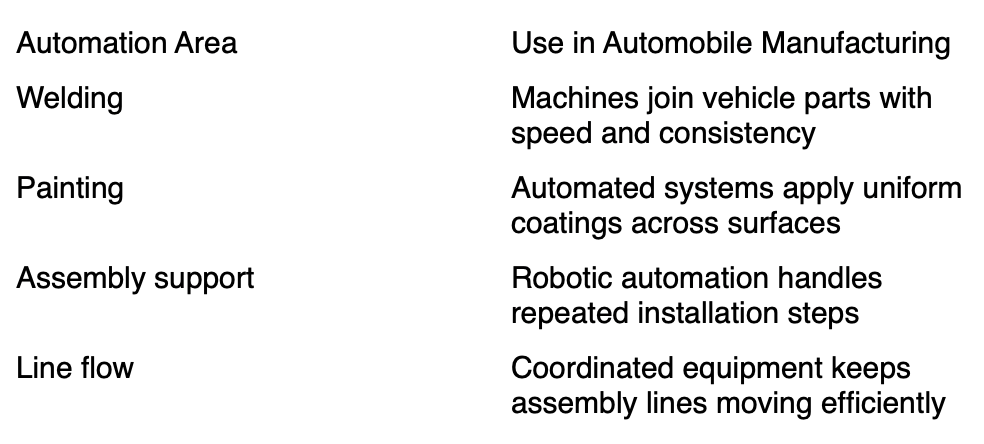
For high-volume plants, these systems improve throughput and help maintain dependable quality from one vehicle to the next.
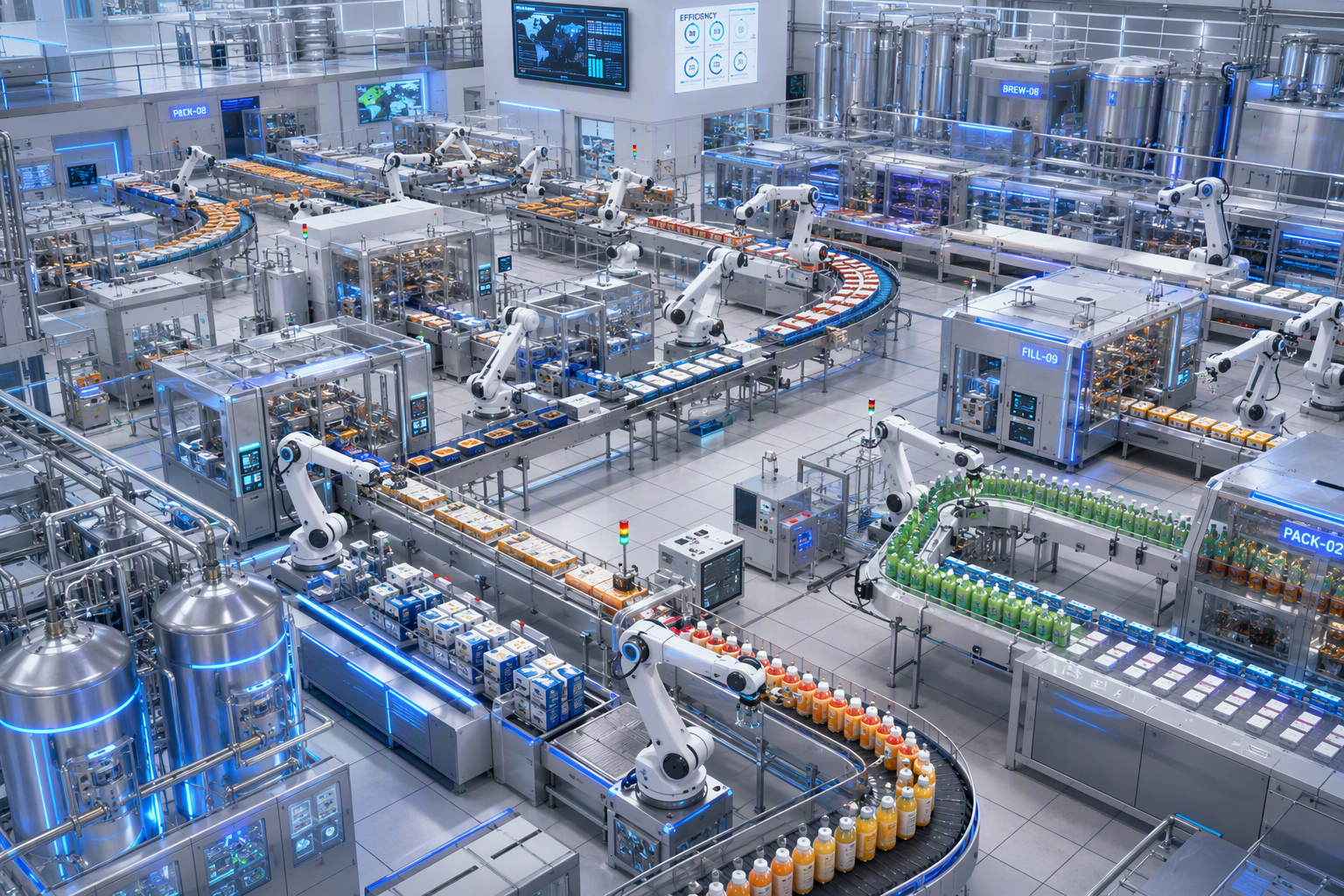
Applications in Food and Beverage Processing
Food and beverage processing uses automation to manage repetitive, high-speed tasks such as mixing, filling, capping, and packaging. These operations need consistency, cleanliness, and reliable timing. Process automation helps companies keep output steady while reducing variation from one run to another.
This sector also benefits from batch production flexibility. Manufacturers often produce different recipes, package sizes, or product lines in scheduled runs. Programmable systems help make those changes while still keeping operations efficient. That balance is important when demand shifts or seasonal products are involved.
Quality control is another major advantage. Automated systems help ensure each bottle, can, or package meets the expected standard. By combining controlled equipment with consistent monitoring, food and beverage processing plants can improve reliability, reduce waste, and keep production moving with fewer interruptions.
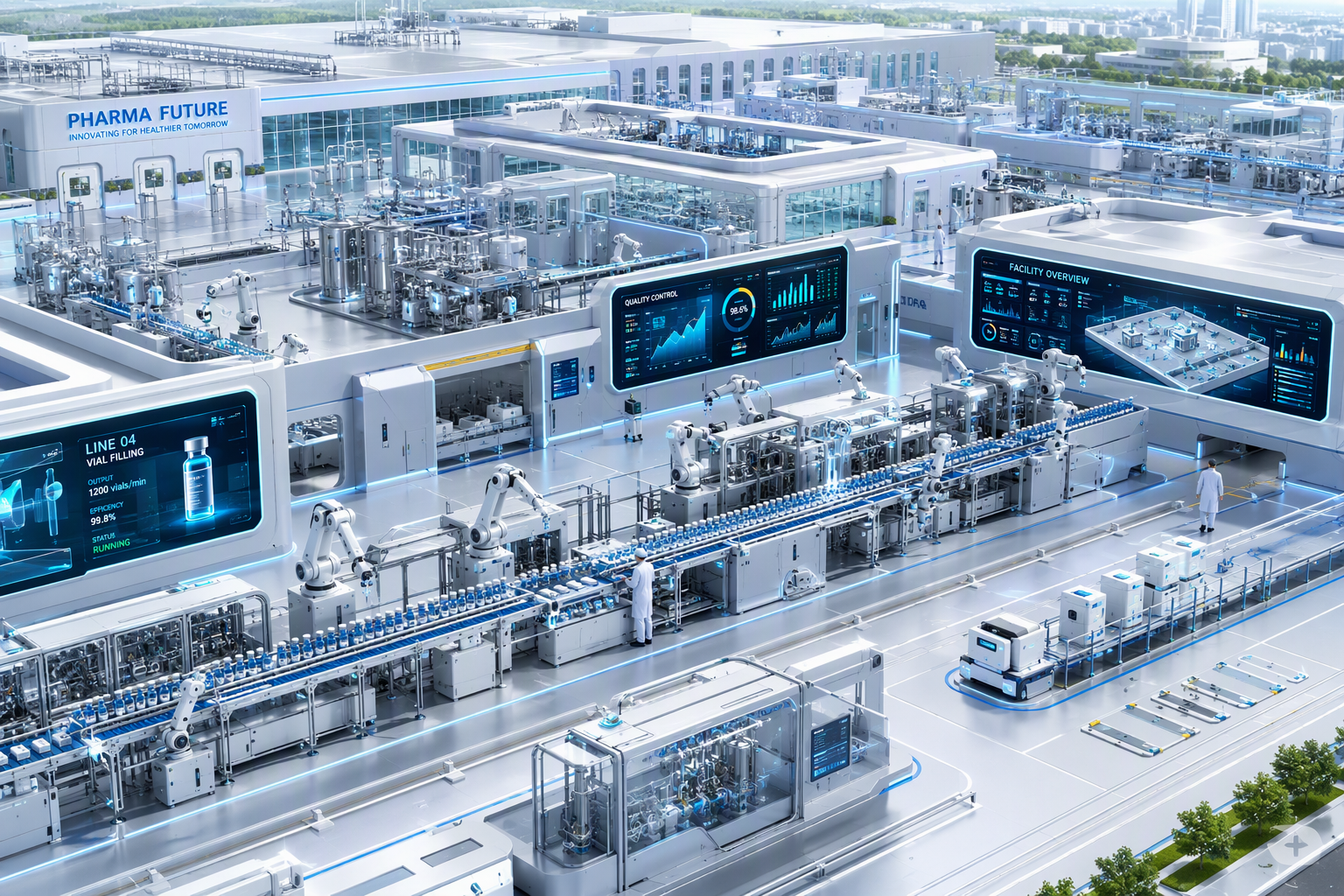
Adoption by the Chemical and Pharmaceutical Industry
The chemical industry and pharmaceutical industry depend on precision, repeatability, and close process oversight. In these environments, automated solutions help manage tightly controlled operations where small variations can affect safety, output, or compliance.
Quality control is especially important in both sectors. Automated monitoring and control systems help maintain stable conditions and support consistent product results. This reduces the chance of process drift and makes it easier to identify issues before they affect larger production volumes.
Regulatory compliance is another key reason these industries use automated systems. Clear monitoring, repeatable execution, and better data visibility help companies follow strict process requirements. For businesses working under heavy standards and documentation pressure, automation creates a more dependable way to run sensitive operations at scale.
Selecting the Right Industrial Automation Provider
Choosing the right Industrial Automation Solutions provider is about more than buying equipment. You need a partner that understands your production goals, your automated system needs, and the role of advanced technologies in your facility.
The best providers help you plan, implement, and support automated solutions in a way that fits your workflow. They also make it easier to scale or adapt over time. To make a smart choice, it helps to know what services to expect and what factors matter most.
Essential Services Offered by Automation Solution Providers
Good automation solution providers do more than install hardware. They help businesses understand where automation fits best, how systems should be configured, and what support is needed after launch. Their role often spans planning, deployment, monitoring, and improvement.
Because automation affects many parts of production, providers should also help with maintenance needs and long-term reliability. Some systems now include tools for predictive maintenance, analytics, and performance visibility. These services support process automation and make digital transformation easier to manage over time.
Common services often include:
- System design and implementation support
- Programming and integration of automated equipment
- Monitoring tools for maintenance needs
- Predictive maintenance and performance analytics
A strong provider helps you move from idea to operation with less risk. That guidance is especially useful when a company is making a major transition toward connected and more intelligent manufacturing.
Factors to Consider When Choosing a Provider
Start by looking at how well a provider understands your production environment. A good fit depends on whether the company can align automated technology with your actual floor conditions, product mix, and operating goals. What works in one plant may not work in another.
You should also consider how the provider approaches quality standards and long-term performance. Reliable automation needs more than a quick installation. It should support stable output, clear monitoring, and the ability to maintain results as production changes. A provider should be ready to discuss these points clearly.
Cost matters, but not just the initial price. The better question is whether the solution supports lasting cost savings through higher efficiency, fewer errors, and better uptime. When choosing a provider, focus on value, fit, and support rather than headline price alone.
Leading Global Industrial Automation Companies
The Industrial Automation Solutions industry includes many leading companies that build control platforms, robotics, connected software, and factory technologies. While providers differ in focus, the strongest ones are known for reliability, broad support, and the ability to deliver advanced technologies at scale.
Rather than choosing based only on size or name recognition, companies should compare how well a vendor’s automation solutions match their goals. Some excel in robotics, some in control systems, and others in connected software or integrated plantwide support.
When reviewing leading companies, look for strengths such as:
- Experience across multiple manufacturing settings
- Proven support for advanced technologies
- Strong service, integration, and maintenance capabilities
- Scalable automation solutions for future growth
In practice, the best choice is the one that fits your process, your workforce, and your operational priorities. Reputation matters, but alignment matters more.
Conclusion
In conclusion, industrial automation solutions are transforming the landscape of modern manufacturing, offering numerous advantages that can significantly enhance productivity, efficiency, and safety. By understanding the various types of automated systems and the key components involved, businesses can make informed decisions that align with their operational goals. As industries continue to embrace advanced technologies like AI, IIoT, and cloud computing, the potential for innovation and growth becomes limitless. If you're considering a shift towards automation, now is the time to explore the right solutions for your business. Don't hesitate to reach out for a free consultation to see how we can help you optimize your operations and achieve sustainable success.
Frequently Asked Questions
What is an industrial automation systems integrator and why is it important for manufacturers?
An Industrial Automation Solutions systems integrator connects machines, software, and controls into one working automated system. For manufacturers, that matters because it improves the manufacturing process, supports operational efficiency, and reduces unnecessary human intervention by making sure all parts of the system communicate properly.
Can you provide examples of successful industrial automation implementations in the United States?
Yes. In the United States, common examples include automotive plants using industrial robots on production lines, warehouses using autonomous vehicles for transport, and food or consumer goods facilities using manufacturing automation for filling, packaging, and inspection. These automated solutions improve speed, consistency, and labor use.
Are there environmental and sustainability benefits to using industrial automation solutions?
Yes. Industrial Automation Solutions supports sustainability by improving resource optimization, reducing waste, and helping processes run more efficiently. Better process automation can also cut downtime and material loss, which may lead to lower costs while supporting environmental goals at the same time.
You might also like