Industrial Automation Solutions: Key Innovations to Explore
Key Highlights
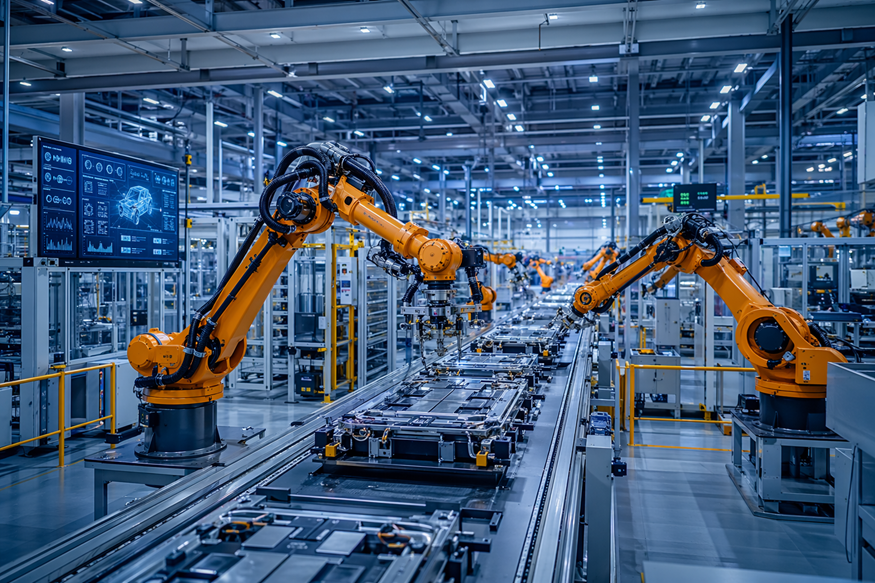
- Industrial Automation Solutions uses control systems, software, and machines to run industrial processes with less human intervention.
- Modern Industrial Automation Solutions improve product quality, worker safety, and operational efficiency across the production line.
- Core technologies include sensors, actuators, edge devices, programmable logic controllers, HMI, and SCADA tools.
- Robotics, machine vision, the Industrial Internet of Things, and machine learning support real time decisions.
- Common industry applications include automotive manufacturing, food processing, pharmaceuticals, electronics, and warehousing.
- Strong planning, system integration, and the right provider help manage initial investment and long-term performance.
Introduction
Industrial Automation Solutions is changing how companies manage industrial processes every day. Instead of relying heavily on manual labor, businesses now use Industrial Automation Solutions to improve speed, consistency, and control. That shift matters if you want better output without adding more pressure to your team. From assembly lines to data collection, Industrial Automation Solutions helps reduce errors and support smarter decisions. The result is a production environment that is safer, more efficient, and better prepared for changing market demands.
Understanding Industrial Automation Solutions
Industrial automation solutions are combinations of hardware and software that help manage industrial processes with minimal human intervention. A typical system may include sensors, controllers, robots, software, and communication networks working together in one connected setup.
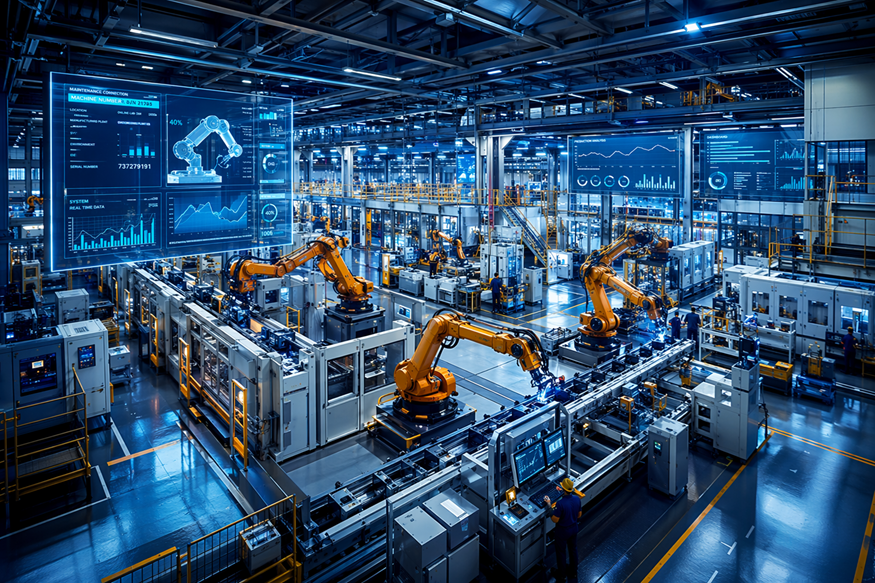
For manufacturing companies, these systems help by handling repetitive tasks, collecting accurate data, and keeping the production process consistent. That means fewer errors, stronger product quality, and better use of labor. To see how this works in practice, it helps to start with what defines an industrial automation solutions.
What Defines an Industrial Automation Solution?
An industrial automation solution is a structured way to control machines and workflows with less direct effort from human operators. It is more than one machine doing one job. Instead, it is a system that connects sensing, decision-making, and physical action across industrial processes.
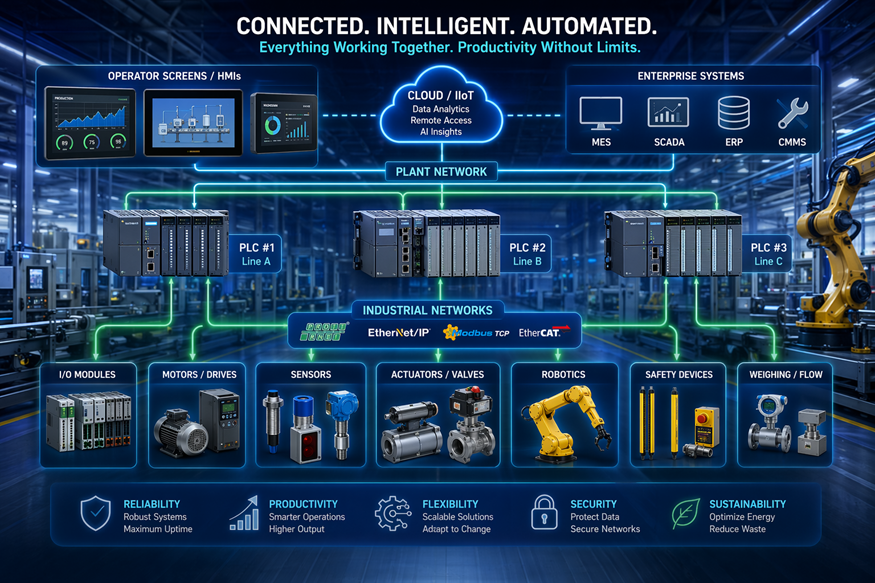
In most cases, sensors detect conditions on equipment or along the production line. Controllers such as PLCs receive that information and decide what should happen next. Actuators, motors, and robotic systems then carry out the required movement. Software and operator screens give people visibility into the process.
What makes this valuable for you? It creates a closed-loop system that can respond in real time, maintain stable output, and improve product quality. That consistency is why an industrial automation solution has become a core part of modern manufacturing automation.
How Industrial Automation Solutions Support Manufacturing Companies
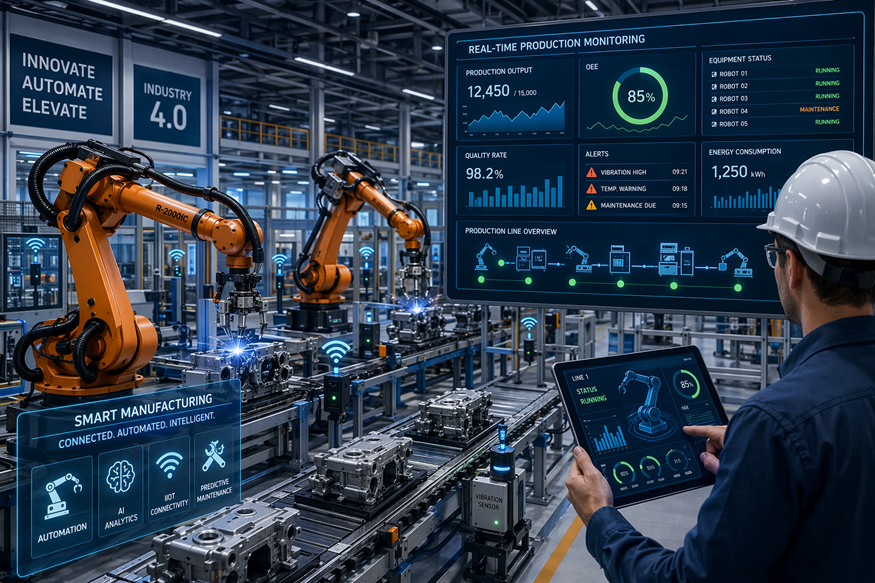
For many manufacturers, automation solutions solve everyday problems that slow growth. If your production line deals with bottlenecks, downtime, labor shortages, or uneven output, can help stabilize the manufacturing process and reduce strain on your workforce.
A big advantage is how well these systems handle repetitive tasks. Robots and automated equipment can run around the clock without fatigue, which helps lower dependence on manual labor for routine work. That often leads to faster cycle times, better throughput, and more reliable performance across the line.
There is also a strong quality and safety benefit. Automated systems reduce variation, support quality control, and move human workers away from hazardous environments. In simple terms, automation solutions help manufacturing companies produce more, make fewer mistakes, and use people where their judgment adds the most value.
Key Components of Modern Industrial Automation
Every modern automation system depends on a few core building blocks. These parts gather information, make decisions, and trigger action across the production process. Without them, even advanced programmable automation or flexible automation cannot deliver stable performance.
You will usually see a control system supported by sensors, actuators, PLCs, operator interfaces, and industrial networks. Each part has a clear role, and together they keep machines connected and responsive. The next sections break down how these technologies support industrial control systems in real facilities.
Sensors, Actuators, and Edge Devices
Sensors are the starting point for many automated decisions. They detect what is happening on a machine, production line, or in the wider plant environment. That may include position, movement, pressure, or other operating conditions that matter to a control system.
Once data is collected, actuators turn commands into physical movement. They open, close, lift, push, rotate, or stop equipment as needed. In practical terms, sensors tell the system what is happening, and actuators carry out the response. This simple chain is central to automation technology.
Edge devices support that process by helping data move quickly and efficiently near the source. In connected environments, they help equipment respond in real time rather than waiting for delayed decisions. For you, that means tighter control, better reliability, and smoother operation across industrial processes.
Programmable Logic Controllers (PLCs) and Control Systems
Programmable logic controllers are a core part of industrial automation. These devices receive signals from sensors, process that information, and send instructions to machines. In many facilities, they act as the brain of the automated system and keep production moving in a predictable way.
A control system built around PLCs helps companies automate specific tasks with speed and consistency. This is especially useful in batch production, where equipment may need quick adjustments for different products. That is why PLCs are widely used in programmable automation and other flexible setups.
Industrial control systems often bring PLCs together with networks, operator software, and field devices. When those parts work in sync, you get more accurate control, fewer process errors, and stronger uptime. For many manufacturers, PLC-based automation is the foundation of reliable operation.
Human-Machine Interface (HMI) and Supervisory Control and Data Acquisition (SCADA)
Operators still need visibility, even in highly automated plants. A human-machine interface gives people a simple way to monitor equipment, review status, and interact with the control system without managing every manual step on the floor.
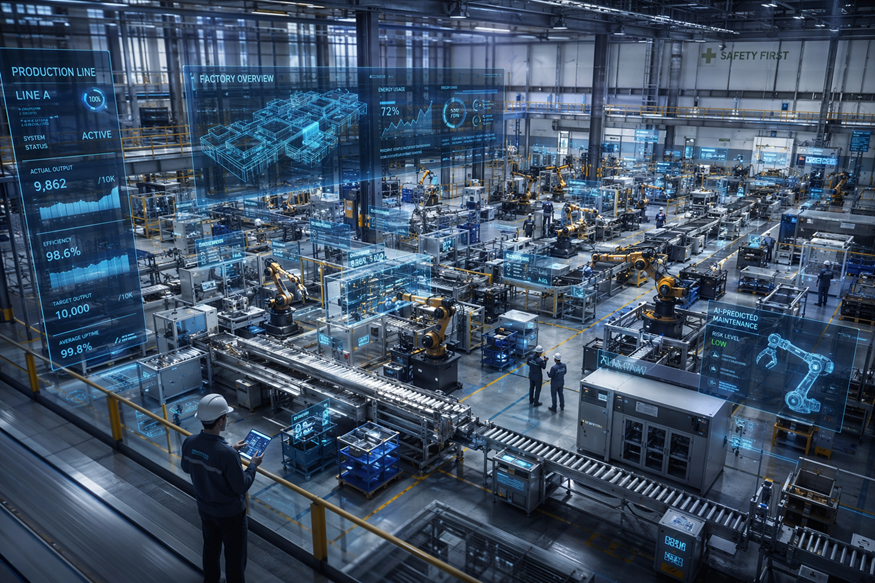
SCADA adds a wider view. Supervisory Control and Data Acquisition systems collect real time data from connected devices and processes, then present that information in one place. This helps teams track production, spot issues early, and respond faster when something changes.
Together, HMI and SCADA improve decision-making and control. Instead of guessing what is happening, you can see trends, alarms, and process conditions as they develop. That supports quality control, reduces waste, and makes industrial automation easier to manage across an entire production line.
Major Technologies Powering Automation Solutions
Today’s automation solutions are powered by a mix of proven equipment and newer digital tools. Industrial robots still handle many physical tasks, but they now work alongside connected software, data tools, and smart monitoring systems that improve how plants operate.
The internet of things, machine learning, and advanced analytics help companies move beyond simple automation. These technologies make it easier to respond in real time, reduce downtime, and improve quality. To understand their value, it helps to look at each technology group more closely.
Role of Robotics and Machine Vision in Automation
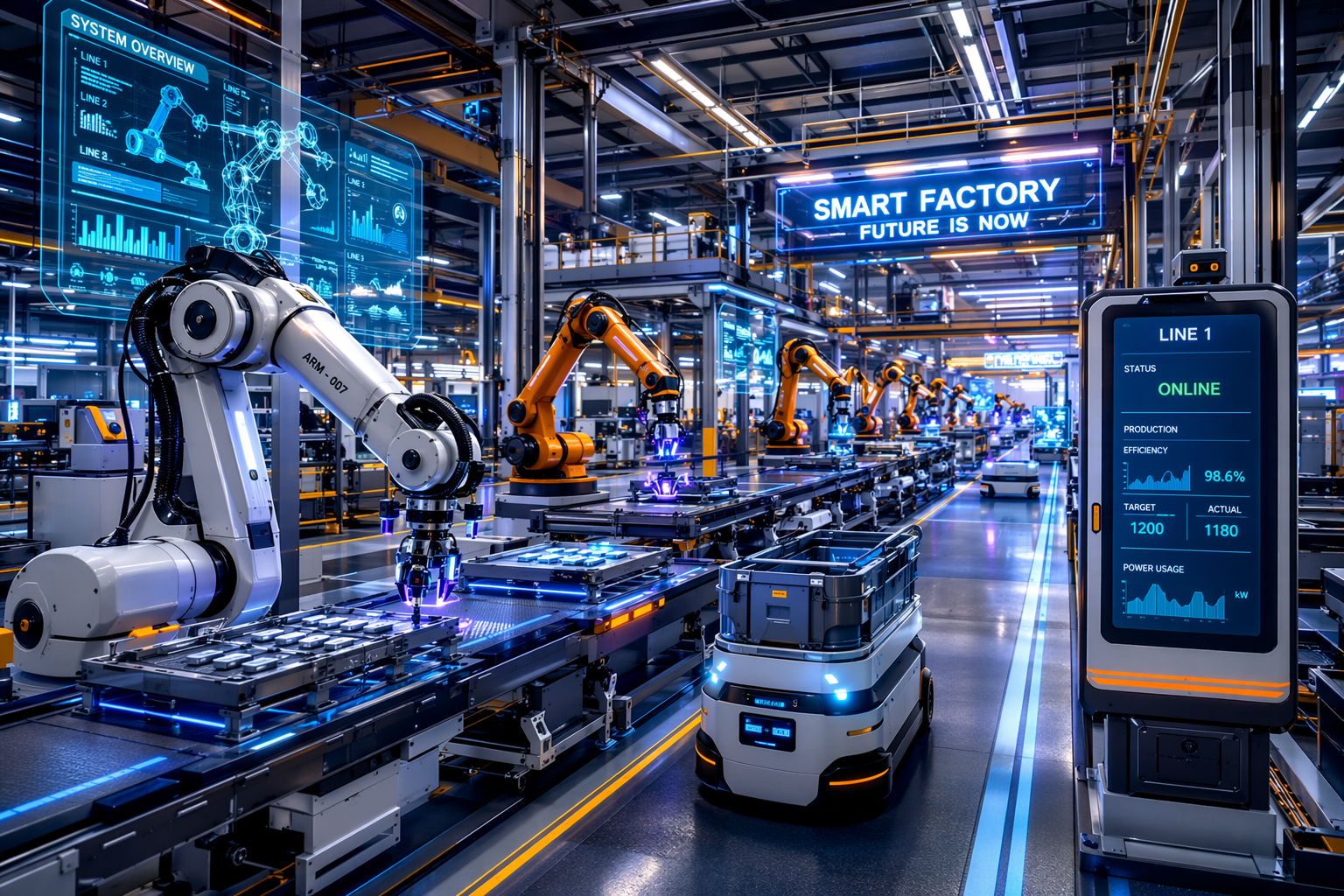
Robotics plays a major role in manufacturing automation because machines can repeat the same motion with high precision. Industrial robots are commonly used for welding, painting, assembly, packaging, and other repetitive tasks that demand speed and consistency.
Machine vision strengthens that capability by allowing technology to inspect products and detect problems. In quality control, this matters because small errors can affect output, waste materials, or create rework. Vision systems help identify defects faster than manual checks in many settings.
When robotics and machine vision work together, you get a stronger production process. Robots perform the task, while vision tools confirm whether the result meets the required standard. For your operation, that means improved accuracy, better product quality, and fewer interruptions across the production line.
Integration of Industrial Internet of Things (IIoT)
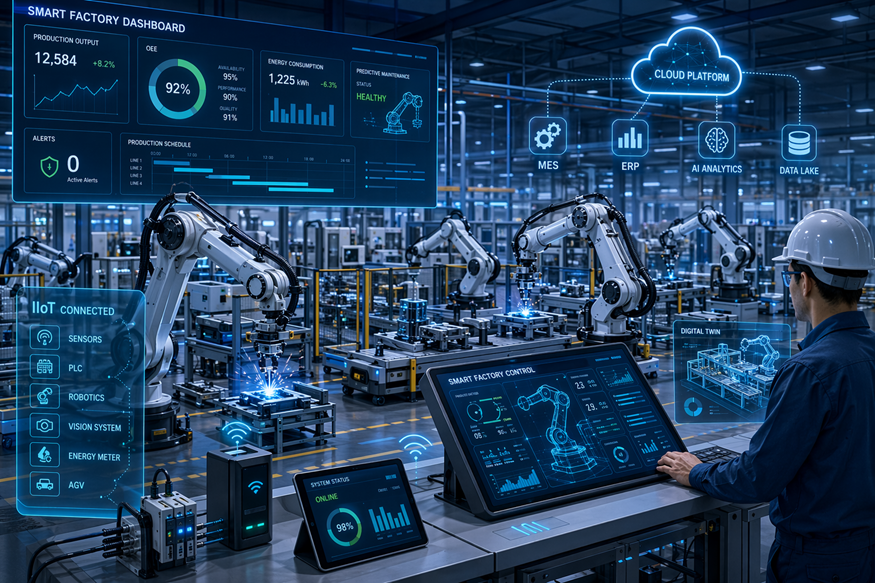
The Industrial Internet of Things connects machines, sensors, and software so they can share information across a facility. In practice, IIoT brings iot devices into the production environment and helps create the connected structure behind smart factories.
This connection depends on communication networks that move data between equipment, control systems, and monitoring tools. Once that information is available, teams can track conditions, compare performance, and respond to changes more quickly. That is a big step up from isolated machines working alone.
For manufacturers, the value of the industrial internet of things is clear. It supports better visibility, stronger coordination, and more informed decisions. It also helps plants monitor the entire production line in real time, which makes it easier to reduce downtime and improve operational efficiency.
AI, Machine Learning, and Data Analytics in Industrial Settings
Artificial intelligence and machine learning are expanding what automation can do in industrial settings. These tools help systems analyze information, detect patterns, and support faster decisions without depending only on manual review.
One of the biggest benefits comes from data analysis. Automated systems collect production information continuously, and that data can reveal inefficiencies, quality issues, or equipment trends. When you understand those patterns, you can improve processes and make better decisions with less guesswork.
Predictive maintenance is a strong example. Instead of waiting for a failure, companies use real time data to identify early warning signs and act sooner. That helps reduce unplanned shutdowns, extend equipment life, and protect output. In many facilities, AI-driven insight is becoming a practical part of daily operations.
Industry Applications of Industrial Automation Solutions
Industrial automation solutions are used across many parts of the manufacturing sector because different facilities face different operating challenges. Some need speed for mass production, while others need flexibility for batch production, small runs, or changing product requirements.
That is why industry applications vary so widely. Fixed systems, programmable setups, and other types of automation can all fit depending on output goals and product mix. The next sections look at which sectors use automation most often and how those systems support real work on the floor.
Common Sectors Adopting Automation in the United States
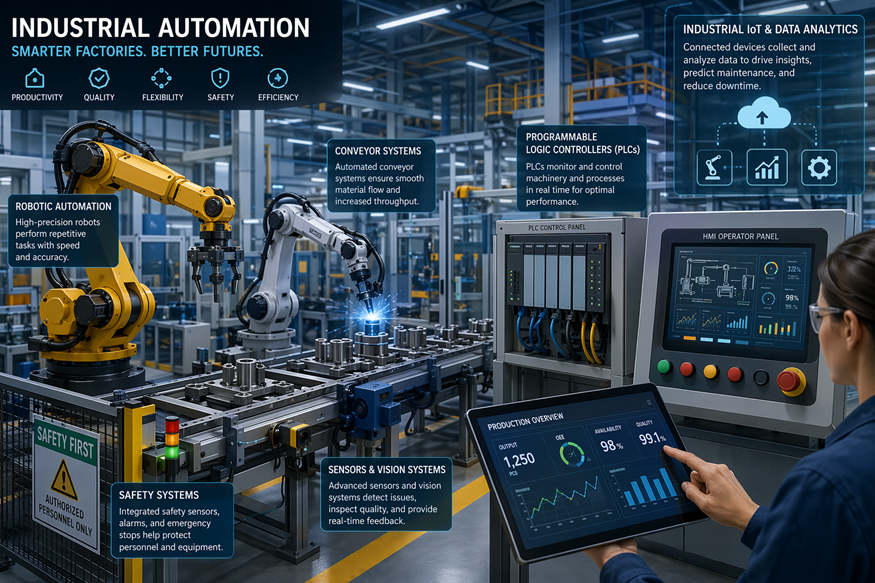
A variety of sectors in the United States are increasingly embracing solutions to enhance operational efficiency. The manufacturing industry, particularly automotive manufacturing, has seen a significant shift, utilizing industrial robots and programmable automation for assembly lines. Sectors like consumer goods, pharmaceuticals, and food processing also leverage technology, streamlining production processes while ensuring product quality. These industries benefit from enhanced data analysis capabilities and improved cycle times, meeting market demands while reducing labor costs and boosting overall productivity.
Use Cases in Automotive, Food Processing, and Pharmaceuticals
In automotive manufacturing, automated systems often power welding, painting, part installation, and material movement. These tasks are ideal for robotic systems because they repeat frequently and require precision. The result is stronger consistency and better operational efficiency across large assembly lines.
Food processing uses automation in a different way. Plants often rely on computerized control systems and sensors for mixing, filling, capping, and packaging. This helps facilities process high volumes while keeping output uniform and reducing waste during fast-moving production runs.
Pharmaceuticals often need a flexible automation system that can support changing product requirements and controlled workflows. Because quality, consistency, and clean handling matter so much, it helps maintain repeatable performance. For companies in these sectors, the shared benefit is clear: more reliable production with fewer avoidable disruptions.
Leading Providers and Services in Industrial Automation
Choosing the right partner matters almost as much as choosing the right industrial automation system. Automation solution providers help companies plan, build, connect, and support the technologies used across production environments.
Their value often goes beyond equipment. Many firms also provide automation services such as engineering support, deployment, upgrades, and system integration. Some specialize in software and workflow tools, while others focus on hardware and controls. Next, we will look at examples of providers in the US market and the services companies typically offer.
Top Industrial Automation Solution Providers in the US
In the US market, companies often look for providers that can help them respond to changing market demands, improve efficiency, and support long-term reliability. Based on the compiled information, two named examples stand out for different reasons within industrial automation.
Sure Controls is presented as a company focused on helping manufacturers identify technologies and strategies for smarter operations. HighGear is described as a workflow and business process platform that supports manufacturing automation, no-code workflow changes, reporting, and deployment support.
Here is a simple text table comparing those examples:
| Provider | Focus in industrial automation | Noted strengths |
|---|---|---|
| Sure Controls | Industrial automation support for manufacturing processes | Helps identify suitable automation solutions and production strategies |
| HighGear | Workflow automation and business process management | No-code tools, real-time reporting, training, deployment, and integrations |
Services Offered by Automation Solution Companies
Automation solution companies usually support more than equipment sales. Their services often cover planning, deployment, training, monitoring tools, and ongoing support. This helps manufacturers move from a manual setup to a connected operating model with fewer disruptions.
Integration is one of the most important services because new systems must work with existing machines, software, and workflows. Some providers also support business process mapping, reporting tools, and custom connections between platforms. In some cases, they help align automation with product design changes or shifting production needs.
Why does this matter for you? Good service can protect reliable operation after launch, not just during installation. Strong support also improves cost savings over time by reducing downtime, limiting rework, and helping your team use the system effectively as demands change.
The Role of Systems Integrators in Project Implementation
Systems integrators play a practical role in turning automation plans into working operations. During implementation, they help connect machines, software, controllers, and networks so the automation system functions as one coordinated environment instead of a collection of separate parts.
This work is important because many facilities already have existing equipment on the production line. New tools must fit those conditions, communicate properly, and support the way the plant actually runs. That is where system integration becomes essential. It reduces compatibility issues and helps avoid costly delays.
For your project, systems integrators can also support testing, setup, and adjustments during rollout. Their goal is not just to install hardware. It is to make sure the full system works reliably in real production conditions. That support is often key to smoother adoption and better long-term performance.
Planning and Implementing an Automation Project
A successful project starts with careful planning, not rushed buying decisions. You need to look at where your facility struggles today, whether that is downtime, quality issues, labor shortages, safety risks, or limits on output. From there, it becomes easier to identify the specific tasks that automation should handle first. That step keeps the project practical and tied to measurable business needs.
Cost matters too. The initial investment for machinery, software, training, and infrastructure can be high, so companies should compare that cost against expected gains such as lower operational costs, reduced scrap, fewer shutdowns, and higher throughput. Good planning also includes workforce training, integration needs, and long-term maintenance. These factors shape whether automation delivers stable results after launch.
Factors to Consider When Automating an Industrial Facility
Several crucial aspects influence the decision to automate an industrial facility. First, understanding the specific needs of the production processes is essential, as different tasks may require tailored solutions. Next, considering the initial investment versus potential cost savings in labor and operational efficiency can guide decision-making. Additionally, evaluating the role of human operators and ensuring suitable systems, such as programmable logic controllers, are integrated will enhance reliability. Lastly, assessing the benefits of automation on product quality and safety in hazardous environments is key.
Conclusion
In conclusion, exploring industrial automation solutions reveals a transformative potential for manufacturing companies. By integrating innovative technologies such as robotics, AI, and IoT, businesses can enhance efficiency, reduce costs, and improve overall productivity. Understanding the key components and applications of these solutions is crucial for any organization looking to thrive in today's competitive landscape. As you embark on or progress through your automation journey, consider partnering with leading providers who can guide you in implementing the right strategies tailored to your specific needs. If you're ready to take the next step, don't hesitate to reach out for a consultation to discover how these innovations can elevate your operations.
Frequently Asked Questions
How can a company choose the right industrial automation solution provider?
Start with your specific needs, such as quality issues, downtime, batch production, or integration challenges. A strong automation solution provider should understand your system goals, support implementation, and help you adapt to market demands. The best selection process compares technical fit, service capability, and long-term support.
What are the key benefits of deploying industrial automation solutions in factories?
Automation solutions help factories improve operational efficiency by reducing repetitive tasks, minimizing errors, and increasing throughput. They also support cost savings through lower waste, fewer shutdowns, and reduced labor pressure. Another major benefit is stronger product quality, since automated systems produce more consistent results over time.
What does an industrial automation company do?
An industrial automation company helps businesses automate industrial processes using connected hardware, software, and controls. Its work may include planning, implementation, training, integration, and other automation services. In simple terms, it helps make a production line faster, safer, and easier to manage with less manual effort.
You might also like