Industry 4.0 In Manufacturing
Industry 4.0 In Manufacturing
Key Highlights
The dawn of a new era in manufacturing is upon us, known as Industry 4.0. This revolutionary phase promises to transform how we produce goods and services by harnessing cutting-edge technologies and data-driven strategies. As manufacturers face increasing demands for efficiency and innovation, understanding the core principles of Industry 4.0 becomes essential for survival in today's competitive landscape. From smart factories powered by the Industrial Internet of Things (IIoT) to the integration of artificial intelligence and robotics, this blog will guide you through the key concepts, technological advancements, and practical steps needed to embrace this fourth industrial revolution. Whether you're a seasoned professional or just starting to explore these innovations, it's time to dive into what makes Industry 4.0 a game-changer for manufacturing as we know it.
Introduction
Industry 4.0 is changing how manufacturers design, build, and deliver products. It is the latest stage of the industrial revolution, powered by digital technologies that connect machines, systems, and people. Instead of relying only on fixed automation, companies now use data, software, and smart equipment to improve speed, quality, and flexibility. If you want to understand where manufacturing is headed, industry 4.0 gives you a clear view of what modern production looks like and why it matters.
Understanding Industry 4.0 in Manufacturing
Industry 4.0 is the integration of intelligent digital technologies into the manufacturing process. In simple terms, it means factories, equipment, and business systems work together through connected data. It supports smarter decisions, faster responses, and better visibility across operations.
Unlike earlier stages of the industrial revolution that focused on mass production or basic automation, industry 4.0 connects the full manufacturing process in real time. To see that difference clearly, it helps to look at the full definition of industry change across each era.
The evolution of industrial revolutions
The first industrial revolution began in Britain in the late 18th century. It shifted production away from hand labor by using water power and steam power instead of relying only on animal power and human effort. That change helped factories produce goods on a much larger scale.
Next came the second industrial revolution about a century later. This phase introduced assembly lines, oil, gas, and electric power. Those advancements of industry made mass production faster and more consistent, while early communications tools helped businesses coordinate work better.
The third industrial revolution started around the middle of the 20th century and continued into the late 20th century with computers, telecommunications, and data analysis. The fourth industrial revolution builds on that foundation with digital technologies, smart machines, connected systems, and broader automation across the value chain.
What sets Industry 4.0 apart from earlier phases
Earlier industrial phases improved production by adding power, machinery, and later computers. Industry 4.0 goes further because it connects physical equipment with software, sensors, and business systems. That digital transformation creates a much wider view of what is happening at every stage.
One key difference is the degree of automation. Instead of machines doing isolated tasks, connected equipment can share information in real time. With the industrial internet of things, factories can monitor performance, detect issues faster, and support minimal human intervention in some activities.
Another change is scope. Industry 4.0 is not limited to one machine or one line. It can connect the entire supply chain, from production assets to logistics and service systems. That is why autonomous systems and data-driven decisions now play a much bigger role in manufacturing.
Key Concepts of the Fourth Industrial Revolution
The fourth industrial revolution is the move toward connected, intelligent, and highly responsive industrial operations. It combines the internet of things, automation, analytics, and software to improve how factories run. At its core, it supports smart manufacturing through better visibility and faster action.
A major part of this digital transformation is the digital twin, which creates a virtual view of equipment, processes, or supply chains using live data. To understand these ideas better, it helps to break them into the practical concepts manufacturers use every day.
Defining smart manufacturing
Smart manufacturing means using connected technologies and data to improve how products are made. It moves beyond traditional mass production by making systems more aware, flexible, and responsive. Instead of treating each machine like a separate tool, it links operations into one informed environment.
This idea grew from earlier factory automation, including programmable logic controllers that helped control machinery and collect information. Those systems started the digital shift, but today manufacturers can connect that information across the full manufacturing process for better coordination and faster decisions.
Cloud computing strengthens smart manufacturing by making it easier to store, process, and share large amounts of data. That connection supports production, engineering, supply chain activity, and service functions. As a result, companies can improve quality, reduce manual work, and respond more quickly to changing needs.
The role of digital transformation
Digital transformation is the process of weaving digital technologies into the way a manufacturer works. It is not just about adding new tools. It changes how data moves, how teams make decisions, and how industrial operations connect from the factory floor to enterprise systems.
In manufacturing, this shift links production with business processes such as planning, supply chain activity, sales, warehousing, and customer service. When previously separate information comes together, companies gain more visibility and can act with greater speed and confidence.
That is why digital transformation matters so much in Industry 4.0. It supports smarter workflows, stronger coordination, and better use of information. Once this foundation is in place, the technologies behind Industry 4.0 become much more effective across everyday operations.
Core Technologies Powering Industry 4.0
Industry 4.0 depends on a group of connected digital technologies rather than one single invention. The most important include the industrial internet of things, artificial intelligence, robotics, cloud platforms, cybersecurity, and digital twin systems. Each one adds value, but their combined use creates the biggest impact.
What makes these tools powerful is their ability to collect, share, and act on big data. The next sections explain how each technology supports smarter, faster, and more flexible manufacturing.
Industrial Internet of Things (IIoT)
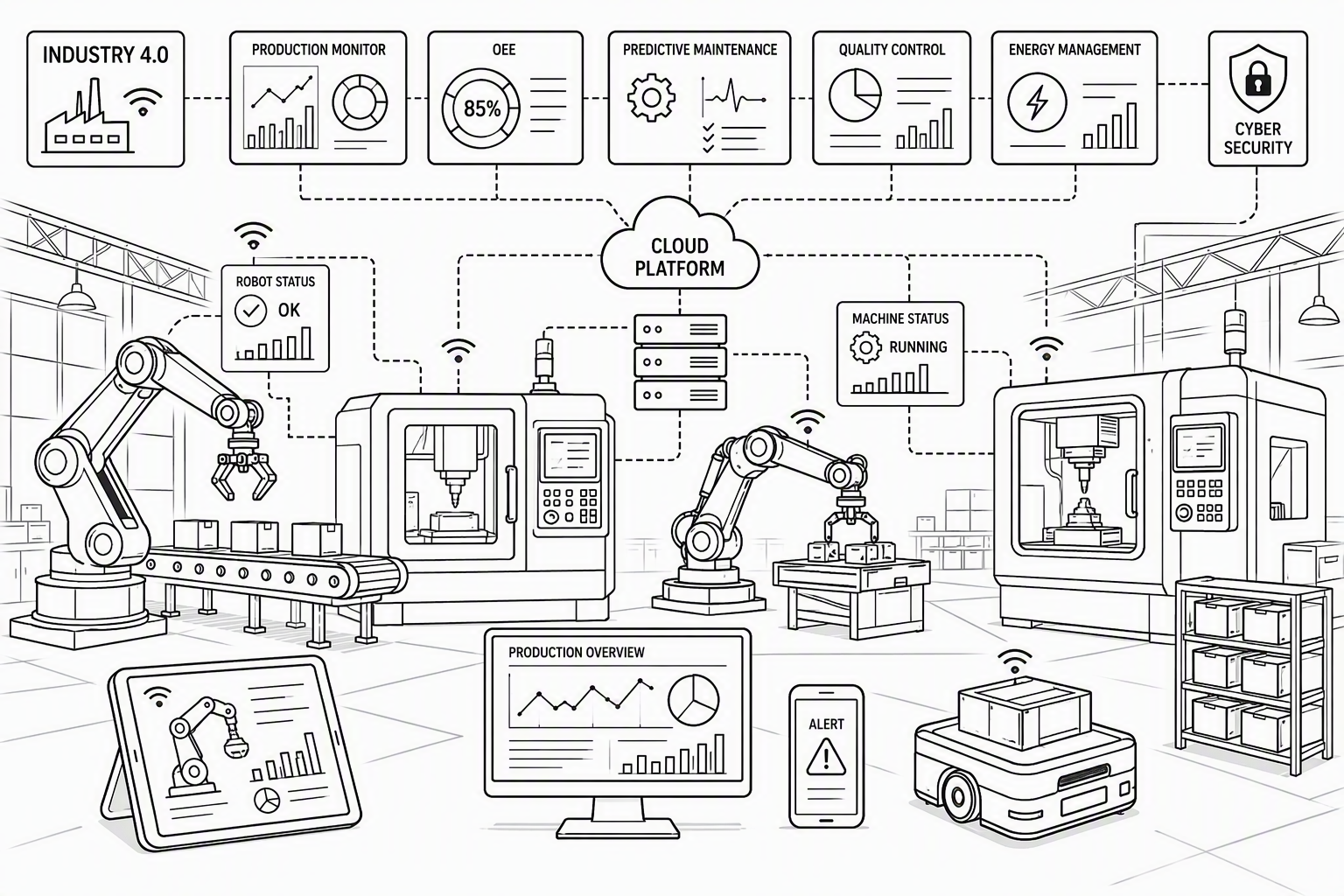
The industrial internet of things is one of the main building blocks of Industry 4.0. It uses connected machines, devices, and equipment to capture and exchange information. In manufacturing, this means assets on the factory floor can communicate their status, output, or condition without waiting for manual checks.
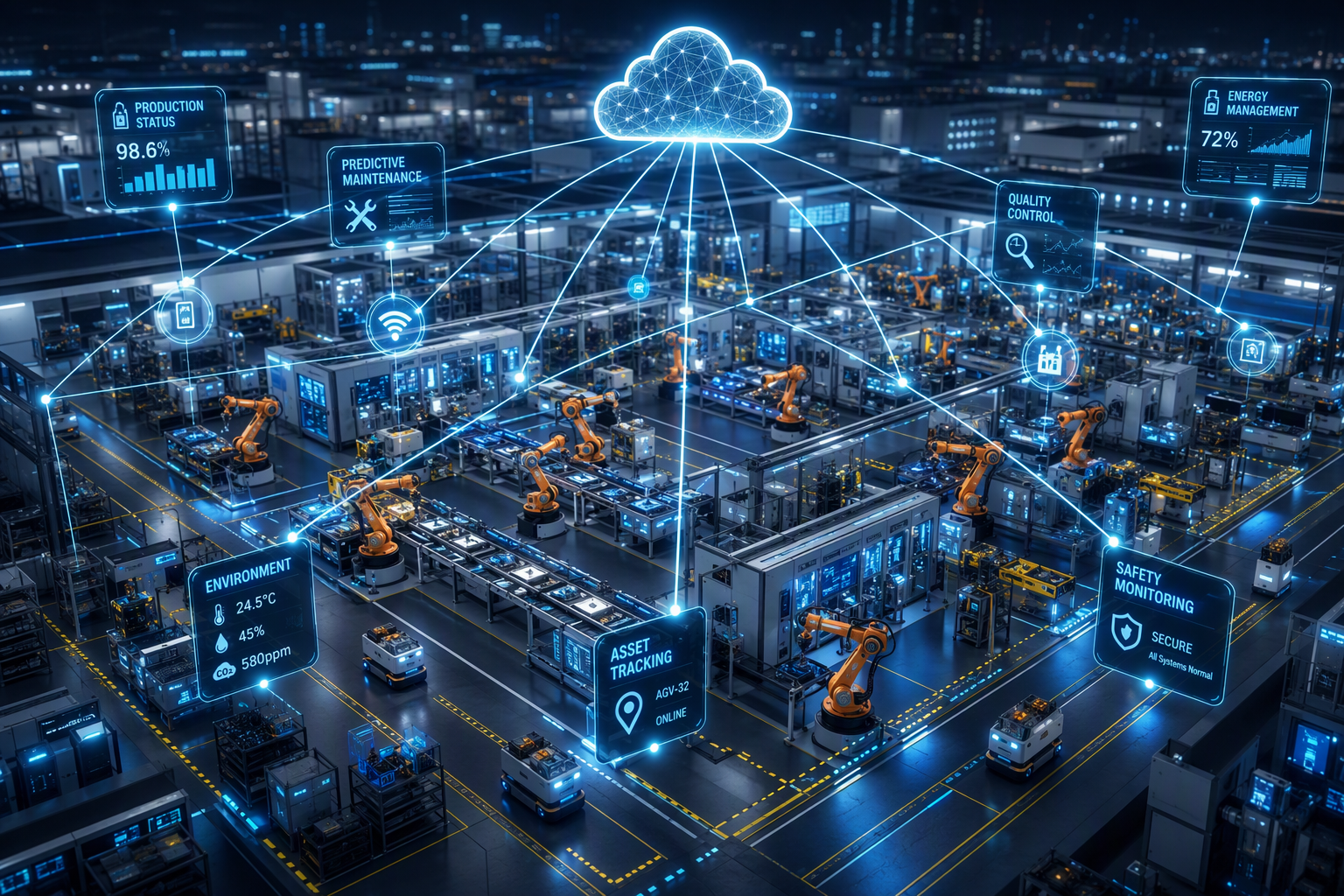
The internet of things becomes especially useful when iot sensors are added to machines and products. These sensors create real time visibility into performance, location, and quality. That helps companies detect issues earlier, improve scheduling, and support faster responses to changing production needs.
IIoT also reaches beyond the factory. It strengthens a connected supply chain by sharing useful information with suppliers, logistics partners, and other business systems. When equipment and materials are more visible, planning becomes easier and waste can be reduced across operations.
Artificial intelligence and machine learning applications
Artificial intelligence helps manufacturers turn large amounts of information into useful action. It can review patterns, detect unusual behavior, and support better choices across operations. In Industry 4.0, AI is valuable because factories generate more data than people can review quickly on their own.
Machine learning takes this further by learning from past and current data. A common use is predictive maintenance, where systems study machine behavior to identify likely failures before they happen. That improves uptime and helps teams address problems before they interrupt production.
Big data analytics and cloud computing
Manufacturers collect big data from machines, sensors, enterprise systems, and supply chain activity. On its own, that data does little. The value comes from data analysis, which helps companies spot trends, identify patterns, and make more informed decisions.
Big data analytics can improve planning, quality, maintenance, and resource allocation. It also creates broader visibility by combining factory data with information from sales, warehousing, suppliers, and service teams. That breaks down silos and gives decision-makers a fuller picture of operations.
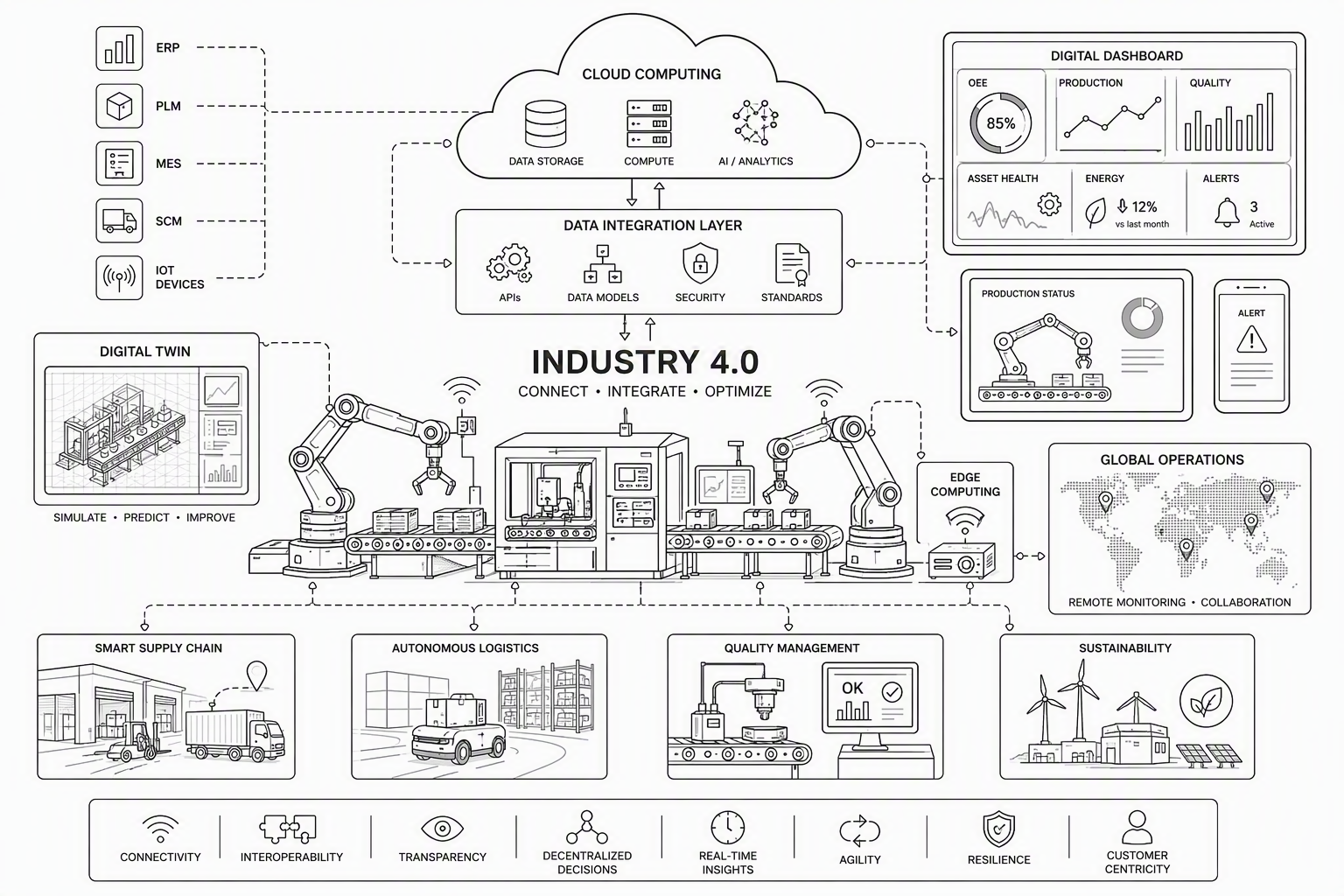
Cloud computing makes this possible at scale. It supports storage, processing, and integration across engineering, production, distribution, and service functions. The compiled information also points to broad industry discussion shaped by leaders such as the executive chairman of the world economic forum, showing how data and cloud are central to modern industrial strategy.
Robotics and automation in manufacturing
Robotics and automation have long been part of manufacturing, but Industry 4.0 makes them smarter and more connected. Instead of performing fixed, isolated actions, machines can now work with live data, software, and sensors to adjust to changing conditions faster.
This matters on the assembly line and across wider production facilities. Connected robotics can support repetitive, delicate, or high-speed tasks while reducing errors. In some settings, advanced systems can operate with minimal human intervention, especially when paired with strong monitoring and control tools.
These changes also support agile manufacturing. When production systems can respond more quickly to demand shifts or process updates, companies gain flexibility without losing efficiency. That makes automation a key part of how Industry 4.0 transforms production processes.
Cybersecurity considerations for smart factories
As factories become more connected, cybersecurity becomes more important. Smart manufacturing depends on machines, software, sensors, and networks working together. That same connectivity creates new openings that bad actors may try to exploit.
Manufacturers did not always give cybersecurity enough attention, especially on operational equipment. But digital transformation links information technology and operational technology more closely, so companies need protection across both. Without it, malicious attacks or malware can disrupt production and expose critical systems.
A strong approach includes prevention, monitoring, and threat detection across connected assets and data flows. This is not an optional extra. It is a core requirement for any company that wants to adopt Industry 4.0 safely and maintain trust in its smart factory environment.
How Industry 4.0 is Transforming Manufacturing
Industry 4.0 is changing manufacturing by turning isolated systems into connected environments. Through digital transformation, companies can monitor assets, improve coordination, and respond faster to issues. This shift supports smart manufacturing that is more flexible, informed, and efficient.
It also improves production processes through real-time visibility, predictive actions, and digital twin models that simulate changes before they reach the production line. The following sections show where that impact appears most clearly.
Enhanced production efficiency and flexibility
One of the clearest benefits of Industry 4.0 is higher production efficiency. Connected systems help manufacturers see where time, materials, or equipment are being underused. With better visibility, they can improve scheduling, reduce waste, and make stronger daily decisions.
That same visibility improves resource allocation. When production facilities share timely information with planning and supply functions, companies can direct people, materials, and machine capacity where they are needed most. This leads to smoother workflows and fewer avoidable delays.
Flexibility improves as well. Industry 4.0 supports agile manufacturing by helping companies adapt to demand changes, product variation, and operational disruptions more quickly. Because data can connect the entire supply chain, manufacturers are better positioned to balance efficiency with responsiveness.
Real-time data for better decision-making
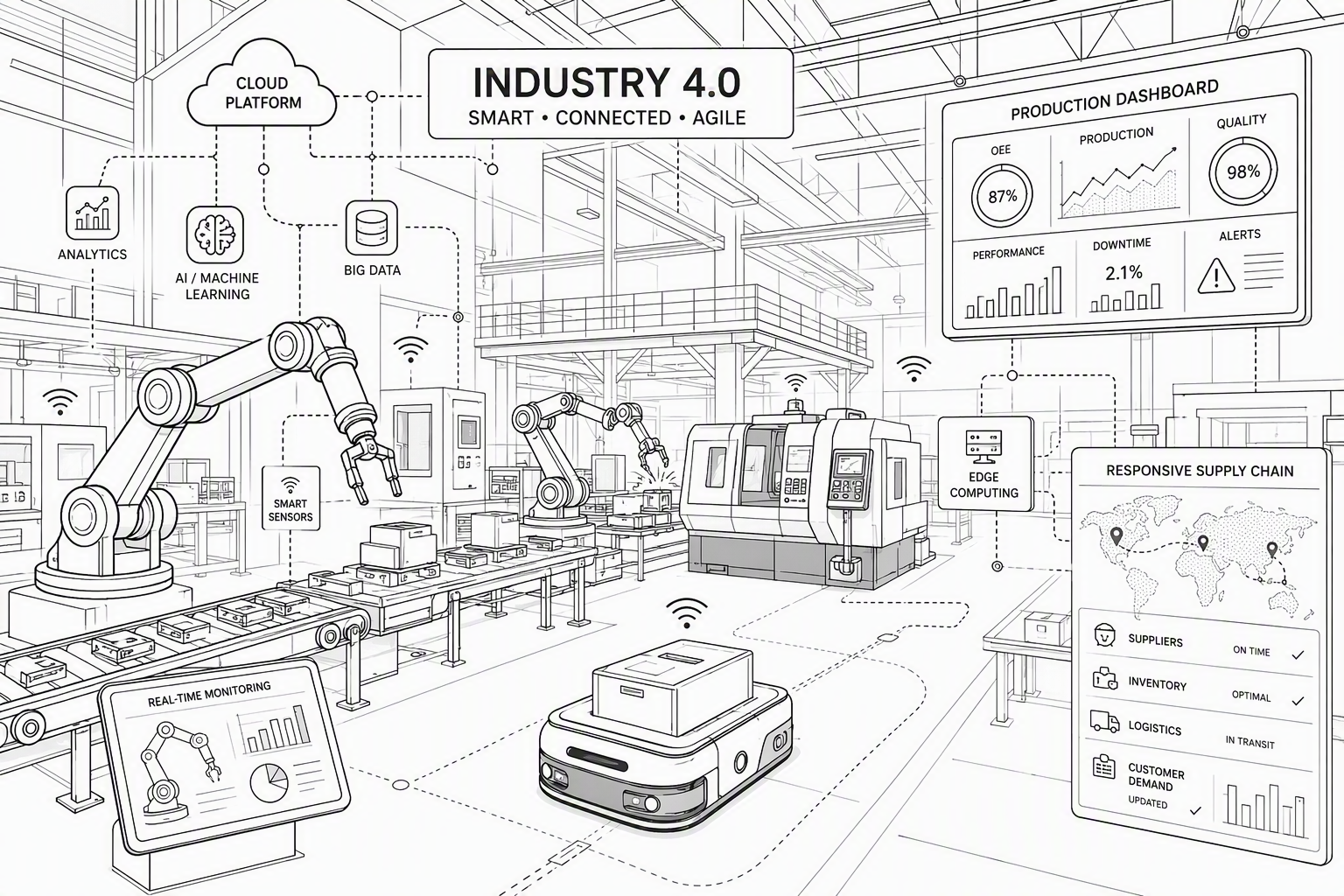
Real time information changes how manufacturers make decisions. Instead of waiting for end-of-shift reports or delayed updates, teams can see what is happening as conditions change. That creates faster reactions and more accurate responses on the shop floor.
Data analytics makes this possible by turning big data from sensors, machines, and systems into clear insights. With stronger data analysis, manufacturers can identify patterns, compare performance, and spot exceptions before they grow into bigger problems. This improves control over the manufacturing process.
If you are new to Industry 4.0, this is a good place to begin. Start by understanding how data is collected, shared, and used. Once you see how real time visibility supports decisions, the value of connected manufacturing becomes much easier to understand.
Predictive maintenance and reduced downtime
Predictive maintenance is one of the most practical examples of Industry 4.0 in action. Instead of servicing equipment only on a fixed schedule or after failure, manufacturers use data to estimate when a machine is likely to need attention.
This works by combining iot sensors, big data, and machine learning. Sensors track conditions such as performance and machine behavior. Analytics then looks for patterns that suggest wear or a rising risk of failure. That helps maintenance teams act earlier and with better timing.
The result is less production downtime and more efficient maintenance processes. Equipment stays available longer, emergency repairs become less frequent, and production interruptions can be reduced. For many manufacturers, this is one of the fastest ways to see real value from connected technology.
Beginner’s Guide to Getting Started with Industry 4.0
Getting started with industry 4.0 does not mean changing everything at once. A better approach is to understand your current state, identify priorities, and build a practical path forward. That makes digital transformation more manageable and easier to support internally.
For beginners, the smartest implementation plan starts with business needs, not hype. Once you know where digital technologies can improve performance, you can choose tools, people, and projects with more confidence.
Essential tools, equipment, and resources needed
Before you invest heavily, focus on the basic building blocks. Industry 4.0 works best when your systems can collect data, connect processes, and support useful analysis. That does not always mean replacing everything. In many cases, existing equipment can be improved with added connectivity.
Common starting resources include:
- iot sensors to capture machine and process data
- cloud computing capacity to store and process information
- enterprise resource planning systems that connect factory and business data
- network-ready equipment or gateway devices for older machines
- analytics tools that help turn raw data into useful insight
You also need people who can evaluate the current setup and guide next steps. Technology alone is not enough. The goal is to create a practical foundation where digital technologies support operations in a way your team can actually use.
Step-by-step guide to implementing Industry 4.0
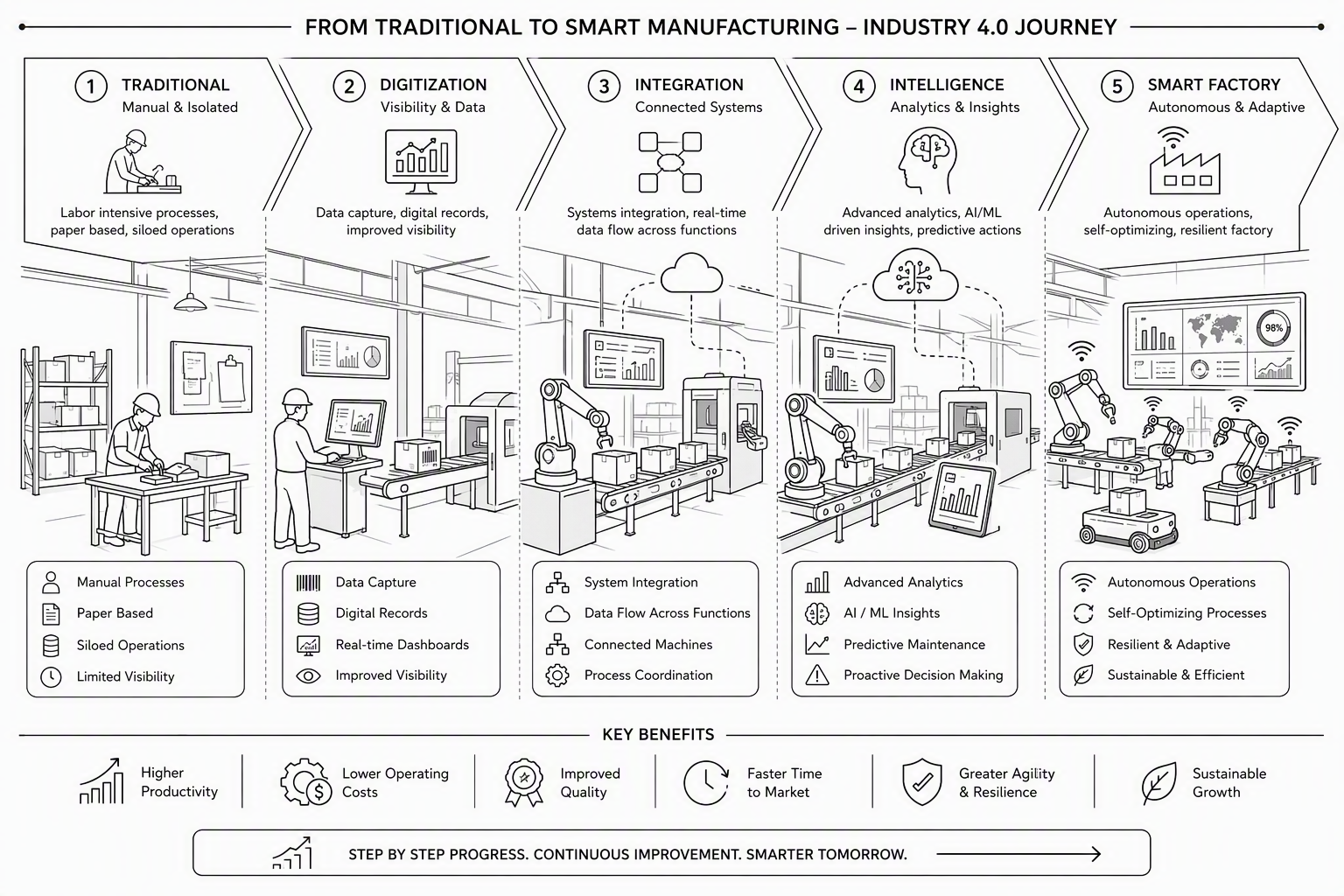
A successful implementation usually happens in stages. You do not need to transform the whole plant at once. In fact, a phased approach often works better because it lowers risk and gives teams time to learn what brings the most value.
A useful roadmap includes:
- assess the current manufacturing process and supporting systems
- prioritize the digital transformation opportunities with the clearest business value
- connect technology plans to business processes, training, and leadership support
- launch pilot projects, measure results, and expand what works
This step-by-step method also helps with common challenges such as unclear priorities, limited budgets, and integration concerns. By moving in stages, companies can build confidence, prove value, and avoid creating disruption across operations.
Step 1: Assess your current manufacturing processes
Your first step is to understand where you stand today. Review the manufacturing process, the systems that support it, and the data you already collect. This kind of audit shows what is working, where bottlenecks exist, and which areas may offer quick wins.
Look closely at industrial processes across your production facilities. Are machines connected? Is information trapped in separate systems? Are decisions delayed because data is hard to access? Questions like these help reveal where digital transformation can make a clear difference.
This stage also helps you decide whether older equipment should be retrofitted or replaced. By mapping current assets and workflows, you create a starting point for more informed choices later. Without that baseline, technology investments can easily miss the mark.
Step 2: Identify and prioritize suitable Industry 4.0 technologies
Once you understand your current operations, choose the Industry 4.0 tools that solve the most important problems first. Not every company needs the same starting point. Some may benefit most from visibility on the factory floor, while others need stronger planning or maintenance support.
That is why priorities matter. Digital technologies should match your operational goals, budget, and readiness. For example, iot sensors and the industrial internet of things may be the right first move if you need better equipment monitoring or real-time production insight.
Good prioritization also improves resource allocation. It helps you focus time, people, and money on the areas most likely to show value. Starting with a narrow, high-impact use case usually leads to a smoother rollout and clearer returns.
Step 3: Build a skilled team and develop training programs
Technology adoption works best when your people are ready for it. Industry 4.0 changes daily work, so training should be part of the plan from the start. Teams need to understand not just how new tools work, but why they matter.
A strong workforce strategy connects skills development to actual business processes. Operators, maintenance teams, planners, and managers may all need different support. Clear communication helps reduce resistance and shows how digital transformation can remove repetitive tasks and improve decision-making.
This also addresses one of the most common challenges in adoption: uncertainty. People are more likely to support change when expectations are clear and training feels practical. A skilled team gives your company a much better chance of turning new technology into real results.
Step 4: Start small with pilot projects and scale up
A small pilot is often the safest way to begin. Instead of changing every workflow at once, test digital technologies in one area where the outcome can be measured clearly. That could be one machine group, one line, or one maintenance problem.
Pilot projects give you room to learn. You can see how systems perform, how teams respond, and what adjustments are needed before expanding. This step-by-step approach reduces disruption and helps leadership judge whether the solution is worth broader investment.
Once the pilot shows value, you can scale up to other production processes with more confidence. This method keeps risk manageable and turns early success into a model for wider adoption. For many companies, that is the most practical path into Industry 4.0.
Real-World Applications and Examples
Industry 4.0 is not just a theory. Manufacturers are already using connected systems to improve maintenance, quality, planning, and coordination across production facilities. These real-world examples show how digital transformation creates measurable value when data and operations come together.
Many of the strongest results appear in smart factories, collaborative robotics, and connected supply chain activity. Let’s look at two practical examples.
Smart factories and connected supply chains
Smart factories use sensors, software, robotics, and analytics to monitor and improve production. They create real-time visibility into assets and processes, making it easier to catch defects, schedule maintenance, and improve workflows. This is one of the clearest signs of digital transformation in manufacturing.
The same connected thinking extends into supply chain management. When manufacturers share production data with suppliers and logistics partners, they can adjust deliveries, reduce waste, and react better to disruptions. A digital twin can also model a process, line, factory, or supply chain to test changes before acting.
| Area | How Industry 4.0 helps |
|---|---|
| Smart factories | Use sensors and data to improve visibility, quality, and productivity |
| Connected supply chain | Shares timely information to improve scheduling and delivery decisions |
| Digital twin | Simulates processes and systems to reduce risk before changes are made |
| Supply chain management | Connects production, inventory, and logistics for better coordination |
Collaborative robots (cobots) on assembly lines
Collaborative robots, often called cobots, are a practical example of Industry 4.0 on the factory floor. They differ from traditional industrial robots because they are designed to work alongside people rather than staying fully separated from them.
On an assembly line, cobots can support repetitive or precise tasks while human workers handle judgment, adjustments, and problem-solving. This mix of robotics and human capability can improve speed, consistency, and working conditions without removing the value of skilled employees.
Cobots also fit well into modern automation strategies because they can support flexible production. As manufacturers look for more responsive operations, collaborative robots offer a useful way to improve efficiency while keeping people involved in the process.
Challenges and Solutions in Adopting Industry 4.0
Adopting Industry 4.0 brings real advantages, but it also comes with challenges. Many companies struggle with legacy systems, skills gaps, and uncertainty about where to begin. Digital transformation is rarely just a technical project. It affects operations, people, and planning.
The biggest issues usually involve technology integration and change across business processes. The good news is that both can be managed with a clear roadmap and realistic rollout.
Overcoming technology integration obstacles
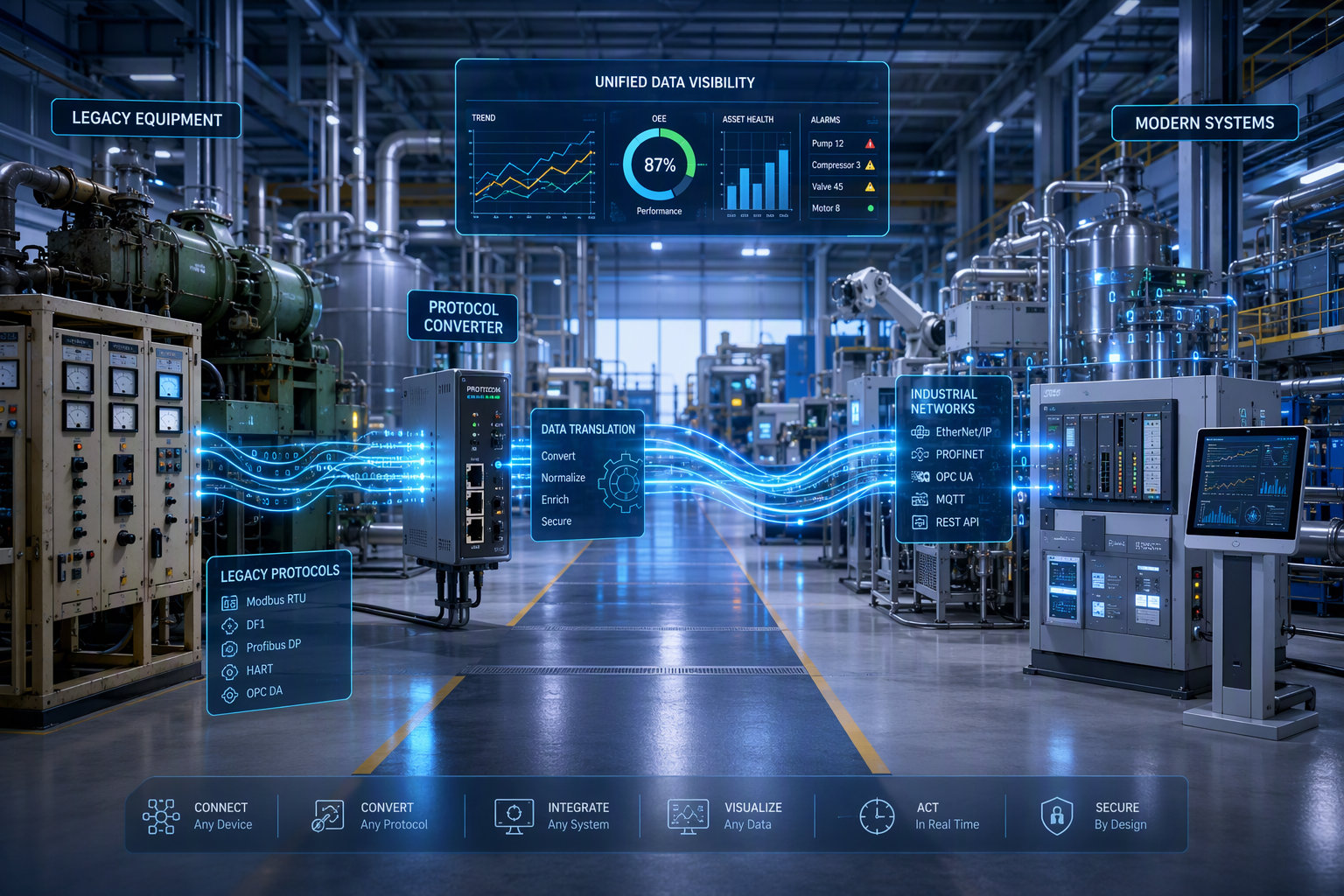
Technology integration can be difficult when older systems were not built to communicate with newer platforms. Manufacturers often have a mix of legacy machines, separate databases, and disconnected software. That makes it harder to create the unified data flow Industry 4.0 needs.
A good implementation plan starts by identifying where these gaps exist. From there, companies can decide whether to retrofit equipment, upgrade software, or improve system links. The goal is to connect digital technologies in a way that supports the business rather than adding more complexity.
It also helps to align technology integration with business processes. When systems are chosen based on real operational needs, adoption becomes more practical. Clear priorities and phased execution reduce risk and make it easier to expand over time.
Conclusion
In conclusion, Industry 4.0 represents a monumental shift in manufacturing, combining cutting-edge technologies such as the Industrial Internet of Things (IIoT), artificial intelligence, and big data analytics to create smarter, more efficient production environments. By embracing these advancements, manufacturers can enhance operational efficiency, improve decision-making through real-time data, and reduce downtime with predictive maintenance strategies. While the transition may pose challenges, the rewards of increased flexibility and productivity are undeniable. As you consider how to implement these concepts in your operations, remember that taking small steps can lead to significant transformations. If you're ready to dive deeper into this industrial revolution, get in touch for a free consultation to explore how we can assist you on this journey.
Frequently Asked Questions
Why is the Internet of Things important in Industry 4.0?
The internet of things is important because it connects machines, assets, and products through iot sensors that capture real time information. In the industrial internet of things, that data supports better monitoring, faster decisions, and tools like the digital twin, which models real operations using live inputs.
What role does artificial intelligence play in smart manufacturing?
Artificial intelligence helps smart manufacturing turn raw information into useful action. With machine learning and data analytics, manufacturers can detect patterns, improve quality checks, and support predictive maintenance. That means fewer unexpected failures, better decisions, and more efficient use of equipment and production resources.
Is Industry 4.0 just a trend or a true industrial revolution?
Industry 4.0 is a true industrial revolution because it changes how products are made, monitored, and delivered. The fourth industrial revolution combines digital transformation and connected digital technologies to reshape operations. Its long-term impact on flexibility, automation, and data use points directly to the future of industry.
What are common challenges for beginners adopting Industry 4.0?
Common challenges include unclear starting points, legacy systems, limited skills, and resistance to change. Successful digital transformation depends on careful technology integration, practical workforce adaptation, and strong change management. Starting with a focused pilot and clear priorities usually makes adoption easier and more effective.
You might also like