OPC UA vs MQTT for Plant Data Collection: How to Choose
OPC UA vs MQTT for Plant Data Collection: How to Choose

Key Highlights
- OPC UA is built for structured data exchange in industrial automation, with strong data models and built-in security mechanisms.
- MQTT uses a central mqtt broker and a lightweight publish-subscribe approach that fits the internet of things well.
- On the plant floor, OPC UA often fits machine-level integration, while MQTT shines when many systems need real time updates.
- Security is stronger out of the box with opc ua, but MQTT can still be secured well with TLS and authentication.
- Many modern architectures use both together for practical, scalable connectivity.
Introduction
In industrial automation, the OPC UA versus MQTT question comes up fast once you start connecting machines, software, and cloud tools. Both are widely used, but they solve different problems. Open platform communications through OPC UA focuses on structured, secure machine data access. The mqtt protocol focuses on lightweight message movement across many devices and applications. If you are deciding what belongs on your plant network, the right answer depends less on hype and more on how your systems actually need to communicate.
Understanding OPC UA and MQTT in Industrial Automation

At a high level, the main differences between OPC UA and MQTT in industrial automation come down to purpose, structure, and scale. OPC UA was designed for rich data exchange between industrial systems. MQTT was built as lightweight telemetry transport for moving messages efficiently through a mqtt broker.
That means OPC UA gives you more built-in context around devices and data, while MQTT gives you simpler, broader distribution. One is strong in structured machine communication. The other is strong in flexible event-driven delivery. To see where each fits, it helps to define both more clearly.
Defining OPC UA: Core Concepts and Features
OPC UA stands for Open Platform Communications Unified Architecture. It is an open standard developed for secure, reliable, platform-independent communication in industrial automation. In practice, it is much more than a network protocol for moving values from one point to another.
What makes the opc ua standard different is its depth. An opc ua server can expose more than tags. It can present data models, object relationships, methods, data types, and other context that helps software understand what a machine value actually means. That is valuable when you need dependable machine-to-machine or supervisory control integration.
On the shop floor, an opc ua client connects to an opc ua server and requests or subscribes to data access points in a defined structure. That rich framework is a strength, but it also explains why OPC UA usually takes more planning, more engineering time, and more care during deployment.
Defining MQTT: Core Principles and Architecture
MQTT stands for Message Queue Telemetry Transport. It was originally created for constrained communications, including oil pipelines and unreliable links. That history still matters because the mqtt protocol was built to work well where low bandwidth and high latency are real problems.
Its core architecture is simple. Devices publish messages to a mqtt broker. Other applications subscribe to the topics they care about. This publish-subscribe model means the sender does not need to know who receives the data. The broker handles routing, which keeps systems loosely coupled.
For industrial teams, that simplicity is the appeal. Message queue telemetry transport has a small code footprint, uses less resources, and can be implemented quickly. It does not define rich semantics by itself, but it is very effective when you need fast, scalable distribution of events, alarms, and mqtt data across many endpoints.
The Role of Industrial IoT Connectivity in Modern Plants
Modern plants are no longer just PLCs and HMIs on one isolated line. You now have historians, MES platforms, analytics tools, remote dashboards, and edge devices all asking for machine data. That shift is why industrial internet of things architecture matters in day-to-day operations.
Good connectivity supports data acquisition from controllers, sensors, and legacy equipment without adding unnecessary complexity. It also helps you move useful information to the people and systems that need it, whether that is maintenance, operations, quality, or management. In many industrial applications, you are not just collecting values. You are making them available across the business.
That becomes even more important when you need visibility into a remote asset or multiple sites. Practical industrial IoT connectivity is what turns isolated machine data into something your operation can actually use.
Comparing Communication Models: OPC UA vs MQTT
The communication model is where the difference becomes obvious. OPC UA traditionally uses a client-server approach. MQTT relies on publish-subscribe through a mqtt broker. That architectural split affects how data flow works, how many connections you manage, and how systems scale over time.
If you are asking about performance and scalability, this is the section that matters most. Client-server can work very well for direct machine access. Publish-subscribe is usually better when many producers and consumers need the same data. Here is how that plays out on the plant floor.
Client-Server Structure in OPC UA
In a classic OPC UA setup, an opc ua client connects directly to an opc ua server. The client asks for values, metadata, or events, and the server responds. This one-to-one pattern is familiar to controls engineers because it fits many machine and line integration tasks.
The strength of this server architecture is precision. An opc ua server exposes an address space that organizes tags, objects, methods, and relationships in a structured way. That makes data access more meaningful than raw register reads. The client can browse what exists and interpret it with more confidence.
Still, every direct connection adds work. As the number of systems grows, the amount of engineering and maintenance can grow with it. For a few machines and a few consumers, that may be fine. Across a large site, point-to-point connection management can become a real burden.
Publish-Subscribe Model in MQTT
MQTT works differently. Instead of one client reaching into one server, a publisher sends messages to a mqtt broker, and subscribers receive what matches their topics. This pubsub model removes the direct dependency between sender and receiver, which is why it scales so well.
That decoupling helps in busy industrial systems. A temperature sensor, edge gateway, dashboard, and analytics engine do not need custom links between each other. Message queue telemetry transport lets them exchange data through the broker with a small code footprint and minimal overhead.
MQTT also gives you quality of service choices. You can tune delivery behavior per message, depending on whether speed or certainty matters more. For plant teams, that flexibility is useful. The system can support simple monitoring, broad event distribution, and larger enterprise data sharing without redesigning every connection.
Impact on Factory Floor Data Flow and Device Integration
On the factory floor, implementation effort often decides the winner before technical theory does. OPC UA gives richer context, but MQTT is usually easier to stand up for simple event and sensor data movement. That is one reason many teams choose MQTT first for broad factory automation visibility.
Think about daily integration work. You may need to connect PLCs, historians, dashboards, cloud services, and legacy equipment with minimal downtime. In those cases, the communication model directly affects how much mapping, maintenance, and testing your team must handle.
- OPC UA is stronger when device integration needs structured data and defined relationships.
- MQTT is simpler when factory floor systems just need fast, shared data flow.
- Legacy equipment often needs a gateway no matter which protocol you choose.
- Sensor data distribution to many consumers is usually easier with MQTT.
Security Considerations in OPC UA and MQTT
Security is one of the biggest decision points in any industrial network design. OPC UA and MQTT both can be secured, but they approach security mechanisms differently. OPC UA includes more built-in features for encryption, authentication, and broader session handling.
MQTT depends more heavily on surrounding architecture, including tls encryption and application-layer controls. That is not automatically a weakness, but it does shift more responsibility to the implementation team. For controls engineers and plant managers, the real question is not just which looks better on paper, but which will be configured correctly in your environment.
Security Mechanisms of OPC UA
OPC UA was built with security in mind. It includes integrated security mechanisms that address transport security, application security, user authentication, authorization, encryption, and data integrity. For industrial teams, that built-in approach is a major reason to use opc ua in sensitive environments.
It also protects more than raw values. Because OPC UA often carries a richer data structure, security applies to sessions, methods, objects, and the broader communication model. That matters when machines expose important operational context rather than just simple tag reads.
Still, the challenge is complexity. OPC UA can support tls encryption, certificates, and strong authentication, but those tools only help when they are implemented well. On real projects, the protocol’s depth can lead to uneven deployment quality. Strong native capability is useful, but it does not replace disciplined engineering and network design.
How MQTT Handles Encryption and Authentication
MQTT takes a different path. The mqtt protocol does not define its own complete security stack in the way OPC UA does. Instead, it leans on standard network security methods such as tls encryption, SSL, certificates, and other controls built around the broker and application layer.
That gives flexibility. A mqtt broker can be secured with encrypted transport and authentication methods that fit your infrastructure. Many teams like that because they can apply familiar IT security practices rather than learning a fully integrated protocol security model from scratch.
The tradeoff is that you must close the gaps yourself. Message queue telemetry transport is efficient, but user and application security are not fully prescribed by the base standard. If the implementation is loose, messages could be exposed as plain text or managed poorly. Good MQTT security is very achievable, but it depends heavily on architecture discipline.
Which Protocol Delivers Stronger Security for Industrial Use?
If you compare the protocols on built-in security alone, opc ua is stronger. It includes more native coverage for authentication, authorization, encryption, and integrity. MQTT can still be secure, but that security depends more on broker setup, transport controls, and application design.
The network picture also matters. MQTT publish-subscribe can reduce exposure because clients initiate outbound connections to the mqtt broker. Traditional OPC UA client-server setups may require open inbound paths to OT assets, which can increase the attack surface if the architecture is not carefully segmented.
| Security Area | OPC UA | MQTT |
|---|---|---|
| Built-in security | Strong native security mechanisms | Limited in base protocol |
| Encryption | Integrated options, often including certificates and encryption | Usually secured with TLS/SSL |
| Authentication | Defined within protocol architecture | Commonly handled by broker and application layer |
| Network exposure | Client-server may require inbound access | Often uses outbound broker connections |
| Delivery guarantees | Session behavior manages reliability | QoS levels provide delivery guarantees |
| Risk if poorly configured | Complex deployments can be misapplied | Messages may end up as plain text |
Scalability and Performance Analysis
As systems grow, protocol choice starts affecting cost, maintenance, and responsiveness. Scalability and performance are not just IT concerns. They show up in engineering hours, gateway count, and how smoothly your data acquisition strategy holds together during expansion.
OPC UA can perform well, but its traditional architecture is heavier when many systems need to talk at once. MQTT was designed for efficient telemetry transport and low bandwidth conditions, so it often scales more naturally. The details matter, especially when you are planning for many devices, sites, or software consumers.
Handling High Device Volume with OPC UA
OPC UA can support significant industrial workloads, especially where the value lies in structure rather than sheer message volume. It is well suited to device integration scenarios where machines must expose context-rich information, methods, and relationships through defined data models.
That said, large rollouts can become difficult with classic client-server patterns. Each additional system may need separate connections, configuration, and maintenance. As your site adds lines, software platforms, and vendor packages, the number of direct integrations can grow faster than expected.
For many opc ua applications, the benefit still justifies the work. If the operation depends on browsing an address space, using standardized semantics, or handling complex equipment objects, OPC UA remains very useful. It just is not the lightest path when your main goal is to push high volumes of simple updates across many endpoints.
MQTT’s Strengths in Large-Scale Data Transmission
MQTT was built for scale. Its publish-subscribe design reduces connection sprawl because producers and consumers do not need to know each other directly. A central mqtt broker becomes the message hub, which is why the protocol can support dozens to millions of devices and subscribers.
That structure works especially well for telemetry transport. If your operation needs to move lots of event updates, status changes, or sensor values, MQTT is usually easier on network and compute resources. It was made for low bandwidth conditions, and that efficiency still helps even on good plant networks.
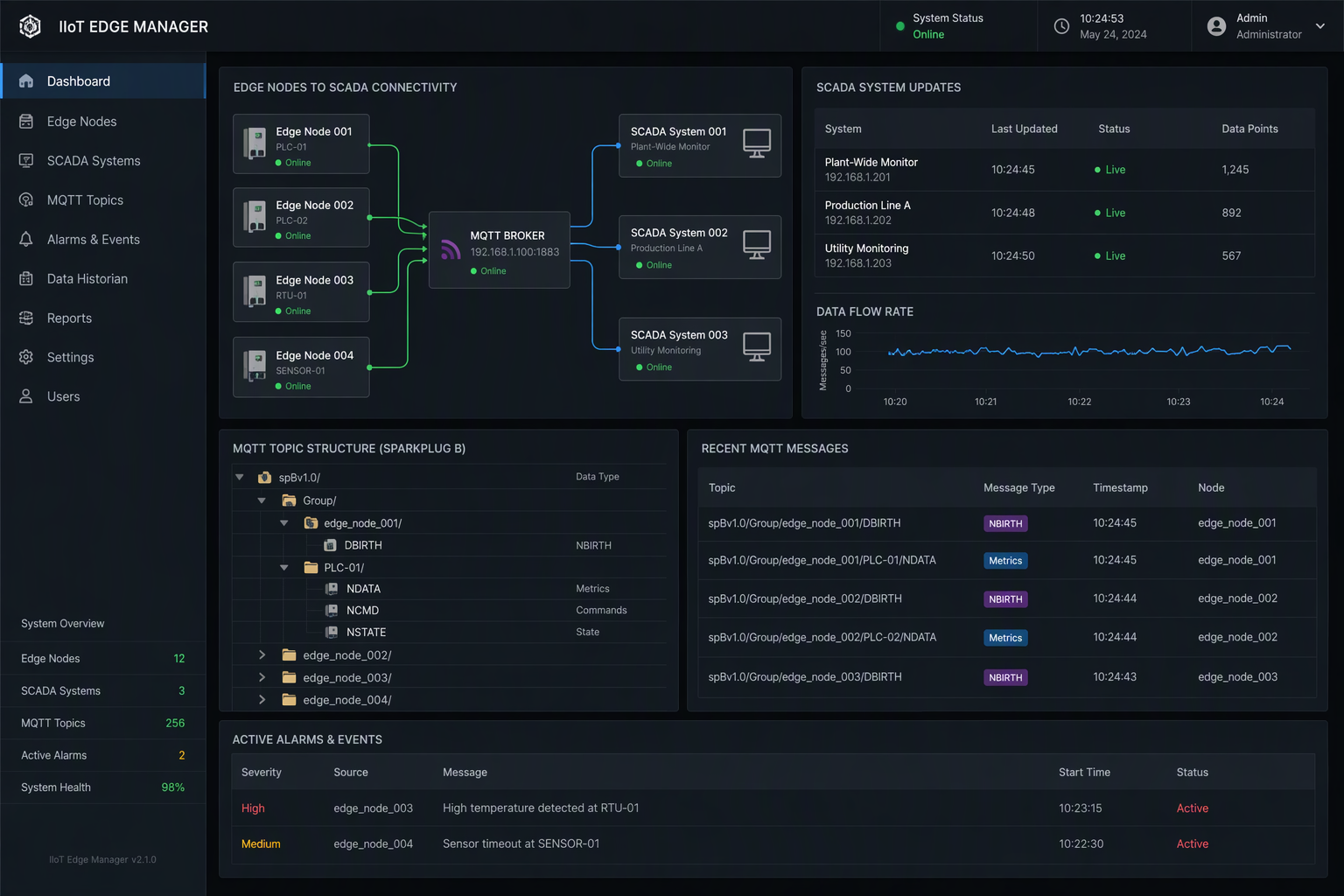
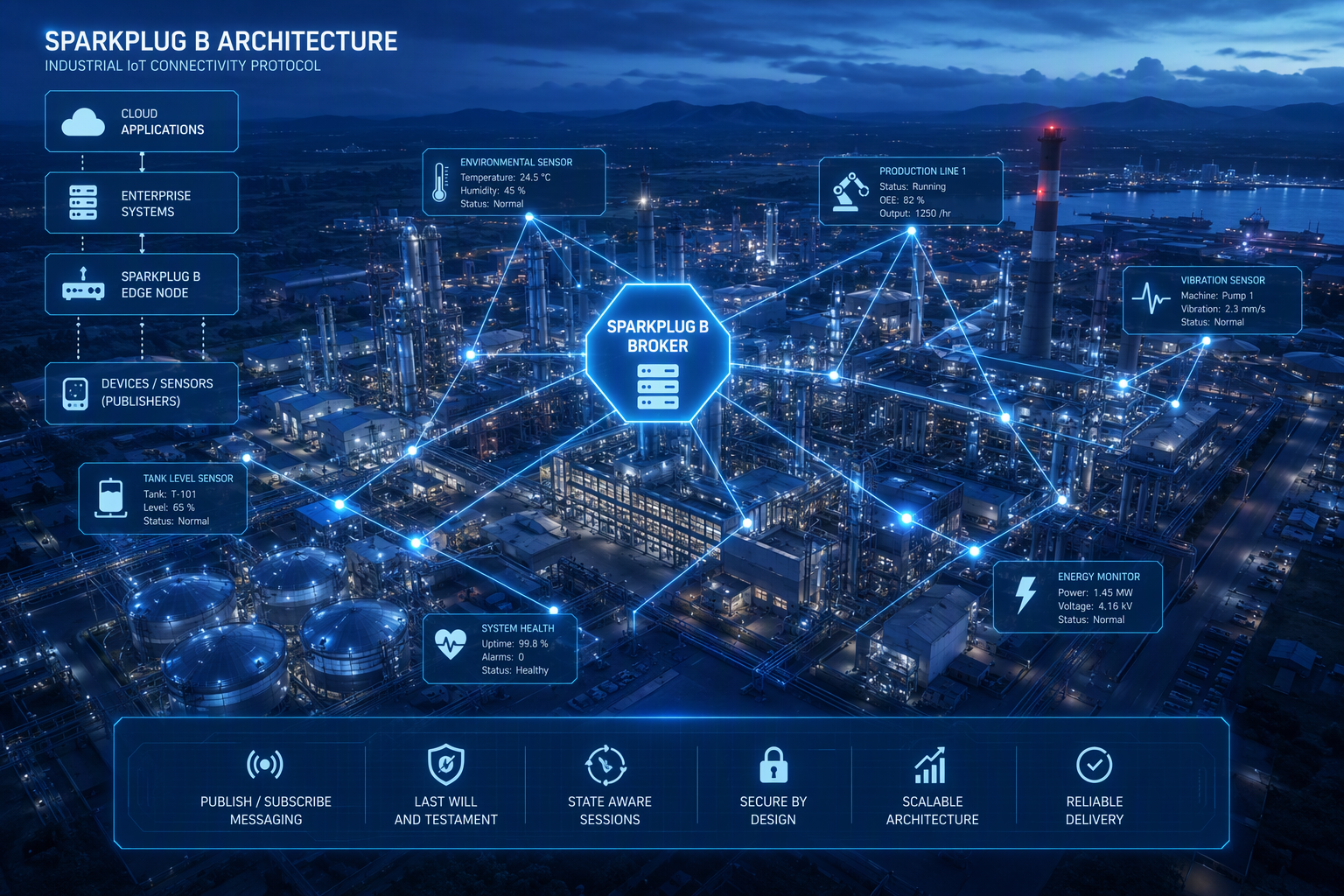
The main caution is interoperability depth. MQTT does not define every layer of meaning by itself. In SCADA and industrial systems, Sparkplug B can help close those gaps by adding more structure and consistency. That makes large-scale MQTT deployments more manageable for practical operations teams.
Latency, Bandwidth, and Performance on Diverse Plant Networks
Performance on a plant network is rarely just about raw speed. You are balancing latency, bandwidth, reliability, and maintainability. A packaging line on a stable LAN behaves differently than a remote asset over cellular or satellite links. That is where the protocol choice becomes very practical.
MQTT generally has the edge in constrained or distributed environments. OPC UA can still perform well, especially inside a local facility where richer interaction is needed. But if the network is noisy, expensive, or stretched across long distances, simpler data transmission usually wins.
- MQTT was designed for high latency and low bandwidth conditions.
- OPC UA fits best where direct, structured access matters more than message efficiency.
- Satellite links and remote locations favor lightweight publish-subscribe traffic.
- Local high-speed networks can support either option, depending on application needs.
Integration with Cloud Services and IoT Platforms
When plants connect operational data to analytics or enterprise tools, cloud fit becomes part of the protocol decision. MQTT usually has the simpler path into cloud services because many platforms are already designed to accept mqtt data directly through broker-based ingestion.
OPC UA also connects to modern architectures, but it often enters through gateways, translators, or more specialized connectors. If your priority is direct data access into broad IoT platforms, MQTT often has the advantage. If your priority is machine context and rich semantics first, OPC UA still brings value before the handoff.
OPC UA’s Compatibility with Leading Cloud Providers
OPC UA can play an important role in cloud-connected architectures, especially when your source data needs structure before it leaves the OT layer. Controllers, field devices, and gateways may expose rich machine context through opc ua, and that context can be useful for analytics, traceability, and engineering applications.
Its strength is not that every cloud platform speaks OPC UA natively in the simplest possible way. The strength is that the protocol can preserve meaning through data models and domain-specific definitions. In some cases, opc ua companion specifications help standardize how equipment types are represented.
For teams working with cloud services such as Google Cloud, OPC UA is often part of the upstream data layer rather than the final transport layer. It provides clean source data that can then be routed into broader systems through connectors, middleware, or other integration services.
Using MQTT as a Gateway for Cloud Analytics
MQTT is often the easier bridge to cloud analytics because the model fits how many IoT platforms already operate. A mqtt broker gathers events and values from machines, gateways, or edge software, then pushes mqtt data outward to dashboards, analytics engines, and enterprise applications.
That makes it a practical transport layer between OT and IT. The protocol is lightweight, event-driven, and efficient for telemetry transport, which is exactly what cloud pipelines usually want. You are not forcing every consumer to poll for updates. Data moves when something changes.
For plant teams, that means faster setup and cleaner distribution. Whether the destination is a hosted analytics stack, a reporting environment, or broader iot platforms, MQTT usually reduces friction. If you need plant data in many places at once, this model is often easier to manage than many separate direct connections.
Empowered Automation’s Approach to Streamlined IoT Connector Setup
For many manufacturers, the real challenge is not picking a protocol in isolation. It is getting useful plant data out of mixed systems without creating another integration headache. That is where a practical systems integrator matters. Empowered Automation, a Chicago-area systems integrator, focuses on making that setup usable for real operations teams.
From a plant-floor perspective, streamlined setup means fewer custom handoffs, clearer data paths, and faster deployment in remote locations or busy facilities. It also means choosing the right level of structure for the use cases you actually have, not the use cases a vendor wishes you had.
- Use purpose-built data connectors to reduce custom engineering work.
- Match the protocol to the source and destination, not to trends.
- Plan for remote locations, cloud endpoints, and plant systems together.
- Use IoT connectors where they simplify rollout and support.
Practical Implementation on the Plant Floor

On the plant floor, architecture diagrams only matter if the rollout works during production. Implementation comes down to downtime risk, available skills, existing equipment, and how quickly you need usable data. That is why ease of deployment matters so much in manufacturing environments.
In general, MQTT is easier to implement for broad message distribution, while OPC UA takes more effort but gives richer machine interaction. Neither is automatically better in all use cases. The question is what level of structure, scale, and maintainability your operation really needs.
Ease of Deploying OPC UA Solutions in Manufacturing Environments
Deploying opc ua in manufacturing environments often starts with a solid data source. Many modern devices, PLCs, and software packages already support opc ua servers, which helps. When that support exists and the information model is useful, the protocol can provide clean, structured access to machine data.
The challenge is the size of the standard. OPC UA covers far more than simple polling. Its server architecture may include browsing, methods, eventing, subscriptions, historical data access, and security layers. That breadth is valuable, but it can slow deployment when your team just needs a few production values online quickly.
So is OPC UA easy to implement? It depends. For well-supported equipment and clear internal use, deployment can be straightforward. For mixed-vendor systems or broader cross-network use, it usually takes more engineering than MQTT. The richer the feature set you need, the more planning matters.
Steps for Setting Up MQTT in Factory Automation
Setting up MQTT in factory automation is usually faster because the protocol is small and focused. You define a mqtt broker, connect publishers and subscribers, set security, and agree on how topics and payloads will be structured. That is often enough to begin moving useful mqtt data in a short time.
What takes thought is consistency. The mqtt protocol does not define your naming, payload format, or equipment model for you. If you skip that discipline early, state management and future scaling become messy. A quick pilot can turn into a long cleanup project if topics are poorly organized.
- Stand up and secure the mqtt broker.
- Connect a source device, such as a temperature sensor or gateway.
- Define topic names and payload conventions before expansion.
- Set retained messages, QoS, and failure behavior where needed.
OPC UA and MQTT: Complementary or Competitive?
This is where many teams land after working with both technologies: the answer is often not either-or. OPC UA and MQTT can compete in some projects, but in many real plants they fit different layers of the same architecture.
OPC UA is strong at the machine and supervisory side, where structured data types and semantics matter. MQTT is strong as a distribution layer through a mqtt broker, especially in a unified namespace or broader enterprise integration pattern. Used together, they can cover more ground with less compromise.
Hybrid Architectures and the Unified Namespace Trend
The unified namespace trend reflects a practical lesson from real deployments: data is more useful when it is shared once and consumed many times. In that model, MQTT often acts as the scalable distribution backbone, while other systems publish structured information into it.
That is where hybrid architectures make sense. OPC UA can serve as the source of well-organized machine information, including rich data structure and equipment meaning. MQTT can then move those updates across industrial systems without requiring every application to build its own direct connection path.
For plant teams, the benefit is not theory. It is reduced integration sprawl and clearer ownership of data types and context. You still need naming rules, governance, and design discipline, but the combined model can support both operational visibility and enterprise access more effectively than a single-layer approach.
Case Study: Maximizing Results with an Empowered Automation Integration
Consider a typical industrial automation scenario: machines expose operational values locally, while plant leadership wants real time production visibility across multiple systems. A one-protocol answer may leave gaps. Pure OPC UA can become connection-heavy. Pure MQTT can miss source-level context unless it is designed carefully.
In that kind of project, Empowered Automation can bridge the practical gap through a focused integration approach. As a Chicago-area systems integrator, the company’s value is not just technology selection. It is translating plant-floor needs into an architecture that operators, engineers, and managers can actually support.
- Pull structured source data from machine-side systems where available.
- Route selected values into scalable enterprise-facing distribution paths.
- Match protocol design to actual use cases, not blanket standards.
- Keep the integration maintainable for long-term plant ownership.
Conclusion
In conclusion, both OPC UA and MQTT present unique advantages for industrial automation, catering to different operational needs. While OPC UA excels in providing a robust framework for secure data exchange and seamless integration with cloud services, MQTT stands out for its lightweight, efficient messaging model suited for high-volume data environments. Depending on your specific requirements—such as scalability, security, or implementation ease—choosing the right protocol can significantly influence your plant’s performance. As we move toward more interconnected systems, understanding these differences becomes crucial for making informed decisions. For assistance in navigating these technologies, reach out to Empowered Automation and explore how our IoT connectors can simplify your integration process.
Frequently Asked Questions
Can MQTT fully replace OPC UA in industrial IoT applications?
Not completely. The mqtt protocol can handle many industrial iot data exchange needs, especially for scalable message movement. But opc ua still has advantages where rich semantics, machine context, and structured access matter. In many use cases, MQTT complements OPC UA rather than replacing it.
Which protocol is more future-proof for smart manufacturing?
For smart manufacturing, both have a strong future. OPC UA remains important as an open standard for structured machine communication. MQTT stands out for scalability through a mqtt broker and broad enterprise integration. The most future-proof strategy is often using each where it fits best.
How do OPC UA and MQTT compare in real-world maintenance scenarios?
In industrial settings, maintenance teams often use opc ua when they need deeper equipment context and direct access. MQTT helps when many systems need status updates, alarms, or shared machine conditions through a mqtt broker. Historical data planning matters with both, because transport alone does not create maintenance insight.
You might also like