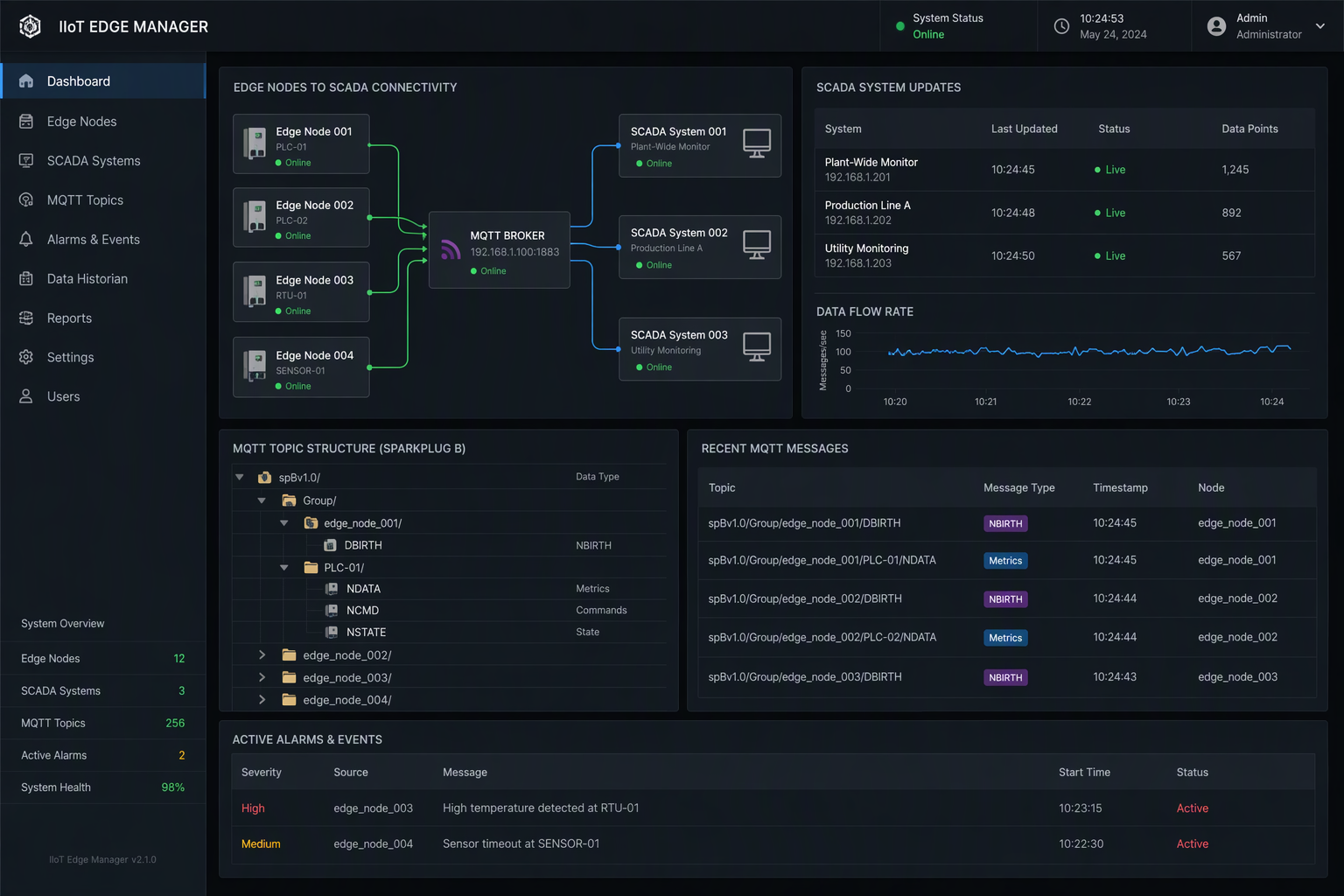
What Is Sparkplug B? A Complete Guide for Industrial IoT
What Is Sparkplug B? A Complete Guide for Industrial IoT

Key Highlights
- Sparkplug B adds structure to the mqtt protocol for industrial iot.
- It standardizes topic namespace, payload structure, and state management.
- You get birth and death messages that improve state awareness.
- It helps edge node and SCADA connections work more predictably.
- Protocol Buffers make messages compact for constrained links.
- It fits many plant applications, but unified namespace and multi-consumer needs may require careful review.
Introduction
Sparkplug B is an open standard built for industrial iot systems that use the mqtt protocol. If you work with PLCs, SCADA, HMIs, or gateways, you already know the basic problem: MQTT moves messages well, but it does not tell different vendors how to structure them. Sparkplug B fills that gap. It defines a common way to name topics, encode payloads, and manage device state so plant data is easier to trust, route, and use.
Understanding Sparkplug B in the Industrial IoT Landscape
At a practical level, Sparkplug B is a specification maintained by the Eclipse Foundation that sits on top of MQTT. It does not replace the mqtt broker or the transport layer. Instead, it tells each edge node and application how to publish data in a consistent way.
That matters in industrial environments where devices from different vendors need dependable data exchange. Sparkplug B is important because it adds structure, state awareness, and repeatable integration rules to industrial iot projects. The next sections break down how MQTT works, where Sparkplug B fits, and why that structure matters on the plant floor.
Overview of MQTT Protocol and Its Role in IIoT
The mqtt protocol is a lightweight publish-subscribe method for moving data between systems. In IIoT, devices publish messages, and applications subscribe to the topics they need. An mqtt server, also called a broker, sits in the middle and handles message routing.
That simplicity is one reason MQTT is common in control systems and remote assets. It can move data exchange traffic efficiently, even when networks are limited. You can connect edge devices, gateways, SCADA software, and analytics tools without forcing every system into a direct point-to-point link.
Still, MQTT leaves the mqtt topic namespace and payload format open by design. One machine builder may publish plain text JSON on one topic. Another may use a custom binary data format somewhere else. Sparkplug B relates to MQTT by defining those missing rules for industrial communication.
Sparkplug B’s Relationship with MQTT Explained
Think of mqtt sparkplug b as a layer of industrial rules on top of standard MQTT 3.1.1. The sparkplug b specification keeps MQTT’s publish-subscribe transport, but it standardizes the mqtt topic namespace, message types, and payload format so systems can understand each other more easily.
It also defines how messages are encoded. Instead of plain text payloads, Sparkplug B uses Protocol Buffers. That gives you a compact binary format, typed metrics, and more efficient message delivery, which helps when bandwidth is limited or many devices are publishing at once.
For plant teams, the big point is simple. MQTT is the transport. Sparkplug B is the structure. If MQTT gets data from A to B, Sparkplug B helps B know what the data means, whether the sender is alive, and how to process it with fewer custom mappings.
Why Sparkplug B Matters for Today’s Industrial Data Connectivity
On the plant floor, most connectivity problems are not transport problems. They are interpretation problems. A sensor value arrives, but nobody knows the agreed data type, tag context, state, or ownership. Sparkplug B helps by creating a standardized framework for industrial data communication across different vendors.
That structure reduces one-off integration work. A SCADA system, edge gateway, or host application can subscribe to known message types and topic patterns instead of reverse-engineering each device. In many projects, that becomes the practical source of truth for live operational data.
Why does that matter day to day?
- It improves consistency when multiple machine builders publish data.
- It reduces custom parsing and hand-built mapping logic.
- It gives operations teams clearer state information for alarms and recovery.
Key Concepts and Components of Sparkplug B

Sparkplug B defines a clear architecture for how data moves from devices to applications. The main pieces are the mqtt broker, the edge node at the edge of network, connected devices, and a primary application that monitors system state. That structure gives device integration a common pattern.
Just as important, Sparkplug B defines how the topic path, payload format, and group id are used. These rules help organize data in a consistent way, even if your broader unified namespace strategy has different needs. The following sections cover the publish-subscribe model, system roles, and data organization in more detail.
Why Sparkplug B Matters for Today’s Industrial Data Connectivity
The publish-subscribe model separates senders from receivers. An edge device or gateway publishes data to an mqtt broker, and any approved subscriber can receive it without a hardwired connection to the source. That is a strong fit for changing plant architectures.
In industrial iot, this matters most at the edge of network. A single edge node can collect signals from multiple industrial devices, package them, and publish them once. SCADA, historians, or monitoring tools can then subscribe without each system polling the same source.
Sparkplug B improves this familiar model by adding state awareness and tighter rules around message meaning. It is not only about moving values. It is about telling subscribers whether the node is online, what metrics exist, what their data quality is, and whether a full rebirth is needed after a break.
Core Elements: Edge Nodes, Devices, and Primary Application
A Sparkplug system has a few core roles. The edge node is usually a gateway, IPC, or PLC-side component that gathers data and publishes it upstream. Beneath it, devices represent the actual field assets, such as sensors or actuators, each with its own device id.
Then you have the primary application. This host monitors birth, death, and state messages and acts as the main coordinator for lifecycle behavior. In SCADA-style systems, that role is central because it helps maintain a dependable view of what is connected and valid.
Here is the simple breakdown:
- Edge node: publishes data and lifecycle messages using a node id.
- Device: physical asset under the node, identified by device id and device type.
- Primary application: watches health, sequence, and re-synchronization.
Unified Namespace: Organizing Industrial Data Efficiently
Many teams ask whether Sparkplug B is the same thing as a unified namespace. It is not. A unified namespace is a broader architectural pattern for making plant data available as a shared source of truth across many consumers and business layers.
Sparkplug B supports organized industrial data through a strict sparkplug b topic namespace and standard data format. That can work well in n:1 SCADA integration, where one central host benefits from fixed topic structures and lifecycle control.
At the same time, the compiled guidance makes a practical distinction. Sparkplug B’s fixed hierarchy and primary host concept can become limiting in some unified namespace designs, especially when many independent consumers need flexible topic structures, retained current values, or ISA-95-style depth.
The Sparkplug B Specification Essentials
The sparkplug b specification defines three essentials that controls engineers care about right away: a standard topic namespace, a defined payload structure, and a fixed set of message type behaviors. Those pieces work together to improve data integrity and reduce custom interpretation.
It also formalizes lifecycle messaging through birth certificate and death certificate events for nodes and devices. That is a big reason Sparkplug B is useful in SCADA modernization. Next, let’s look at payload design, topic structure, and the standard messages you will see in a working system.
Payload Structure: Format, Encoding, and Design Principles
Sparkplug B handles payload structures in MQTT by using Google Protocol Buffers. Instead of plain text, it encodes each message in a compact binary format. That keeps payload size down and gives subscribers a reliable way to read values, timestamps, metadata, and state information.
Each payload structure contains an array of metrics. Those metrics include names or aliases, values, timestamps, and defined data types. Sparkplug B supports a wide set of types, from numbers and strings to more complex structures, which makes it practical for real plant data.
A few design principles stand out:
- Use Protocol Buffers for efficient, typed transport.
- Send full metric definitions in birth messages first.
- Use aliases later to reduce repeated metric name overhead.
Topic Namespace: How Sparkplug B Structures Data Communication
Sparkplug B defines a strict topic namespace pattern: spBv1.0/group_id/message_type/edge_node_id/[device_id]. That format tells subscribers exactly what kind of message they are receiving and where it came from. For plant applications, that reduces guesswork and simplifies subscriptions.
Each part has a job. The group id creates a logical grouping, such as a site or functional area. The message type identifies whether the message is NBIRTH, DDATA, NCMD, or something else. The edge node id points to the publishing node, with device_id used when a specific device is involved.
This sparkplug b topic namespace is one of the main features of the specification. It enables predictable routing, clearer filtering, and easier onboarding of new equipment. The tradeoff is rigidity. If your architecture needs deeper hierarchies or more flexible topic modeling, you may feel those limits quickly.
Standard Message Types: Birth, Death, Data, and Command Messages
Sparkplug B standardizes the message types you will see in operation. That includes node and device birth certificate messages, death certificate notifications, data messages, command messages, and state messages from the host. Because each type has a fixed purpose, subscribers can respond more consistently.
The nbirth message and dbirth message announce presence and publish metric definitions. NDEATH and DDEATH show that a node or device has gone away. NDATA and DDATA carry live values. NCMD and DCMD send commands. STATE tells the system whether the host is available.
State Management and Data Reliability
For many plant teams, state management is the real reason to use Sparkplug B. Plain MQTT can move device data, but it does not standardize how systems report startup, shutdown, or failure. Sparkplug B adds that missing state awareness.
It uses birth and death messaging, sequence handling, and MQTT last will behavior to improve data reliability and give subscribers clearer state information. That helps SCADA and supervisory applications know whether incoming values are current, stale, or missing because a node dropped offline. Here is how that lifecycle works in practice.
Managing Device and Application State in Real-Time
Sparkplug B improves communication between PLCs and SCADA systems because it standardizes state information, not just values. When an edge node or device connects, it publishes a birth certificate containing available metrics, types, aliases, and initial values. The subscriber immediately knows what exists and what is valid.
If a disconnect happens, the system publishes a death certificate. That tells the host and other subscribers that the device data should no longer be treated as live. You are not left guessing whether the value is frozen, stale, or simply unchanged.
This state awareness is especially useful in real-time operations. A SCADA application can alarm on loss of a node, trigger failover steps, or request rebirth when sequence issues appear. That is far more deterministic than building custom status logic on top of plain MQTT topics.
The Lifecycle of Sparkplug B Devices in IIoT Systems
A Sparkplug B device lifecycle starts with connection to the broker. The node sends birth messages, and attached devices may send their own birth messages as well. These messages define metrics and establish a known starting point for device integration.
During normal operation, the node or device sends data updates. If the session ends cleanly, death messages tell subscribers the device id or node has left the system. If the connection drops unexpectedly, the broker can publish the prepared death notice through last will handling.
There is also host-level supervision through state messages. The primary host application publishes its own state so edge nodes know whether the main consumer is available. In some deployments, this affects node behavior and synchronization. For controls engineers, that means less ambiguity during restarts, failures, and reconnects.
Fault Tolerance and Ensuring Reliable Plant Communication
No messaging standard makes a plant network perfect, but Sparkplug B adds tools that improve fault handling. Sequence counters help detect breaks in message delivery. The bdSeq value helps stop an old death notice from being applied to a new session. That protects data integrity during reconnect events.
There are limits, and you should know them. Operational Sparkplug messages use QoS 0, so individual updates can still be lost. The design goal is consistent overall state, not guaranteed delivery of every single metric change. In many plant communication scenarios, that is acceptable. In some, it is not.
What helps in practice?
- Standardized death handling through last will.
- Sequence checks for re-sync and rebirth control.
- Clearer failure detection for higher availability operations.
Comparing Sparkplug B with Plain MQTT
Sparkplug B and plain mqtt use the same transport, but they solve different problems. Plain mqtt focuses on message movement. Sparkplug B adds a standardized format for topics, payloads, and lifecycle behavior. That is why it often improves interoperability in plant applications.
The tradeoff is complexity and rigidity. You get stronger structure, but you also accept Protocol Buffers, fixed topic rules, and the primary host model. The next sections compare integration effort, vendor consistency, and where Sparkplug B helps or hurts in daily operations.
Differences in Data Handling and Integration
With plain mqtt, every project decides its own data format, topic naming, and status logic. That flexibility can be useful, but it also creates more custom work. One vendor may publish JSON. Another may send plain text or a private binary structure. Integration becomes project-specific.
Sparkplug B reduces that variation. A sparkplug b payload has known message types, typed metrics, and expected lifecycle behavior. That helps industrial applications connect new assets faster because the receiving side already knows how to interpret birth, data, and death events.
Still, legacy devices may need an edge gateway or custom mapping before they fit the model. And if your team is used to human-readable payloads, Protocol Buffers can feel less transparent during troubleshooting. So the advantage is standardization, while the cost is added structure and tooling needs.
Consistency, Interoperability, and Unified Industrial IoT Connectivity
When different vendors publish into the same environment, consistency matters more than elegance. Sparkplug B helps by enforcing a standardized format for topic paths, payloads, and lifecycle events. That improves interoperability and reduces the amount of custom parsing each downstream system must maintain.
For a central SCADA or monitoring platform, this can create cleaner industrial iot connectivity. New nodes describe themselves through birth messages, and subscribers can work from known metric types and data quality indicators. That is a real benefit when systems are growing fast.
The practical gains usually show up as:
- More predictable onboarding across different vendors.
- Better consistency in data quality and status handling.
- Easier scaling for centralized consumer applications.
For broader unified namespace goals, though, you should still compare those gains against Sparkplug B’s topic and retained-data constraints.
Advantages and Potential Limitations in Plant Applications
In industrial environments, Sparkplug B shines in classical SCADA modernization. It gives structured onboarding, defined state, compact payloads, and easier data integration for n:1 architectures. If your plant applications center on one main host, that can save real engineering time.
It also works well where links are constrained, such as remote utilities or field assets using cellular or other limited networks. Metric aliasing and compact encoding help cut bandwidth, which matters when every byte affects cost or latency.
But there are limitations. Sparkplug B does not use retained messages for data or birth events, so new consumers cannot simply query the broker for the latest state. Selective access to one metric inside a bundled payload is also harder. For multi-consumer architectures, rich historical data access, or strict delivery guarantees, those limits can be significant.
Practical Implementation Strategies for Controls

Engineers
If you are a controls engineer or plant manager, the main question is not whether Sparkplug B is interesting. It is whether it fits your automation architecture, staffing, and uptime needs. On the plant floor, a clean rollout matters more than a theoretical standard.
Start with one line, one broker, and a small set of industrial systems. Focus on device integration, naming discipline, and state testing before you scale. The next sections cover how to begin, how to connect PLCs and SCADA, and how a Chicago-area integrator can support the work.
Getting Started with Sparkplug B on the Plant Floor
The best way to start with Sparkplug B is small and controlled. Pick one production area, one mqtt broker, and one edge of network device that already has stable data available. Then define your group, node, and device naming before anyone starts publishing.
On the plant floor, make birth and death behavior part of your FAT and SAT mindset. Do not only test values. Pull network cables. Restart gateways. Confirm subscribers respond correctly when rebirth is needed. That is where Sparkplug B earns its keep.
A simple starting checklist helps:
- Define metric names and data types up front.
- Verify birth sequencing before trusting live updates.
- Test disconnect and reconnect behavior for data integrity.
Integrating Sparkplug B with PLCs, RTUs, and SCADA Systems
In most plants, PLCs and RTUs do not publish Sparkplug B directly without some help. A gateway, IPC, or software edge node often reads from the plc or RTU and then publishes Sparkplug messages to the mqtt broker. That becomes the bridge between field control and higher-level systems.
For SCADA systems, Sparkplug B can reduce manual setup because the birth messages announce available metrics and their types. Instead of hand-building every point map from scratch, the host gets a more structured starting point. That is one reason Sparkplug B is tied so closely to SCADA modernization.
From a control systems standpoint, this approach works best when one central application owns the supervisory picture. If your architecture is more distributed, plan the topic model and consumer behavior carefully before you commit.
Empowered Automation’s Approach to Industrial IoT Projects in Chicago
For Chicago-area manufacturers, Sparkplug B should be treated as a practical architecture decision, not a buzzword. Empowered Automation approaches industrial iot work from that plant-floor perspective: what data needs to move, who needs it, how fast, and what happens when a node drops.
That matters because good industrial data exchange is about operational clarity. Some projects benefit from Sparkplug B’s structure, especially SCADA-centered designs. Others need a wider strategy for multi-system access and flexible consumption. The right answer depends on the production environment, not the trend.
As a Chicago-area systems integrator, Empowered Automation can support that evaluation and the supporting layer of industrial IoT connectivity. In many cases, the success of a Sparkplug rollout depends as much on implementation discipline as on the standard itself.
Using Sparkplug B with Popular IIoT Tools
Sparkplug B is not just a paper standard. It is used with real iiot tools, mqtt broker platforms, and edge software such as Node-RED. That makes it practical for pilot systems, remote sites, and production deployments where you need repeatable data exchange.
The key is using tools that understand Sparkplug topics, Protocol Buffers, and lifecycle messages. Below, you will see how Node-RED fits, what compatibility means with major platforms, and where scalable IoT connectors help secure the bigger architecture.
Step-by-Step: Deploying Sparkplug B with Node-RED
Node-RED can implement Sparkplug B by using Sparkplug-aware nodes and an mqtt server connection. In the compiled example, you configure the broker, define the edge node name and group, set whether aliases are used, and connect device nodes that publish metrics.
Next, you define the device metrics and their data types, then enable immediate birth behavior if needed. Once deployed, the flow can publish DBIRTH and DDATA messages for device data. A Sparkplug input node can subscribe to those topics and decode the incoming data messages.
The usual workflow looks like this:
- Configure broker, group, edge node, and alias settings.
- Define metrics and types in the Sparkplug device node.
- Deploy, verify birth messages, then monitor incoming data.
Compatibility with Major IIoT Platforms and MQTT Brokers
Sparkplug B can work with any mqtt broker because it still uses MQTT transport. The bigger issue is not raw compatibility. It is whether clients and tools are Sparkplug-aware enough to handle topic rules, Protocol Buffers, aliases, and lifecycle behavior properly.
That is the practical answer to questions about platforms like Azure Event Grid. Support depends on how the platform or connected application handles Sparkplug B semantics, not just whether it can receive messages from an mqtt broker. Industrial systems often need decoding and interpretation layers around the transport.
For teams mixing tools from different vendors, test the full workflow early. Confirm birth handling, state awareness, command behavior, and metric decoding before you assume plug-and-play interoperability. On paper, transport compatibility is easy. Operational compatibility takes validation.
Best Practices for Scalability and Security with IoT Connectors
Production Sparkplug B systems need more than correct topics. They need naming discipline, controlled buffering, restart testing, and basic MQTT hardening. Security starts with TLS, authentication, and topic permissions. Those steps protect data integrity before the system gets large and hard to unwind.
Scalability also depends on good edge behavior. Use metric aliasing where it helps. Watch store-and-forward queues so backlogs do not grow unchecked. Test broker restarts and node restarts on purpose. A design that recovers cleanly is much closer to real high availability.
This is where well-planned iot connectors matter. They help connect plant assets to brokers and applications without turning every new machine into a custom project. If you are building for expansion, design the connector layer, state model, and security rules together from the start.
Real-World Use Cases of Sparkplug B
Sparkplug B is most useful when you need structured, state-aware messaging across real equipment. The compiled guidance points to several strong fits: SCADA modernization, bandwidth-limited remote assets, and plant systems where standardized data flow matters more than free-form flexibility.
That makes it relevant to smart manufacturing, utility operations, and remote monitoring projects. It can also support predictive maintenance when device state and metric quality are important. The use cases below show where Sparkplug B tends to help most in day-to-day operations.
Case Study: Modernizing a Manufacturing Facility with Sparkplug B
Picture a manufacturing facility with several machine builders, inconsistent MQTT topics, and too much manual point mapping into SCADA. Sparkplug B can clean that up by giving each publishing node the same topic rules, birth sequence, and typed metrics. That is a practical smart manufacturing upgrade.
In this scenario, device integration gets easier because new nodes announce themselves through birth messages. Operators and engineers gain better visibility into state, and data quality becomes easier to interpret because messages follow the same structure.
The most likely gains would include:
- Faster onboarding of machines from different vendors.
- More consistent data quality and alarm behavior.
- Better central visibility, even if a broader unified namespace is not the main goal.
Enhancing Data Flow and Remote Monitoring in Utilities
Utilities and distributed assets are a strong fit because network quality is not always ideal. Sparkplug B’s compact encoding and alias use can lower bandwidth needs, which is helpful for remote monitoring over cellular, satellite, or other constrained links.
For water, wastewater, wind, or similar operations, that improves plant communication between remote industrial devices and the central host. State messaging also helps operators know whether a site is truly offline or simply quiet, which matters a lot when nobody is standing next to the panel.
There are still design questions. If you need easy broker-side access to retained current values or rich historical data entry points for many consumers, Sparkplug B may not cover everything by itself. But for structured remote telemetry into one main supervisory application, it fits well.
Enabling Predictive Maintenance and Smart Analytics
Predictive maintenance depends on trustworthy context. Raw values alone are not enough. You also need to know whether the source was online, whether the metric definition changed, and whether the data should be treated as valid. Sparkplug B helps by attaching better state information to device data streams.
That does not magically create analytics. What it does is make upstream collection more orderly for analytics and monitoring tools. Birth messages define what metrics exist, while lifecycle events tell downstream systems when the source disappeared or restarted.
For maintenance teams, that can improve confidence in condition-based models. Better data quality and clearer state reduce the risk of building alerts on stale or misunderstood signals. It is a helpful foundation, especially when analytics depend on repeatable collection from many assets.
Conclusion: Sparkplug B Brings Structure to Industrial IoT
In summary, Sparkplug B plays a pivotal role in enhancing industrial IoT connectivity by providing a structured framework for data communication. Its integration with the MQTT protocol creates a robust environment for real-time data management. With its standardized message types and state management capabilities, you can significantly improve operational efficiency and reliability within your facility. To see how Sparkplug B fits into a broader plant-floor data strategy, read our pillar guide Industrial Connectivity in Manufacturing: The Complete Guide. If you're ready to explore how Sparkplug B can transform your industrial processes, consider reaching out for a free consultation to discuss tailored strategies that fit your unique needs.
Is Sparkplug B supported by platforms like Azure Event Grid?
Sparkplug B compatibility with Azure Event Grid or other iiot platforms depends on more than broker access. If a platform can receive messages from an mqtt broker, transport may work, but full Sparkplug B support requires correct handling of Protocol Buffers, topic rules, and lifecycle semantics.
What are the main security considerations when deploying Sparkplug B?
Start with MQTT basics: TLS, user authentication, and topic permissions on the mqtt broker. Then test restart and disconnect behavior so Sparkplug B state management works as expected. Good security protects data integrity, but good failure testing protects operations when nodes or networks misbehave.
What should I look for when choosing an MQTT broker for Sparkplug B?
Choose an mqtt broker that fits your Sparkplug B clients, security needs, and recovery expectations. Check compatibility with Sparkplug-aware tools, plus scalability, restart behavior, and high availability options. The broker only moves messages, but stable broker performance is still critical to reliable plant communication.
You might also like