Sparkplug B vs Plain MQTT: Key Differences Explained
Sparkplug B vs Plain MQTT: Key Differences Explained

Key Highlights
- Plain MQTT moves messages well, but it does not define a common structure for industrial iot data.
- Sparkplug B adds a standard topic namespace, typed metrics, and protocol buffers for a more consistent payload format.
- The biggest practical gap is state management, including birth and death messages that show device status clearly.
- Plain MQTT often needs custom integration work, while Sparkplug B reduces that effort.
- For plant systems, Sparkplug B usually scales better across many devices and vendors.
Introduction
If you are comparing mqtt sparkplug b with plain mqtt, the real question is simple: do you only need message transport, or do you need a usable industrial iot framework? Plain mqtt is lightweight and flexible, which is why many teams start there. But on a plant floor, flexibility can turn into inconsistency fast. Sparkplug B was created to solve that problem with standardized topics, typed data, and device state awareness that make systems easier to build, support, and expand.

Understanding MQTT in Industrial IoT
At its core, MQTT is a publish-subscribe transport layer used by mqtt clients to send device data through a broker. That makes it attractive for industrial iot, where many assets need to report values without tight point-to-point connections.
Still, industrial applications and control systems need more than delivery. They need context, naming rules, and dependable device status. That is where the limits of standard MQTT show up, and where Sparkplug B starts to make more sense. To see why, it helps to start with the basics of MQTT itself.
What Is MQTT and How Does It Work?
MQTT is a lightweight messaging protocol built around a publish-subscribe model. Instead of devices talking directly to each other, mqtt clients publish messages to an mqtt broker. Other clients subscribe to topics and receive the messages they need. That keeps connections simple and reduces direct dependencies.
From a controls view, think of the broker as a traffic manager. A PLC gateway, historian connector, and dashboard can all exchange data through the same transport layer. Each message is routed by topic, not by hard-coded device-to-device links. That makes expansion easier.
What MQTT does not define is the mqtt topic namespace beyond basic syntax, or the payload format inside the message. One machine might send JSON, another plain text, and another custom binary. So MQTT is very good at delivery, but structure is left up to you.
Key Roles of MQTT in Manufacturing Environments
On the plant floor, MQTT is often used as a common path between machines, software, and reporting tools. In industrial automation, that can simplify data movement from edge devices into SCADA, HMI, or analytics layers without heavy polling.
You might use an mqtt engine or broker setup to connect packaging lines, utility meters, and environmental sensors into one data architecture. For control systems teams, the value is not just connectivity. It is the ability to move data across systems that were never designed to speak the same language.
Typical roles include:
- Sending production and status values from edge devices to higher-level applications
- Supporting device integration across different machine cells
- Reducing direct point-to-point links between control systems
- Feeding dashboards, historians, or host application tools with near real-time data
Benefits and Limitations of Plain MQTT for IIoT
Plain mqtt is popular because it is simple, flexible, and easy to start with. For a small pilot, that can be enough. If you only need to publish a few values from one device type to one application, plain mqtt may work very well.
The issue appears when industrial applications grow. Different teams choose different topics, payloads, and naming rules. One machine may publish state messages in JSON. Another may send only numbers. A third may not report application state or device status at all. Soon, every integration becomes a special case.
Common strengths and limits are:
- Flexible topic and payload choices, which speed up prototypes
- Easy debugging when messages are human-readable
- No required standard for state messages or metric definitions
- More custom integration effort as systems, vendors, and device type counts increase
Introducing Sparkplug B: The Next Step in MQTT Messaging
Sparkplug B builds on MQTT rather than replacing it. The transport still uses MQTT, but the sparkplug specification adds rules that make industrial data easier to organize, interpret, and trust across systems.
That matters at the edge of network, where gateways and machines often come from different vendors and publish data in different ways. Sparkplug B gives those devices a shared structure. Next, let’s look at what Sparkplug B actually is and why it was built for industrial work.
What is Sparkplug B? (link to Empowered Automation’s guide)
Sparkplug B is an open specification for industrial messaging built on top of MQTT 3.1.1. It defines how devices should organize topics, encode data, and report lifecycle events. In other words, it adds industrial rules to the basic text of mqtt message transport.
A Sparkplug B system uses a standard topic pattern and compact payloads based on protocol buffers. It also introduces concepts such as group IDs, message types, and an edge node id so subscribers can understand who is publishing and what kind of message is being sent.
If you want a deeper primer, read What is Sparkplug B: https://www.empoweredautomation.com/what-is-sparkplug-b-a-complete-guide-for-industrial-iot/. For plant teams in the Chicago area, Empowered Automation often helps manufacturers apply Sparkplug B in practical industrial automation projects.
Evolution from Plain MQTT to Sparkplug B
The move from plain mqtt to Sparkplug B happened because flexibility alone was not enough for plant systems. MQTT made message delivery easy, but it did not stop every vendor from inventing its own topic names, payload layout, and status handling.
As mqtt sparkplug adoption grew, the industry gained a specification that answered those missing pieces. Now devices can publish under a known topic structure, identify message purpose, and send typed metrics that downstream systems can parse consistently. That reduces custom code and confusion.
Think of it this way: plain MQTT is a road. Sparkplug B adds lane markings, signs, and rules. You still use the same road, but traffic flows in a more predictable way. For industrial teams, that predictability is the real upgrade.
Why Sparkplug B Was Developed for Industrial Automation
Sparkplug B was developed because industrial automation projects need more than message delivery. They need a shared data model, reliable device state, and simpler device integration across edge nodes, SCADA software, and reporting tools. Standard MQTT leaves those choices open, which creates inconsistency.
In industrial use, that inconsistency costs time. Engineers end up writing parsers, mapping tags, and documenting every vendor’s approach. The sparkplug specification reduces that work by standardizing how data is named, typed, and announced when devices connect or disconnect.
It was designed to solve practical plant problems such as:
- Reducing custom integration between different vendors
- Giving applications automatic visibility into device capabilities
- Improving reliability through lifecycle messages and state awareness
Core Differences: Sparkplug B vs Plain MQTT
The biggest difference between sparkplug b and plain mqtt is scope. Plain MQTT handles transport. Sparkplug B defines how industrial data should be packaged, named, and managed after it arrives. That changes how easy your system is to scale and maintain.

Sparkplug B adds protocol buffers, a fixed mqtt topic namespace, and built-in state awareness. Plain MQTT lets you create all of that yourself, but you must design and support it. The next sections break those differences into data structure, topic organization, and lifecycle handling.
Data Modeling and Structure
Data modeling is where many plant projects either stay manageable or become a maintenance problem. With plain MQTT, one machine may publish motor speed as a number, another as a JSON field, and another with no units or timestamp. Sparkplug B improves this by using a defined data model.
In a sparkplug b payload, metrics carry metric names, values, timestamps, and data types. That means receiving systems know what they are getting without guessing. The result is less parsing logic and more predictable data exchange between applications.
| Feature | Plain MQTT | Sparkplug B |
|---|---|---|
| Data model | User-defined | Standardized |
| Data types | Not enforced | Strongly typed |
| Metric names | Inconsistent by sender | Declared and structured |
| Payload style | JSON, text, or custom | Protocol buffers |
| Parsing effort | Often custom | More predictable |
Topic Namespace and Organization
Topic design is another major split. Plain MQTT gives you freedom, but that freedom can become clutter. One line may publish to plant/line1/temp, while another uses sensors/press3/value. You can make it work, but topic structure often grows unevenly over time.
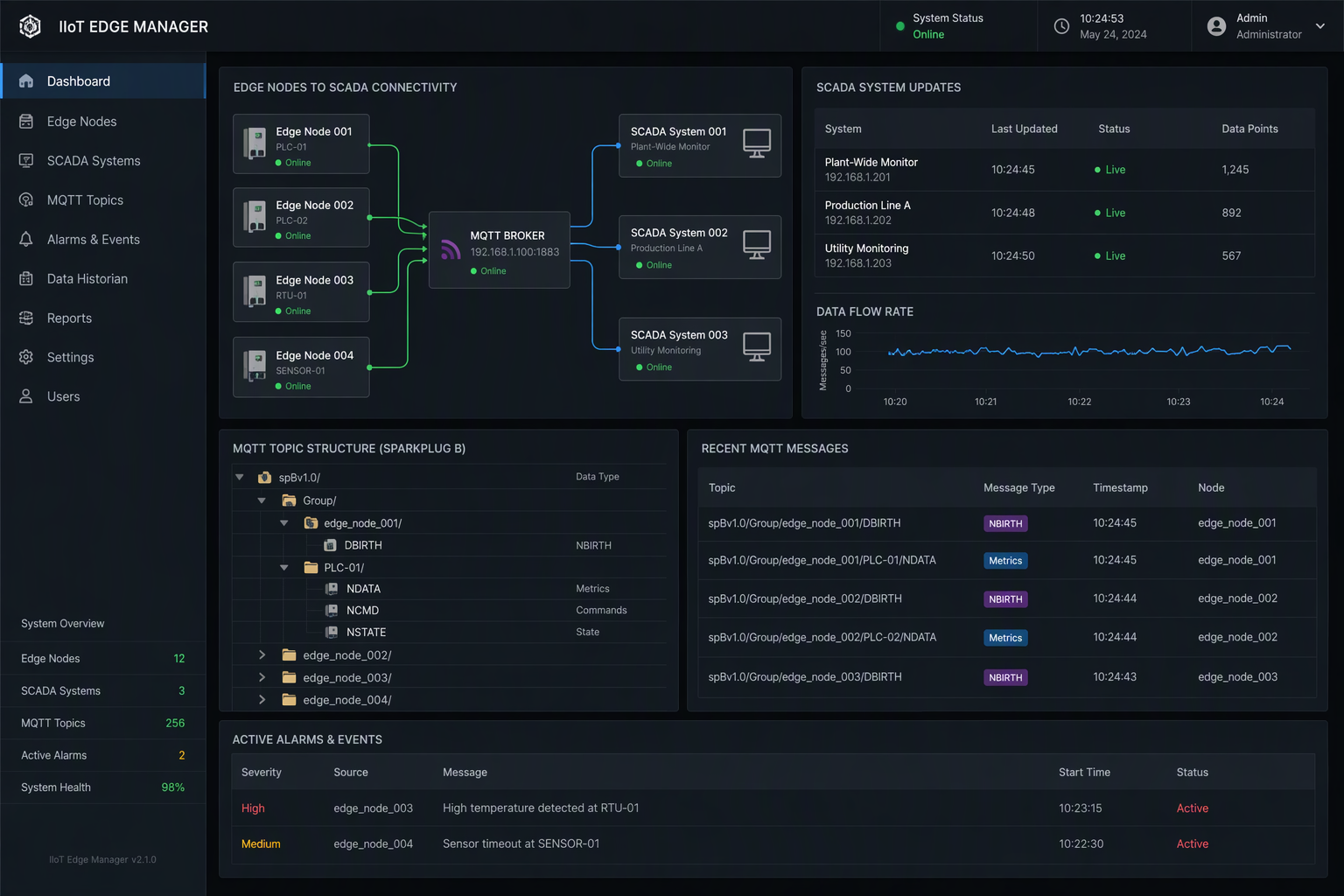
Sparkplug B enforces a clear topic namespace using a pattern like spBv1.0/group_id/message_type/edge_node_id/device_id. That makes subscriptions easier to plan and supports a more unified namespace across the facility. A subscriber can understand message purpose directly from the topic.
This matters because it gives you:
- Logical grouping with a clear group id
- Consistent identification of each node and device id
- Easier wildcard subscriptions across a plant or site
Built-in State Management Features
Here is the feature that most plant teams notice first: state management. Plain MQTT can use last will, but it does not define a full lifecycle model. You have to invent your own way to show whether a machine, gateway, or application is alive.
Sparkplug B makes device state explicit. When an edge node or device connects, it publishes a birth certificate that describes available metrics and initial values. If it drops off, a death certificate is sent, often using MQTT last will support. Subscribers do not need to guess what happened.
That built-in approach gives you:
- Birth certificate messages for self-description on connect
- Death certificate messages for fast failure awareness
- Clearer state messages so applications can trust current device state
Data Handling on the Plant Floor
On a real plant floor, data handling is not just about publishing values. You also need to know which machine sent them, whether the connection is healthy, and whether the numbers are current or buffered. That context shapes decisions.
During daily operation, a single mqtt broker may receive industrial data from line controllers, utility panels, and edge gateways at once. The difference between plain MQTT and Sparkplug B becomes clear in how each one carries device data and state information. Let’s look at those workflows next.
Sending Device Data with Standard MQTT
With standard MQTT, sending device data is straightforward. An edge gateway or PLC interface acts as one of the mqtt clients, publishes a topic, and includes the current values in the payload. For a pilot system, this can be quick and effective.
A simple example is a filler publishing speed, run status, and fault code as JSON. Another machine may send only a raw value. That flexibility helps at first, but the payload format is entirely up to the sender. If each asset sends data points differently, every subscriber has to adjust.
On a production line, that means your SCADA connector, dashboard, and historian may each need custom parsing rules. The transport works, but consistency does not come for free. As device counts grow, support effort usually grows with them.
Enhanced Data Consistency with Sparkplug B
Sparkplug B improves consistency by making every sender describe itself in a standard way. When a device comes online, subscribers receive a birth message with its metrics, data types, and initial values. That gives systems a common starting point before live updates begin.
In practical terms, imagine a packaging line with several OEM skids. With sparkplug b, each skid can publish in the same basic pattern, even if the underlying controllers differ. The receiving application gets better state information and stronger state awareness without separate per-machine logic.
Key operational gains include:
- Data consumers can trust metric structure across many assets
- Death messages show when a publisher disappears unexpectedly
- That leads to fewer mapping surprises and easier expansion when new machines are added.
Managing Device Birth and Death Messages
Birth and death handling is one of the clearest Sparkplug B advantages in day-to-day operations. A birth certificate announces that a node or device is online and tells subscribers what metrics exist. A death certificate tells the rest of the system that the publisher is no longer available.
Why does that matter? Because device state should not depend on stale assumptions. If a line gateway loses power, the system should show that loss clearly instead of leaving the last values on screen as if they were still live. Sparkplug B makes that behavior part of normal messaging.
For plant teams, the benefits are practical:
- Faster detection of communication loss
- Cleaner restart and reconnect behavior
- Better trust in displayed values and alarms through clear death messages
Payload Formats and Interoperability
Payload design affects far more than message size. It influences parsing speed, consistency, and how easily systems from different suppliers can work together. That is why payload choices matter in plant architectures.
Plain MQTT leaves the data format open. Sparkplug B standardizes it with protocol buffers, a compact binary format built for structured data. That gives industrial teams a stronger base for device integration, especially when many systems need to exchange typed values reliably.
Serialization in Plain MQTT vs Sparkplug B's Protocol Buffers
Serialization is simply the way data is encoded before transmission. In plain MQTT, you can choose almost any data format: JSON, text, or custom binary. That flexibility is useful, but it also means every receiver must know the sender’s rules.
Sparkplug B standardizes serialization with protocol buffers. This compact binary format keeps messages smaller than typical JSON payloads and preserves strong typing. In busy industrial networks, that can reduce bandwidth use and simplify decoding for Sparkplug-aware applications.
The tradeoff looks like this:
- Plain MQTT is easier to inspect with basic tools because text payloads are human-readable
- Sparkplug B protocol buffers are more efficient and structured
- Sparkplug B usually needs specialized tooling or libraries for decoding and debugging
Handling Complex Industrial Data Sets
Industrial systems rarely send one simple value forever. They send counters, status bits, floating-point process values, timestamps, and sometimes buffered records after a connection returns. Managing that mix well is where structure becomes valuable.
The sparkplug b specification supports a broad set of data types, along with timestamps and quality indicators. It can also flag historical data when store-and-forward is used. That helps receiving systems tell the difference between live production values and delayed updates after a network interruption.
For industrial data exchange, that matters. A SCADA screen, historian, and analytics layer can all process the same message set with fewer assumptions. Instead of asking, “What did this sender mean?” your systems can focus on the value itself. That is a practical advantage in industrial automation.
Cross-Vendor Device Compatibility
Cross-vendor work is where plain MQTT often becomes labor-intensive. Different vendors may all claim MQTT support, yet each uses different topics, payload fields, and naming. The transport matches, but the data contract does not. That weakens interoperability.
Sparkplug B improves device integration by standardizing the message pattern above the broker level. A machine from one vendor and a gateway from another can publish in a common structure, as long as both support the specification. The broker can still be a standard MQTT broker such as Mosquitto or HiveMQ.
That helps because:
- Cross-vendor systems become easier to subscribe to and decode
- A new device type can fit faster into the same architecture
- You still need Sparkplug-aware clients, but broker compatibility is generally not the barrier.
Real-world Use Cases and Practical Examples
Theory helps, but plant teams usually want to know what this looks like in operation. The best comparisons come from real workflows: machine monitoring, multi-vendor integration, and fast deployment at the edge.

Across industrial environments, mqtt sparkplug b shows its value when many edge devices must report status and data in a common way. If you are deciding when to use sparkplug b, the following examples show where it solves problems that plain MQTT often leaves to custom engineering.
Monitoring Machine States in a Factory Using MQTT
Suppose a factory wants to monitor run, stop, and fault conditions from ten machines through one mqtt broker. Using standard MQTT, each machine can publish device status and production values to chosen topics, and dashboards can subscribe to them. That is a workable first step.
The challenge shows up when the machines do not publish in the same way. One builder may use one mqtt topic namespace, another a different one, and a third may skip clear device state handling entirely. Data messages arrive, but the meaning around them may vary.
Typical issues include:
- Inconsistent topic naming across OEM equipment
- Different payload layouts for similar status signals
- Weak visibility when a machine goes offline unexpectedly
So plain MQTT can monitor machines, but it often needs extra design discipline to stay organized.
Achieving True Plug-and-Play Interoperability with Sparkplug B
Sparkplug B gets closer to true plug-and-play behavior because devices announce themselves and publish within a common structure. When a compliant node connects, subscribers can learn its metrics from birth messages instead of waiting for manual documentation or custom mapping sheets.
On the plant floor, that improves device integration. A new skid, sensor gateway, or utility monitor can join a broader unified namespace with much less setup effort than a one-off plain MQTT implementation. The shared topic rules and state messages create a more repeatable onboarding process.
That plug-and-play benefit usually shows up as:
- Faster commissioning of new connected assets
- Less custom parser work for each new device
- Better visibility into online and offline status
Empowered Automation Success Story in Chicago Industry
In Chicago-area manufacturing, a common challenge is tying together legacy controls, newer OEM skids, and plant reporting systems without creating a brittle web of custom mappings. That is exactly the sort of environment where Sparkplug B makes sense.
Empowered Automation, a Chicago-area systems integrator, naturally fits this kind of industrial automation work. By applying mqtt sparkplug patterns at the edge, teams can standardize how edge nodes publish machine data, status, and lifecycle events into a cleaner architecture. The benefit is not hype. It is reduced integration friction.
For a plant manager, that can mean faster startup and easier future expansion. For a controls engineer, it means less time chasing topic mismatches and undocumented payloads. Sparkplug b helps create a system that is easier to understand on day one and easier to support later.
Implementation: Tools and Ecosystem Support
Once you decide to use Sparkplug B, the next question is implementation. The good news is that you do not need a special transport stack. You still use a standard mqtt broker, then add Sparkplug-aware tools on the publishing and subscribing sides.
That can include node-red flows, Sparkplug nodes, and integration libraries that understand the namespace, payloads, and lifecycle messages. Setup details vary, but the same core pieces appear each time: broker access, topic planning, metric definitions, and a stable device id strategy.
MQTT Brokers Compatible with Sparkplug B (e.g., Mosquitto, HiveMQ)
Sparkplug B works over standard MQTT infrastructure, so a normal mqtt broker can carry the messages. That means widely used platforms such as Mosquitto and HiveMQ can support Sparkplug traffic at the broker level. The broker handles transport, sessions, and quality of service as usual.
The key point is this: full Sparkplug behavior comes from the clients and applications that understand the specification. The broker does not need to “be Sparkplug” in a special way, but your publishers and subscribers do need Sparkplug-aware logic for birth, death, and Protocol Buffer decoding.
In practice, compatibility usually means:
- Mosquitto and HiveMQ can transport Sparkplug B messages
- Sparkplug-aware clients are needed to interpret and use them correctly
Using Node-RED with Sparkplug B Messaging
Node-RED is a practical option for Sparkplug B work at the edge of network. It is widely used to connect devices, process values, and move data to and from MQTT. With Sparkplug-specific nodes, much of the topic handling and payload encoding is already built in.
A common approach is to install node-red-contrib-mqtt-sparkplug-plus, configure the broker, define the edge node and device metrics, and then publish DBIRTH and DDATA messages through the flow. You can also subscribe to Sparkplug topics and view decoded messages in debug outputs.
Typical Node-RED steps include:
- Add Sparkplug nodes and connect them to your broker
- Define group, node, device, and metric settings
- Enable immediate birth messaging on deployment
- Optionally use store-and-forward and metric aliasing
Supported Devices and Integration Libraries
Supported devices are usually not defined by a fixed brand list. In practice, the question is whether your edge devices, gateways, or software clients can publish and consume Sparkplug-compliant messages. That can include Node-RED-based gateways and other Sparkplug-aware applications.

Integration libraries matter because they handle Protocol Buffer encoding, topic rules, and lifecycle logic. Without them, you would be recreating much of the specification yourself. A clean device id plan also matters, since consistent identification is a major part of a stable deployment.
When evaluating support, focus on:
- Whether the device type or gateway can act as a Sparkplug publisher or subscriber
- Whether available integration libraries handle birth, death, and metric serialization correctly
Conclusion
In conclusion, the comparison between Sparkplug B and plain MQTT highlights the significant advantages that Sparkplug B brings to industrial IoT applications. With its enhanced data consistency, built-in state management features, and better handling of complex data sets, Sparkplug B provides a robust framework for effective communication in manufacturing environments. As plant managers and controls engineers look to optimize their systems, understanding these differences can lead to better decision-making and smoother integration across diverse devices. For those looking to delve deeper into the capabilities of Sparkplug B, visit Empowered Automation’s guide. Embracing these advancements will not only streamline operations but also pave the way for a more connected and efficient future in industrial automation.
Frequently Asked Questions
When should I choose Sparkplug B over plain MQTT?
Choose sparkplug b over plain mqtt when your industrial use case involves multiple devices, vendors, or applications and you need built-in state management. If your mqtt broker is carrying plant data that must be structured, self-describing, and easier to scale, Sparkplug B is usually the better fit.
Are there any limitations or downsides to Sparkplug B?
Yes. Sparkplug b has a steeper learning curve than plain MQTT. Because mqtt sparkplug uses protocol buffers and stricter rules, debugging can be less simple with basic tools. Some industrial applications or device type implementations may also need Sparkplug-aware software instead of generic MQTT clients alone.
What are some alternatives to Sparkplug B for MQTT messaging?
The main alternative is plain MQTT with your own topic and payload conventions. Many mqtt clients can do that, but you must define structure, lifecycle behavior, and device integration rules yourself. Compared with sparkplug b, that alternative offers flexibility, but it usually creates more custom engineering over time.
You might also like