Where to Buy IoT and What is IoT?
Where to Buy IoT?
Empowered Automation is offering the best and complete Internet of Things (IoT) solutions ready to deploy smart applications including hardware, software, and a variety of smart home devices for smart cities, along with cloud connection, all enhancing aspects such as supply chain management. This is considered the best company for IoT devices supplier, particularly in providing innovative smart home devices that enhance convenience and energy efficiency. Before you make any purchase, let us give you a brief introduction about the IoT.
What is IoT
The expression Internet of Things (IoT) refers to a network of physical devices and was first formulated in 1999, in close connection with smart devices like RFID (Radio Frequency Identification Devices) and advanced internet connectivity within the Internet of Things, by the English engineer Kevin Ahston, co-founder of the Auto-ID Center in Massachusetts.
The Internet of Things (IoT) refers to the process of connecting to the Internet of everyday devices and physical objects of daily use, including devices such as the most familiar objects used in the home, like light bulbs, to resources in the health sector, such as medical devices, to wearable devices, to smart ones, and finally, to smart cities with internet connectivity, often minimizing human intervention. When choosing the right IoT device for your needs, consider factors such as the specific task you want the device to perform, compatibility with your existing devices or systems, security features, ease of use, and available support. Assess the environment in which the everyday devices will be used and research products that are reliable and have positive user feedback.
How Does the IoT Work?
IoT stands for any system of physical devices that receive and transfer data over wireless networks, with limited manual intervention. This is achieved by integrating processing devices into the objects. The term 'IoT devices' refers specifically to these connected physical components—such as sensors, cameras, or appliances—that collect and share data. On the other hand, 'IoT platforms' are the software frameworks that manage, connect, and analyze the data from multiple IoT devices, helping users control and make sense of all the information being gathered on various IoT platforms.
For example, a smart thermostat – smart thermostats like those from Nest and smart refrigerators often take on the same meaning as IoT devices – can receive data on the user's location while they are traveling, and use it to regulate the home temperature before their arrival. The user does not need to intervene, and the result is better than manually adjusting the thermostat using IoT devices and other smart home devices. When buying an IoT device, you should look for features such as strong security protocols, compatibility with your existing devices, reliable connectivity options (like Wi-Fi or Bluetooth), remote control capabilities, regular software updates, and user-friendly interfaces. These features help ensure your IoT devices work smoothly, securely, and efficiently within your smart home ecosystem.
A typical IoT system, such as the smart home described above, works by sending, receiving, and analyzing data in a continuous loop of feedback. Depending on the type of IoT system, the analysis can be performed by manual intervention or by artificial intelligence (AI) and machine learning (AI / ML) technologies, including machine learning, in real-time or in the long term, leveraging machine learning capabilities.
Let's go back to the example of the smart home. To predict the optimal time to check the thermostat before arriving home, the IoT system can connect to the Google Maps API to examine local traffic patterns in real-time and use long-term car data to learn about the travel habits of the user. The IoT data captured by each user of smart thermostats, which can contribute to more efficient energy use and consumption, can then be used by utility companies for larger-scale optimization initiatives, showcasing the value of IoT data in real-world applications, similar to how industrial IoT technologies are transforming manufacturing. The use of IoT data in these scenarios illustrates the interconnectedness of smart devices with user behavior. Hope now it's clear that What is IoT?
What are IoT Devices?
IoT devices are IoT devices capable of carrying out data collections in real time in an increasingly precise and targeted way according to specific application areas (equipment dedicated to detecting data related to the temperature of environments, the movement of vehicles, air quality, noise in certain environments, or the presence of certain substances. In the healthcare industry, for example, the applications of IoT in the healthcare industry are numerous, including the monitoring of vital signs such as heart rate and blood pressure. In this phase, it is correct to speak of sensors that detect information and transform it into digital data. In this pre-IoT phase, there is no connection to the network. Devices that in different forms and modalities are interrogated “manually” or with an organization of the data collection not supported by a network.
The transition from sensors to the Internet of Things (IoT) and smart devices is constituted precisely by the network connection. The Internet of Things, in fact, utilizes artificial intelligence to enhance the sensor that detects the data of the "thing" that "talks" about its temperature, its movement, the quality of its air, and that "puts these everyday smart devices' data on the network of physical devices," allowing them to operate within a broader network of physical devices.
With this step we enter the Internet of Things (IoT), which in turn has then seen a series of phases that all refer to a vast network of important work on data analytics and customer behavior analysis, including insights into customer behavior that enhance the customer experience, which we can schematize as follows: If you are interested in purchasing IoT devices online, popular options include major e-commerce platforms such as Amazon, Best Buy, and specialized electronics retailers. These sources offer a wide variety of IoT devices suitable for personal, home, or business use.
- Devices – Connected to the network – Capable of detecting data and capable of communicating data, especially through data processing methodologies.
- Devices – Connected to the network is capable of detecting multiple types of data and transferring this data efficiently through data processing techniques.
- Devices – Able to perform a very first level of processing (selection) of data at a local level to transfer only data that correspond to certain requirements and improve production processes.
- Devices – Connected to the network is capable of collecting data, carrying out the first level of selection, and carrying out actions based on the indications received to enhance production processes.
- Devices – Connected to the network can detect data, select them, transmit only those necessary for the projects in which they are involved, to carry out actions based on the indications received, and carry out actions according to a local processing capacity.
The Application Areas of the Internet of Things
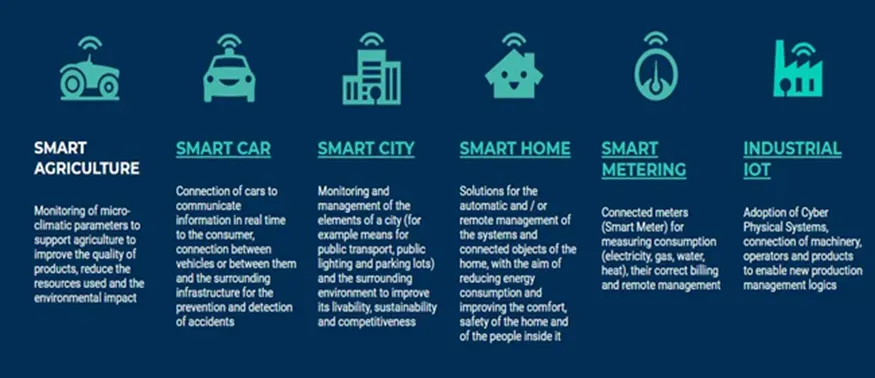
The Internet of Things (IoT) is a paradigm that potentially knows no application boundaries: from the car that communicates with the road infrastructure to prevent accidents to household appliances and everyday objects that coordinate to optimize the use of power; from the production plants that exchange data with the manufactured products for the management of their life cycle; from medical devices located in an emergency room to skis that send information on the state of the snow, or on the severity of a fall. If it is true that all objects can become "intelligent" by connecting to the vast network of the Internet of Things and exchanging information about themselves and the surrounding environment, it is equally true that this process does not occur in all areas with the same speed, especially without human intervention: this depends on the existence of consolidated technological solutions, from the competitive equilibrium in a given market and, ultimately, from the balance between the value of information and the cost of creating the network of intelligent objects. In this part, we will deepen the main areas of application of the Internet of Things, including the potential applications of IoT, with a focus on the market and value creation aspects.
Where Can You Find IoT?
The Internet of Things (IoT) can be found in a variety of settings, including homes, smart cities that leverage IoT**, and industrial IoT settings. In homes, IoT devices include smart thermostats, security systems, and voice-activated assistants. Smart cities utilize IoT technology to manage traffic, monitor air quality, and optimize energy consumption and energy use. In industrial settings, IoT enables predictive maintenance, supply chain monitoring, and enhanced machinery performance.
What is IoT?
The Internet of Things (IoT) refers to a network of interconnected devices that communicate and exchange data over the internet, leveraging internet connectivity and cloud computing. These devices, which range from household appliances and wearable technology to industrial machinery and urban infrastructure, including industrial IoT applications, are embedded with sensors, software, and internet connectivity technologies. The industrial IoT enables these devices to collect and share data, automate processes, and provide insights, ultimately enhancing efficiency, convenience, and decision-making across various domains.
How Much Does an IoT Cost?
The cost of implementing IoT varies widely depending on several factors, including the type and scale of the project, the devices used, including IoT sensors, security cameras, and IoT devices, and the infrastructure required. Basic consumer IoT devices like smart thermostats or fitness trackers can range from $50 to $300. More complex systems, such as industrial IoT solutions, can cost thousands to millions of dollars, incorporating expenses for sensors, connectivity, data processing, software platforms, and the potential of IoT technology. Additionally, there are ongoing costs for maintenance, data storage, and cybersecurity measures to ensure the system's reliability and security. The potential of IoT will continue to influence these costs significantly.
What is Considered an IoT?
An Internet of Things (IoT) device is any physical object that is embedded with sensors, software, and other technologies to connect and exchange data within a vast network of other smart devices, systems, and internet connectivity. Examples of Internet of Things devices include smart refrigerators, smart thermostats (e.g., Nest), wearable fitness trackers (e.g., Fitbit), security cameras (e.g., Ring), and connected cars (e.g., Tesla).
- Smart home devices: Thermostats, lighting systems, security cameras, voice assistants, and smart refrigerators.
- Wearable technology: Fitness trackers and smartwatches.
- Industrial equipment: Machinery with sensors for predictive maintenance to improve efficiency, supply chain monitoring devices, and automated manufacturing systems that leverage predictive maintenance technology.
- Healthcare devices: Remote patient monitoring systems, smart medical devices, and health tracking wearables.
- Smart city infrastructure: Traffic management systems, smart streetlights, and environmental monitoring sensors.
These devices collect and transmit data, allowing for automation, improved efficiency, and enhanced decision-making across various applications.
What is IoT for Beginners?
For beginners, the Internet of Things (IoT) can be understood as a network of everyday objects that are connected to the internet, enabling them to send and receive data. These objects, often called "smart" devices, include items like home appliances, wearable fitness trackers, security cameras, and even vehicles. The main idea behind IoT is to make these everyday objects "talk" to each other and to users, allowing for improved automation and real-time monitoring to enhance customer experience. For example, a smart thermostat can learn your schedule and adjust the temperature automatically, while a fitness tracker can monitor your activity and sync with your smartphone to help you meet your health goals. IoT aims to make life more convenient, efficient, and informed by integrating technology into the everyday objects we use in our daily lives.
How Long Do IoT Devices Last?
The lifespan of IoT devices varies widely based on factors such as device type, usage, and build quality. Generally, consumer IoT devices like smart thermostats, fitness trackers, smart refrigerators, and smart home assistants can last between 2 to 5 years. In the healthcare industry, the number of IoT devices that provide continuous monitoring can also monitor patients' vital signs, which may influence device longevity. Industrial IoT devices, designed for more robust applications, often have a longer lifespan, typically ranging from 5 to 10 years or more, depending on the operating environment and maintenance practices. Regular software updates, proper maintenance, and battery replacements can help extend the life of IoT devices. However, technological advancements and changing user needs may lead to upgrades before the end of a device's functional life.
Why IoT Is Important
The Internet of Things (IoT) is pivotal in driving significant changes across various industries, making it crucial for businesses and consumers alike. One of the foremost reasons for its importance is the environmental impact it can have in building smart cities with efficient IoT solutions. By leveraging IoT-enabled devices, including IoT sensors, organizations can optimize resource consumption, reduce waste, and ultimately lower their carbon footprints. For instance, smart sensors can monitor energy use and consumption in real-time, allowing for adjustments that enhance efficiency and sustainability. The potential applications of IoT are particularly promising as the future of IoT unfolds, and we can expect advancements that further minimize environmental degradation while promoting eco-friendly practices.
Moreover, IoT is reshaping customer behavior by providing personalized experiences and insights, especially in terms of inventory management and supply chain management. Businesses can analyze vast amounts of IoT data generated by IoT devices to understand consumer preferences better and tailor their offerings accordingly. This effective inventory management and data-driven approach not only enhances customer satisfaction but also fosters loyalty, as consumers increasingly gravitate towards brands that understand and cater to their needs. Thus, the future of IoT holds immense potential in transforming how industries operate and interact with their customers.
IoT Technologies and Communication Protocols
The backbone of the Internet of Things (IoT) relies on a variety of technologies and communication protocols, including cloud computing platforms, that facilitate seamless data exchange among devices. Data processing and analytics play a crucial role in the data processing of the immense volumes of information generated by IoT devices, enabling businesses to derive actionable insights into customer behavior. By utilizing advanced data processing analytics platforms, organizations can monitor performance, predict trends, and make informed decisions based on real-time data.
In addition, IoT platforms serve as the essential infrastructure that connects various devices, ensuring they can communicate effectively within the IoT system. These platforms support different communication protocols, such as MQTT and CoAP, which are designed to enable lightweight messaging between devices. By employing these protocols, IoT devices can efficiently transmit IoT data over networks, enhancing interoperability and ensuring that IoT data flows smoothly from one device to another. The integration of data processing techniques, data analytics, and robust communication protocols is pivotal for the successful deployment and scalability of IoT solutions in a comprehensive IoT system.
10 Common IoT Communication Protocols
IoT communication protocols are vital for enabling everyday devices in an IoT system, including various security cameras, to connect and share data effectively, allowing for numerous everyday objects to communicate seamlessly. Here are ten common protocols that facilitate seamless communication in IoT systems: If you're just starting out, there are several beginner-friendly IoT development kits available for purchase, such as the Arduino Starter Kit, Raspberry Pi, and ESP32 development boards. These kits support many of the common IoT communication protocols and come with extensive documentation and community resources to help newcomers learn and experiment effectively.
- MQTT (Message Queuing Telemetry Transport): A lightweight messaging protocol ideal for low-bandwidth, high-latency environments, crucial for an effective IoT strategy and solutions approach.
- CoAP (Constrained Application Protocol): Designed for small, constrained devices, CoAP is an efficient protocol for IoT applications, highlighting the potential of IoT and supporting a robust IoT strategy.
- HTTP (Hypertext Transfer Protocol): The foundation for data communication on the web, widely used for IoT applications such as smart thermostats to assess their environmental impact and explore the potential applications of IoT.
- Bluetooth: A short-range wireless technology that connects a network of physical devices over small distances, commonly used in wearable devices to monitor their environmental impact.
- Zigbee: A low-power wireless protocol designed for IoT applications, particularly in home automation, allowing a network of physical devices to communicate efficiently, optimizing energy use while monitoring vital signs of users.
- LoRaWAN (Long Range Wide Area Network): A protocol for long-range communication, ideal for connecting a vast network of physical devices over vast distances.
- NB-IoT (Narrowband IoT): A cellular technology designed for low-power IoT devices, highlighting the benefits of IoT for everyday devices in smart cities, providing wide coverage and deep penetration.
- Sigfox: A low-power, wide-area network technology that enables simple, cost-effective connectivity for IoT devices, showcasing the benefits of IoT for everyday devices in smart cities.
- AMQP (Advanced Message Queuing Protocol): A protocol that facilitates message-oriented middleware, ensuring reliable communication and supporting data analytics for improved messaging efficiency in a network of physical devices, showcasing the potential applications of IoT.
- Wi-Fi: A widely used wireless technology that allows devices to connect to the internet and communicate with each other, often leveraging data analytics to enhance connectivity options and explore the potential applications of IoT.
These protocols form the foundation of IoT communication, enabling a network of physical devices to exchange data and perform various tasks, ensuring the efficient processing of IoT data across different applications.
IoT Security
As IoT devices proliferate, the security of sensitive data becomes a paramount concern for IoT platforms. With numerous devices collecting and transmitting personal information, it is essential to implement robust security measures to protect against cyber threats. Security cameras, for instance, are often vulnerable to hacking if not properly secured. Thus, businesses must prioritize the protection of their sensitive data against breaches and IoT infrastructure by adopting best practices that include regular software updates, data encryption, and strong authentication protocols to safeguard sensitive data effectively.
Moreover, understanding the potential vulnerabilities in IoT devices can aid organizations in developing comprehensive security strategies that also consider their environmental impact. By regularly conducting security assessments and audits, businesses can identify weaknesses in their systems and address them proactively in real-time. Additionally, the integration of artificial intelligence in a rapidly evolving technological landscape ensures the security of IoT devices, which not only safeguards sensitive data but also enhances customer trust and overall customer experience while minimizing environmental impact.
IoT Risks
While the Internet of Things offers numerous benefits to the healthcare industry, including the benefits of IoT, it also poses significant risks that organizations must address in the healthcare industry, especially in terms of supply chain management, including optimizing supply chains. One of the primary concerns is the potential for human intervention in critical systems. For instance, if a security camera is hacked, unauthorized users may gain access to sensitive areas, leading to security breaches. Additionally, predicting equipment failures can occur if devices are not properly maintained or monitored, resulting in costly downtime and disruptions.
Businesses need to establish protocols for managing these risks effectively. This includes implementing continuous monitoring and real-time monitoring systems to track device performance in real time and ensure that any maintenance costs, equipment failures, and anomalies are addressed immediately. By fostering a culture of vigilance and preparedness, organizations can mitigate the risks associated with IoT deployment and ensure smoother operations.
IoT Security Best Practices
To protect sensitive data and enhance customer experience, organizations must adopt the best practices for a comprehensive IoT strategy and IoT security. First and foremost, changing default passwords and using strong, unique credentials for each device is crucial. This basic step can significantly reduce the risk of unauthorized access. Additionally, businesses should implement a zero-trust security model, ensuring that all devices and users are authenticated before accessing the network, following best practices in IoT management for optimal security and performance, including adhering to the best practices for data protection and privacy.
Regularly updating software and firmware for smart home devices is another essential practice to safeguard IoT devices against vulnerabilities, including the impact on energy consumption in their operations. These updates often include patches for known security issues, helping to protect against potential attacks. Furthermore, using an effective IoT strategy that includes encryption for data transmission can secure sensitive information from interception, enhancing the overall security posture of the IoT ecosystem and optimizing energy consumption in supply chains. By following these best practices, organizations can create a robust security framework that protects their smart home devices and enhances the overall customer experience.
IoT Precautions
To ensure the effective and secure deployment of IoT devices, organizations must adopt a range of precautions that mitigate risks associated with connectivity and data privacy. One essential precaution is implementing robust inventory management practices to track all IoT devices within the network, preventing equipment failures and optimizing supply chains. This practice helps organizations maintain a clear understanding of their devices, including their status and security vulnerabilities. Regular audits of device inventory management can identify outdated technology or unmonitored devices that may pose security risks. Additionally, analyzing customer behavior through the data collected by IoT devices can offer invaluable insights into potential security gaps and areas for improvement, leading to enhanced customer experience and reduced maintenance costs. By ensuring that all devices are accounted for and continuously monitored, organizations can significantly reduce the risk of unauthorized access and data breaches.
Another key precaution involves establishing a comprehensive cybersecurity framework that includes regular software updates and patches for all IoT devices and IoT sensors, particularly considering the role of cloud computing. Keeping systems up-to-date reduces the likelihood of exploitation by malicious actors and prevents equipment failures, ensuring that security vulnerabilities are addressed promptly, which can also help in managing maintenance costs. Organizations should also implement access controls, ensuring that only authorized personnel can manage and configure IoT devices and sensors. This approach not only protects sensitive data but also enhances the overall integrity of supply chain management in the IoT ecosystem. By prioritizing these precautions, businesses can create a secure environment that safeguards both their operational data and customer information, ultimately leading to enhanced trust and satisfaction.
Finally, organizations should invest in employee training programs that raise awareness about IoT security best practices and the significance of responsible data handling, including data analytics strategies as part of their IoT strategy. Educating staff on the potential risks associated with IoT devices, such as phishing attacks or insecure connections, empowers them to take proactive measures in safeguarding the organization's digital assets without unnecessary human intervention. By fostering a culture of security awareness and preparedness, businesses can effectively leverage IoT technologies in real time while minimizing risks to their operations and customer trust.
The Future of IoT
The future of the Internet of Things (IoT) is bright, with immense potential of IoT for growth and innovation. As more devices become interconnected, the possibilities for the potential applications of the future of IoT in various sectors will expand significantly. The integration of data analytics tools will allow businesses to harness the vast amounts of data generated by IoT devices, enabling them to make more informed decisions about the future of IoT and drive operational efficiencies focused on the future of IoT.
Moreover, advancements in artificial intelligence and artificial intelligence-driven machine learning will play a critical role in the evolution of IoT and IoT sensors. These technologies will enable devices, including IoT sensors, to learn through artificial intelligence and adapt to user behavior, enhancing personalization and providing tailored experiences. As the IoT landscape continues to evolve, organizations must remain agile and embrace new machine learning technologies to leverage the full potential of IoT and stay competitive in an increasingly connected world.
How Machine Learning and Computer Vision Are Making Construction Sites Safer
Machine learning and computer vision are revolutionizing safety protocols in construction sites by harnessing the power of data analytics. These technologies enable real-time monitoring and analysis of site conditions, allowing for the early detection of potential hazards. For instance, machine learning algorithms can analyze video feeds from surveillance cameras to identify unsafe behaviors, such as workers not wearing helmets or entering restricted areas. This proactive approach enhances safety protocols by alerting site managers immediately, thereby preventing accidents before they occur. Moreover, data analytics can be leveraged to assess past incidents, enabling construction companies to identify patterns and implement targeted safety training programs. The integration of such advanced technologies not only enhances the overall safety of construction environments but also fosters a culture of accountability among workers, ultimately leading to a reduction in workplace injuries.
Role of IoT Solution Providers and IoT Product Development Companies
As the Internet of Things (IoT) landscape expands, the role of IoT solution providers and product development companies becomes increasingly vital. These organizations are instrumental in developing, deploying, and managing IoT applications tailored to specific business needs, showcasing the potential applications of IoT. With the increasing vast network of IoT devices and IoT device innovations, IoT solution providers offer a comprehensive suite of services, enabling businesses to define their IoT strategies and implement connected solutions that enhance operational efficiency and supply chain management. By integrating various elements such as sensors, connectivity, cloud computing, and data analytics, they create end-to-end IoT ecosystems that drive innovation and streamline processes.
Moreover, IoT product development companies focus on designing and building IoT solutions and devices that meet the unique requirements of different industries. Their expertise in hardware and software development ensures that devices are not only functional but also capable of securely communicating data across networks. By predicting equipment failures, businesses can collaborate with these specialized providers to leverage the latest advancements in IoT technologies and deploy data analytics solutions that optimize supply chain management, enhance customer engagement, and foster data-driven decision-making for efficient production processes. The partnership with experienced IoT solution providers and product developers is crucial for organizations looking to stay competitive in an increasingly connected world, ultimately paving the way for transformative growth and efficiency.
IoT Platforms: What They Are and Examples to Know
IoT platforms serve as the backbone of Internet of Things ecosystems, providing the necessary infrastructure for devices to connect, communicate, and share data seamlessly. These IoT platforms enable businesses to develop and manage cloud computing IoT platforms solutions efficiently, allowing for the integration of various technologies and devices into a cohesive system. A robust IoT platform typically includes features such as device management, data analytics, and application development capabilities, empowering organizations to harness the full potential of their IoT investments.
Here's a brief overview of some popular IoT platforms:
| Key Features | Examples |
|---|---|
| IBM Watson IoT | Advanced data analytics, AI integration, and security Smart manufacturing, healthcare |
| Microsoft Azure IoT | Scalable cloud services, device management, and analytics Retail, smart cities |
| Amazon Web Services (AWS) IoT | Comprehensive infrastructure, connectivity options Automotive, agriculture |
| Google Cloud IoT | Machine learning capabilities and data processing Industrial automation, smart homes, and industrial IoT |
| ThingSpeak | Open-source platform for IoT analytics and visualization Environmental monitoring |
These platforms not only facilitate data collection and processing, but also enable businesses to implement actionable insights powered by machine learning that drive operational efficiencies and enhance customer experiences, including improvements in supply chain management. By leveraging the capabilities of these IoT platforms and focusing on efficient supply chain management, organizations can stay ahead of the curve and adapt to the rapidly evolving demands of the market.
Emerging IoT Trends: AI Integration and Smart Textiles
The Internet of Things (IoT) is witnessing a transformative wave with the integration of artificial intelligence (AI) and the emergence of smart textiles. Artificial intelligence (AI) and machine learning enhance IoT by enabling devices to learn from data, making them more responsive and intelligent. For instance, AI algorithms can analyze data from IoT sensors in real-time, allowing for predictive maintenance with the help of IoT sensors in various industries. This capability not only increases efficiency but also minimizes energy consumption, as machines can operate at optimal levels based on actual usage patterns.
In parallel, smart textiles are revolutionizing how we interact with our clothing and environments. These textiles, embedded with sensors and connectivity, can monitor health metrics and vital signs, adjust to temperature changes, and even communicate with other IoT devices. For example, smart clothing can track heart rates during workouts and send real-time feedback to fitness apps, thus enhancing the user experience and overall customer experience. As AI and smart textiles evolve, they promise to open new avenues for energy-efficient solutions and energy use in personalized health monitoring, demonstrating the vast potential of IoT in everyday life.
Are You Ready for the AI of Things?
As the AI of Things continues to evolve, it's essential to consider how this technology can enhance your daily life. Smart thermostats, such as the popular smart thermostats options available on the market, security cameras, and smart refrigerators are just the beginning of what IoT can achieve. With the potential of IoT, these smart thermostats and other devices can learn your preferences, monitor your habits, and optimize energy use, ultimately making your home more efficient and personalized.
What Are Smart Textiles?
Smart textiles represent a groundbreaking advancement in the future of IoT landscape, blending technology with everyday clothing. These innovative materials are capable of interacting with their environment, providing functionalities such as monitoring health metrics and enhancing user experience in smart homes without the need for human intervention. As the future of IoT unfolds, especially in the realm of smart textiles, they will play a pivotal role in merging fashion with technology, offering a seamless integration of connected devices into our daily lives while considering their environmental impact.
What Is Smart Dust?
Smart dust refers to tiny, wireless microelectromechanical systems (MEMS) that can collect and transmit data from their environment. These smart devices, often no larger than a grain of sand, are equipped with sensors and can monitor various conditions such as temperature, light, and motion. Smart dust has the potential to revolutionize various sectors by embedding intelligence into everyday objects, enabling them to communicate data seamlessly. For instance, in agriculture, smart dust could be used to monitor soil moisture levels or crop health, providing farmers with real-time insights to optimize their operations.
Benefits of IoT in Everyday Life
The benefits of IoT solutions in everyday life are profound, as IoT solutions enhance convenience and efficiency across various domains. With the rise of smart home technology, individuals can now control a myriad of devices—from lighting to security systems—remotely through their smartphones. This connectivity not only streamlines daily tasks but also contributes to significant reductions in energy use, allowing homeowners to monitor and adjust their energy consumption in real-time without the need for human intervention. For instance, smart thermostats can learn user preferences and adjust heating or cooling accordingly, leading to both comfort and cost savings on utility bills.
Moreover, the integration of IoT devices promotes a higher quality of life by providing personalized experiences. For example, wearables like fitness trackers enable continuous monitoring of health metrics, encouraging healthier habits by offering insights based on their daily activities. This level of personalization enhances user engagement and satisfaction, ultimately transforming how we interact with our surroundings while potentially reducing maintenance costs.
How Should Businesses Approach IoT?
In today's competitive landscape, businesses must develop a comprehensive IoT strategy to effectively leverage the technology and enhance customer experience. A well-defined IoT strategy, highlighting the benefits of IoT, involves identifying specific use cases that align with business objectives, such as optimizing supply chain management and improving supply chains operational efficiency. This strategic approach enables organizations to determine the types of IoT devices needed and how they can be integrated into existing processes.
Additionally, businesses should prioritize data management and analytics as part of their IoT implementation. By analyzing IoT data collected from IoT devices, companies can gain valuable insights into customer behavior and preferences, allowing them to tailor their offerings more effectively. For instance, retailers can use IoT data to optimize inventory levels and enhance customer interactions related to customer behavior, ultimately driving sales and improving customer loyalty through better understanding of customer behavior. Emphasizing a strong IoT strategy can significantly improve a company's competitive edge in the market.
Protecting Wearables and Rugged Devices From Cyber Attacks
As the adoption of IoT devices, such as wearables, continues to rise, the number of IoT devices remains a critical concern for cybersecurity. These devices often store sensitive data, making the increasing number of IoT devices attractive targets for cybercriminals. To safeguard sensitive data, manufacturers and users must adopt robust cybersecurity measures. This includes implementing strong authentication protocols and regular software updates to protect against vulnerabilities. Additionally, organizations should educate users about safe practices, such as avoiding unsecured networks and enabling encryption, to further secure their devices from potential attacks. By prioritizing cybersecurity, businesses can protect their customers' data and maintain trust in their IoT solutions.
How Will AI Change UX Design?
Artificial intelligence is poised to transform user experience (UX) design by enabling more personalized and intuitive interfaces. With the ability to analyze vast amounts of user data, AI can identify patterns in user behavior and preferences, allowing designers to create more tailored experiences. As a result, applications and websites can adapt in real-time to meet individual user needs, enhancing customer experience. For example, AI can facilitate dynamic content delivery based on user interactions, ensuring that users receive relevant information at the right moments. This shift towards AI-driven design not only enhances usability but also fosters deeper engagement, ultimately leading to increased customer satisfaction and loyalty.
Where to buy IOT in the USA? : r/HeliumNetwork
In the USA, IoT devices, including various IoT device options, can be purchased from various sources including online retailers like Amazon and specialized electronics stores. Additionally, local tech shops often carry a selection of IoT products. Always compare prices and read reviews to ensure you're making the best purchase for your needs.
Frequently Asked Questions (FAQs)
The Internet of Things (IoT) raises numerous questions among consumers and businesses alike. One common query is about the security of IoT devices, as many users are concerned about their data privacy and potential vulnerabilities. Additionally, people often ask how the number of IoT devices can improve their daily lives, from enhancing home automation to streamlining business operations. It's also worth noting that as technology evolves, queries regarding the future of IoT and its implications on various industries are becoming increasingly prevalent.
What are some examples of IoT devices?
IoT devices encompass a wide range of smart technology that enhances daily life. Common examples include smart home devices like thermostats and lighting systems, industrial IoT applications for monitoring equipment and optimizing production processes, as well as wearable technology such as fitness trackers. These devices enable seamless communication and data exchange, optimizing user experiences and driving efficiency in both personal and industrial settings.
After Cruise Ban, What’s Next for Autonomous Vehicles?
The future of autonomous vehicles holds immense promise, particularly as IoT technology continues to advance. With the recent cruise ban, companies are exploring innovative solutions to enhance vehicle safety and communication with surrounding infrastructure. Potential applications of IoT include real-time traffic monitoring, predictive maintenance, and smart routing, which can significantly improve road safety and efficiency in smart cities, alongside enhancements in supply chains. The integration of AI with IoT will also play a crucial role, allowing these vehicles to learn and adapt to their environments, ultimately transforming urban mobility and paving the way for fully autonomous transportation solutions. As the industry navigates regulatory challenges, partnerships between tech firms and automotive companies will be essential in driving the future of IoT in the automotive sector.
Where to buy IOT in the USA? : r/HeliumNetwork
In the USA, IoT devices can be purchased through various online retailers like Amazon, Best Buy, and specialized tech stores. Additionally, platforms like eBay offer used options. For specific IoT solutions, consider visiting manufacturer websites or local tech expos to explore the latest innovations and connect directly with vendors.
You might also like