AWS IoT vs Azure IoT Manufacturing: Which Fits?
AWS IoT vs Azure IoT Manufacturing: Which Fits?

Key Highlights
- AWS IoT fits manufacturers that want flexible, metered usage and strong MQTT support.
- Azure IoT works well when your industrial iot setup has steady, predictable message volumes.
- Device management differs mainly in AWS named shadows and Azure device twins with broader graph modeling.
- For data analytics, AWS leans on SiteWise and Amazon Kinesis, while Azure connects tightly with Data Explorer and Power BI.
- Security strengths differ too, with aws iot device defender and Azure Sphere serving different manufacturing needs.
- Your best iot platform depends on traffic patterns, existing systems, and scaling goals.
Introduction
Choosing between aws iot and azure iot can shape your manufacturing strategy for years. Both platforms support the internet of things at scale, but they solve problems in different ways. One leans toward flexible, usage-based operations. The other emphasizes predictable capacity and tight Microsoft integration. If you run connected factories, production lines, or remote assets, that difference matters. The right choice is not about hype. It is about how your devices communicate, how your teams work, and how your costs behave as you grow.
Overview of IoT Platforms in Manufacturing
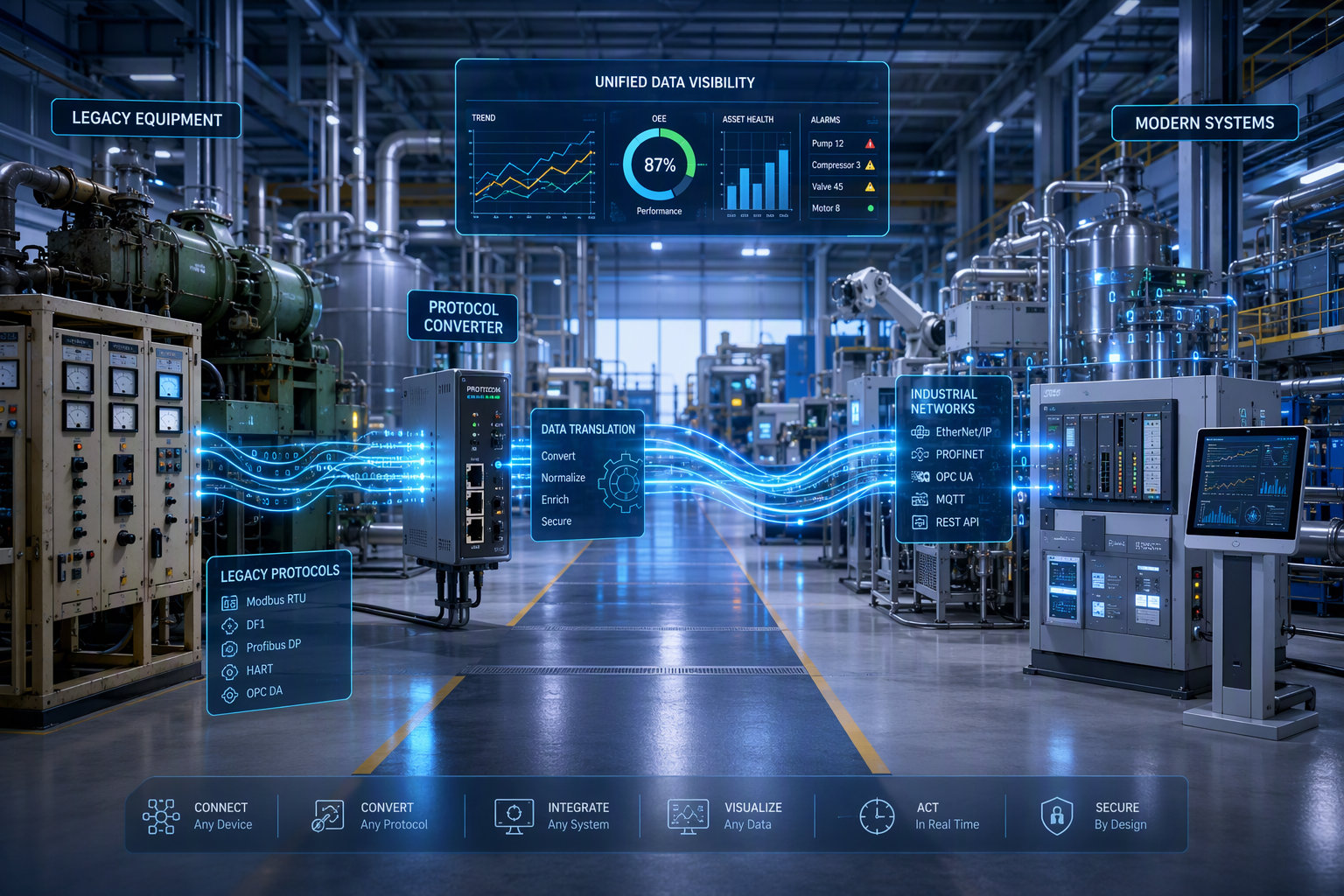
In manufacturing, an iot platform gives your iot devices a secure way to send iot data into a cloud service. That foundation supports monitoring, control, and automation across lines, plants, and field assets. It is the base layer of any serious iot solution.
Both AWS and Azure can handle industrial iot workloads at very large scale. The real differences show up in protocol support, billing, state handling, and integration paths. Those choices affect day-to-day operations, so it helps to first look at how connected devices actually fit into modern production.
Role of Connected Devices in Modern Manufacturing
Walk through any modern plant and you will see how much depends on iot devices. Sensors track vibration, temperature, and runtime. Controllers report machine status. Gateways collect readings from industrial equipment and pass them upstream for monitoring or action.
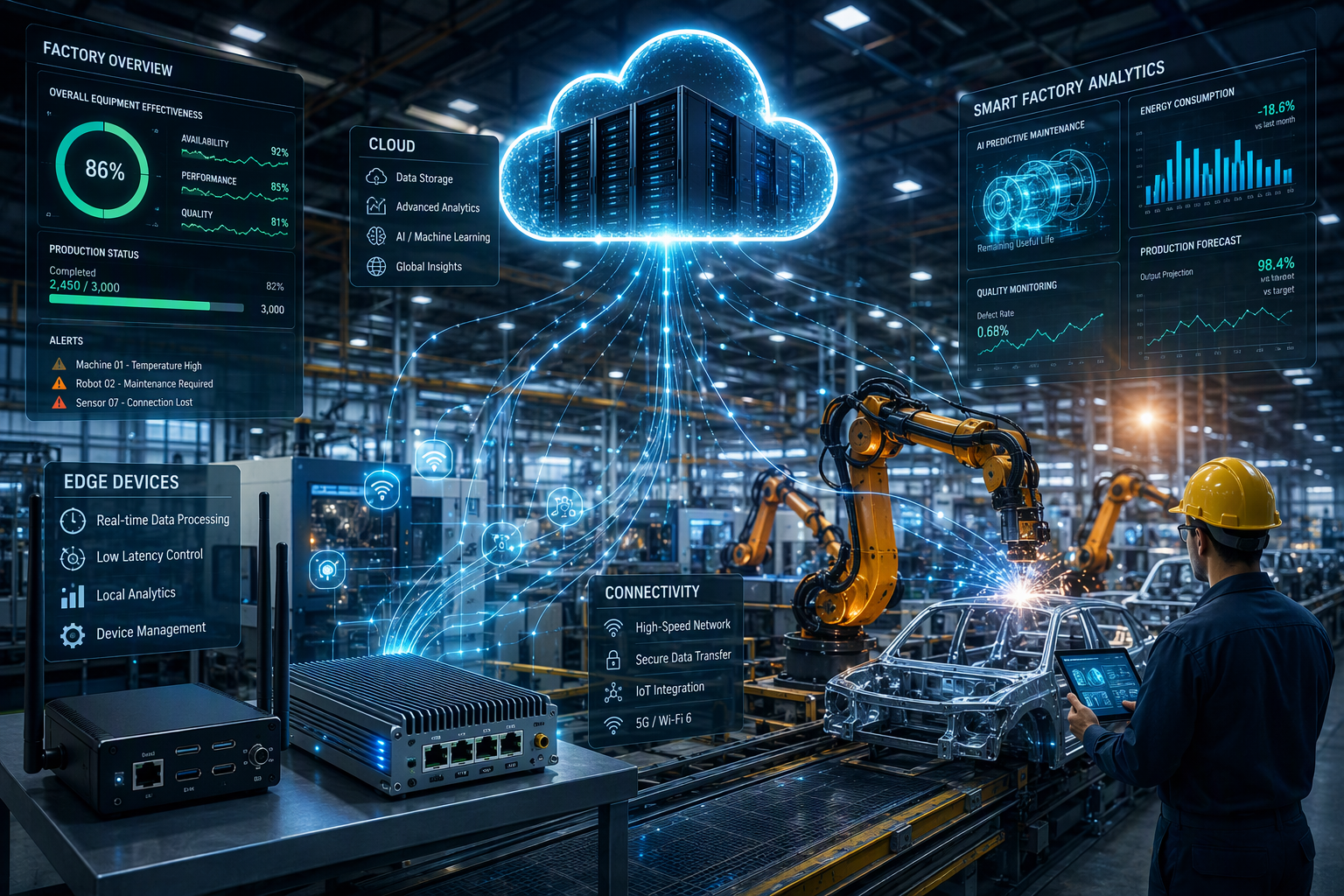
Some of that work happens close to the machine. Edge devices can process events locally, which helps when a line needs fast responses or when internet links are unstable. This setup reduces latency and keeps critical tasks moving even if cloud connectivity drops for a moment.
At the same time, cloud platforms provide the shared control layer for larger iot deployments. They help teams organize devices, store state, and route telemetry into analytics tools. In manufacturing, device management matters because each asset must stay visible, secure, and easy to update without slowing production.
Why Manufacturers Choose Cloud-Based IoT Solutions
Manufacturers choose cloud computing because it simplifies growth. Instead of building every backend component in-house, you can use managed iot services for ingestion, monitoring, storage, and analysis. That speeds up rollout and reduces the burden on internal teams.
Another reason is device connectivity. Plants often have mixed fleets, different protocols, and multiple locations. A cloud layer helps standardize how equipment connects and how data moves between operations, engineering, and business systems. That makes expansion easier when one pilot turns into many sites.
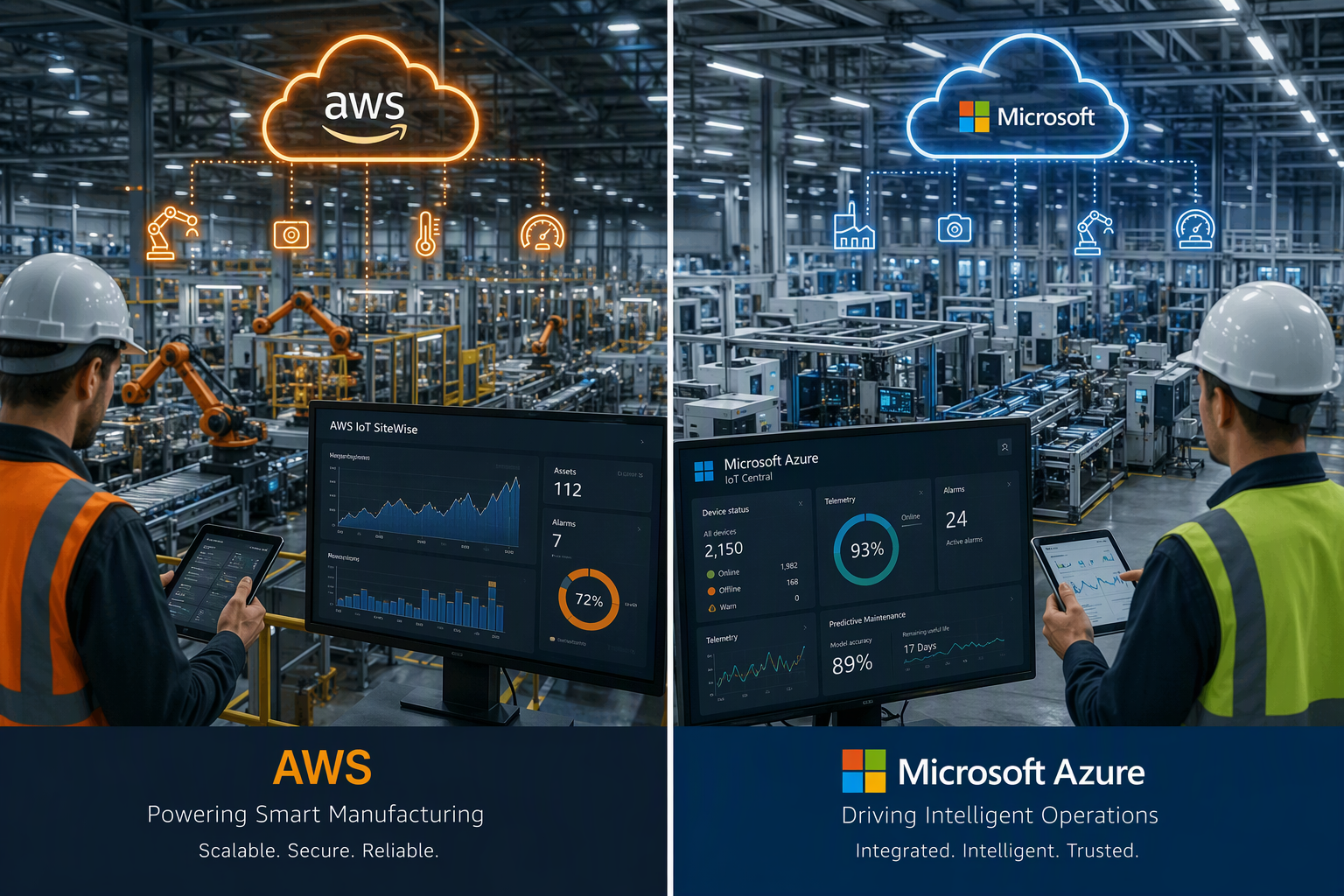
Your current ecosystem also matters. If your team already relies on aws cloud tools, AWS often feels natural. If your business runs heavily on microsoft azure, Azure can provide smoother integration with familiar platforms. From here, it makes sense to look at each option on its own terms.
Understanding AWS IoT for Manufacturing
AWS IoT is built for large fleets, flexible traffic, and broad service choice. At the center is aws iot core, a managed broker and messaging layer that lets devices connect securely with cloud applications. For manufacturers, that makes it useful for telemetry, remote operations, and plant-wide monitoring.
What stands out is how AWS connects industrial iot workloads to other aws services for analytics, storage, and edge processing. It also supports modern MQTT features, which can simplify firmware design. Next, let’s break down the core tools, management features, and security strengths.
Core AWS IoT Services for Industrial Use
For industrial teams, AWS offers a layered set of services rather than one single dashboard. aws iot core handles device messaging and secure connectivity. From there, manufacturers can connect telemetry to downstream tools for local actions, historian-style modeling, and advanced analysis.
At the edge, iot greengrass matters because factories often need processing near machines. aws iot greengrass lets you run workloads locally and keep operations responsive when connectivity is inconsistent. That can be useful for filtering data, running logic, or supporting machine learning inference close to production assets.
Key AWS building blocks include:
- aws iot core for secure messaging and cloud connectivity
- aws iot greengrass for edge workloads and local processing
- AWS IoT SiteWise for industrial asset modeling and time-series monitoring
- aws iot device defender for auditing, monitoring, and anomaly detection
Device Management Capabilities in AWS IoT
AWS approaches iot device management with tools for onboarding, organizing, monitoring, and updating fleets. That helps when you have equipment spread across plants, suppliers, and test environments. In manufacturing, that control is important because downtime from poor fleet visibility can become expensive fast.
A key AWS feature is Device Shadow. While Azure uses device twins, AWS uses shadows as a document store for state. One useful detail is support for named shadows. You can separate firmware status from user or operations settings, which reduces the chance of teams overwriting each other’s changes.
That design supports cleaner data management in complex environments. It works well when each machine is treated as its own unit and different teams need distinct control layers. The tradeoff is cost sensitivity, since frequent shadow reads and writes increase usage charges across aws services.
Security Features for Manufacturing with AWS IoT
Security is one of the strongest reasons manufacturers consider AWS. The platform supports device authentication, encryption, and large-scale certificate handling. That matters when your connected assets move from a pilot into thousands of endpoints across multiple facilities.
A standout feature is aws iot device defender. It focuses on behavioral monitoring rather than just static rules. In practice, that means it can flag unusual activity, such as a device sending far more outbound traffic than expected. For busy iot operations, that acts like fleet-specific intrusion detection.
This approach pairs well with cloud applications that depend on stable device behavior. It also helps control financial risk, since abnormal traffic can drive up metered costs. If you want strong monitoring tied closely to device behavior and data analytics, AWS offers a practical security model.
Understanding Azure IoT for Manufacturing
Azure IoT is Microsoft’s connected device stack for monitoring, control, and enterprise integration. azure iot hub acts as the central message layer for two-way communication between devices and applications. For manufacturers, that creates a strong base for plant telemetry, asset tracking, and system coordination.
What makes microsoft azure iot different is its close tie to broader Microsoft tools and its stronger digital modeling story. azure iot edge also supports local workloads for faster processing near equipment. The next sections cover Azure’s industrial services, management approach, and security posture.
Core Azure IoT Services for Industrial Use
Azure gives manufacturers a connected set of services that work especially well when the business already uses Microsoft tools. azure iot hub manages secure communication, while surrounding services help with app building, digital modeling, and device security across large industrial environments.
One major strength is how Azure connects device state to broader operational context. That is where azure digital twins becomes useful. Instead of treating each device as isolated, it helps model rooms, lines, plants, and relationships between assets. For many factories, that structure makes data easier to interpret.
Core Azure services include:
- azure iot hub for device messaging and secure connectivity
- azure iot central for faster iot application setup with hosted tools
- azure sphere for hardware-level and cloud-linked security
- azure digital twins for modeling factory spaces and asset relationships
Device Management Capabilities in Azure IoT
Azure handles device management through a mix of hub-level controls and strong provisioning tools. iot hub supports secure communication and state synchronization, while Azure Device Provisioning Service is known for zero-touch enrollment at scale. That is helpful when devices are deployed across contract manufacturers or multiple facilities.
Azure’s device twins store desired and reported properties, much like AWS shadows. The difference is the broader model around them. Device twins connect naturally to Azure’s graph-oriented architecture, which is useful when machines belong to lines, lines belong to plants, and context matters as much as telemetry.
This structure can reduce the need for separate mapping databases. It also fits well with tools like data explorer for fleet investigation and troubleshooting. If your manufacturing setup is hierarchical and heavily structured, Azure’s device management story can feel more natural than a purely document-based model.
Security Features for Manufacturing with Azure IoT
Azure brings several security layers that appeal to industrial teams with strict governance needs. The platform supports authentication, secure communication, and device controls across large fleets. For companies already using Microsoft identity systems, that alignment can simplify operations.
A central piece is azure active directory, which strengthens access control across users, services, and connected workflows. On the device side, Azure also offers Azure Sphere, which extends protection from hardware up through cloud-based monitoring. That gives Azure a stronger end-to-end story for organizations that want built-in platform and silicon security.
For manufacturers using iot edge, these protections support safer local workloads and more controlled data processing near equipment. Compared with AWS, Azure’s security position feels more identity- and hardware-centered, while AWS leans more on behavior monitoring and anomaly detection in live fleet activity.
Comparing Scalability for Manufacturing Projects
Both platforms scale to very large fleets, so the better choice depends on traffic shape rather than headline capacity. In raw terms, each iot platform can support millions of devices and huge message volumes. The real question is how that growth affects architecture and cost.
AWS often suits variable or bursty workloads because its iot services follow a metered model. microsoft azure is often a stronger fit when message flow is steady and predictable under reserved capacity. To see why, it helps to compare how each platform handles expansion in real manufacturing environments.
Large-Scale Deployment Options in AWS IoT
AWS scales well when device traffic is uneven. That matters in manufacturing iot projects where some assets report only a few times a day while others spike during alarms, updates, or shift changes. The metered model means you pay for actual usage rather than reserved headroom.
Another advantage is protocol support. aws iot has adopted MQTT v5 strongly, which helps with request-response patterns, metadata routing through user properties, and shared subscriptions for backend scaling. These features reduce custom logic and make large distributed systems easier to manage across amazon web services.
In the aws cloud, this creates a clean path for event-driven manufacturing setups. If your fleet includes many low-duty-cycle assets or unpredictable traffic patterns, AWS usually offers better scalability economics. The main caution is cost control, since firmware errors or noisy devices can increase spending quickly.
Handling Growth with Azure IoT Scaling Tools
Azure scales differently. With azure iot hub, you choose tiers and units that define a daily message quota. That can be a smart model for factories with stable telemetry, such as sensors that report continuously at known intervals. In those cases, budget planning becomes simpler.
This provisioned approach creates predictability, which many operations and finance teams like. If your iot device traffic stays close to planned limits, reserved capacity can be efficient. The downside is that small increases past a threshold may force you to buy more capacity than you immediately need.
Inside microsoft azure, scaling also benefits from close ties to analytics and AI tools such as azure machine learning. That makes it attractive when growth is not just about more devices, but also about expanding models, dashboards, and enterprise workflows around them.
Integration with Manufacturing Systems
For manufacturers, the best iot platform is rarely judged on connectivity alone. It also needs to work with ERP, MES, reporting tools, and plant databases. That is where data ingestion paths and service integration start to matter just as much as message handling.
AWS and Azure both support strong integration, but the easier path depends on your existing stack. If your business runs heavily on Microsoft tools, Azure often feels more native. If your teams already build around AWS services, AWS may offer a smoother route. Here is how each side connects.
Connecting AWS IoT to ERP and MES Platforms
AWS connects manufacturing data through a broad service ecosystem. aws iot can route telemetry into SiteWise, Kinesis, storage, and serverless workflows, which gives teams flexibility when linking plant signals with ERP or MES processes. That flexibility is useful if your integrations are custom or spread across several systems.
For industrial devices, AWS is especially practical when telemetry needs to feed historian-style views, predictive maintenance pipelines, or event-driven workflows. SiteWise helps structure time-series information from equipment, while analytics services can prepare that information for downstream business use.
The tradeoff is architectural choice. Because AWS offers many building blocks, your integration design may require more planning around data management and routing. If your organization values modular services and already uses the AWS ecosystem, aws iot can integrate very effectively with manufacturing applications.
Integrating Azure IoT with Existing Manufacturing Workflows
Azure often feels easier for businesses already committed to Microsoft business software. azure iot hub can move plant telemetry into analytics, reporting, and enterprise workflows using services that many operations teams already know. That reduces friction when connecting shop-floor events to business decisions.
A big strength is the path into data explorer, where teams can query raw telemetry quickly for troubleshooting and trend analysis. Add azure stream analytics, and you get real-time processing for live signals from machines. This is useful when production teams need immediate visibility into exceptions or shifting conditions.
Then there is Power BI. For many manufacturers, power bi makes Azure especially appealing because it turns device data into familiar dashboards without a major context switch. If ERP, reporting, and Microsoft-centric workflows already shape your environment, Azure usually integrates more naturally.
Analytics and Data Insights for Manufacturers
Manufacturing teams do not just want connected assets. They want useful answers from them. That is why data analytics, data processing, and visualization matter so much when choosing an IoT stack. Both platforms offer strong options, but their strengths appear in different places.
AWS has a solid industrial path through SiteWise, Amazon Kinesis, and related services. Azure shines when telemetry flows into Data Explorer, dashboards, and machine learning services inside the Microsoft ecosystem. Let’s look at what each platform offers for turning raw signals into operational insight.
AWS IoT Analytics for Manufacturing Data
AWS gives manufacturers several ways to work with operational telemetry. aws iot analytics is designed to clean, process, and store device data for analysis. When paired with SiteWise, it becomes useful for industrial trends, equipment monitoring, and predictive maintenance scenarios.
For streaming use cases, amazon kinesis adds real-time data movement and processing at scale. That matters if you need to track live events from production lines or react to changing conditions as they happen. Within the aws cloud, teams can also use aws lambda functions to trigger actions without managing servers.
This makes AWS strong for flexible, event-driven analytics stacks. If your plant data needs to move through custom pipelines or into several cloud services, AWS offers broad options. It is especially effective when manufacturing analytics depend on modular workflows rather than a single tightly coupled reporting environment.
Azure IoT Data Processing and Visualization Tools
Azure stands out when manufacturers want analytics tightly connected to reporting and business intelligence. azure stream analytics processes telemetry in real time, which helps plants monitor events as data arrives. That is useful for alerts, live dashboards, and rapid response on production issues.
For deeper modeling, azure machine learning extends the platform into AI-driven forecasting and pattern detection. Combined with a data lake, it supports large-scale storage and later analysis across many production assets, facilities, and time periods. This setup is well suited to enterprises building broader data programs.
Visualization is where Azure often feels especially strong. power bi gives teams a familiar way to explore results and share insights across operations, maintenance, and management. If your goal is fast reporting plus Microsoft-aligned data science, Azure often has the easier path for manufacturing data processing and presentation.
Pricing Models and Cost Considerations
Pricing is one of the biggest differences between these cloud platforms. aws iot pricing follows a pay-as-you-go model with separate charges for connectivity, messaging, and shadow operations. That works well for low-duty-cycle fleets, but costs can rise fast if traffic behaves badly.
azure iot pricing is based more on reserved capacity through hub tiers and units. That gives better predictability for stable traffic. In the iot market, neither model is always cheaper. The right answer depends on device behavior, message volume, and how much idle capacity you can tolerate.
AWS IoT Pricing for Manufacturing Applications
AWS uses a metered billing model. You pay based on activity, including connection time, messages, and shadow operations. For a manufacturing iot solution with sporadic reporting, that can be very efficient because there is little idle cost. For chatty fleets, costs can climb quickly.
This model gives flexibility, but it also creates exposure. A firmware issue or retry loop can generate far more traffic than expected. Teams using aws cloud at scale usually need strong monitoring and spending controls. Extra services such as SiteWise, Analytics, and other aws iot services may also add separate charges.
| Cost area | AWS cost behavior for manufacturing |
|---|---|
| Connectivity | Metered by connection usage |
| Messaging | Charged by message volume |
| Shadow operations | Charged for reads and writes |
| Extra services | Separate pricing for analytics, SiteWise, and related data storage |
Azure IoT Pricing for Manufacturing Solutions
Azure pricing centers on provisioned capacity. With azure iot hub, you choose a tier and unit size that gives a set daily message quota. This can make cost planning easier for plants with stable telemetry and repeatable reporting patterns from machines or sensors.
That predictability is the main advantage. Finance and operations teams know what capacity they are buying and what the monthly charge should look like. The downside is efficiency at the margins. If your traffic barely crosses a limit, you may need to purchase another unit and pay for unused headroom.
Services around the hub can also affect total cost. azure iot central, analytics tools, and related cloud platforms may add charges based on your iot application design. In short, Azure often works best when usage is steady enough to fill the capacity you reserve.
Industry-Specific Features and Reliability
Manufacturers often need more than general connectivity. They need industry-specific features that match plant operations, equipment structures, and strict uptime expectations. Both vendors offer strong iot offerings, but they emphasize different strengths for industrial settings.
AWS leans into manufacturing-focused solutions such as SiteWise and edge processing with Greengrass. Azure stands out with digital modeling and hardware-linked security tools. Reliability is also strong on both sides, though your best fit depends on workload type, enterprise stack, and tolerance for platform complexity.
Manufacturing-Focused Solutions in AWS IoT
AWS supports manufacturing with services that map well to plant monitoring and operational data. SiteWise is a major example because it helps model industrial assets, ingest time-series information, and compute metrics. That is valuable for performance tracking and predictive maintenance.
At the edge, aws iot greengrass helps factories process data near machines instead of sending everything straight to the cloud. This is useful when industrial equipment needs low-latency responses or must keep running during temporary connectivity issues. It supports a more resilient plant architecture.
From a practical standpoint, AWS aligns with best practices for modular industrial design. It gives teams separate services for ingestion, analytics, and control, which can suit organizations with mature engineering groups. For iot operations focused on flexibility and local intelligence, AWS offers a strong manufacturing toolkit.
Industry-Specific Features in Azure IoT
Azure’s manufacturing appeal comes from context-rich modeling and integrated security. azure digital twins helps create digital representations of spaces, systems, and asset relationships. In a factory, that means you can model machines within lines, lines within buildings, and connect telemetry to operational context.
On the security side, azure sphere adds a distinct advantage for organizations that value hardware-rooted protection. That makes Azure attractive where device trust, long-term support, and secure field deployment are major concerns. It is not limited to manufacturing, but it fits industrial use very well.
azure iot edge adds local execution for processing and AI close to equipment. While Azure also supports areas like smart cities, the same modeling and edge concepts transfer neatly into plants. For manufacturers with structured environments and Microsoft-heavy operations, these industry-specific features can be compelling.
Platform Reliability for Mission-Critical Operations
In broad terms, both providers are reliable enough for serious enterprise iot use. Each has proven it can ingest telemetry at hyperscale, and both support large fleets and demanding production environments. So the better answer is not about basic uptime alone.
Platform reliability depends on how well the service model matches your workload. AWS often fits mission-critical operations that need burst handling, modern MQTT support, and flexible scaling without paying for idle capacity. Azure often fits operations with stable throughput, strong enterprise governance, and tight Microsoft integration.
For manufacturing, the risk is usually not choosing a weak platform. It is choosing the wrong one for your traffic, architecture, or business processes. When cloud platforms match operational reality, both AWS and Azure can support dependable, long-running industrial systems.
Device Provisioning and Protocol Support
Provisioning and protocol choices affect deployment speed, firmware complexity, and long-term maintainability. In manufacturing, that matters because fleets often include constrained hardware, mixed vendors, and rollout across many sites. You want device provisioning to be secure, repeatable, and easy to automate.
AWS and Azure both support major protocols, but they differ in execution. AWS has a stronger native MQTT story, especially for modern device communication. Azure’s iot hub adds strong provisioning through DPS and supports multiple protocols, though advanced MQTT experiences can depend on the service path you choose.
MQTT Provisioning and Onboarding with AWS IoT Core
AWS has a clear advantage for teams that want lightweight mqtt communication. aws iot core strongly supports MQTT v5, which helps simplify request-response behavior, metadata handling, and shared subscriptions. For constrained manufacturing hardware, that can reduce firmware overhead and make implementation cleaner.
This matters during device onboarding because protocol simplicity often speeds development and testing. If your devices are resource-limited and your architecture depends on standards-based messaging, AWS provides a straightforward path. It is especially attractive for greenfield designs where engineers want to avoid heavier protocol stacks.
Once devices are in the field, AWS can pair cloud messaging with local processing through Greengrass. That supports plants where edge logic and MQTT-based communication work together. For pure MQTT-centric fleets, onboarding with AWS often feels easier from a firmware and architecture perspective.
Device Provisioning Using Azure IoT Hub and Protocols
Azure’s biggest provisioning strength is scale and automation. azure iot hub works with Device Provisioning Service, which is widely seen as excellent for secure zero-touch enrollment. It also supports late binding, so devices do not need to know their final hub assignment before they ship.
That is a major advantage in manufacturing supply chains. Devices can be produced in volume, then assigned to the right environment when powered on. For many enterprises, that makes provisioning operationally easier, even if AWS may feel cleaner for pure MQTT firmware design.
Azure also supports device twins, which help maintain synchronized state after setup, and iot edge for local workloads. Its protocol support includes MQTT, AMQP, and HTTP. So if your priority is managed enrollment and enterprise-scale provisioning discipline, Azure has a very strong position.
Conclusion
In conclusion, choosing between AWS IoT and Azure IoT for manufacturing hinges on various factors including scalability, security features, and integration capabilities. Both platforms offer robust solutions tailored to meet the diverse needs of the industry, but understanding their unique advantages will help you make an informed decision. Evaluate your specific requirements, from device management to analytics, to select the best fit for your operations. By leveraging the right IoT platform, you can enhance efficiency, drive innovation, and ultimately achieve greater productivity in your manufacturing processes. If you're ready to explore these options further, reach out for a free consultation to help guide your choice!
Frequently Asked Questions
Which platform is more suitable for large-scale manufacturing: AWS IoT or Azure IoT?
aws iot is often better for industrial iot projects with bursty or uneven traffic because its cloud service model scales with usage. azure iot is often stronger when telemetry is steady and predictable. For scalability, the better platform depends on whether your fleet needs flexible metering or reserved capacity.
How do device management features differ between AWS IoT and Azure IoT for manufacturers?
For device management, aws iot core uses Device Shadow, including named shadows that separate state by function. azure iot hub uses device twins and connects them to broader digital models. AWS fits modular control of individual assets, while Azure’s iot services suit hierarchical manufacturing environments.
What are the security considerations for deploying connected devices with AWS IoT vs Azure IoT?
AWS emphasizes behavioral monitoring through aws iot device defender, which helps detect unusual fleet activity. Azure adds hardware-linked protection with azure sphere and strong identity controls. Your iot platform choice should reflect whether you prioritize anomaly detection, hardware security, or how security connects to data management and device connectivity.
You might also like