Industrial Automation Solutions
Essential Solutions for Industrial Automation You Need Now
Key Highlights
- Smart industry relies on core automation systems to enhance efficiency and productivity in manufacturing. Industrial automation uses technologies like industrial robots, control systems, and process automation to handle repetitive tasks. Leading companies providing industrial automation solutions include Siemens, ABB, Rockwell Automation, Schneider Electric, and Mitsubishi Electric, all known for their advanced automation systems and expertise in process automation.
- Industrial automation uses technologies like industrial robots, control systems, and process automation to handle repetitive tasks.
- Key automation types include fixed, programmable, and flexible, each suited for different production needs.
- Modern automation integrates the Industrial Internet of Things (IIoT), sensors, and data analytics for real-time monitoring.
- Implementing industrial automation helps reduce downtime, improve product quality, and lower operational costs.
- Choosing the right solution involves considering your factory's specific needs, whether it's a turnkey or custom system.
Introduction
In today's competitive world, businesses are constantly looking for ways to improve efficiency, reduce costs, and maintain high quality. Industrial automation has emerged as a powerful solution, helping companies overcome these challenges with advanced, technology-driven processes. These automation systems are transforming the manufacturing process, making it smarter and more streamlined. Top industrial automation companies differ in their offerings through specialized solutions—some focus on robotics and AI integration, while others provide comprehensive software platforms, custom engineering, or turnkey automation packages. This diversity allows businesses to select partners that best align with their specific needs and strategic goals. Are you ready to see how smart industry automation can revolutionize your operations and give you a competitive edge?
Core Concepts of Smart Industry Automation
Smart industry automation is all about creating interconnected and intelligent manufacturing environments. It leverages technologies like the Industrial Internet of Things (IIoT), machine learning, and smart sensors to make automation systems more adaptive and responsive. This approach goes beyond simple process automation, enabling systems to make decisions and optimize operations with minimal human input.
Choosing the right industrial automation solution depends on your factory's unique goals. Consider your production volume, product variety, and budget. Whether you need a simple system for repetitive tasks or a complex, data-driven framework, understanding the core concepts is the first step. Let's explore what defines automation in this new era and the technologies that power it.
What Defines Automation in the Smart Industry
At its heart, automation in the smart industry is about using computerized systems to manage and control industrial processes, significantly reducing the need for human intervention. This isn't just about replacing manual labor; it's about enhancing precision, speed, and safety. These systems are designed to handle repetitive tasks with a level of consistency that is difficult for humans to maintain over long periods.
The main types of industrial automation solutions include fixed, programmable, and flexible automation. Each type offers different levels of adaptability to changes in product design or production volume. For example, fixed automation is ideal for mass production of a single product, while flexible automation can handle a variety of products with minimal changeover time.
Ultimately, the goal of these automation systems is to create a seamless workflow from raw materials to finished goods. By implementing effective process control, companies can ensure that every step of the manufacturing journey is optimized for peak performance, quality, and efficiency. This leads to better products, lower costs, and a stronger competitive position in the market.
Essential Technologies Powering Smart Solutions for Industrial Automation
Smart solutions for industrial automation is driven by a combination of powerful technologies that work together to create an intelligent and connected shop floor. These innovations allow manufacturers to gather data, analyze performance, and make informed decisions in real time. Industrial automation providers offer services that integrate these technologies to create custom solutions for industrial automation.
The backbone of this technological revolution includes several key components. These elements are what transform a traditional factory into a smart one, enabling unprecedented levels of control and insight.
Some of the most essential technologies include:
- Control Systems: These are the brains of the operation, managing everything from simple machines to complex production lines.
- Industrial Robots: Used for tasks like welding, assembly, and material handling, they improve speed and precision.
- Industrial IoT (IIoT): This network of connected sensors and devices gathers real-time data from machinery.
- Data Analytics and Machine Learning: These tools process the vast amounts of data collected by IIoT devices to predict maintenance needs and optimize processes.
Key Types of Industrial Automation Solutions
When exploring industrial automation, you'll find that not all solutions for industrial automation are created equal. They are generally categorized based on their flexibility and the specific tasks they are designed to perform. Understanding these distinctions is crucial for selecting the right approach for your manufacturing needs, from simple process automation to complex, integrated systems.
The main types of industrial automation are fixed, programmable, and flexible automation. Each type utilizes different control systems, such as programmable logic controllers (PLCs), to manage operations. Below, we'll examine these categories more closely and also look at the differences between pre-packaged turnkey solutions for industrial automation and fully customized systems.
Fixed, Programmable, and Flexible Automation Explained
Fixed automation, also known as "hard automation," involves equipment that is designed to perform a single, specific task repetitively. It's highly efficient for mass production where the manufacturing process doesn't change. Think of an assembly line that produces the same part thousands of times a day.
Programmable automation offers more flexibility. The production equipment, often controlled by programmable logic controllers (PLCs), can be reprogrammed to handle different product variations or sequences of operations. This is ideal for batch production where products are made in groups.
Flexible automation is the most versatile type, combining elements of both fixed and programmable automation. These control systems can handle a high variety of products with virtually no downtime for changeovers, making them perfect for just-in-time manufacturing
| Automation Type | Production Volume | Product Variety |
|---|---|---|
| Fixed Automation | High | Low |
| Programmable Automation | Medium | Medium |
| Flexible Automation | Low to Medium | High |
Turnkey and Custom Automation Systems
Yes, turnkey solutions for industrial automation are readily available and offer a straightforward path to implementation. A turnkey system is a pre-designed, ready-to-install package that addresses a common manufacturing challenge. These automation products are often developed based on proven designs and can be deployed quickly, providing a faster return on investment.
On the other hand, custom automation systems are designed from the ground up to meet the unique requirements of a specific factory or process. While they require more time and a larger initial investment, the level of customization can lead to significant long-term benefits in efficiency and performance.
The choice between turnkey and custom automation systems depends on your specific needs. If your process is standard within your industry, a turnkey solution might be the perfect fit. However, if you have a highly specialized operation or unique production goals, a custom system will provide a more tailored and effective solution.
Components of a Modern Industrial Automation System
A modern industrial automation system is a complex network of interconnected hardware and software working in harmony. Think of it as the nervous system of your factory floor. At its core, it consists of control systems that act as the brain, sensors that serve as the eyes and ears, and industrial equipment that performs the physical work.
The integration of the Industrial IoT has further evolved these systems, allowing for seamless communication and data sharing between components. To better understand how it all comes together, we will explore the key components, including the different types of control systems and the crucial role of sensors, robotics, and IoT integration.
Control Systems: PLC, DCS, and SCADA
Control systems are the heart of any industrial automation setup, responsible for managing and directing machinery. The three most common types of industrial control systems are PLCs, DCS, and SCADA. Programmable Logic Controllers (PLCs) are ruggedized digital computers used to automate specific machine processes. They are known for their reliability and are a go-to for controlling individual machines.
A Distributed Control System (DCS) is used for process control in larger, continuous production environments like chemical plants or refineries. Unlike a PLC that might control a single machine, a DCS manages and coordinates an entire plant or a large, complex process by distributing control functions among multiple controllers.
Supervisory Control and Data Acquisition (SCADA) systems are used to monitor and control industrial processes over large geographical areas. A SCADA system gathers data from remote locations and sends it to a central site for monitoring and control, making it ideal for utilities and pipelines.
Sensors, Robotics, and IoT Integration
In a smart factory, sensors are the digital eyes and ears of the operation. These devices are essential for data collection, providing real-time information on temperature, pressure, position, and more. Smart sensors take this a step further by processing data locally before sending it to a central system, reducing network load and enabling faster responses.
Industrial robots are the workhorses of automation, performing tasks with speed, precision, and endurance. From welding and painting to assembly and packaging, these robots streamline operations, improve quality, and enhance worker safety by taking over dangerous or repetitive jobs.
The real power comes from Industrial IoT integration, which connects these components into a single, cohesive network. This integration allows for a continuous flow of information, enabling advanced capabilities like:
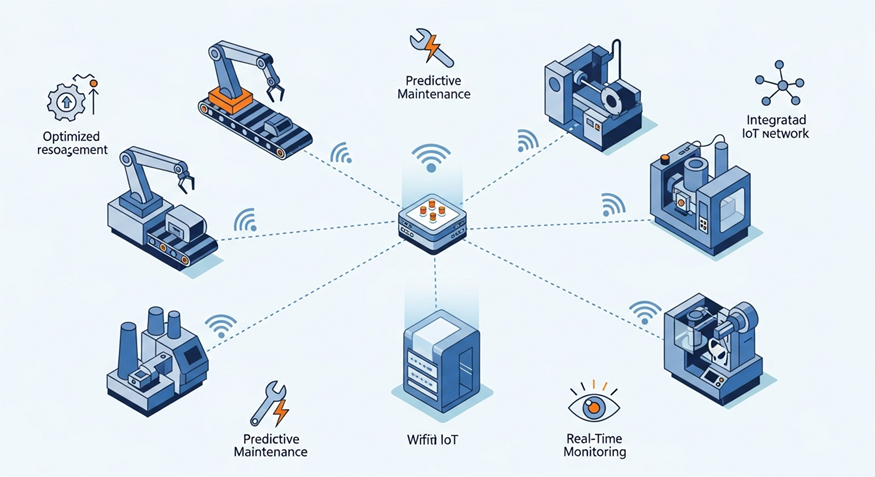
- Predictive maintenance alerts
- Real-time performance monitoring
- Automated quality control checks
- Optimized resource management
How Industrial Automation Transforms Manufacturing Efficiency
Industrial automation is a game-changer for manufacturing efficiency. By automating production processes, companies can operate faster, more consistently, and with fewer errors. These automation systems streamline everything from data acquisition to quality control, allowing for a level of optimization that is simply not possible with manual methods.
This transformation is driven by the ability to monitor operations in real time and make data-driven decisions. Let's examine how real-time monitoring and analytics provide immediate insights, and how this leads to tangible benefits like reduced downtime and significant improvements in product quality.
Real-time Production Monitoring and Data Analytics
Real-time monitoring is one of the most powerful benefits of smart automation. It gives you a live view of your entire production floor, allowing you to track progress against the production schedule, identify bottlenecks as they happen, and respond to issues immediately. This constant stream of information is crucial for maintaining a smooth and efficient workflow.
This data is then fed into data analytics engines. Using big data analytics, manufacturers can uncover hidden patterns and trends in their operations. For instance, you can analyze energy consumption to identify opportunities for savings or examine machine performance to optimize production speeds without sacrificing quality.
The insights gained from this analysis are invaluable. They enable you to make proactive, informed decisions rather than reacting to problems after they occur. This data-driven approach to management is what truly separates a smart factory from a traditional one, leading to continuous improvement and enhanced competitiveness.
Reduced Downtime and Quality Improvements
Unexpected downtime is a major drain on profitability. Smart automation addresses this with predictive maintenance. By analyzing data from sensors on your equipment, the system can predict when a machine is likely to fail and schedule maintenance before it breaks down. This proactive approach to downtime reduction is a significant advantage over traditional, reactive maintenance.
A maintenance management system integrated with your automation platform can streamline this process even further. It can automatically generate work orders, manage spare parts inventory, and track maintenance history, ensuring your equipment is always in top condition.
Furthermore, automation leads to remarkable improvements in product quality. Automated systems perform tasks with unwavering consistency, adhering to strict quality standards 24/7. This reduces human error, minimizes waste, and ensures that every product that leaves your factory meets the highest standards, enhancing your brand's reputation for quality.
Frequently Asked Questions (FAQs) on Smart Industry Automation
Navigating the realm of smart industry automation can raise several questions among those curious about its implications on production and efficiency. Common inquiries often include the role of automation systems in enhancing overall efficiency and the impact of machine learning on data collection. Understanding how predictive maintenance can minimize downtime and improve product quality is vital, as is recognizing the importance of regulatory compliance in automation processes. Engaging with FAQs helps demystify these concepts and offers clarity for businesses looking to adapt to these innovative solutions for industrial automation.
What factors should I consider when choosing an industrial automation solution provider?
When selecting from industrial automation companies, consider their experience, the range of automation products they offer, and their expertise with control systems. Ensure they understand your industry's needs for regulatory compliance and can provide ongoing support for their automation systems. Look for a partner, not just a vendor.
What industries benefit most from smart automation solutions?
Nearly every industry benefits from industrial automation. Key sectors include manufacturing, automotive, consumer goods, food and beverage, pharmaceuticals, and aerospace and defense industries. Automation optimizes the manufacturing process and streamlines the supply chain, boosting efficiency and quality across the board.
Are turnkey automation solutions a good fit for small and medium factories?
Yes, turnkey automation can be an excellent choice for small factories. These pre-engineered solutions for industrial automation are often more affordable and quicker to implement than custom systems. They provide a practical way for smaller operations to start their industrial automation journey and improve manufacturing efficiency without a massive upfront investment.
Conclusion
In conclusion, embracing smart industry automation is not merely a trend but a necessary evolution for businesses seeking to enhance efficiency and productivity. The innovations in control systems, sensors, and IoT integration pave the way for unprecedented improvements in manufacturing processes. By understanding the core concepts and types of solutions for industrial automation available, you can make informed decisions that align with your operational goals. As the industrial landscape continues to evolve, adopting these technologies will position your business for success in a competitive market. If you're ready to take the next step in automating your operations, reach out for a free consultation to explore tailored solutions for industrial automation that fit your needs.
You might also like