Industrial Automation Industry: Innovations Driving Change
Key Highlights
- Industrial automation uses connected control systems to run machines with less manual effort.
- Smart factories rely on automation systems to improve speed, consistency, and operational efficiency.
- Artificial intelligence is helping teams make better real time decisions and reduce downtime.
- Core tools include PLCs, SCADA, DCS, MES, sensors, and field devices.
- Fixed, programmable, and flexible automation each fit different production needs.
- Growth is rising as manufacturers seek smarter operations, safer work, and stronger output.
Introduction
Industrial automation is changing how companies manage the manufacturing process every day. Instead of depending heavily on manual steps, businesses now use control systems, connected machines, and software to keep production moving with better speed and consistency. You can see this shift across plants, warehouses, and processing sites in the United States. As demands grow, industrial automation is becoming a practical way to improve output, reduce interruptions, and support more reliable operations.
Exploring the Industrial Automation Industry: Key Insights
Defining the Industrial Automation Industry
At its core, the industrial automation industry focuses on using machines, software, and automation solutions to control industrial systems with less direct labor. It brings together hardware, data, and process control to keep operations steady and repeatable.
In practice, industrial automation works by linking equipment, sensors, and decision tools so tasks can be monitored and adjusted automatically. This setup helps businesses handle production with more accuracy, faster response times, and a stronger grip on daily performance. The next sections explain the technologies behind it.
Key Concepts and Core Technologies in Industrial Automation
Several building blocks make industrial automation possible. Control logic tells equipment what to do, when to do it, and how to respond when conditions change. That logic sits inside controllers and software that guide machines through repeatable steps.
Another important concept is programmable automation. Unlike hardwired setups, it lets teams update instructions for new products or batch production runs. This makes automation technology more adaptable when factories need to shift output without rebuilding the whole system.
On the plant floor, field devices collect data and carry out commands. Sensors measure conditions, actuators trigger movement, and industrial robots handle repetitive work with steady accuracy. Current trends shaping the industry include smarter connectivity, flexible programming, and more data-driven control that supports faster decisions across operations.

Types of Industrial Automation Systems
When people talk about the main types of industrial automation, they usually mean three common models. These automation systems are fixed automation, programmable automation, and flexible automation. Each one supports a different way of producing goods.
Fixed automation fits high-volume, repeated output. Programmable automation works well when product settings change in batches. Flexible automation supports faster shifts between production needs. Knowing these types helps you match the right system to the job. Next, let’s look at each one more closely.
Fixed and Hardwired Automation
Fixed automation, often called hard automation, is built for a stable production line with little variation. It works best when companies make the same item at high volume and want speed, consistency, and low unit cost.
This approach is especially useful for repetitive tasks that do not change often. Because the equipment is set up for a narrow purpose, it delivers dependable output but offers less freedom when production needs shift.
Typical traits include:
- High efficiency on a dedicated production line
- Strong performance for repetitive tasks
- Limited ability to adapt to new product designs
So, what major type does this represent? It is the best choice when product demand is steady and process steps remain nearly identical over long runs.
Programmable Automation in Modern Factories
Programmable automation gives factories more room to change. Instead of staying locked into one product, machines can follow new instructions when a production run changes. That makes this model useful for batch production and mixed output environments.
In modern factories, the heart of this setup is automation logic stored in control software. Teams can adjust sequences, timing, and machine behavior without replacing entire systems. This cuts disruption when production plans need updating.
You will often see programmable automation where product varieties are common but runs are still structured and repeatable. It offers a middle ground between rigid hard automation and highly adaptive systems. For many manufacturers, that balance supports practical flexibility without giving up consistency.
Flexible and Integrated Automation Solutions
Flexible automation is designed for operations that need quick adjustment. It allows equipment to switch between tasks or product types with less delay, making it valuable when production requirements change often.
This model is closely tied to integrated automation solutions used in smart factories. Machines, software, and data systems work together so changes can happen with less interruption. That helps businesses respond faster to shifting demand and shorter product cycles.
Key advantages include:
- Faster adaptation to changing production requirements
- Better coordination across connected automation solutions
- Strong alignment with smart factories and mixed product flows
Among the major types of industrial automation systems used today, flexible automation stands out when agility matters as much as output.
Core Components of Industrial Automation
Every automated setup depends on a few essential parts working together. Control systems direct operations, field devices collect or carry out signals, and programmable logic controllers handle key decisions at the machine level. These pieces keep automated tasks structured and reliable.
Just as important, control logic connects everything into one usable system. It tells machines how to respond to inputs, alarms, timing, and process conditions. To understand industrial automation clearly, it helps to break down these components one by one.

Role of Programmable Logic Controllers (PLCs)
Programmable logic controllers are one of the most important tools in industrial automation. They are built to manage machine actions quickly and reliably, even in demanding environments. In many automation systems, PLCs sit at the center of equipment control.
Their main job is to read inputs, apply control logic, and send outputs in real time. If a sensor detects a change, the PLC can respond almost immediately by starting, stopping, or adjusting a machine action. That speed helps maintain stable operations.
PLCs are popular because they are practical, durable, and easy to integrate with larger systems. Whether controlling one machine or part of a wider line, programmable logic controllers help turn process rules into precise action on the shop floor.
Use of SCADA, DCS, and MES
SCADA, DCS, and MES each support industrial automation in different ways. SCADA is used for supervisory control and data acquisition, giving operators a broad view of equipment status, alarms, and performance across a process.
DCS, or distributed control systems, are often used where many process steps must stay coordinated continuously. They help manage complex operations by distributing control across different areas while keeping the full process aligned.
MES, or manufacturing execution systems, connect production activity with planning and tracking. They can support work orders, production visibility, and coordination with ERP systems. Together, SCADA, DCS, and MES strengthen automation technology by linking machine control, monitoring, and operational management into a more complete system.
Sensors, Actuators, and Connectivity
Sensors and actuators are the hands and eyes of industrial automation. Sensors detect conditions such as position, pressure, or heat, while actuators carry out commands by moving, opening, stopping, or adjusting equipment. These field devices make automated control possible.
Connectivity ties those devices into a working network. When data moves smoothly between machines, controllers, and software, operations become easier to monitor and improve. That connection is a core part of modern automation performance.
Common examples include:
- Temperature sensors that track heat during production
- Actuators that trigger valves, motors, or mechanical movement
- Connected field devices that share signals across systems
Without strong connectivity, even the best sensors and actuators cannot support fast, coordinated responses.
Factory Automation vs. Broader Industrial Automation
Factory automation refers to the automated control of machines and workflows on the shop floor. It focuses on equipment, assembly tasks, line speed, and production consistency inside a plant. You see it most clearly in manufacturing settings.
Industrial automation is broader. It includes factory automation, but it also covers process operations, utilities, material movement, and connected control outside traditional plants. In short, factory automation is one part of the larger industrial automation landscape that supports smart manufacturing at scale.
Unique Focus Areas of Factory Automation
Factory automation has a clear center of gravity: the production line. Its purpose is to keep machines, workers, and materials moving in a steady sequence so output stays on target. That often includes assembly line tasks, machine timing, and coordinated motion.
The systems used here depend heavily on automation logic. Each machine action must happen in the right order, with the right timing, and under the right conditions. This is where controllers, sensors, and operational technology work closely together.
Because the focus is the shop floor, factory automation often emphasizes throughput, repeatability, and equipment coordination. It is less about wide process networks and more about making sure every stage of a physical production line performs smoothly from start to finish.
Overlaps and Differences with Industrial Automation
Factory automation and industrial automation overlap because both use control systems to reduce manual work and improve consistency. Both also support smart factories by helping machines and software operate in a coordinated way.
Still, there are important differences:
- Factory automation focuses mainly on equipment and workflows inside a plant
- Industrial automation includes process automation beyond the factory floor
- Industrial automation may cover utilities, handling systems, and broader operations
- Both aim to reduce routine human intervention, but at different scopes
So how do they relate overall? Factory automation is a specialized part of industrial automation. It handles production-focused tasks, while industrial automation covers a wider set of connected activities across industrial operations.

Current Market Size and Growth Prospects in the United States
The United States automation market continues to expand as industrial automation becomes more important across production, utilities, and logistics. Growth is supported by demand for better output, stronger visibility, and more adaptable operations. Large market players are helping drive that shift.
Market value is also influenced by sector-wise adoption. As more industries modernize equipment and software, automation spending spreads across a wider base. While growth patterns differ by sector, the direction is clear: automation is moving from an option to a strategic priority.
Market Value and Leading Players
In the United States, the automation market is shaped by strong demand and a mix of established market players. Companies investing in modernization often look for vendors with broad product lines, software support, and deep industrial experience.
Several names appear often in discussions about leading suppliers. Rockwell Automation has a strong presence in North America, while Schneider Electric and Siemens AG are major players across automation hardware, software, and integrated solutions.
Here is a simple text table showing their general role in the market:
| Market Players | General Focus in the Automation Market |
|---|---|
| Rockwell Automation | Factory control, PLCs, software, and production-focused systems |
| Schneider Electric | Energy management, automation solutions, and connected operations |
| Siemens AG | Broad industrial platforms, control systems, and digital tools |
Together, these companies influence buying decisions, technology direction, and market competition.
Sector-Wise Adoption Statistics
Sector-wise adoption does not happen evenly. Some industries automate earlier because they have high output demands, strict quality needs, or complex industrial systems. Others move more gradually due to older equipment or slower capital planning.
Manufacturing remains one of the strongest areas because the manufacturing process benefits quickly from machine control, repeatability, and better line coordination. The supply chain also gains from automation through tracking, handling, and improved flow between operations.
Smart manufacturing is pushing adoption further by connecting production data with planning and execution. As more sectors see practical value in visibility, consistency, and responsiveness, automation spreads beyond traditional factories into a wider range of industrial environments.
Predicted Growth Trends Through 2030
Looking toward 2030, growth trends point to broader use of connected automation technology across many industries. Businesses want systems that do more than run machines. They want tools that help predict issues, improve planning, and support better asset use.
That is why predictive maintenance is gaining attention. Instead of waiting for equipment failure, companies can use operating data to spot problems earlier and reduce disruption. This helps lower downtime and improves maintenance planning.
Digital twin tools are also shaping future demand. By modeling equipment or processes virtually, teams can test changes before applying them on site. Taken together, these growth trends suggest the market will continue expanding as companies seek smarter, more proactive operations.
Key Innovations Shaping the Industry
Industrial automation is moving forward through a set of practical new technologies. The biggest shifts involve automation technology that improves visibility, response speed, and system coordination. Companies are no longer focused only on machine control.
Now, artificial intelligence, robotics, and industrial iot are helping operations become more connected and adaptive. These innovations support better decisions, stronger process control, and more useful data across equipment networks. The next sections show how each of these changes is shaping the industry right now.
Artificial Intelligence and Machine Learning
Artificial intelligence is changing industrial automation by helping systems move beyond fixed responses. Instead of only following static rules, tools can analyze patterns, flag issues, and support decisions based on operating data. That makes automated environments more responsive.
Machine learning adds another layer by improving performance over time. It can recognize trends in equipment behavior and help teams identify early signs of wear or process drift. This is especially useful for predictive maintenance, where timing matters.
Agentic ai points toward even more active support. In real time environments, it may help coordinate actions, recommend adjustments, or guide operators through exceptions. The result is not the removal of people, but smarter systems that help teams act faster and with better information.
Industrial Internet of Things (IIoT)
Industrial iot connects machines, software, and field devices so data can move across operations more easily. This improves visibility and gives businesses a clearer picture of what is happening at every stage of production and handling.
That connectivity is a major reason smart factories continue to expand. When devices can share status, performance, and alerts quickly, teams gain better control and can respond to issues with less delay. Edge computing also helps by processing some data closer to the source.
Key benefits include:
- Better connectivity between equipment and systems
- Faster insight from connected field devices
- Stronger support for smart factories using edge computing
As a trend, industrial iot is shaping automation by making operations more informed, linked, and responsive.

Robotics and Collaborative Robots (Cobots)
Robotics remains a major force in industrial automation because robots handle work that needs speed, precision, or long periods of repetition. They are especially useful where output must stay steady and task variation is limited.
Collaborative robots, or cobots, bring a different approach. They are designed to work closer to people, supporting tasks rather than replacing every human role. This has made them attractive in environments facing labor shortages or changing staffing needs.
Common use cases include:
- Repetitive tasks that can cause fatigue over time
- Material handling between stations or storage areas
- Support for operations affected by labor shortages
Together, traditional robotics and collaborative robots help companies improve throughput while giving workers more support in demanding parts of the process.
Digital Twins and Simulation Technology
A digital twin is a virtual model of equipment, systems, or a full production process. It gives teams a way to study performance and test adjustments without interrupting actual operations. That makes planning more informed and less risky.
Simulation technology supports process optimization by showing how changes could affect throughput, timing, or resource use before anything is changed on the floor. This can save time when operations need to improve flow or introduce a new setup.
Cloud computing makes these tools easier to access across teams and sites. With shared data and virtual models, businesses can evaluate scenarios more efficiently. In practical terms, digital twin tools help companies make better decisions before changes reach live operations.
Industrial Automation Applications Across Leading Sectors
Industrial automation is now used across many sectors, but adoption is strongest where output, quality, and uptime matter most. Businesses turn to automation solutions when they need more consistent control over the manufacturing process or large-scale operations.
Leading use cases appear in manufacturing, automotive, pharmaceuticals, food processing, energy, and utilities. Each sector applies automation differently, yet the goal is similar: improve performance, reduce avoidable delays, and manage operations with better visibility. Let’s look at how this plays out across major industries.
Manufacturing and Automotive
Manufacturing and automotive are among the strongest adopters of industrial automation because both rely on speed, repeatability, and tightly managed workflows. In these settings, small delays can affect the entire production line.
Automation systems help control assembly, movement, and inspection with more consistency. Motion control is especially important in automotive operations, where machines must handle coordinated actions with high precision across multiple stages of the manufacturing process.
Typical applications include:
- Production line sequencing and synchronized machine actions
- Motion control for assembly and component positioning
- Automated handling that supports consistent automotive output
These sectors lead adoption because they gain clear value from faster throughput, lower variation, and better coordination across complex manufacturing environments.
Pharmaceuticals and Food Processing
Pharmaceuticals and food processing use automation technology to support consistency, cleanliness, and accurate handling. These sectors often need strict process discipline, which makes automated control especially useful for maintaining steady operations.
Quality control is a major reason adoption stays strong. Automated systems can support measured dosing, timing, packaging flow, and inspection routines with less variation than heavy reliance on manual labor. That helps reduce mistakes and support dependable output.
Even when people remain essential, automation gives teams better support for repetitive or sensitive steps. In both pharmaceuticals and food processing, the value comes from tighter control, improved repeatability, and more dependable process execution across busy production environments.
Energy, Utilities, and Beyond
Energy and utilities rely on automation because they operate large, continuous systems that need steady monitoring. These environments often involve distributed assets, long operating hours, and high expectations for reliability.
Supervisory control helps operators watch conditions, respond to alarms, and keep processes aligned across wide areas. Automation also supports operational efficiency by improving visibility into performance and helping teams respond faster when conditions shift.
Another key benefit is better control of maintenance costs. When systems are monitored more closely, problems can be identified earlier and service planning becomes more manageable. Beyond these sectors, similar automation principles are now spreading into other industrial operations that need dependable control at scale.
Main Benefits of Adopting Industrial Automation
Why do so many companies invest in industrial automation? The answer usually comes down to measurable gains in productivity, operational efficiency, and consistency. Automated systems help businesses keep work moving with fewer delays and better process control.
There are also wider advantages. Industrial automation can improve worker safety, reduce pressure from repetitive tasks, and support smarter resource use. For manufacturers, these benefits often add up to stronger daily performance and a more reliable operating model. The next sections break those gains down clearly.
Boosting Productivity and Efficiency
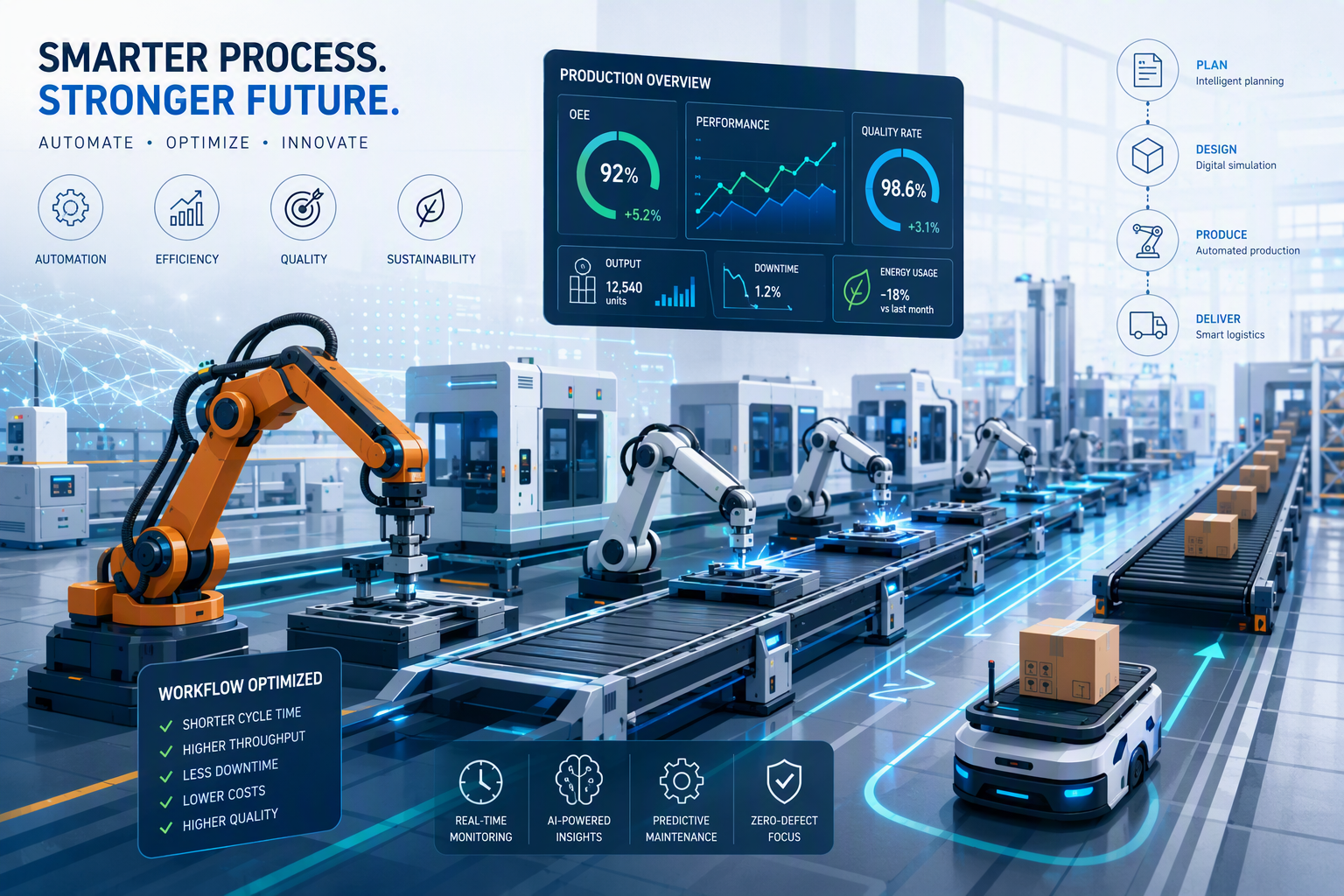
One of the clearest benefits of automation is higher productivity. Machines can perform repetitive tasks with steady speed, which helps companies keep operations moving without the slowdowns that often come with fully manual processes.
Efficiency improves for a similar reason. Automation systems reduce waiting, improve timing, and support smoother handoffs between tasks. When machines, sensors, and software work together, fewer interruptions stand in the way of output.
Process optimization also becomes easier because businesses can see where delays happen and adjust settings more quickly. In manufacturing, this means more consistent flow, better use of equipment, and stronger production performance over time. For many companies, productivity and efficiency gains are the first wins they notice.
Improving Quality and Reducing Errors
Automation helps improve quality because machines follow set instructions with steady precision. That reduces variation between units and makes it easier to maintain stable output, especially in environments where manual inconsistency can create problems.
Real time monitoring strengthens this even more. Sensors can detect changes as they happen, allowing automation solutions to respond quickly or alert operators before defects spread through a production run. This supports stronger quality control across the line.
Important advantages include:
- More reliable quality checks during active production
- Faster detection of issues through real time sensors
- Better consistency from automation solutions that follow fixed rules
When quality is monitored continuously, businesses can catch errors earlier and reduce waste more effectively.
Enhancing Worker Safety and Working Conditions
Industrial automation can make workplaces safer by shifting dangerous or physically demanding work away from people. Machines are well suited for hazardous tasks, especially when conditions involve heat, motion, or repetitive strain.
This does not remove the human operator from the process. Instead, it changes the role. People spend less time performing risky actions directly and more time supervising, adjusting, or managing exceptions. That balance supports safer daily routines.
Minimal human intervention in dangerous zones can also improve working conditions over time. When automation handles the hardest tasks, workers often gain a cleaner, more controlled environment and a role that relies more on oversight than physical exposure.
Optimizing Resource Use and Lowering Costs
Automation supports better resource use by helping companies run equipment more consistently and with clearer visibility. When processes are monitored closely, teams can avoid waste and keep operations aligned with planned output.
Automation technology also helps lower costs tied to inefficiency. Fewer interruptions, better timing, and more stable machine behavior can reduce losses that come from rework, delays, or uneven performance. That contributes directly to stronger operational efficiency.
Maintenance costs may improve as well when systems provide earlier warning of developing issues. Instead of reacting only after a breakdown, businesses can plan service more effectively. Over time, these gains in resource use and cost control make automation easier to justify.
Challenges and Barriers Facing the Industrial Automation Industry
Industrial automation brings major value, but adoption is not always simple. Many companies face integration problems when new tools must work with older equipment or separate software environments. Interoperability can also slow progress if systems do not communicate well.
Cybersecurity is another concern as connectivity expands. At the same time, workforce transformation creates pressure for reskilling so employees can manage changing roles. These barriers do not stop automation, but they do require careful planning before full deployment.
Integration and Interoperability Issues
Integration is one of the biggest challenges because industrial sites rarely start from scratch. Many already use older machines, separate software tools, and different control systems that were not designed to work together.
Interoperability becomes a problem when those systems cannot exchange data smoothly. A factory may have strong equipment on the operational technology side but weaker connections to information technology platforms that manage planning or reporting. That gap can limit visibility and coordination.
Fixing this takes time, cost, and technical effort. Businesses often need a clear strategy for linking information technology with operational technology in a way that supports performance without creating new complexity. If that planning is weak, automation projects can stall or underperform.
Cybersecurity Concerns
As industrial environments become more connected, cybersecurity becomes harder to ignore. Automation systems now exchange more signals, store more operating data, and depend on wider networks than many older plants were built to handle.
That creates risk in smart factories where data acquisition, control, and monitoring all depend on reliable digital access. The more connected the environment, the more important it is to protect machine communication, user access, and system integrity from disruption.
Edge computing adds value by processing data closer to equipment, but it also introduces more digital touchpoints that must be secured. For companies expanding automation, cybersecurity is not just an IT issue. It is a core operational concern tied directly to uptime and trust in the system.
Workforce Transformation and Reskilling Needs
Automation changes jobs as much as it changes machines. That is why workforce transformation is a major issue in the automation market. Companies need people who can supervise systems, interpret data, and manage exceptions, not only perform manual labor.
For many teams, this creates a gap between existing skills and future needs. A human operator may need training in digital interfaces, machine diagnostics, or coordinated process oversight. Without that support, adoption can create confusion instead of improvement.
Reskilling helps close that gap. It prepares employees to move into roles that focus more on monitoring, control, and decision support. Companies that invest in people alongside technology are usually better positioned to make automation work over the long term.
The Future of Industrial Automation: What Lies Ahead
The next decade of industrial automation will likely be defined by systems that are more connected, more adaptive, and more informed by data analytics. Businesses want technology that supports faster decisions and more flexible operations without adding unnecessary complexity.
Emerging trends also point to new business models built around service, software, and continuous improvement. As automation grows, companies will focus less on standalone machines and more on integrated value across the full operating environment. That future is already taking shape.
Emerging Trends and New Business Models
Several emerging trends are changing what companies expect from automation. Businesses now want systems that can adapt faster, connect more easily, and support continuous improvement across production, planning, and service.
This shift is encouraging new business models. Instead of buying isolated equipment only once, companies increasingly look for automation solutions that can be updated, expanded, and supported over time. That fits well with the broader move toward smart manufacturing.
Agentic ai may push this further by helping systems recommend or coordinate actions with less delay. As that capability develops, future business models may center more on ongoing optimization, software-driven value, and flexible service relationships rather than simple hardware replacement cycles.

Impact of AI and Data Analytics on Future Growth
Artificial intelligence and data analytics are expected to play a major role in future growth because they turn operating data into practical action. Instead of reacting after a problem appears, companies can use patterns and signals to act earlier.
Predictive maintenance is a clear example. When systems detect early signs of wear, teams can schedule service before a failure disrupts output. That helps reduce unplanned downtime and improves confidence in equipment performance.
Over time, this smarter use of data can make automation more valuable across many sectors. Better forecasting, faster decisions, and stronger process insight all support future growth. For companies planning ahead, artificial intelligence is becoming a practical tool for resilience and performance.
Conclusion
In summary, the industrial automation industry is undergoing remarkable transformations driven by innovative technologies. From the integration of AI and IIoT to the rise of collaborative robots, these advancements are enhancing productivity, safety, and efficiency across various sectors. As businesses navigate this evolution, understanding the benefits and challenges of adopting automation becomes crucial for success. Embracing these innovations not only streamlines operations but also prepares industries for future growth and adaptability. Whether you’re a manufacturer or a service provider, staying informed about these changes will empower you to harness the full potential of industrial automation. If you’re ready to take the next step, get in touch with us for a free consultation on how automation can transform your business.
Frequently Asked Questions
What industries are leading the adoption of industrial automation?
The strongest adoption of industrial automation is seen in sectors where the manufacturing process must stay fast and consistent. Automotive, pharmaceuticals, energy, and related manufacturing operations lead the way because they benefit from better control, repeatability, and improved uptime across complex workflows.
How is artificial intelligence changing the automation sector?
Artificial intelligence is helping control systems become more responsive and informed. Machine learning can identify patterns in equipment behavior, support predictive maintenance, and improve decisions in real time. Agentic ai may extend that further by guiding actions and helping operators manage changing conditions faster.
What challenges should companies consider before adoption?
Before adoption, companies should assess integration with current equipment, interoperability between systems, cybersecurity risks, and the need for reskilling staff. These issues can affect operational efficiency if they are overlooked. A clear plan helps businesses avoid disruption and get better results from automation investments.
You might also like