Predictive Maintenance vs Downtime Tracking
Predictive Maintenance vs Downtime Tracking: Why You Need Both to Protect Plant Capacity
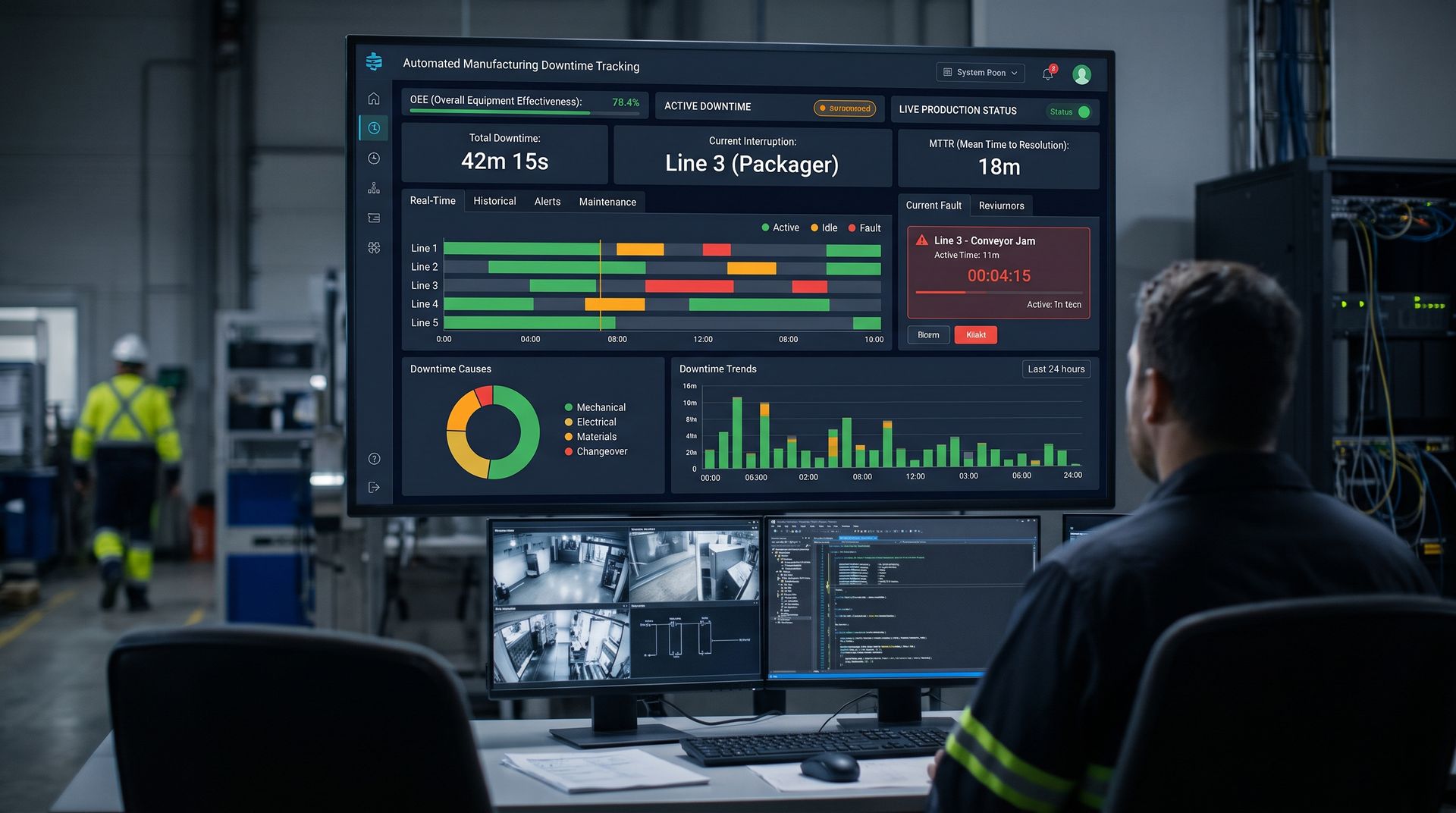
As manufacturing facilities pursue digital transformation and Industry 4.0 initiatives, plant leadership is frequently bombarded with vendor pitches for cutting-edge technologies. Two of the most common investments are Predictive Maintenance (PdM) systems—utilizing IoT sensors, vibration monitoring, and machine learning algorithms—and Automated Downtime Tracking systems—utilizing SCADA and Data Historians to capture OEE and stoppage metrics.
Unfortunately, many organizations treat these two technologies as competing initiatives. One camp of engineers argues: "If we buy an advanced predictive maintenance system, machines won't fail unexpectedly, so we won't need to worry about tracking downtime."
The other camp counters: "Downtime tracking gives us immediate visibility into why our lines are stopping today; advanced predictive analytics are an expensive distraction."
Both perspectives are fundamentally flawed.
Deploying predictive maintenance without downtime tracking is like installing high-tech smoke detectors in a building without an evacuation map: you receive alerts, but have no structural context for how those alerts impact the wider operation. Conversely, tracking downtime without predictive telemetry is like performing an autopsy: you know exactly how the patient died, but you were powerless to stop it.
Here is an analysis of how predictive maintenance and downtime tracking intersect, the costly mistakes plants make when deploying them in isolation, and how to combine them into a unified operational intelligence architecture.
Mistake #1: Deploying Predictive Maintenance on the Wrong Assets
Why it happens: Plants purchase a turnkey predictive maintenance package consisting of dozens of wireless vibration and temperature sensors. Technicians walk the floor and mount these sensors on the easiest, most accessible assets—typically large, standalone utility pumps, air compressors, and exhaust fans.
What it costs: Wasted capital and zero OEE improvement. An exhaust fan might give you months of beautiful, predictive vibration data, but that fan has not caused an unplanned stoppage in five years.
Meanwhile, your primary production bottleneck—a complex, high-speed cartoner—continues to suffer chronic, daily breakdowns that starve the entire plant. Because the plant has no automated downtime tracking to identify its true capacity constraints, PdM capital is squandered monitoring assets that have no bearing on daily production throughput.
The fix: Use Downtime Pareto Analysis to direct your predictive maintenance investments. Before spending a single dollar on PdM sensors, pull historical downtime data from your SCADA platform. Rank your machines by total lost production hours and frequency of unexpected stops.
Deploy predictive monitoring exclusively on the top 20% of assets causing 80% of your operational downtime. Downtime tracking tells you where to look; predictive maintenance tells you when to act.
Mistake #2: Siloing Predictive Sensor Data Away from the Plant SCADA Network
Why it happens: Many modern wireless PdM sensors come bundled with proprietary cloud portals. The sensor vendor installs an IoT cellular gateway, data streams directly to an external third-party dashboard, and technicians are given a separate smartphone app to view vibration spectra and thermal graphs.
What it costs: The creation of an isolated "data silo." Plant operators, controls engineers, and shift supervisors who spend their working hours inside the main SCADA control room have zero visibility into the PdM portal.
When a predictive sensor detects elevated bearing friction and flashes an alert inside the proprietary cloud app, the machine operator running the line in the factory has no idea. The machine is run hard until the bearing seizes, causing the exact breakdown the PdM system was purchased to prevent.
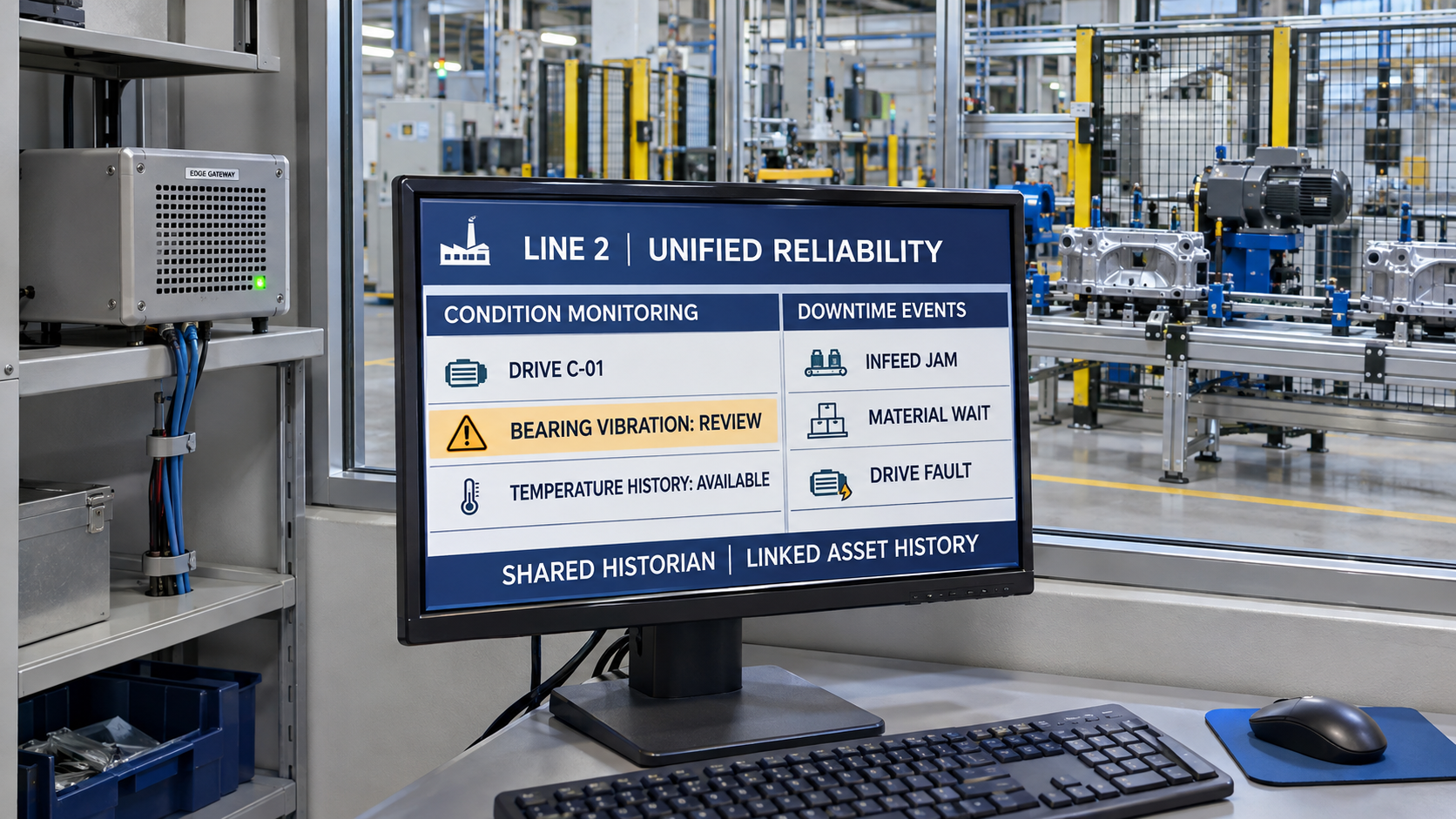
The fix: Unify your telemetry inside an open industrial architecture. Empowered Automation utilizes native IoT device connectors, MQTT Sparkplug B, and OPC UA to ingest vibration, temperature, and electrical telemetry directly into your central Data Historian and SCADA platform.
When a predictive sensor detects anomalous mechanical behavior, the warning flashes directly on the machine's primary HMI and SCADA overview screen, allowing operators and maintenance to coordinate actions within their normal operating workflow.
Mistake #3: Ignoring the Stoppages That Predictive Maintenance Cannot Predict
Why it happens: Plants invest heavily in predictive maintenance and expect their overall downtime numbers to collapse to near zero. When downtime remains high, leadership becomes disillusioned with the technology.
What it costs: Frustration and misdirected resources. Predictive maintenance is brilliant at detecting gradual, mechanical degradation: bearing wear, shaft misalignment, gearbox tooth pitting, and motor insulation breakdown.
However, in discrete manufacturing, packaging, and assembly operations, the majority of downtime is not mechanical degradation. It is caused by:
- Sensor misalignments and optical blinding.
- Upstream packaging material variations (warped cardboard, thin plastic film).
- Pneumatic pressure fluctuations.
- Operator mistakes and recipe errors.
- Upstream starvation and downstream blockage.
Predictive vibration sensors will never predict a carton jam or an out-of-spec roll of film. If you rely solely on PdM, you leave your largest sources of daily downtime completely unmanaged.
The fix: Build a balanced reliability strategy. Use predictive maintenance to safeguard critical rotating machinery against catastrophic mechanical failure, and use automated SCADA downtime tracking to identify, categorize, and eliminate operational, material, and electrical stoppages.
Mistake #4: Failing to Validate PdM Predictions Against Actual Downtime Records
Why it happens: A PdM system flags a "Stage 2 Bearing Fault" on a conveyor motor. Maintenance plans an intervention, replaces the motor, and logs the task. However, no one ever verifies whether that motor was actually approaching failure, or whether the algorithm threw a false positive due to ambient machine vibration.
What it costs: Over-maintenance and erosion of technician trust. If maintenance crews spend weekends replacing bearings that look brand-new upon physical teardown, they will quickly begin ignoring the predictive alerts entirely. Once technicians lose faith in the predictive algorithm, the system becomes shelfware.
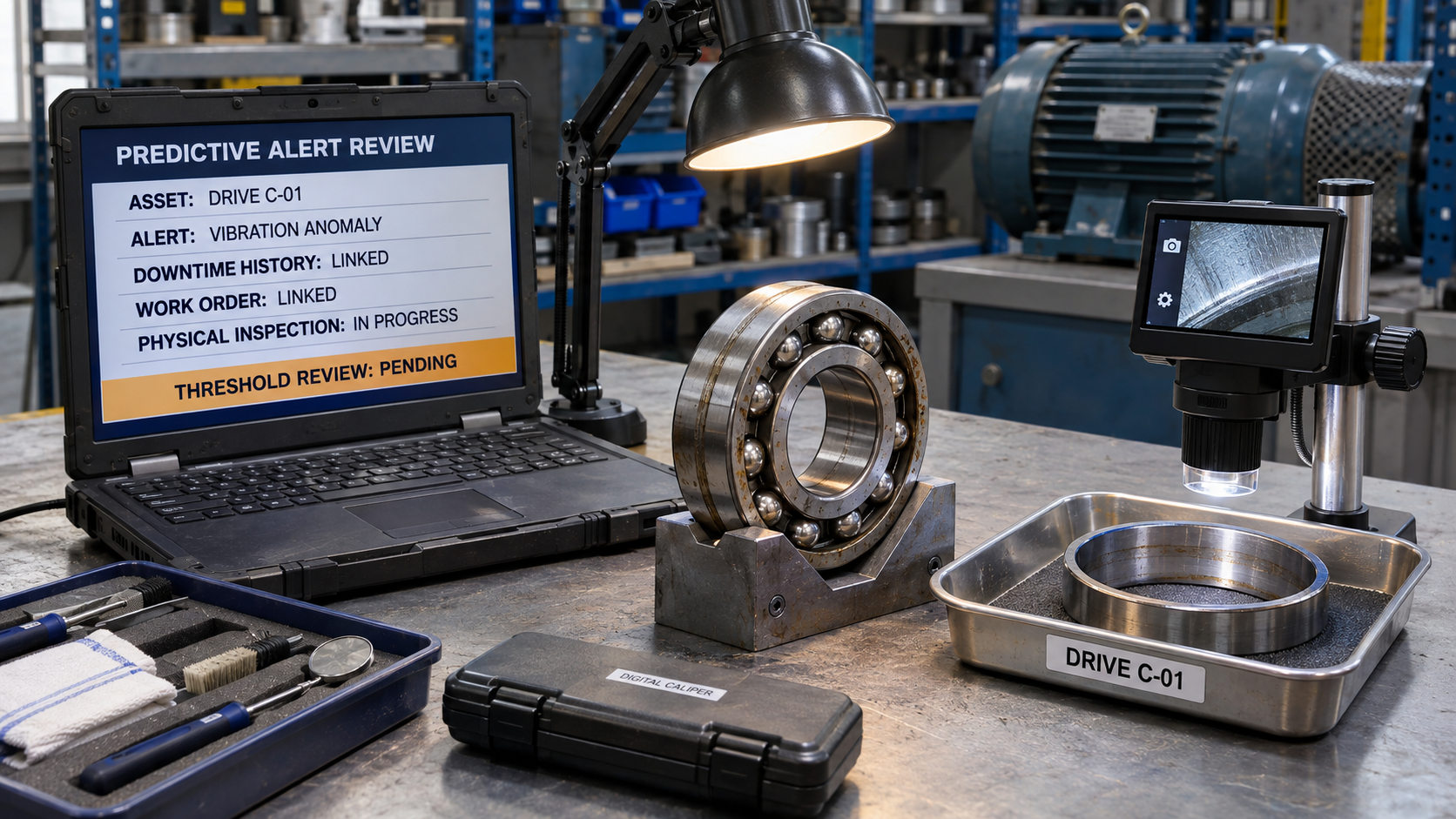
The fix: Close the loop between PdM predictions and downtime history. When a machine experiences an unplanned stop, query the Data Historian: did the predictive telemetry show a corresponding anomaly in the days leading up to the trip?
If yes, the predictive threshold was validated. If the machine tripped without any predictive warning, or if an alert was triggered on healthy equipment, the algorithms and sensor placements must be tuned. Continuous cross-validation between predictive tags and actual downtime records is the only way to build a reliable maintenance engine.

The Complementary Roles: PdM vs. Downtime Tracking
Understanding the distinct functions of these two systems is critical for making strategic automation investments:
Metric / DimensionAutomated Downtime Tracking (SCADA/Historian)Predictive Maintenance (PdM / Telemetry)Primary PerspectiveHistorical / Retrospective: Analyzes where production was lost, why it stopped, and what it cost.Proactive / Predictive: Analyzes current physical degradation to forecast future failure before it occurs.Primary Data SourcePLC states, interlock bits, operator inputs, cycle times, and scrap counts.High-speed vibration spectra, ultrasound, thermal imaging, and motor current signatures.Failures AddressedJams, material splits, sensor faults, operator errors, line imbalances, recipe flaws.Bearing spalling, gear wear, motor winding failure, shaft unbalance, lubrication loss.Primary BeneficiaryOperations Managers, Continuous Improvement Teams, Plant Directors.Reliability Engineers, Maintenance Planners, Mechanical Technicians.Strategic FunctionPinpoints the plant's bottlenecks and reveals where to invest capital.Protects the plant's bottlenecks from catastrophic physical destruction.
Unified Reliability Architecture Audit Checklist
Assess whether your facility has successfully integrated predictive telemetry with downtime tracking:
- [ ] Data Integration: Do predictive sensor streams (vibration, temperature) feed into the same Data Historian that logs machine downtime?
- [ ] Targeted Placement: Are your predictive sensors deployed strictly on equipment identified as primary line bottlenecks by Downtime Pareto charts?
- [ ] Control Room Visibility: Are predictive maintenance warnings visible to operators on primary SCADA screens and line HMIs?
- [ ] Comprehensive Coverage: Does your operational tracking capture non-mechanical downtime (jams, material issues, starvation) alongside mechanical breakdowns?
- [ ] Algorithm Validation: Are predictive alerts regularly cross-referenced against post-repair physical inspections to eliminate false positives?
Conclusion
Predictive Maintenance and Downtime Tracking are not rivals; they are two halves of the same operational brain. Downtime tracking provides the macro-level operational map, exposing the bottlenecks, micro-stops, and procedural friction that bleed plant capacity. Predictive maintenance provides the micro-level mechanical lens, protecting critical equipment from sudden, catastrophic failure.
Plants that attempt to deploy one without the other inevitably struggle—either spending fortunes monitoring non-critical assets or endlessly cataloging breakdowns they have no power to prevent.
By unifying both disciplines within a centralized SCADA and Data Historian architecture, you arm your team with the actionable intelligence required to run a high-output, highly reliable manufacturing facility.
Ready to Unify Your Predictive and Downtime Systems?
Empowered Automation Solutions designs unified industrial control architectures that bridge the gap between predictive maintenance and downtime intelligence. From integrating smart IO-Link vibration sensors directly into PLC logic to architecting enterprise-wide SCADA platforms and Data Historians, our team ensures your reliability data is clear, actionable, and centralized.
Connect with our engineering team to modernize your plant's data systems:
- Phone: (630) 553-0411
- Email: info@empoweredautomation.com
- Address: 1905 Marketview Dr., Suite 138, Yorkville, IL 60560
Frequently Asked Questions
Can our existing SCADA system handle high-frequency vibration data for predictive maintenance?
Yes, provided the architecture is designed correctly. While high-speed raw vibration spectra are often processed at the edge by dedicated vibration processors or IO-Link master modules, the calculated scalar values (such as RMS velocity, peak acceleration, and high-frequency defect metrics) can easily be streamed into standard SCADA platforms like Ignition or FactoryTalk over OPC UA or MQTT.
Which technology should we invest in first: Downtime Tracking or Predictive Maintenance?
In almost every scenario, Automated Downtime Tracking should come first. Without automated downtime tracking, you do not have objective data proving which machines are your true bottlenecks. Installing downtime tracking first provides the financial and operational roadmap showing exactly which assets warrant an investment in predictive monitoring.
How does integrating PdM data into a Data Historian save money?
It eliminates expensive, proprietary third-party software subscriptions. By streaming predictive telemetry directly into your on-premise or private-cloud industrial Data Historian, you retain full ownership of your time-series data, can correlate it freely with process variables, and avoid paying recurring per-sensor cloud licensing fees to third-party vendors.
You might also like