SCADA Applications: Revolutionizing Industrial Operations
SCADA Applications: Revolutionizing Industrial Operations

Key Highlights
- A SCADA system is essential for industrial automation, providing real-time data acquisition and process control.
- It combines hardware and software for high-level supervision of industrial processes, boosting operational efficiency.
- Key components include the HMI, RTUs, PLCs, and the communication network that connects everything.
- SCADA is used across critical sectors like energy, water treatment, and manufacturing for monitoring and control.
- Integrating a SCADA control system improves productivity, enhances safety, and allows for better decision-making.
- Strong cybersecurity measures are crucial to protect these vital systems from unauthorized access and cyber threats.
Introduction
Welcome to the world of industrial automation! Have you ever wondered how large-scale industrial processes, like power grids or water treatment plants, run so smoothly? The secret often lies in powerful technology. SCADA applications are at the heart of modern industry, providing the tools to monitor, manage, and optimize complex operations from a central location. This technology is a game-changer for boosting operational efficiency and ensuring that our critical infrastructure functions reliably around the clock.
Understanding SCADA in Industrial Operations
SCADA, which stands for Supervisory Control and Data Acquisition, is a type of industrial control system that gives operators a high-level view of their entire operation. It acts as the central nervous system for vast industrial environments, collecting information and enabling control over equipment spread across large distances.
This system is not about direct, moment-to-moment machine control but rather about supervising the entire process. A SCADA system empowers human operators to make smart decisions, automate complex tasks, and keep industrial operations running efficiently and safely. Let's explore what SCADA is, its core functions, and how it operates in the real world.
What is Supervisory Control and Data Acquisition (SCADA)?
Supervisory Control and Data Acquisition (SCADA) is a specialized industrial control system designed for managing and monitoring large-scale industrial processes. Think of it as a "supervisory-level" control system that provides a comprehensive overview of operations, especially those that power critical infrastructure for entire countries. Its main goal is to simplify the management and automation of these complex systems.
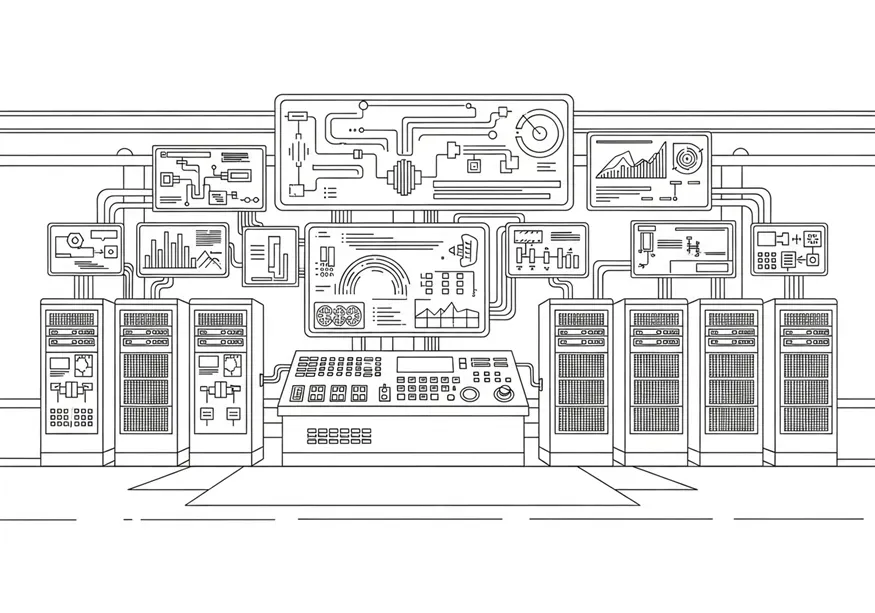
At its core, a SCADA system focuses on two primary functions: data acquisition and supervisory control. It gathers data from sensors and equipment in the field and presents it to a human operator in an understandable format. This allows for effective monitoring and informed decision-making.
While sometimes used interchangeably with the broader term Industrial Control System (ICS), SCADA is technically a specific type of ICS. Its purpose is to provide a universal way to remotely access and manage a variety of local control modules, even if they come from different manufacturers, using standard automation protocols.
Core Functions of SCADA Systems
SCADA systems are built to perform several essential functions that help organizations streamline their industrial processes. The primary goal is to enhance process control and boost operational efficiency by providing operators with the tools they need to manage complex systems effectively.
These systems excel at process monitoring in real time. They continuously gather information from the field, allowing operators to see exactly what is happening at any given moment. This constant flow of data is crucial for maintaining stability and performance. Based on this information, operators can issue control commands to adjust operations as needed.
The core functions that make this possible include:
- Data Collection: Gathering real-time data from sensors, meters, and other field devices.
- Monitoring and Visualization: Presenting collected data through graphical interfaces so operators can easily understand the system's status.
- Control: Sending commands to remote equipment to perform actions like opening a valve or starting a motor.
- Alarming: Notifying operators immediately when a problem or abnormal condition arises.
How SCADA Works in Real-World Settings
In a practical application, a SCADA system connects numerous individual control modules and field devices across a distributed network. These devices, such as sensors measuring temperature or pressure, collect raw process data directly from the industrial equipment. This information is then relayed to a central control station.
At the central station, the SCADA software processes and displays this data for human operators. This provides a complete picture of the ongoing industrial processes, even if they span multiple sites over large distances. The system enables remote access, allowing supervisors to monitor everything without being physically present at each location.
Based on the incoming data, control actions can be initiated. Some actions are automated and pre-programmed, while others require human intervention. For example, if a sensor detects a dangerously high pressure level, the system can automatically trigger a shutdown sequence or alert an operator to take manual control and resolve the issue.
Key Components of a SCADA System
A functional SCADA system is more than just software; it’s a complex architecture of interconnected hardware and software working in harmony. Understanding the key components is essential to grasping how SCADA enables industrial automation and provides the foundation for advanced analytics. Each part has a specific role, from interacting with operators to controlling machines in the field.
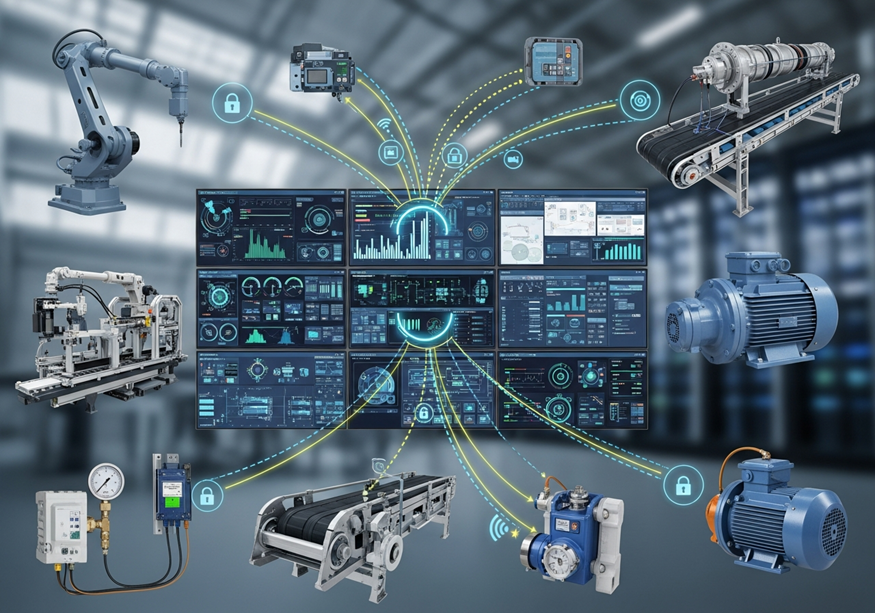
These components work together to collect data, execute commands, and present information in a useful way. We'll look closer at the Human-Machine Interface (HMI), Remote Terminal Units (RTUs), Programmable Logic Controllers (PLCs), and the communication infrastructure that ties the entire SCADA architecture together.
Human-Machine Interface (HMI)
The Human-Machine Interface, or HMI, is the user-facing component of the SCADA system. It's the graphical user interface that allows operators in a control room to interact with the machinery and processes. Essentially, the HMI translates complex process data into easy-to-understand visual representations like charts, diagrams, and alarms.
This HMI software is what operators use to monitor the system's status in real time, acknowledge alarms, and send control commands to the equipment. It provides a centralized point of view, compiling and presenting all the critical information needed for a human supervisor to make informed decisions.
Without a well-designed user interface, the vast amounts of data collected by the SCADA system would be overwhelming. The HMI is one of the most vital system components because it bridges the gap between the human operator and the industrial process, enabling effective supervision and control.
Remote Terminal Units (RTUs)
Remote Terminal Units, known as RTUs, act as crucialintermediaries in a SCADA system. These are small, ruggedized computers placedat remote locations to connect the central supervisory system with the fielddevices, like sensors and actuators. Their main job is to collect data fromthese devices and transmit it back to the main system.
RTUs are more than just simple data collectors. They canperform some limited preprocessing and control logic on their own. For example,an RTU might convert an analog sensor reading into a digital signal or filterout unnecessary data before sending it over the communication infrastructure.This reduces the load on the central system.
By serving as the link between the field and the controlroom, RTUs are essential for enabling remote access and control. They gatherthe data stream from sensors and pass along commands from the SCADA system tothe actuators, making sure the right actions are taken in the field.
Programmable Logic Controllers (PLCs)
Programmable Logic Controllers, or PLCs, are theworkhorses of industrial automation. These are robust, industrial-gradecomputers designed to execute control logic and automate specific tasks withina process. While RTUs are great for remote data gathering, PLCs are optimizedto carry out predefined control algorithms with high efficiency andreliability.
PLCs are programmed to make real-time decisions at thelocal level. For instance, a PLC can control the sequence of operations on anassembly line or manage the start-and-stop functions of a pump based on sensorinputs. They often use programminglanguages like Ladder Logic, which is specifically designed for industrialcontrol applications.
In a SCADA system, PLCs handle the direct,hands-on control of machinery. They process monitoring information and transmitit to the HMI for operator review, but their primary purpose is to execute thecontrol logic that keeps the industrial process running automatically andsmoothly.
Communication Infrastructure and Sensors
The communication infrastructure is the backbone of any SCADA system, connecting all other components. This network is responsible for the reliable transmission of data, ensuring that sensor data reaches the central system and control commands reach the PLCs and RTUs without delay. This infrastructure can involve a mix of wired and wireless technologies.
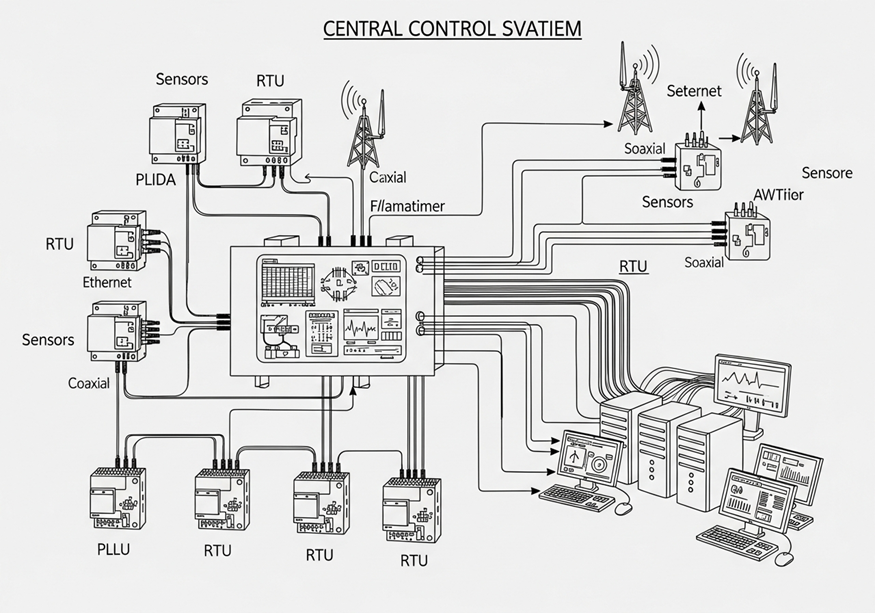
At the field level, networks connect sensors, actuators, and PLCs, often using standard automation protocols like Modbus. For longer distances, the system relies on wide area networks (WANs), including cellular or satellite communications, especially for enterprise applications.
The devices that generate the data are the sensors and actuators.
• Sensors: These devices measure physical properties like temperature, pressure, or flow and convert them into electrical signals.
•
Actuators: These devices receive commands and perform physical actions, such as opening a valve or turning on a motor. This continuous flow of data acquisition is what powers the entire SCADA system.
Industrial Automation Powered by SCADA
Industrial automation is all about using technology toperform tasks that were once done manually, and SCADA systems are a cornerstoneof this revolution. By providing centralized process control, SCADA transformshow industries manage their production processes. It enables operators tooversee and manage vast operations in real time from a single screen.
This capability to monitor and control from a distance iswhat makes SCADA so powerful. It helps automate data collection, streamlineevent handling, and ensure that every part of the operation is running as itshould. Let's explore how SCADA enables process monitoring, automated dataanalysis, and effective alarm management.
Process Monitoring and Remote Control
One of the most significant advantages of a SCADAsystem is its ability to facilitate process monitoring and remote control.Operators can view real-time data from equipment located at various remotesites without needing to be physically present. This is incredibly valuable for industries with geographically dispersed assets, like pipelines or power grids.
The control system gathers data from sensors and displaysit on the HMI, giving operators a live view of everything happening in thefield. This continuous stream of information allows them to spot anomalies ordeviations from normal operating parameters instantly.
With this information at their fingertips, operators can then exercise remote control. They can issue commands through the HMI to adjust settings, start or stop equipment, or respond to issues from the central control room. This capability for rapid, remote intervention ensures that processes remain efficient and safe, minimizing downtime and potential problems.
Automated Data Collection and Analysis
Beyond real-time monitoring, SCADA systems excel at automated data collection and analysis. The system continuously gathers vast amounts of process data from all connected devices and stores it in a database, often called a data historian. This creates a rich repository of historical data that is invaluable for long-term analysis.
This automated data collection removes the need for manual logging, saving time and reducing human error. The collected information provides a detailed record of the system's performance over time. This data can be used to identify trends, troubleshoot recurring issues, and find opportunities for process optimization.
By applying advanced analytics to this historical data, organizations can gain deep insights that drive productivity. These insights help with:
• Identifying patterns in equipment performance to predict failures.
• Optimizing energy consumption and resource allocation.
• Generating reports for regulatory compliance and performance reviews.
Event and Alarm Handling
Effective event and alarm handling is a critical function of any SCADA system. Through continuous monitoring, the system tracks all operational parameters against predefined thresholds. When a parameter goes outside its normal range—for example, if a tank level is too high or a pressure reading is too low—the system automatically generates an alarm.
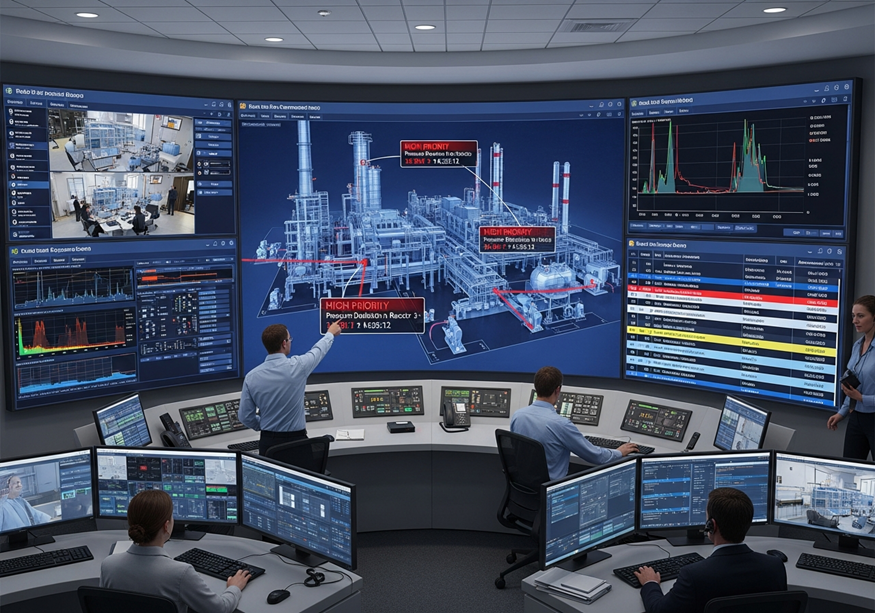
These alarms are immediately sent to the operators in the control room, alerting them to potential problems. The alarms can be prioritized based on their severity, ensuring that the most critical issues are addressed first. This allows for a rapid response, helping to prevent equipment damage, safety incidents, or costly downtime.
In addition to alarms, SCADA systems also log all system events. This event handling provides a complete audit trail of everything that happens, from routine operator actions to major system alerts. This record is essential for post-incident analysis, troubleshooting, and understanding the sequence of events that led to a problem.
SCADA Across Different Industries
The versatility of SCADA systems makes them indispensable across many different industries, particularly those that manage critical infrastructure. From ensuring we have clean water to keeping the lights on, SCADA plays a quiet but crucial role. Its ability to handle remote monitoring and control of complex production processes is what makes it so widely adopted.
Whether it's managing a city's water supply, a nation's power grid, or a factory's assembly line, a SCADA system provides the necessary oversight to maintain efficiency and reliability. Let's look at a few examples of how SCADA is applied in water management, energy utilities, and manufacturing.
Water and Wastewater Management
In the water and wastewater industry, SCADA systems are fundamental to daily operations. They are used to monitor and control every stage of the water treatment and distribution process. This includes monitoring water levels in reservoirs, managing chemical dosages for purification, and ensuring equipment like pumps and valves are performing correctly.
These systems are particularly useful for managing wastewater collection systems, which often cover large geographical areas with many remote locations. A SCADA system allows operators to monitor pump stations and flow rates from a central control room, ensuring that the system operates efficiently and prevents overflows.
By providing precise process control, a SCADA system helps maintain water quality standards and optimize energy consumption. Operators can remotely adjust treatment processes based on real-time data, ensuring the delivery of safe drinking water while keeping operational costs down.
Energy Utilities and Power Generation
Energy utilities rely heavily on SCADA systems to manage the generation, transmission, and distribution of electricity. In power generation, SCADA monitors critical equipment in power plants, whether they are traditional fossil fuel plants or renewable sources like solar farms and wind turbines. This oversight helps maximize uptime and efficiency.
For power transmission and distribution, a SCADA system monitors substations and power lines to prevent overloads and blackouts. Operators can collect data on energy consumption and balance loads across the grid in real time. This is especially important with the rise of smart grids, where SCADA integrates with IoT sensors for more dynamic power management.
By providing a centralized view of the entire grid, SCADA helps energy utilities respond quickly to faults, optimize power distribution, and maintain a stable supply of electricity to consumers. This level of control is essential for the reliability of our modern power infrastructure.
Manufacturing and Facility Operations
In the world of manufacturing, SCADA systems are key to automating and optimizing production processes. They are used to monitor and control everything from individual machines and assembly lines to entire factory operations. This allows manufacturers to track production metrics, monitor machinery health, and maintain quality standards in real time.
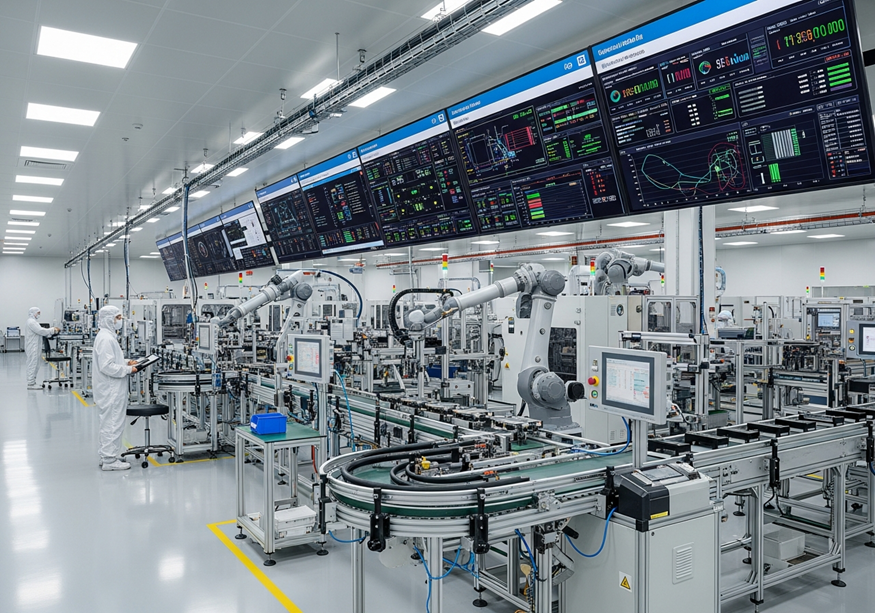
SCADA software provides operators with a detailed view of the factory floor, enabling them to see how different parts of the production process are performing. For example, they can monitor the speed of conveyor belts, the operation of robotic arms, and the temperature of industrial ovens, making adjustments as needed to improve efficiency.
Beyond the production line, SCADA is also used in facility operations for managing building systems like HVAC, lighting, and energy consumption. In smart buildings, the control system helps optimize resource use and maintain a comfortable and safe environment, contributing to overall operational efficiency and cost savings.
SCADA System Security and Cyber Protection
As SCADA systems become more connected, especially with the integration of IoT and cloud technologies, SCADA security has become a primary concern. These systems control our critical infrastructure, making them attractive targets for cyberattacks. A successful attack could cause significant physical damage and widespread disruption.
Ensuring robust cyber protection is essential for safeguarding these vital system components from unauthorized access and malicious activity. This involves understanding the common threats and implementing a multi-layered security strategy. Let's examine the typical cybersecurity risks and the best practices for critical infrastructure protection.
Common Cybersecurity Risks and Threats
SCADA networks face a growing number of cybersecurity risks due to their increased connectivity with corporate networks and the internet. In the past, these systems were often isolated, but modern integration has exposed them to new threats. One of the biggest risks is unauthorized access, where malicious actors gain control of the system.
These threats can exploit system vulnerabilities in software, hardware, or network protocols. Since many SCADA components have long lifecycles, they may run on older software that is difficult to patch, leaving them exposed. A lack of strong access control measures can also make it easier for attackers to move through the network once they gain a foothold.
Common cybersecurity risks include:
- Malware infections, such as ransomware, that can disrupt operations.
- Denial-of-service (DoS) attacks that overwhelm the network and make the system unavailable.
- Man-in-the-middle attacks that intercept and alter communication between system components.
- Insider threats, both intentional and unintentional, from employees with system access.
Best Practices for Safeguarding SCADA Systems
Protecting a SCADA system from cyber threats requires a comprehensive and proactive approach. Implementing a defense-in-depth strategy with multiple layers of security measures is one of the most effective best practices. This ensures that if one layer is breached, others are in place to stop the attack.
A fundamental step is to segment the network. This involves isolating the critical systems of the SCADA network from the corporate IT network and the internet using firewalls and other security controls. This limits the potential attack surface and makes it harder for intruders to move laterally within the network.
Other key security measures include:
- Strong Access Control: Implement role-based access control to ensure users only have access to the parts of the system they need to do their jobs.
- Continuous Monitoring: Actively monitor network traffic and system logs for any signs of suspicious activity or anomalies.
- Regular Patching and Updates: Keep all software and firmware up to date to protect against known vulnerabilities.
- Employee Training: Educate employees on cybersecurity best practices to prevent phishing attacks and other social engineering tactics.
Advantages of Implementing SCADA
Adopting a SCADA system brings a host of benefits that can transform industrial operations. The primary advantage is a significant boost in operational efficiency, leading to substantial cost savings over time. By providing real-time data and control, these systems empower organizations to optimize their processes like never before.
From enabling predictive maintenance to ensuring compliance with quality standards, the advantages are clear. A SCADA system helps improve productivity, enhance safety, and support smarter, faster decision-making. Let's delve into how these benefits are realized across different aspects of an operation.
Improved Efficiency and Productivity
One of the most compelling reasons to implement a SCADA system is the dramatic improvement in efficiency and productivity. By automating many complex and repetitive tasks, SCADA reduces the need for manual intervention. This not only frees up personnel for more strategic work but also minimizes the potential for human error in critical processes.
These automated processes lead to more consistent and reliable operations, which directly translates to increased productivity. For example, a SCADA system can optimize machine runtimes and regulate flow rates with a level of precision that is difficult to achieve manually. This helps maximize output while using resources more effectively.
Furthermore, SCADA contributes to lower maintenance costs. By monitoring equipment health in real time, the system can help identify potential issues before they cause a breakdown. This shift from reactive to predictive maintenance reduces unplanned downtime and extends the life of industrial equipment, boosting overall operational efficiency.
Enhanced Safety and Regulatory Compliance
Safety is a top priority in any industrial environment, and SCADA systems play a crucial role in creating a safer workplace. The system's ability to monitor for hazardous conditions—like high temperatures, pressure build-ups, or gas leaks—and trigger automated safety shutdowns can prevent accidents before they happen.
For industries that manage critical infrastructure, ensuring regulatory compliance is non-negotiable. SCADA systems simplify this by providing accurate, continuous monitoring and logging of data. This historical data serves as a verifiable record to demonstrate adherence to environmental and safety regulations, as well as internal quality standards.
The advanced analytics capabilities of modern SCADA systems can also be used to identify potential safety risks by analyzing trends and patterns in the data. By proactively addressing these risks, organizations can create a more secure environment for their employees and the public while ensuring they meet all their compliance obligations.
Real-Time Decision Making
The ability to make fast, informed decisions is a major competitive advantage, and SCADA systems provide the foundation for real-time decision making. By presenting live process data in an intuitive format, SCADA gives operators the immediate insight they need to understand what's happening and how to respond.
When an issue arises, operators don't have to wait for manual reports or travel to a remote site to diagnose the problem. They can see the relevant data on their HMI screen instantly, allowing for a rapid response. This could involve making a quick adjustment to a process or initiating specific control actions to resolve an alarm.
This access to real-time information empowers everyone from the control room operator to the plant manager to make better decisions. Whether it’s optimizing production on the fly or managing an emergency, the ability to act quickly and confidently based on accurate data is one of the most powerful benefits of a SCADA system.
Comparing SCADA with Other Automation Systems
While SCADA is a powerful tool for industrial automation, it's not the only type of control system out there. It's helpful to understand how a SCADA system compares to other different systems, such as Distributed Control Systems (DCS) and Programmable Logic Controllers (PLCs). Each has a unique control system architecture and is designed for different purposes.
The key differences often come down to scale, function, and how they handle control logic. SCADA excels at supervising a variety of local control modules over large areas, while other systems may be more focused on tight, localized control. Let's compare SCADA with DCS and PLCs to clarify their distinct roles.
SCADA vs. DCS (Distributed Control Systems)
A common point of comparison is between a SCADA system and a Distributed Control System (DCS). While both are used for industrial process control, they have different strengths and are typically used in different contexts. The main difference lies in their architecture and primary focus. A DCS is process-oriented, while SCADA is data-acquisition oriented.
A DCS is typically found within a single plant or facility and is designed for tight, continuous control of complex processes. It integrates control, monitoring, and operator interface into a single system, with controllers distributed throughout the plant. In contrast, the SCADA architecture is designed to supervise processes over large geographical areas, connecting multiple remote sites to a central control room.
Essentially, a DCS offers a more holistic and integrated control solution for a localized process, while a SCADA system is better suited for monitoring and supervising geographically dispersed assets.
| Feature | SCADA System | DCS (Distributed Control System) |
|---|---|---|
| Primary Focus | Data acquisition and supervisory control | Process control and regulation |
| Architecture | Centralized supervision of remote sites | Distributed control within a single site |
| Orientation | Event-driven; responds to changes | Process-driven; continuous control |
| Typical Use Case | Pipelines, power grids, water systems | Chemical plants, refineries, power plants |
SCADA vs. PLC (Programmable Logic Controllers)
It's important to understand that a SCADA system and Programmable Logic Controllers (PLCs) are not mutually exclusive; in fact, they often work together. The key difference is their role in the automation hierarchy. A PLC is a specific hardware device that executes control logic, while SCADA is a software-based system that supervises the overall process.
PLCs operate at the field level, directly controlling individual machines and processes. They are programmed with languages like Ladder Logic to execute specific, high-speed control tasks based on sensor inputs. For example, a PLC might control a single conveyor belt or a filling machine on a production line.
In contrast, a SCADA system sits at a higher level, overseeing multiple PLCs and other field devices. It collects data from them, displays it to an operator, and allows the operator to send high-level commands. So, while the PLC handles the direct, real-time control, the SCADA system provides the centralized monitoring and supervisory management.
Modern SCADA Software Solutions
The SCADA software is the brain of the entire system, and today's solutions are more powerful and flexible than ever. Modern SCADA software solutions from different manufacturers offer a wide range of features, from advanced visualization to cloud integration and predictive analytics. These platforms provide the tools needed to build a robust and scalable control system.
Choosing the right SCADA software is a critical decision, as it will determine the capabilities and user experience of your entire system. There are many options available, from industry giants like Schneider Electric to more specialized providers. Let's look at some of the leading platforms and the key software components to consider.
Overview of Leading SCADA Platforms
The market for SCADA software is diverse, with several leading platforms offered by different manufacturers, each with its own strengths. These software solutions provide the core functionality for industrial automation, including the HMI software, data historian, and communication drivers needed to connect to field devices.
Companies like Schneider Electric, Siemens, Rockwell Automation, and Inductive Automation are major players in this space. Their platforms are known for their scalability, reliability, and extensive feature sets. They offer comprehensive solutions that can be tailored to a wide range of industries, from manufacturing to energy and utilities.
When evaluating these platforms, it's important to consider factors like ease of use, support for industry standards, and the ability to integrate with other enterprise systems. Many modern SCADA software solutions are also embracing new technologies like cloud computing and IoT to offer enhanced remote access and data analytics capabilities.
Features to Look for in SCADA Software
When selecting SCADA software, it's important to look for a set of key features that will ensure the system is powerful, flexible, and easy to use. A well-designed user interface (HMI) is crucial, as it will be the primary tool for operators. It should be intuitive, customizable, and capable of displaying real-time data clearly.
Another critical feature is robust remote monitoring capability. The software should allow secure access from anywhere, on any device, so that operators and managers can stay connected to their processes. This is especially important for industries with assets spread across large areas.
Here are some other essential software components and features to consider:
- Scalability: The software should be able to grow with your operation, from a few hundred data points to millions, without a loss in performance.
- Historian and Reporting: A powerful data historian for logging historical data and flexible reporting tools for analysis and compliance.
- Advanced Analytics: Built-in tools for trend analysis, predictive maintenance, and identifying opportunities for optimization.
- Open Standards Support: Compatibility with standard protocols to ensure easy integration with a wide variety of hardware from different vendors.
Conclusion
In summary, SCADA applications are transforming the landscape of industrial operations by enhancing efficiency, safety, and real-time decision-making capabilities. By integrating advanced technologies and robust security measures, SCADA systems allow industries to monitor and control processes remotely, leading to significant productivity gains. As businesses continue to embrace automation, understanding SCADA's core components and advantages will be essential for staying competitive. The future of industrial operations lies in harnessing these technologies effectively. If you're eager to learn more about implementing SCADA solutions in your organization, don't hesitate to get in touch for a free consultation!
Frequently Asked Questions
How does SCADA enable remote industrial process control?
SCADA enables remote industrial process control by using a communication network to link a central control station with field devices. It performs data acquisition from sensors, displays the information for remote monitoring, and allows operators to send control actions back to the equipment, all without needing to be physically on-site.
Which industries benefit the most from SCADA applications?
Industries managing large-scale critical infrastructure benefit most from SCADA. This includes energy utilities for grid management, water treatment for ensuring water quality, and manufacturing for production line automation. Its capabilities are essential for any sector where centralized industrial automation and monitoring over large areas are required.
What are the steps to secure a SCADA system against cyber threats?
To secure a SCADA system, you should implement security measures like network segmentation, strong access control, and continuous monitoring. Following cybersecurity best practices, such as regular software patching and employee training, is also crucial for protecting against unauthorized access and strengthening overall SCADA security.