Unified Namespace vs Traditional SCADA: Architecture Compared
Unified Namespace vs SCADA: Architecture Compared

Key Highlights
- Traditional SCADA systems usually rely on point connections and fixed data flow paths.
- A unified namespace uses publish-subscribe messaging for real time data integration.
- In modern IIoT environments, SCADA shifts from data hub to one data consumer and controller.
- UNS reduces data silos by creating a shared industrial data architecture across systems.
- Plant teams gain faster access to live data for operations, quality, and analysis.
- Integrating SCADA into a unified namespace improves flexibility, scale, and reuse of data.
Introduction
Manufacturers are moving beyond traditional SCADA because older integration methods struggle to share data across the entire enterprise in real time. A unified namespace offers a simpler industrial data architecture where machines, applications, and business systems can work from the same current state instead of passing files or maintaining many custom links. For controls engineers and plant managers, that means fewer brittle interfaces, better data access, and a more practical path toward Industry 4.0 without abandoning proven operational tools.
Understanding SCADA and Unified Namespace in Industrial Environments
SCADA systems have long been central on the factory floor. They collect industrial data, display process conditions, manage alarms, and support operator action. In many plants, they also became the path for passing production data up to other systems.
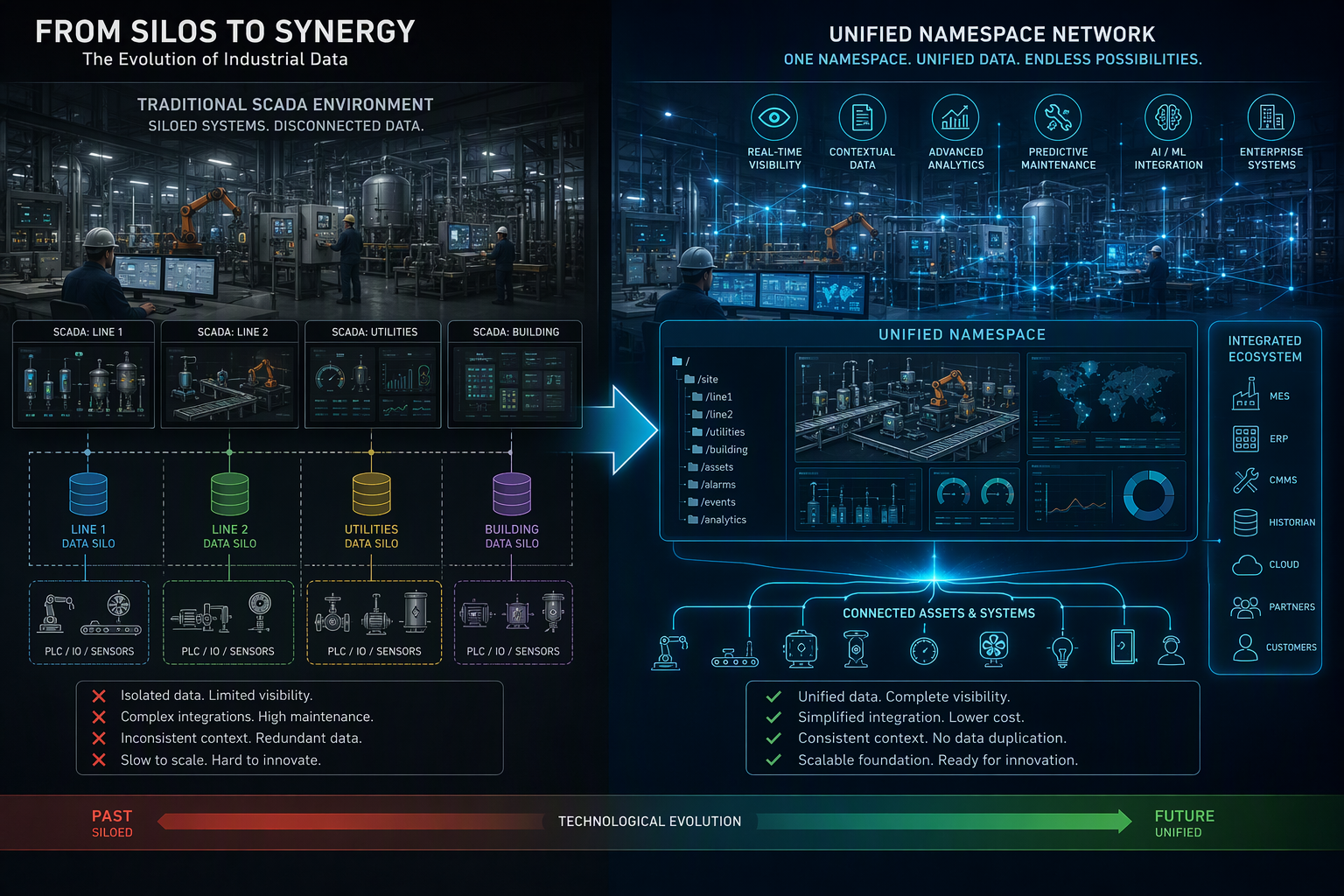
A unified namespace changes that role. Instead of keeping SCADA at the center of every exchange, it places industrial data in a shared structure where many systems can publish and subscribe. That shift is the core comparison to understand before looking at each architecture in detail.
Defining Traditional SCADA Systems for Manufacturing
Traditional SCADA systems are built around supervisory control and data acquisition. They gather sensor data and machine data from PLCs and other field devices, present that information to operators, and support process control through alarms, trends, and setpoint changes.
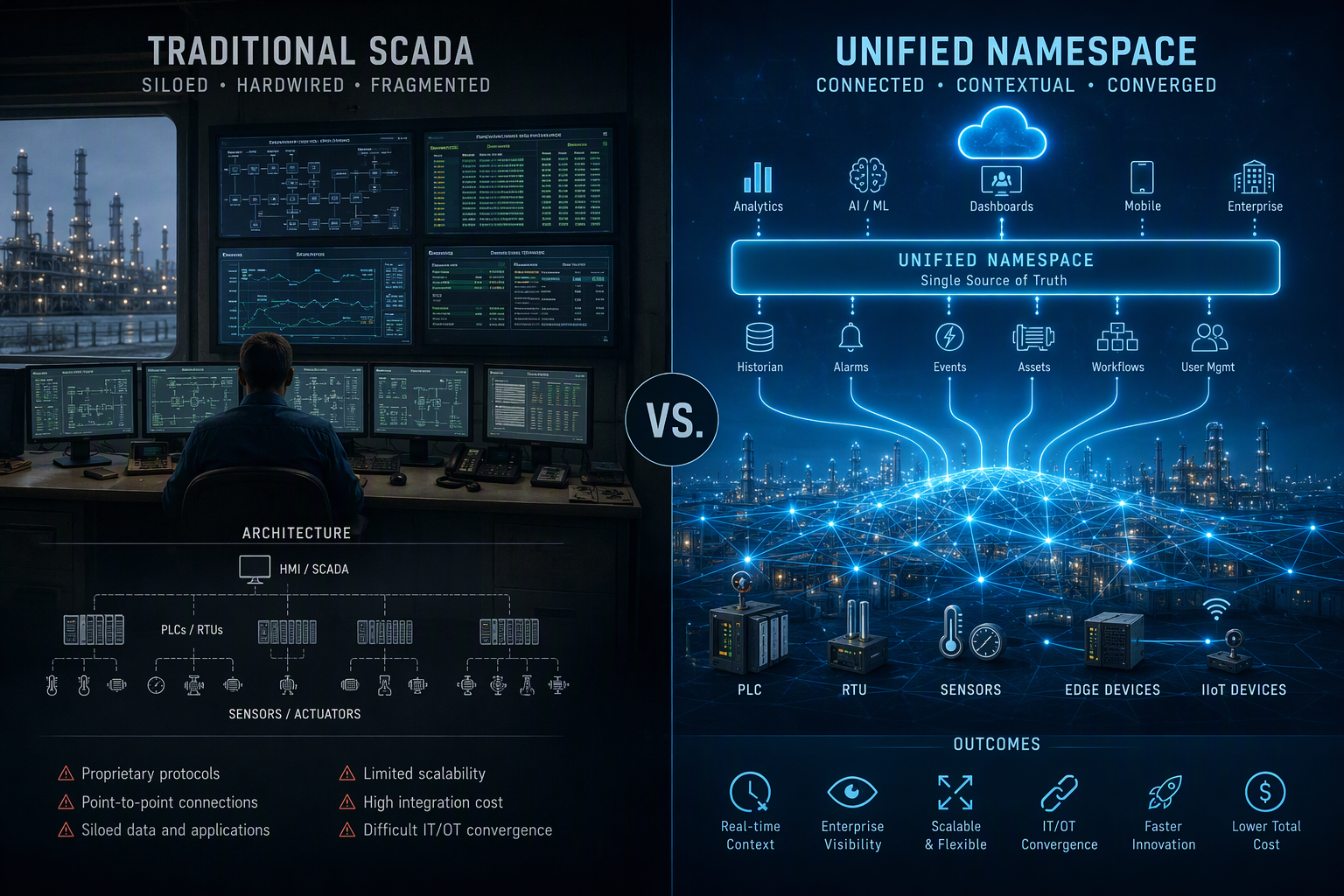
In many facilities, SCADA also stores selected operational data for long-term historization. That makes it valuable for monitoring, troubleshooting, and day-to-day production support. You can think of it as the human-facing layer between equipment and plant personnel.
The main limitation is how data flow is handled. Traditional SCADA often becomes the central mediator between operational technology and higher-level applications. That creates strict dependencies, point-to-point integrations, and data silos. As more consumers need access, the architecture becomes harder to scale and maintain.
Overview of Unified Namespace and Its Role in Industry 4.0
A unified namespace is a company-wide, real time data model that organizes industrial data into one shared structure. It is often built on MQTT and centered around a data broker that distributes updates between producers and consumers.
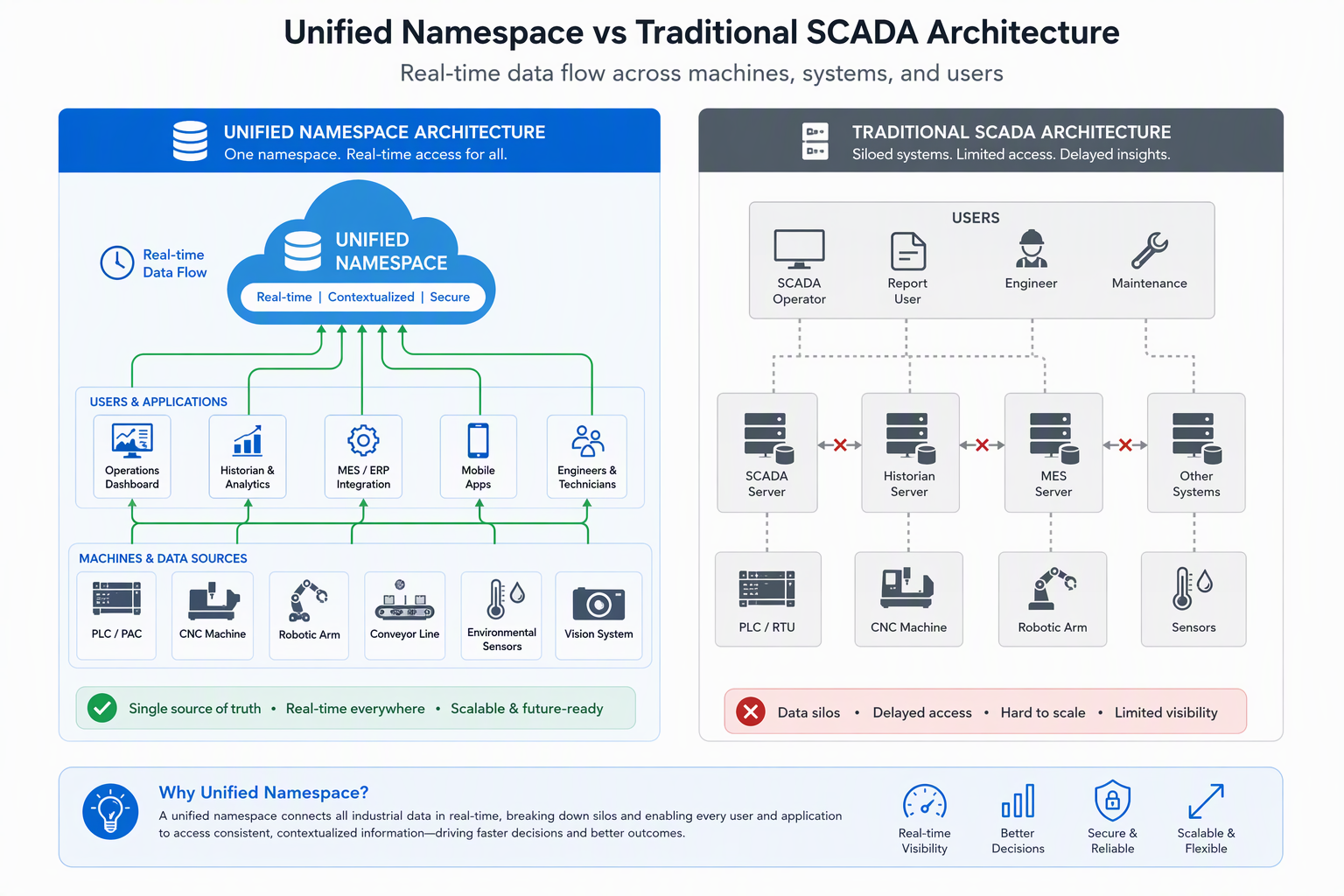
Instead of every application creating direct links, systems publish information once and other authorized systems subscribe to what they need. This creates a single source of truth for current operating conditions, machine states, and production events across sites and levels of the business.
That approach fits Industry 4.0 because it supports horizontal and vertical integration without hardwiring every connection. The broker handles one-to-many distribution, while producers and consumers stay loosely coupled. Compared with SCADA-centric designs, a unified namespace is less about one application owning the data path and more about shared access to live state.
Key Differences Between Unified Namespace and Traditional SCADA
The biggest difference is architectural intent. Traditional architectures usually move data through fixed application paths, often with SCADA systems acting as the middle layer. A unified namespace shifts data integration to a shared publish-subscribe model, so producers and consumers do not need direct awareness of each other.
Just as important, SCADA focuses on supervision and control, while UNS focuses on broad data sharing. That means the comparison is not simply old versus new. It is centralized mediation versus flexible distribution, which sets up the more detailed differences below.
Data Storage and Accessibility Approaches
Traditional SCADA usually stores selected operational data inside its own environment for display, alarms, and history. That works for local operations, but it can limit data access when MES, ERP systems, analytics tools, or a data lake also need the same information.
A unified namespace handles the live layer differently. It is not the long-term database itself. Instead, it publishes real time updates once so multiple systems can subscribe at the same time. Storage can still exist elsewhere, but access to current state becomes far easier.
Key differences include:
- SCADA often keeps data storage tied to the application.
- UNS shares operational data through a common live data layer.
- New consumers can subscribe without rebuilding source connections.
- Data lakes, analytics, and enterprise applications can use the same event stream.
That change improves reuse and reduces duplication.
Communication Protocols and Integration Potential
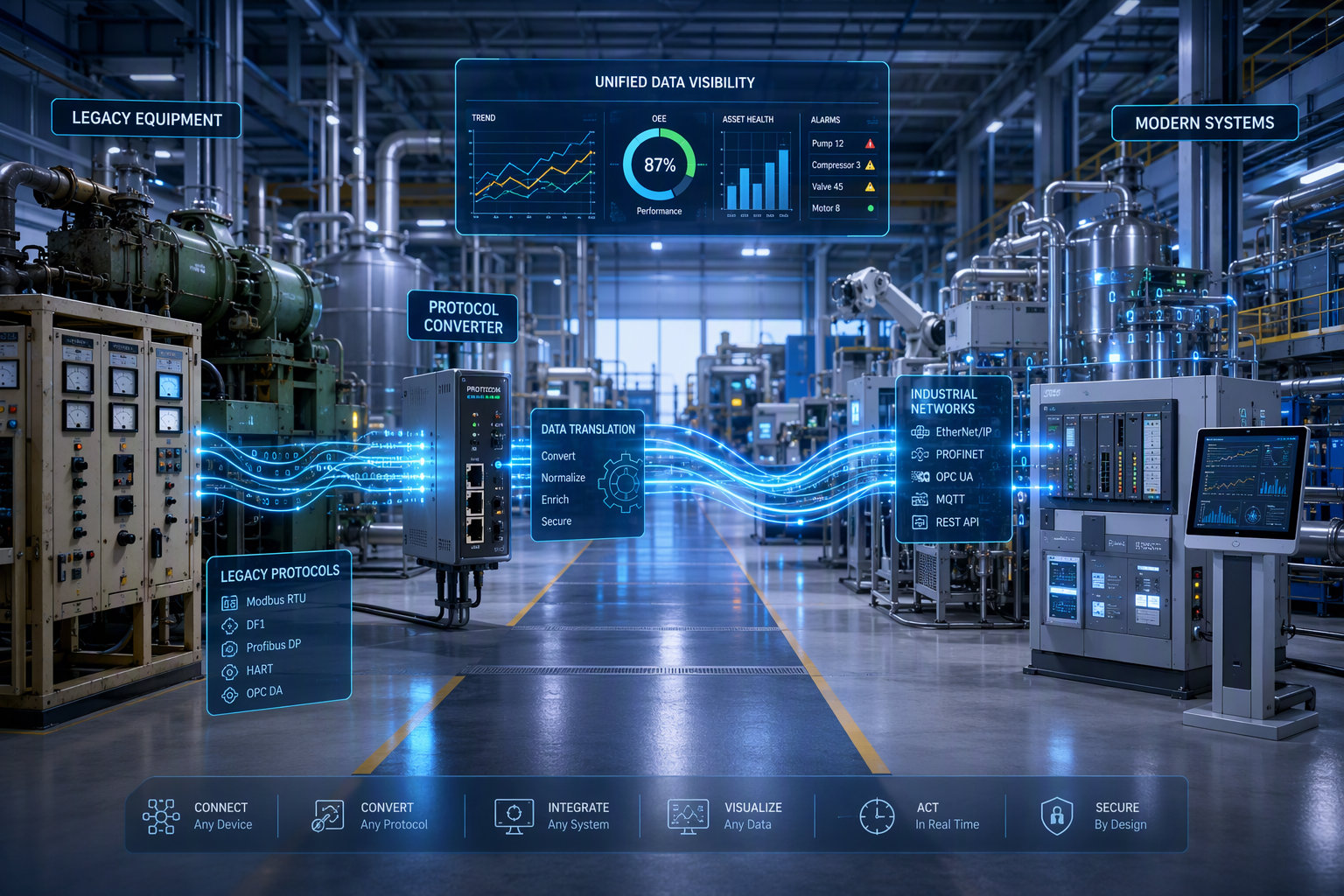
Protocol choice shapes integration effort. In traditional SCADA environments, field devices and PLCs often communicate through OT-specific methods, and higher-level integration depends on custom links. That can mean lots of point connections and lots of maintenance.
In a UNS design, an mqtt broker becomes the central distribution layer. Edge gateways can collect data through protocols such as Modbus or opc ua, transform data formats, and publish standardized messages. SCADA, MES, cloud tools, and other consumers then subscribe to relevant topics.
| Approach | Traditional SCADA | Unified Namespace |
|---|---|---|
| Core communication style | Direct or custom point connections | Publish-subscribe through an mqtt broker |
| OT connectivity | PLC and device specific links | Gateways can bridge OT protocols such as opc ua or Modbus |
| Consumer access | Each consumer often needs separate integration | Many consumers subscribe to the same published data |
| Data formats | Often application-specific | Can be standardized by topic structure and payload rules |
Architecture of a Traditional SCADA System
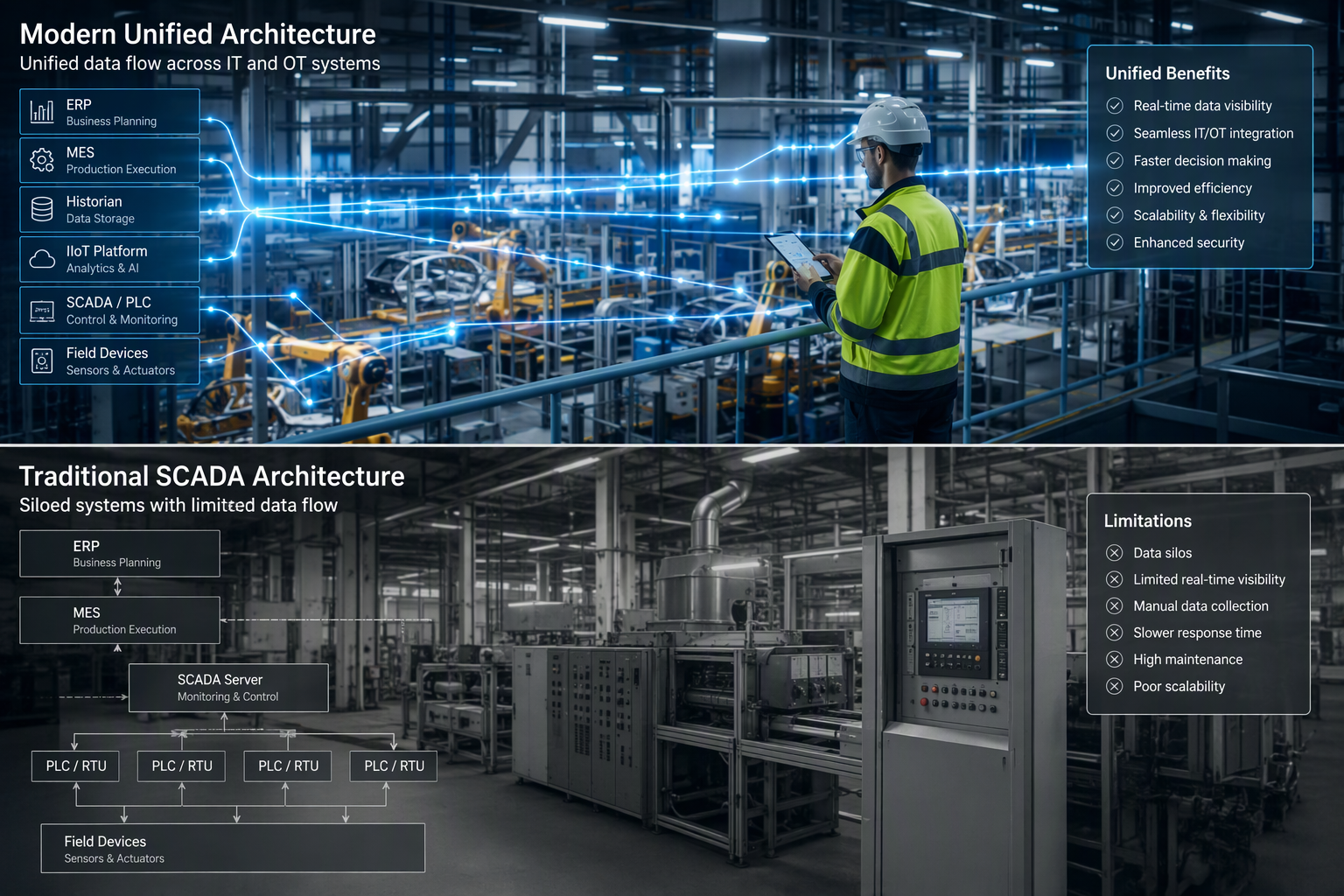
A traditional SCADA architecture usually starts at field devices and PLCs, moves data into the SCADA application, and then passes selected information upward through separate interfaces. The data flow is mostly linear, and the data model often reflects what the SCADA platform needs first.
Because of that structure, SCADA becomes both operator interface and integration layer. It can do the job, but every added connection increases tight coupling. To see why that matters, it helps to break down the components and common plant use cases.
Core Components and How Data Flows
At the core, SCADA systems connect to PLCs and other control devices that gather sensor data from machines and processes. These controllers execute logic locally, while SCADA performs data acquisition, visualization, alarms, and operator interaction.
From there, data flow usually moves upward in steps. The SCADA layer collects values, presents them in HMIs or dashboards, and may archive selected tags for later review. Operators use the system for process control decisions, setpoints, and response to abnormal conditions.
When higher-level systems need the same data, separate integrations are commonly added. That is where complexity grows. Each new path can require custom mapping, translation, and support. Compared with a unified namespace, the architecture is more tightly bound to the SCADA platform and less reusable across industrial applications.
Common Use Cases and Limitations of Legacy SCADA
Legacy SCADA remains useful for many plant-floor needs. It supports operators, helps with alarms, provides historical views, and gives production teams a familiar tool for supervising assets. For quality control and daily troubleshooting, that value is still real.
The problem appears when legacy SCADA is asked to be the plant’s universal integration backbone. As more users want production data in more places, data silos form and operational efficiency suffers. Each added interface can become another long-term support burden.
Common realities include:
- Strong performance for local monitoring and control
- Growing difficulty sharing data broadly across systems
- Higher effort to maintain custom integrations over time
Those limitations are a major reason manufacturers look at UNS as an overlay rather than a full rip-and-replace strategy.
Unified Namespace Architecture Explained
A unified namespace architecture organizes industrial data around a shared publish-subscribe backbone instead of direct application pairings. Producers publish events into the namespace, and consumers subscribe to the topics they need. The data model is structured so the whole business can understand and reuse the same information.
In this setup, SCADA fits as one participant, not the traffic cop for every exchange. That is a practical shift for plants because it preserves control functionality while changing how data flow is distributed and governed.
How Unified Namespace Organizes Industrial Data
A unified namespace organizes operational data through a clear data hierarchy. Topics often reflect the real structure of the business, such as site, area, line, machine, and signal. That makes each data point easier to locate and reuse.
This data model matters because many systems need the same information for different purposes. SCADA may need machine status, MES may need production counts, and analytics may need temperature or vibration values. In a UNS, those consumers work from the same published source instead of separate copies.
For plant teams, that means less confusion about where data lives and which version is current. It also improves industrial operations because changes in machine state can be shared instantly with multiple authorized consumers, supporting faster response, better visibility, and cleaner integration between OT systems and IT systems.
Example Topic Structures and Data Hierarchies
A practical namespace architecture mirrors how your plant is laid out. That keeps topic structure intuitive for controls engineers and useful for business applications. Instead of asking where a tag lives in one software package, users follow the data hierarchy.
For example, a topic could follow a path like factory/area1/site2/line3/machine4/alarms or FactoryA/Line1/Machine3/Temperature. This approach improves data access because different consumers can subscribe by equipment, area, or signal type without needing a fresh integration for each one.
Typical structures may include:
- Site → line → machine → signal
- Topics for status, alarms, counts, or process values
- Separate branches for OT-focused and IT-focused data types
That consistency is what lets a unified namespace scale more cleanly than traditional architectures.
SCADA’s Evolving Role Within a Unified Namespace
In a unified namespace, SCADA systems do not disappear. Their role becomes more focused. They continue to support monitoring, alarms, and control while operating alongside other data sources, applications, and IIoT devices in a shared integration layer.
That is a key point for plant leaders. UNS does not automatically replace SCADA. It changes where SCADA sits in the architecture. Instead of owning every path, it becomes one well-defined participant, which makes integration more scalable and easier to extend.
Integrating SCADA as a Data Source in UNS
When SCADA systems are integrated into a unified namespace, they can subscribe to live machine and process updates from the data broker rather than polling each PLC separately. That reduces duplication and shifts data distribution to the messaging layer built for it.
SCADA can also publish information back into the namespace, such as commands, statuses, or alarms, depending on the design. In this role, SCADA becomes one of several data sources and consumers connected to the same shared environment.
The result is a stronger single source of truth for the current state of operations. MES, ERP, cloud analytics, and SCADA can all work from the same flow of updates. For industrial operations, that improves visibility, shortens response time, and lowers the support burden tied to isolated data paths and manual handoffs.
How SCADA Functions Alongside Modern IIoT Solutions
SCADA systems and modern IIoT devices are usually used together, not as mutually exclusive choices. SCADA remains valuable for supervisory control, while IIoT solutions expand how data integration happens across operational technology and enterprise platforms.
In practice, gateways may translate machine communications into MQTT messages, while SCADA subscribes to the same streams used by other consumers. That lets OT systems keep doing what they do best without forcing every application to talk directly to every controller.
Common patterns include:
- SCADA monitoring live production conditions
- IIoT devices and gateways publishing broader machine data
- Shared consumption by MES, analytics, and cloud applications
This coexistence is one reason UNS is attractive. It modernizes the architecture without discarding proven plant-floor tools.
Main Benefits of Unified Namespace over Traditional SCADA
The main benefits come from making live data easier to share and reuse. A unified namespace improves operational efficiency because systems publish once and many consumers subscribe. That reduces integration overhead and gives teams quicker access to the same current information.
It also supports better data quality and scalability. When one shared structure replaces many duplicated links, there are fewer chances for mismatch or stale values. Those gains become especially visible for plant managers who need broad visibility without piling on new maintenance work.
Improved Real-Time Data Visibility for Plant Managers
Plant managers often struggle when operational data is trapped inside separate applications. One system shows machine status, another tracks production, and another holds alarms. A unified namespace improves real time data visibility by making the current state available to multiple tools at once.
That matters on the factory floor because delays in information create delays in action. If line status, counts, temperatures, or machine events are shared instantly, teams can respond faster and coordinate better across operations, maintenance, and quality.
When SCADA is integrated into that model, it still gives operators the control view they need, but it is no longer the only doorway to the data. That broader visibility supports faster decisions, cleaner communication, and a more accurate picture of plant performance throughout the day.
Flexibility, Scalability, and Simplified Integration
A unified namespace gives plants more flexibility because new consumers can subscribe without forcing a redesign of existing links. That is a major advantage over direct integrations, where every added application creates another dependency to manage.
Scalability improves for the same reason. The PLC or gateway publishes data once, and the broker distributes it to many users. That can support plant systems today and broader enterprise applications later without turning the architecture into a maze of one-off interfaces.
Key advantages include:
- Easier onboarding of analytics, MES, or ERP consumers
- Less reliance on custom integrations between every system pair
- Better separation between data producers and data consumers
- More room to expand digital initiatives over time
For manufacturers, that means more usable data with less architectural friction.
Challenges When Transitioning from SCADA to Unified Namespace
The shift is practical, but it is not automatic. Plants moving from legacy SCADA toward a unified namespace face technical hurdles around protocols, data formats, and existing custom interfaces. Good data management matters because poor naming or inconsistent structures can create confusion fast.
There is also a change management side. Teams need to understand that SCADA is not being stripped of value. Its role is being narrowed and strengthened. That balance is what makes a transition plan workable.
Technical Hurdles and Change Management Considerations
One hurdle is the mix of legacy protocols and custom integrations already in place. Many plants have years of special-case connections between SCADA, PLCs, databases, and business tools. Moving toward UNS means deciding what to keep, what to bridge, and what to retire.
Another issue is standardization. MQTT alone does not define naming, topic depth, or payload structure. Sparkplug B can help in SCADA-related OT communication by standardizing payloads and device messages, but it also has limits around topic flexibility, retain behavior, and IT compatibility.
Teams should plan for:
- Common naming and topic rules
- Careful handling of data formats and data integrity
- Training so operators and engineers trust the new model
Without that discipline, a new architecture can simply recreate old confusion in a different form.
Guidance from Empowered Automation as a Chicago-area Systems Integrator
If you are planning the move, start small and stay grounded in plant priorities. Identify the most valuable data sources, define a clear topic structure, and decide which existing systems should publish or subscribe first. That is usually a better path than trying to rebuild everything at once.
For a practical overview, see What is a Unified Namespace. It helps frame the architecture in plain terms for manufacturing teams that need results, not theory.
Empowered Automation, a Chicago-area systems integrator, can help manufacturers apply best practices for digital transformation and integration. The right partner should understand controls, plant operations, and phased deployment. That combination is what turns a unified namespace from an idea into a maintainable working design.
Conclusion
In conclusion, understanding the differences between Unified Namespace and traditional SCADA is crucial for modern manufacturing environments. While legacy SCADA systems have served their purpose over the years, transitioning to a Unified Namespace offers enhanced real-time data visibility, improved scalability, and streamlined integration with IIoT solutions. By adopting this architecture, plant managers can unlock new efficiencies and insights that drive production success. If you're considering this transition, Empowered Automation is here to help guide you through the process. For more information, check out our article on What is a Unified Namespace.
Frequently Asked Questions
Is Unified Namespace replacing SCADA or do they work together?
In most plants, a unified namespace and SCADA systems work together. SCADA keeps its role in monitoring and control, while the unified namespace improves integration across OT systems, IIoT devices, and business applications. The architecture changes the data-sharing model, not the need for supervisory control.
What are real-world examples of SCADA being integrated with Unified Namespace?
A common example is a factory floor where PLC data is collected by an edge gateway, published to an MQTT broker, and then consumed by SCADA systems, MES, and analytics tools at the same time. That integration improves data flow without requiring separate links from each PLC to each application.
What steps should manufacturers take to begin moving toward a unified namespace?
Begin with a few high-value industrial data sources, define naming and topic standards, and connect them through a broker-based architecture. Use best practices, phase the rollout, and involve a systems integrator that understands controls and digital transformation so the unified namespace supports real plant needs from day one.
Unified Namespace vs SCADA: A New Era of Integration
The convergence of technology in manufacturing has paved the way for innovative architectures that not only streamline processes but also empower plant managers with valuable insights. By leveraging a unified namespace, manufacturers can enhance their operational efficiencies and drive production success to new heights. Empowered Automation stands ready to assist in navigating this transformative journey—discover more by reading our article on "What is a Unified Namespace.
You might also like