What Is the 1st, 2nd, 3rd, and 4th Industrial Revolution?
What is the 1st 2nd 3rd and 4th industrial revolution?
Key Highlights
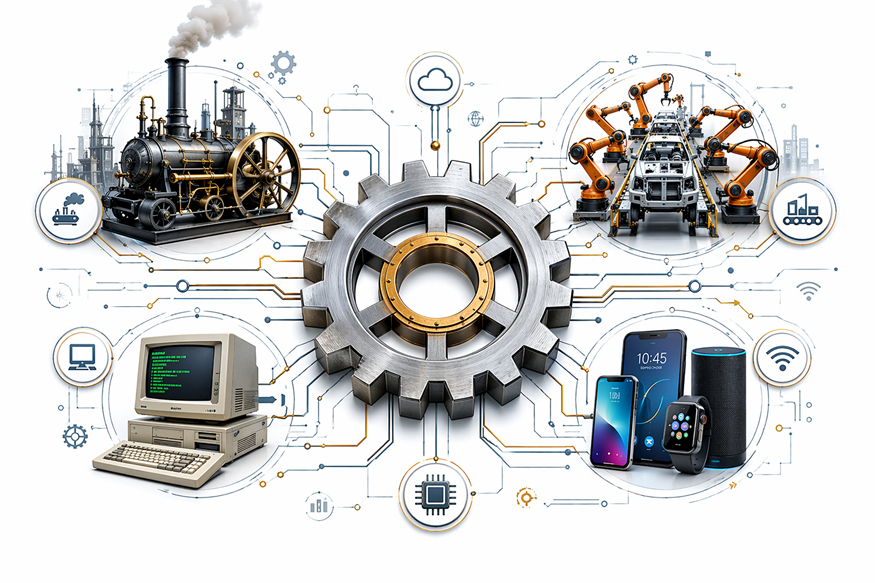
- The industrial revolution happened in four major waves, each changing work and production.
- The first industrial revolution moved hand production toward machines using water power and steam power.
- The second industrial revolution introduced mass production and the modern production line.
- The third wave brought digital transformation through computers, automation, and information technology.
- The fourth industrial revolution connects machines through the internet of things, artificial intelligence, and real-time data.
- In simple terms, Industry 4.0 means smarter, connected systems that improve speed, quality, and flexibility.
Introduction
The industrial revolution is the story of how work, factories, and daily life changed through major waves of innovation. From early machines to the digital revolution, each stage reshaped how goods were made and moved. Today, digital transformation defines the newest phase, often called Industry 4.0. In simple terms, it means connected machines, smarter systems, and faster decisions. To understand where this is heading, it helps to look at the first, second, third, and fourth industrial revolutions in order.
Understanding the Four Industrial Revolutions
The first industrial revolution introduced machine power. The second industrial revolution expanded factories through mass production. The third industrial revolution brought computers, automation, and digital technologies into the manufacturing industry.
Now, the fourth industrial revolution builds on all of that with digital transformation at scale. Unlike earlier shifts that focused on one main breakthrough, Industry 4.0 connects systems, people, and machines in real time. That is what makes it different. The next sections break down each stage and show how progress built from one era to the next.
Defining an Industrial Revolution
An industrial revolution is a large and lasting shift in how goods are made, how people work, and how businesses operate. It usually begins when new tools or systems change the manufacturing industry in a major way. Instead of small improvements, it creates a broad reset across production, transport, and communication.
In many cases, an industrial revolution is also a technological revolution. Steam engines changed factories in one era. Electricity and production lines changed them in another. Later, the digital revolution introduced computers, data collection, and automation into equipment and business systems.
So what does Industry 4.0 mean in simple terms? It is the newest stage of this pattern. It uses connected digital technologies so machines, people, and systems can share information, respond faster, and improve how work gets done.
Key Differences Across the Revolutions
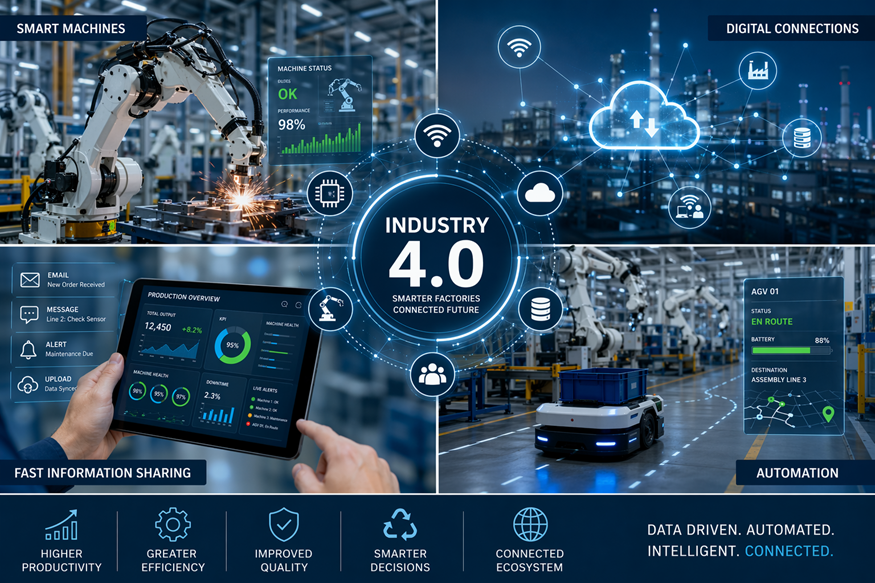
Each industrial era solved a different problem. The first industrial revolution replaced much hand labor with powered machines. The second industrial revolution scaled output through mass production. The third industrial revolution improved control through computers and early automation. The fourth industrial revolution adds connected intelligence through digital technologies.
Here is a simple text table showing the progression:
| Revolution | Main Shift | Key Power or Tools | Main Result |
|---|---|---|---|
| First industrial revolution | From hand work to machines | Water power, steam power | Faster manufacturing |
| Second industrial revolution | Factory expansion | Electricity, railroads, telegraph, production line | Mass production |
| Third industrial revolution | Digital control | Computers, PLCs, telecommunications | Automation and data collection |
| Fourth industrial revolution | Connected operations | IoT, AI, cloud computing, analytics | Smart, real-time systems |
What makes the fourth industrial revolution different is connection. Earlier changes improved machines. Industry 4.0 helps machines, software, and people work together continuously.
The First Industrial Revolution (Industry 1.0)
The first industrial revolution began around 1760. It marked the move away from hand production and animal power toward machines driven by water power and steam power. Early adoption appeared in textile manufacturing, along with iron, agriculture, and mining.
This period changed the manufacturing process by making output faster and more consistent than manual methods. Compared with Industry 4.0, it was not connected or data-driven. Its breakthrough was mechanical power. To see that more clearly, look at the main inventions and their effects below.
Major Innovations and Technologies
The first wave of industrial change centered on practical machines that could do more work than people or animals alone. These new technologies changed how materials were processed and how factories were organized. Water power and steam power were at the center of that shift.
Key developments included:
- Water power for driving early machinery in mills and workshops.
- Steam power for running machines with more flexibility than location-bound water systems.
- Textile manufacturing equipment that increased output and reduced reliance on hand methods.
- Mechanized tools that sped up each manufacturing process.
In simple terms, this era was about replacing slow manual effort with powered equipment. It was not yet digital, smart, or connected. Still, it laid the groundwork for every later industrial stage by proving that machines could transform production at scale.
Impact on Society and the Economy
The first industrial revolution changed more than factories. It altered jobs, output, and the wider economy by shifting work away from manual labor and toward machine-supported production processes. Goods could be made faster, and that increased availability across important sectors.
At this stage, true mass production had not fully arrived, but the foundation was set. Once machines began doing repetitive tasks, businesses could think in larger volumes. Early changes in transport and resource movement also started shaping a more organized supply chain, even if it was still basic by modern standards.
Compared with Industry 4.0 technologies like IoT sensors, artificial intelligence, and cloud platforms, Industry 1.0 was simple. Yet its economic importance was huge. It introduced the idea that better tools could increase output, lower effort, and open the door to broader industrial growth.
The Second Industrial Revolution (Industry 2.0)
The second industrial revolution began around 1871 and is often called the technological revolution. Railroads and telegraph networks expanded, helping factories coordinate work and move goods more effectively. This period pushed industry toward mass production.
Factories developed the modern production line, which improved production processes and supported more consistent output of new products. Supply chain activity also became more coordinated across longer distances. Unlike Industry 4.0, this era focused on scale rather than smart connectivity. The next sections explain how that shift changed both factories and everyday life.
Advancements in Mass Production
What made Industry 2.0 stand out was its ability to produce more goods in a repeatable way. The manufacturing industry moved beyond isolated machines and began organizing work into coordinated sequences. This set the stage for the modern production line.
Important advances included:
- The spread of factory systems built for mass production.
- Railroads that improved movement of raw materials and finished goods.
- Telegraph networks that supported faster communication across operations.
- A more structured approach to supply chain management.
These changes made manufacturing processes more predictable and scalable. Industry 4.0 affects factories differently. Instead of only increasing volume, it improves visibility, speed, and decision-making through connected systems and real-time insights. So while Industry 2.0 focused on quantity, Industry 4.0 adds intelligence to the entire production flow.
Transformations in Daily Life and Industry
As factories grew, the effects reached beyond industrial sites. The manufacturing industry could deliver more goods to more people, making new products more available. This changed daily life by increasing access to items that were once harder to produce or distribute.
Business processes also became more structured. With stronger transport and communication systems, companies could plan work, move materials, and manage orders with greater consistency. The supply chain became broader and more organized, linking production and distribution in ways that supported larger markets.
Industry 4.0 takes that idea much further. It impacts manufacturing processes by adding live data, automation, and connected tools that help factories react faster. Instead of only moving goods efficiently, companies can now also track performance, quality, and demand with much greater precision.
The Third Industrial Revolution (Industry 3.0)
The third industrial revolution emerged in the late 20th century after major advances in computers, telecommunications, and data analysis. This period is often called the digital revolution because digital technologies began reshaping factories and offices alike.
Inside industry, automation and computerization became central. Equipment started using software and electronic controls instead of relying only on mechanical systems. Information technology changed how work was monitored and managed. Compared with earlier revolutions, this one introduced digital control. Next, let’s look at the tools and the wider impact they created.
Automation and Computerization
Industry 3.0 brought factories into the digital age. Instead of using only mechanical systems, businesses began embedding electronic controls and software into equipment. That shift increased automation and gave companies a higher degree of automation across many tasks.
Key tools from this period included:
- Programmable logic controllers to automate machines and begin data collection.
- Computerization of equipment and workflows for more consistent control.
- Enterprise resource planning systems that helped manage operations and information across the business.
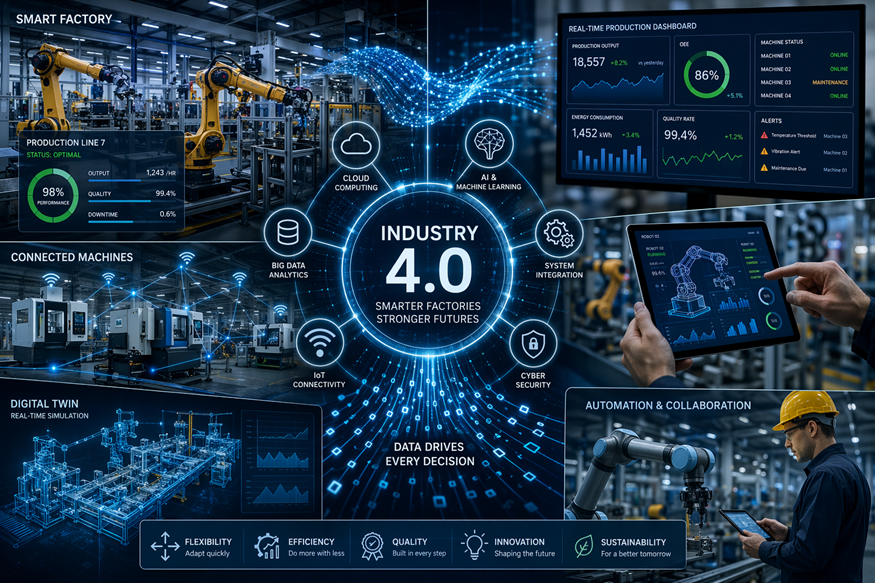
These systems were a major step toward today’s connected factories. Still, Industry 4.0 includes more advanced technologies such as the internet of things, artificial intelligence, machine learning, cloud computing, digital twin systems, and predictive maintenance. So Industry 3.0 created digital control, while Industry 4.0 extends that control through connection, analysis, and continuous feedback.
Effects on Global Manufacturing and Services
The third industrial revolution changed global manufacturing by making production more automated and information-driven. Once factories could use computers and telecommunications, companies gained better control over timing, consistency, and output. Data collection became part of everyday operations rather than an occasional manual task.
This shift also influenced services and business models. Digital platforms and software-supported systems made it easier to organize work, monitor resources, and support decisions across larger organizations. As industries adopted more digital tools, product quality became easier to track and improve.
Industry 4.0 builds on these gains. It impacts manufacturing processes by turning collected data into real-time action. Instead of just recording what happened, connected systems can signal problems early, improve coordination, and support faster responses across production, logistics, and service functions.
The Fourth Industrial Revolution (Industry 4.0)
The fourth industrial revolution is the current stage of industrial change. It uses digital technologies to connect machines, people, and systems across operations. The internet of things, artificial intelligence, and analytics help factories become more responsive and efficient.
In simple terms, Industry 4.0 means smart manufacturing powered by connected data. Machines can share information, support decisions, and help businesses improve quality, speed, and flexibility. It is not just about automation alone. It is about connected intelligence. The next two sections cover the core technologies and real-world applications behind this shift.
Core Technologies Shaping Industry 4.0
Industry 4.0 brings together several tools rather than relying on one invention. These technologies connect equipment, software, and people so decisions can happen faster and with better visibility. The goal is smarter operations, not just more machines.
Core technologies include:
- Internet of things systems that connect equipment and support data exchange.
- Artificial intelligence and machine learning for pattern detection and smarter decisions.
- Cloud computing for scalable access, resilience, and shared information.
- Big data analytics for spotting trends and improving performance.
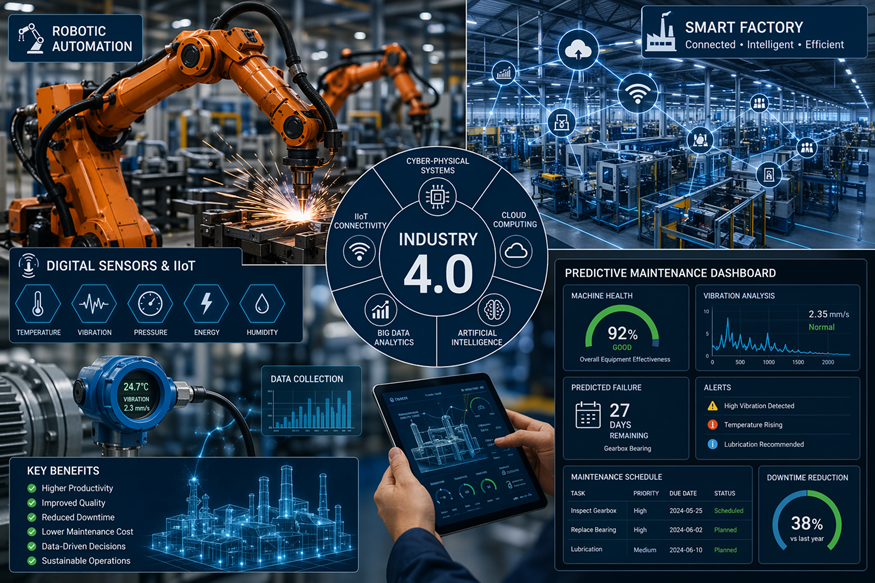
- Smart sensors and digital twin tools for monitoring assets and testing improvements virtually.
These technologies also power predictive maintenance by detecting failure signals before breakdowns happen. That helps reduce downtime, protect equipment performance, and support better planning. Together, they define what technologies are included in Industry 4.0 and why this model is so different from earlier industrial eras.
Real-World Examples of Industry 4.0 Applications
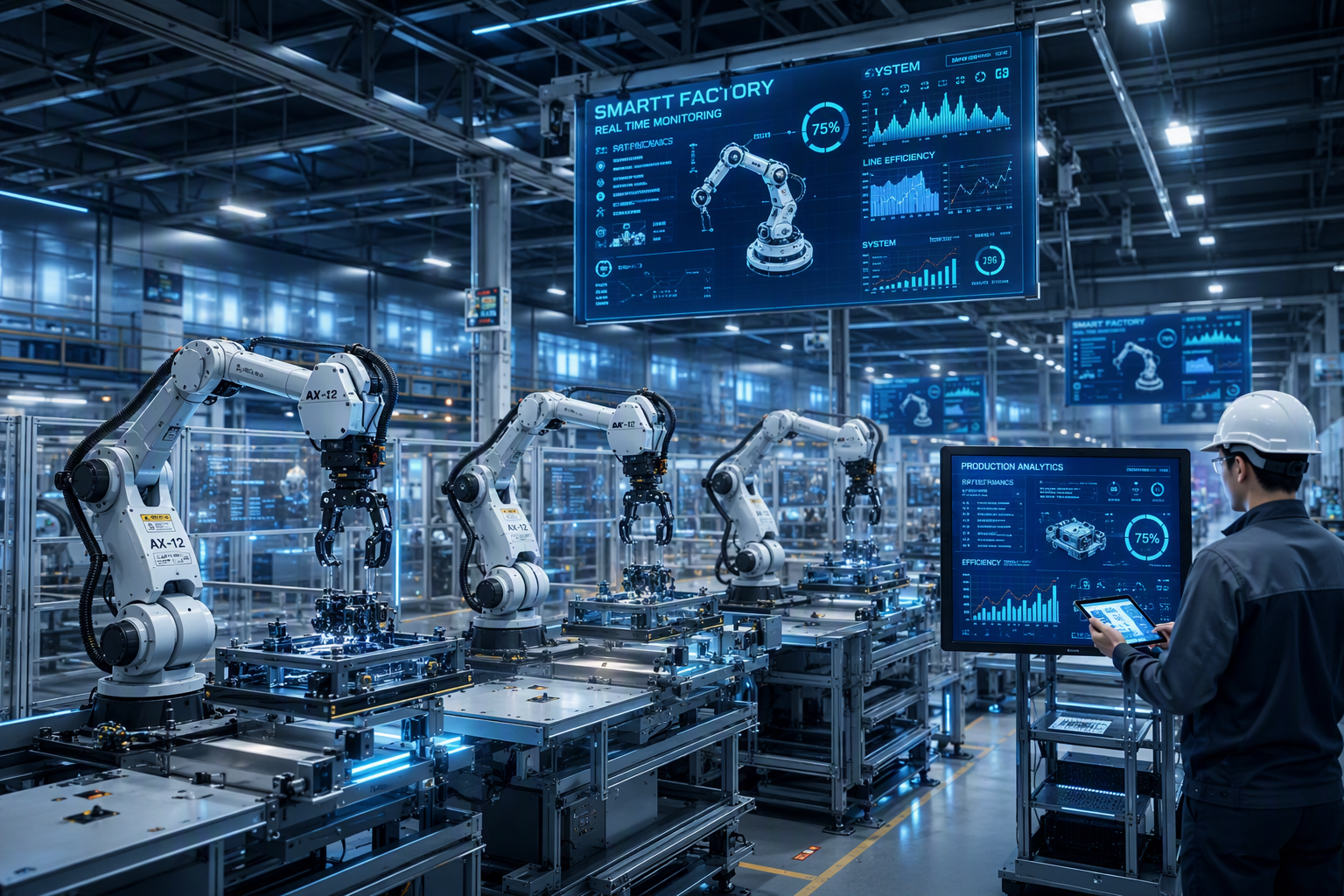
You can see Industry 4.0 in action anywhere companies use connected systems to improve speed, visibility, and quality. In smart manufacturing, factories track equipment, output, and performance in real time. That creates a smart factory environment where issues are spotted earlier and decisions happen faster.
Common examples include:
- Supply chain optimization through real-time tracking, analytics, and better inventory visibility.
- Field service support that uses connected asset monitoring and alerts based on abnormal conditions.
- Virtual reality and augmented tools for training, onboarding, and workforce support.
The same ideas also support broader uses such as autonomous vehicles and smart cities, where connected systems help coordinate movement, safety, and services. In simple terms, Industry 4.0 is used wherever digital tools turn live information into better action across industrial and public environments.
Comparing Industry 4.0 to Previous Industrial Revolutions
The fourth industrial revolution stands apart because it combines many new technologies into one connected system. Earlier eras improved power, scale, or automation. Industry 4.0 adds digital transformation across the full manufacturing process through data analytics, connectivity, and software-driven decisions.
It also changes business models, not just factory equipment. Companies can improve operations, respond faster to demand, and create new services around connected products and assets. That broader impact is why Industry 4.0 feels different from previous revolutions. The next sections cover the main benefits and the challenges companies face during adoption.
Distinguishing Features and Benefits
One major difference with Industry 4.0 is that it connects people, machines, and systems in real time. That supports digital transformation across production, service, and planning. Instead of waiting for reports, teams can act on live information.
Main benefits include:
- More efficient collaboration through shared data and digital platforms.
- Flexible manufacturing that adapts faster to changing demand.
- Better resource allocation through analytics and visibility.
- Lower maintenance costs and stronger product quality through predictive maintenance and monitoring.
Businesses also gain improvements in supply chain management and shorter lead times when data moves smoothly across operations. These are some of the main benefits of adopting Industry 4.0. It helps companies become more agile, reduce waste, improve output, and support better decisions without relying only on manual checks or delayed updates.
Challenges Faced During the Transition
Moving to Industry 4.0 can bring clear gains, but the transition is not automatic. Companies in the manufacturing industry often need to rethink business processes, connect older systems, and make better use of data analysis before they see full value.
Common challenges include:
- Aligning technology choices with real business needs and practical outcomes.
- Scaling use cases across the organization instead of keeping them limited to one area.
- Managing change effectively so teams can adopt new tools and workflows.
Another challenge is turning large amounts of data into useful action. If insights are not tied to equipment performance, quality, or service goals, results can stall. Companies also need to keep customer satisfaction in view. Better technology matters most when it improves reliability, responsiveness, and the overall experience delivered to the market.
Conclusion
In summary, understanding the four industrial revolutions is crucial to grasping how technological advancements have shaped our society and economy. Each revolution has brought forth innovations that transformed industries and redefined daily life, from the mechanization of the First Industrial Revolution to the digital integration of the Fourth. By appreciating these changes, we can better prepare for the future of work and the evolving landscape of businesses. If you're curious to explore more about these revolutions and how they apply to today's world, feel free to reach out for a free consultation to discuss further.
Frequently Asked Questions
How does the Industrial Internet of Things (IIoT) relate to Industry 4.0?
The industrial internet of things is a core part of Industry 4.0. It uses internet of things connections and IoT sensors to enable data exchange between machines, systems, and people. In a manufacturing process, that means better visibility, real-time monitoring, and faster responses to changing conditions.
What are some main benefits for businesses in adopting Industry 4.0?
Industry 4.0 helps businesses improve supply chain management, support efficient collaboration, and use digital technologies more effectively. It also enables predictive maintenance, which can reduce downtime and lower maintenance costs. In many cases, companies also see better quality, stronger flexibility, and quicker decision-making across operations.
Where can beginners learn more about the industrial revolutions?
Beginners can start with resources from the World Economic Forum, where Klaus Schwab, the executive chairman of the World Economic Forum, helped popularize the term for the latest phase. It also helps to read about the German government’s Industrie 4.0 project and explore educational content shared on trusted digital platforms.
You might also like