Boost Your Business with Industrial Automation Solutions
Boost Your Business with Industrial Automation Solutions
Key Highlights
-
Industrial automation helps factories raise operational efficiency and manage repetitive tasks with better speed. Smart automation solutions support stronger product quality by reducing variation and common human error. Modern control systems, PLCs, sensors, and robotics keep industrial equipment running with more consistency.
Some examples of successful industrial automation projects include the implementation of robotic arms in automotive manufacturing, which streamline repetitive assembly tasks; automated sorting systems in food processing plants that improve product quality and reduce human error; and advanced PLC-controlled packaging lines that boost operational efficiency in consumer goods factories. These projects demonstrate how automation solutions enhance control systems and productivity across industries.
- Smart automation solutions support stronger product quality by reducing variation and common human error.
- Modern control systems, PLCs, sensors, and robotics keep industrial equipment running with more consistency.
- Many manufacturers use automation to improve worker safety and lower waste across the production process.
- Data from connected systems supports predictive maintenance, faster decisions, and fewer production delays.
- Industries from food to aerospace use industrial automation to stay competitive and control costs.
Introduction
Industrial automation is changing how the manufacturing industry works every day. Instead of relying only on manual effort, companies use automation solutions like control systems, robotics, sensors, and software to run key tasks with greater accuracy. In a factory setting, an industrial automation system collects data, responds to inputs, and controls machines in real time. That means smoother production, safer work areas, and more consistent output. If you want better performance, automation has become a practical path forward.
Industrial Automation Solutions: Benefits for Your Industry
Overview of Industrial Automation Solutions
Industrial automation covers the tools and systems that help businesses improve the manufacturing process. These automation solutions can include robotics, machine vision, internet of things devices, and advanced control platforms that reduce manual handling and support steady production.
Today, companies commonly use PLCs, SCADA, DCS, conveyor systems, and robotic systems for assembly, packaging, inspection, and material handling. To understand how these pieces work together, it helps to look first at what industrial automation means in modern manufacturing and why it matters.
Defining Industrial Automation in Modern Manufacturing
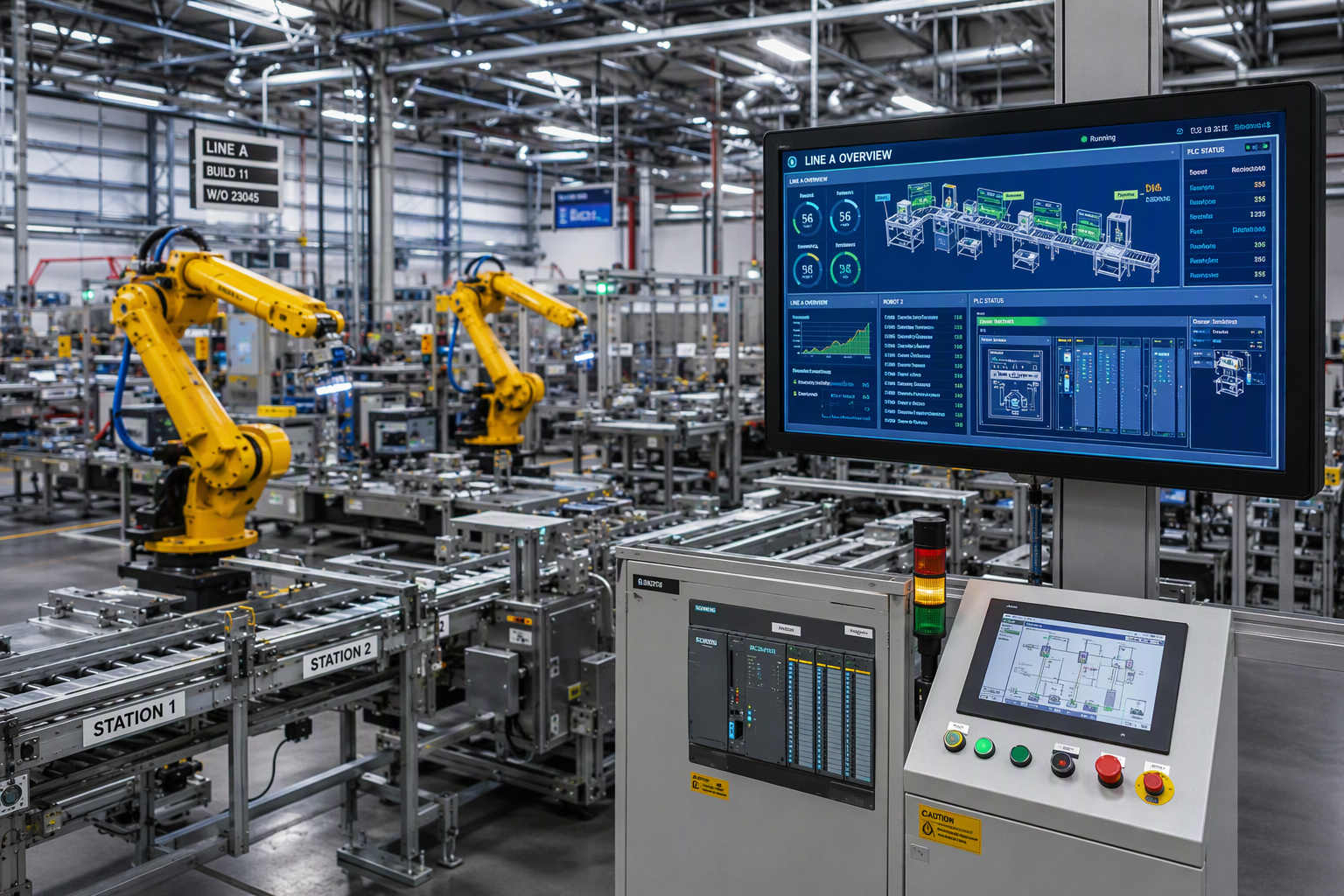
At its core, industrial automation means using technology to control machines and industrial processes with less direct human intervention. In the manufacturing industry, this includes software, robotics, sensors, and control systems that manage tasks once handled only by people.
In a factory automation setting, the system works by receiving inputs from sensors, processing that information through a controller, and then telling machines what to do next. That may include moving products, checking quality, adjusting speeds, or stopping equipment when unsafe conditions appear.
For you, the real value is practical. Industrial automation helps reduce repetitive work, improve consistency, and support worker safety. It does not simply replace human labor. In many facilities, it shifts people toward monitoring, quality inspection, and problem-solving roles that add more value to daily operations.
How Automation Solutions Drive Operational Efficiency
One major reason factories invest in automation solutions is improved operational efficiency. Machines can handle repetitive tasks faster and with fewer pauses, which helps the production line move more smoothly from one stage to the next.
Just as important, automated systems reduce common process issues such as delays, waste, and inconsistency. When sensors and control tools monitor performance in real time, factories can catch problems early, shorten cycle times, and keep assembly lines running with less disruption.
You also gain better use of your workforce. Instead of assigning people to repetitive tasks all day, automation services let employees focus on supervision, quality checks, and maintenance planning. That often leads to lower operating costs, more predictable output, and a stronger response to busy production schedules.
Key Components of an Industrial Automation System
A typical automation system includes control systems, sensors, software, robotics, and connected industrial equipment. Each part plays a role in collecting information, making decisions, and carrying out tasks across the production process. Together, they help factories run with better accuracy and less downtime.
Some components manage process control, while others handle movement, quality inspection, or data collection. The next sections break down the two groups you will see most often in modern industrial automation environments.
Control Systems and Programmable Logic Controllers (PLCs)
Control systems are the decision-making center of an automation system. They monitor what is happening on the floor and send commands that keep machines working in the right order, at the right speed, and within safe limits.
In many factories, programmable logic controllers are the most common tools for this job. PLCs support process control by taking signals from sensors, applying programmed rules, and directing motors, conveyors, valves, or robotic systems. Other platforms, such as SCADA and DCS, help operators watch and manage larger industrial processes in real time.
For your facility, this means better reliability and faster response. If a machine runs outside normal conditions, the control system can adjust operations or stop equipment before the issue grows. That supports product quality, worker safety, and smoother day-to-day production management.
Sensors, Robotics, and Smart Devices in Automation
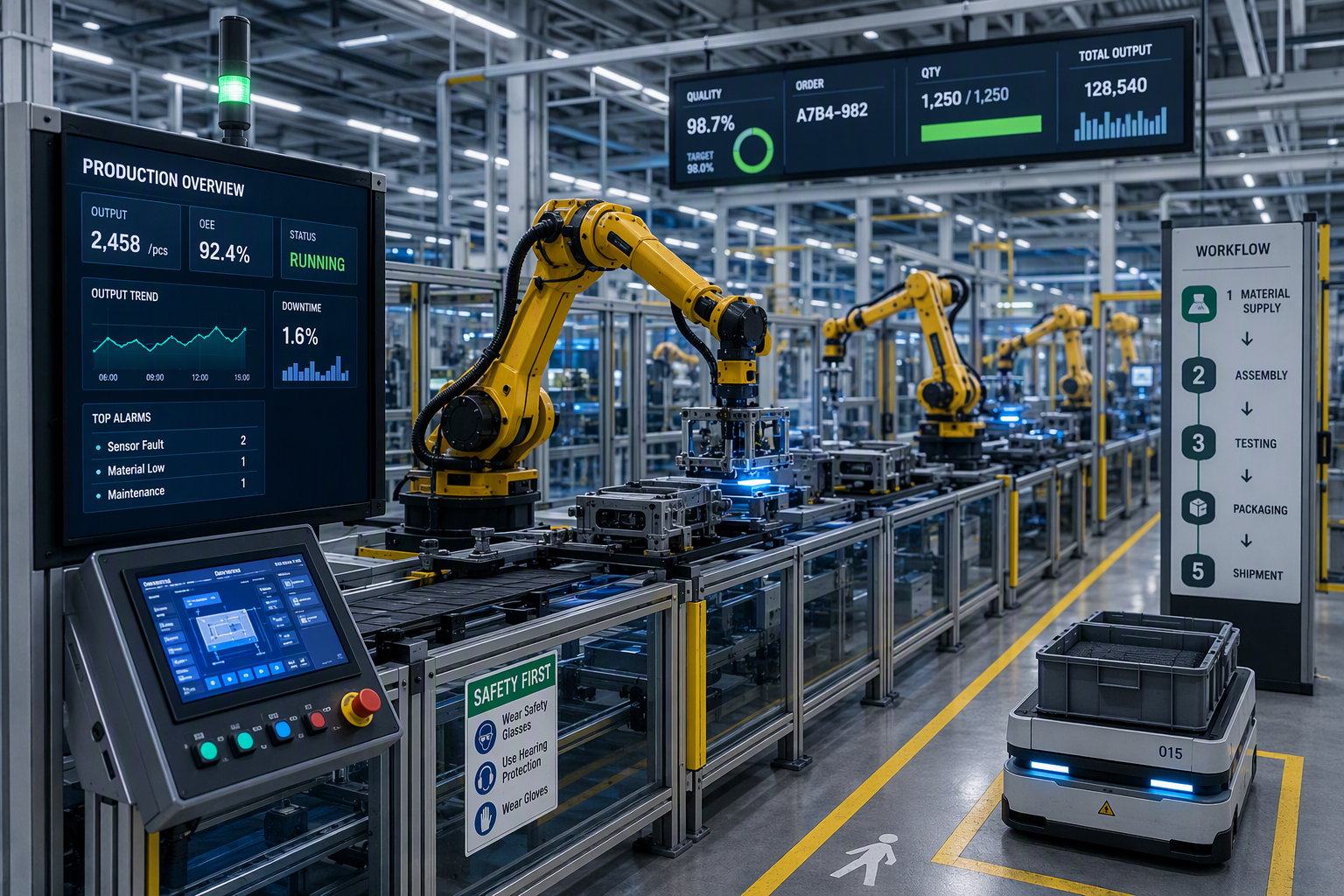
Sensors give automation systems the data they need to function. They track position, temperature, speed, pressure, and other conditions, helping equipment respond quickly to changes on the factory floor.
Industrial robots then act on that information. They can weld, sort, package, move materials, or support quality control with strong repeatability. When paired with machine vision, robots can scan items, detect defects, and handle precision alignment tasks that would be harder to manage manually.
Smart devices add another layer of value. Using internet of things connectivity, they share real-time data across operations. In some setups, machine learning and artificial intelligence help interpret that data for predictive maintenance and performance improvements. For you, that means fewer surprises, better planning, and more control over production quality and uptime.
Common Types of Industrial Automation Solutions
Factories use several automation solutions depending on their volume, product mix, and workflow needs. The most common options include fixed automation, flexible automation, and programmable automation. Each approach supports the manufacturing process in a different way and suits different production goals.
These various technologies can be used for assembly, packaging, inspection, material handling, and process automation. To choose well, you need to understand how each type works and where it fits best in real operations.
Fixed, Flexible, and Programmable Automation Explained
Not every factory needs the same setup. Different automation models are designed for different production process demands, especially when volume, changeovers, and product variety are part of the decision.
Here is a simple way to view the main types:
- Fixed automation is built for high-volume, repeated tasks with a stable workflow.
- Flexible automation helps lines switch between products with shorter changeovers.
- Programmable automation allows equipment to be reprogrammed for different batches or new products.
- Many facilities mix these approaches to match real production needs.
For you, the best fit depends on how often products change and how much consistency you need. The compiled examples show that flexible automation is often valued in modern manufacturing because it supports adaptability while still improving output, quality standards, and overall efficiency.
Real-World Applications in United States Industries
Across the United States, automation solutions are used in various industries that need speed, precision, safety, and reliable output. Real-world examples include manufacturing, food and beverage, pharmaceuticals, energy, aerospace, logistics, mining, chemicals, construction, and agriculture.
These sectors apply automation to different industrial processes, from packaging and testing to assembly, monitoring, and material handling. The goal stays the same: improve consistency, reduce risk, and support better operational performance.
| Industry | Example of automation use |
|---|---|
| Manufacturing | Robots and control systems improve assembly, testing, and packaging |
| Food and Beverage | Automated processing and quality control support hygiene and efficiency |
| Pharmaceuticals and Healthcare | Precise packaging and lab automation reduce human error |
| Aerospace and Defense | High-precision assembly and testing improve accuracy and speed |
| Logistics and Warehousing | Conveyor systems, robotic sorting, and autonomous movement support inventory flow |
Choosing the Right Industrial Automation Provider
Choosing among industrial automation companies can feel complex, especially when your needs include design, integration, support, and future upgrades. The right provider should offer automation services that match your production goals, not just sell equipment.
You should also look at engineering services, maintenance support, and the ability to tailor solutions to your facility. A good partner helps you move from idea to working system with fewer risks. Next, let’s look at the factors that matter most.
Critical Factors in Selecting a Trusted Partner
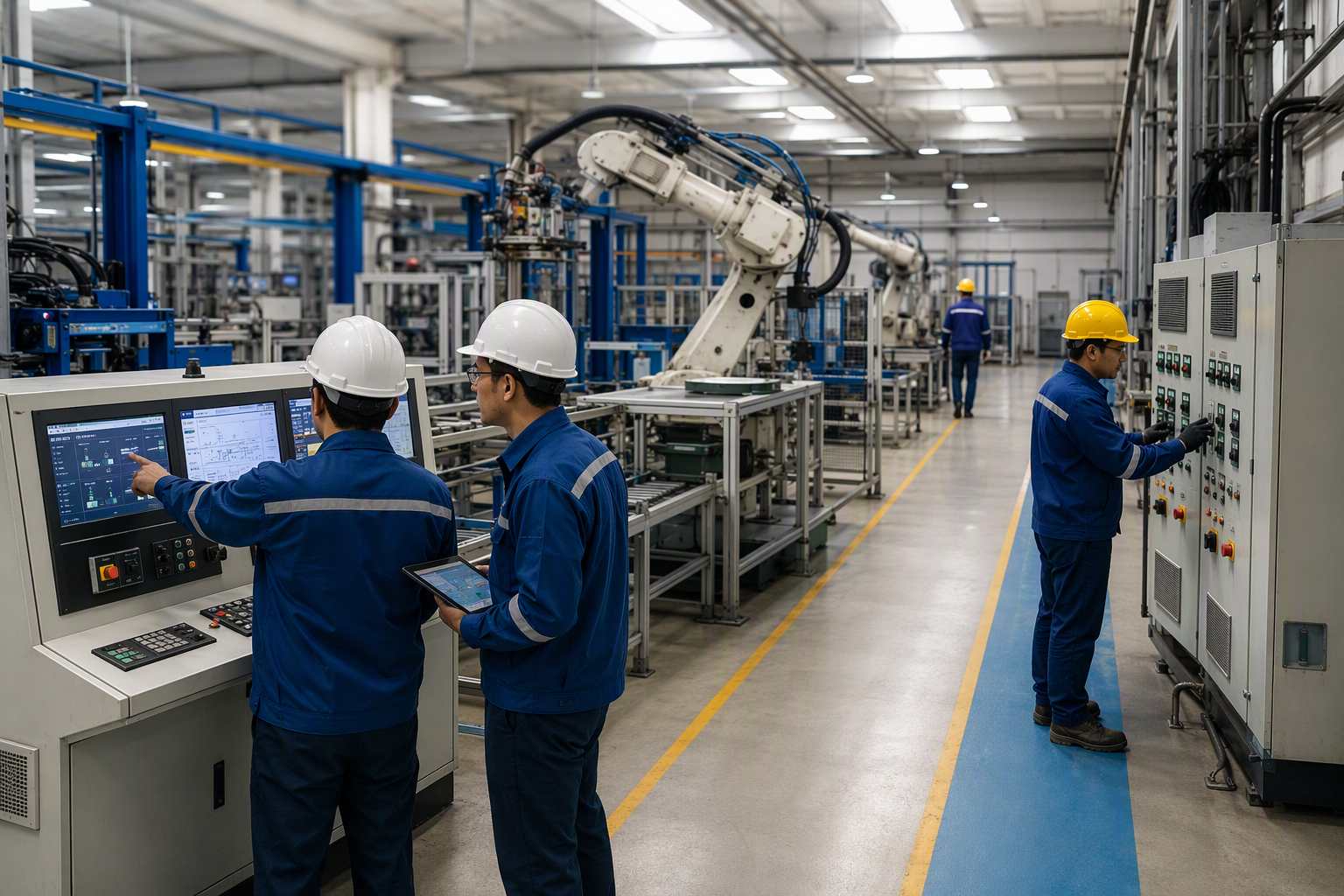
A strong industrial automation provider does more than install machines. The best partners understand your workflow, recommend practical solutions, and support the system after launch so performance stays steady over time.
When comparing providers, focus on a few basics:
- Ability to design customized systems for your operational goals
- Experience with control systems, robotics, IoT, and process automation
- Ongoing maintenance and support services after implementation
- Commitment to quality standards and customer satisfaction
This matters because automation is not only about technology. It is about results. If a provider can improve uptime, support product quality, and help your team adapt, you gain a stronger competitive edge. For many companies, that partnership has a direct effect on cost control, safety, and long-term performance.
Comparing Leading Industrial Automation Companies and Their Services
Top industrial automation companies are usually known for broad automation services, reliable automation products, and support across multiple industries. The compiled information specifically highlights providers that design, deploy, integrate, and maintain systems using robotics, IoT, AI, machine vision, PLCs, DCS, and SCADA.
Some well-known market names also appear in industry keyword discussions, such as Rockwell Automation and Schneider Electric. Still, the core comparison should focus on service capability, system fit, and post-installation support rather than brand name alone.
| Company type or example | Common services offered |
|---|---|
| System integrators | Custom system design, integration, and workflow setup |
| Control specialists | PLC, SCADA, and DCS development for process control |
| Robotics providers | Robotic systems for welding, packaging, sorting, and material handling |
| Full-service automation companies | Engineering services, IoT analytics, maintenance, and upgrades |
Conclusion
In conclusion, embracing innovative industrial automation solutions can significantly enhance operational efficiency and drive productivity in modern manufacturing. By understanding the key components, types, and real-world applications of automation, businesses can make informed decisions when selecting a provider that aligns with their needs. The right automation strategy not only streamlines processes but also supports sustainability and cost savings, paving the way for long-term success. As industries continue to evolve, staying ahead of the curve with cutting-edge technology is essential. If you're ready to transform your operations, reach out today to explore tailored industrial automation solutions designed specifically for your business needs.
Frequently Asked Questions
What are the main benefits of integrating automation solutions in factories?
The main benefits of automation include better product quality, faster handling of repetitive work, and lower costs from reduced waste and fewer errors. Automation solutions can also improve worker safety, support steady output, and help factories manage labor costs by shifting employees into higher-value roles.
How does industrial automation support sustainability and cost savings?
Industrial automation supports sustainability by reducing waste, improving energy efficiency, and helping machines run with better control. Lower energy consumption, fewer defects, and smarter maintenance planning all contribute to cost savings. For many manufacturers, that means better environmental performance without sacrificing production goals.
Which industries in the United States benefit most from implementing industrial automation?
Various industries benefit from industrial automation, especially the manufacturing industry, food and beverage, pharmaceuticals, logistics, energy, aerospace, agriculture, and mining. Consumer goods producers and defense industries also gain from better precision, safer operations, and more reliable output across complex production environments.