Future Innovations in the Industrial Automation Sector
Future Innovations in the Industrial Automation Sector
Key Highlights
- Industrial automation utilizes control systems and technologies like industrial robots to manage the production process with minimal human input.
- The primary benefits of automation include enhanced productivity, improved safety, and consistent product quality.
- Key innovations driving the sector include artificial intelligence, advanced robotics, and the Internet of Things (IoT).
- Automation systems are becoming crucial for addressing labor shortages and sustainability goals in manufacturing.
- The future of industrial automation points toward more connected, intelligent, and eco-friendly factories.
Introduction
Welcome to the cutting edge of modern industry! The Industrial Automation Sector is no longer a concept from science fiction; it's a reality that is transforming the manufacturing process for businesses everywhere. From handling materials to final product delivery, automation systems are making operations more efficient and reliable. This article will explore the exciting world of industrial automation, covering its various types, the benefits it offers, and the future innovations that are set to revolutionize how work gets done.
Overview of Industrial Automation Sector
Industrial automation is the use of control systems, like computers and robots, to manage industrial processes with very little human involvement. It's a significant step beyond simple mechanization, forming the core of today's smart manufacturing and Industry 4.0. Essentially, it shifts the focus from people operating machines to machines operating themselves.
This technology is crucial because it allows for a faster, safer, and more consistent production process. The benefits of automation are clear: it boosts efficiency, reduces errors, improves safety, and lets manufacturers scale up production while maintaining high quality. Let's look closer at what defines automation today and why it's so vital for U.S. manufacturing.
What Defines the Industrial Automation Sector Today
At its core, industrial automation today is about creating a self-regulating, automated system. It uses control systems to create a continuous feedback loop where machines monitor conditions, process data, and respond in real time. This allows the system to make adjustments automatically to maintain peak performance without constant human intervention.
Each automated process relies on a closed-loop system. Sensors gather data from the production line, controllers like PLCs make decisions based on that data, and actuators or robots carry out the necessary physical actions. This integration reduces the need for direct human labor in repetitive or hazardous tasks.
This approach to process automation results in a system that is faster, safer, and more consistent than one relying solely on manual work. It allows businesses to scale production without proportionally increasing their workforce, a key element of modern manufacturing strategy.
Importance of the Industrial Automation Sector in U.S. Manufacturing
In the competitive landscape of U.S. manufacturing, industrial automation has become indispensable. Initially, automation was primarily about boosting productivity and cutting labor costs. While those benefits remain, the focus has expanded to include enhancing the quality and flexibility of the manufacturing process. Automated systems can operate around the clock, significantly increasing output.
Industrial automation systems also address quality control with incredible precision. For example, in the automotive industry, installing pistons by hand once had an error rate of 1-1.5%. Today, industrial robots perform this task with an error rate of just 0.00001%. This level of accuracy is impossible to achieve with manual labor alone.
By deploying automation on the production line, U.S. manufacturers can reduce operational expenses, improve product consistency, and respond more quickly to market changes. This makes them more competitive on a global scale and better equipped to handle modern production demands.
Types of Industrial Automation Sector Systems
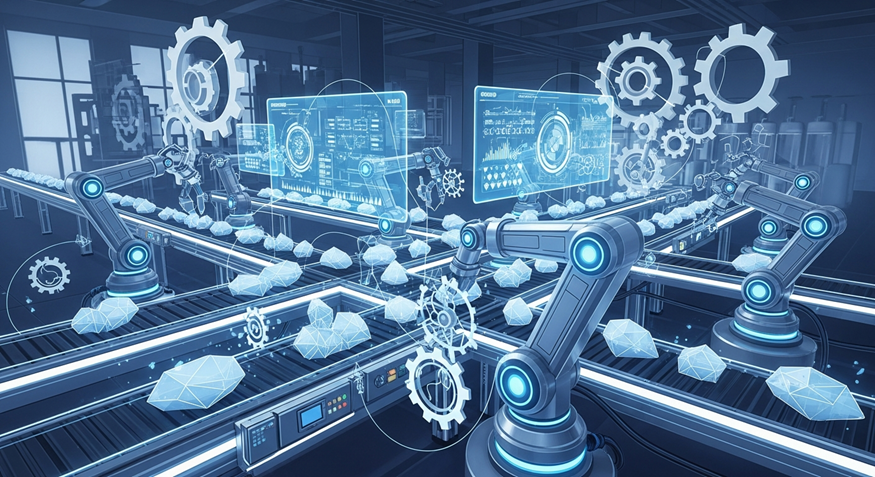
Industrial automation isn't a one-size-fits-all solution. There are several types of industrial automation, each designed for different production requirements and levels of flexibility. The main categories are fixed, programmable, flexible, and integrated automation. Understanding the differences between these automation systems is key to choosing the right approach for your specific needs.
Choosing the right automation solutions can dramatically impact efficiency and adaptability. Whether you need to produce millions of identical items or small batches of custom products, there's a type of automation suited for the job. We'll explore fixed, flexible, and programmable automation in more detail.
Fixed and Hard Automation Explained
Fixed automation, also known as hard automation, is designed for high-volume, repetitive tasks. It involves using specialized equipment built for a single, specific part of the production process. Once set up, these systems run continuously with minimal changes, making them incredibly efficient for mass production.
This type of automation is ideal when the product design is stable and not expected to change frequently. Because the equipment is custom-built for one job, it can perform with incredible speed and high precision. The manufacturing industry often uses fixed automation for assembly lines where consistency is key.
Key characteristics of fixed automation include:
- High initial investment in custom equipment
- High production rates
- Inflexibility to product changes
- Low unit cost for large volumes
Flexible and Soft Automation Applications
Flexible automation, sometimes called soft automation, offers the highest level of adaptability. These systems are designed to handle a variety of products and can be quickly reconfigured to adapt to changes in production without significant downtime. This makes them perfect for industries that need to respond rapidly to changing market demands.
This form of automation is excellent for batch production where product designs change frequently. Instead of being locked into one task, machines on the production line can be easily adjusted. Flexible automation uses a combination of robotics, sensors, and intelligent software to manage different raw materials and assembly processes.
Common applications of flexible automation include:
- Custom product manufacturing
- Industries with high product variety, like consumer goods
- Operations requiring quick changeovers between tasks
- Systems that can handle different product models simultaneously
Programmable Automation Integration
Programmable automation is a middle ground between fixed and flexible systems, well-suited for batch production. It uses machines that can be reprogrammed to perform different tasks, but changing the program and retooling the equipment requires a setup process. This makes it more flexible than fixed automation but less so than truly flexible systems.
The core of this type of automation is often programmable logic controllers (PLCs) or computer-controlled machines like CNCs. These allow operators to change the sequence of operations to produce different product variations in batches. After one batch is complete, the system can be reprogrammed for the next.
Key features of programmable automation are:
- Flexibility to handle product variations
- Suitable for batch production cycles
- Lower production rates compared to fixed automation
- Reprogramming capability for new tasks within the production process
Key Benefits of the Modern Industrial Automation Sector
The benefits of the Industrial Automation Sector are transformative for any manufacturing operation. By implementing automation, companies can achieve significant cost savings, boost overall efficiency, and create a safer environment for their employees. These advantages address real-world operational challenges and lead to measurable improvements across the board.
From streamlining workflows to ensuring consistent quality, automation provides a powerful set of tools for modern businesses. Let’s explore how it specifically boosts productivity and enhances quality and worker safety.
Boosting Productivity and Efficiency
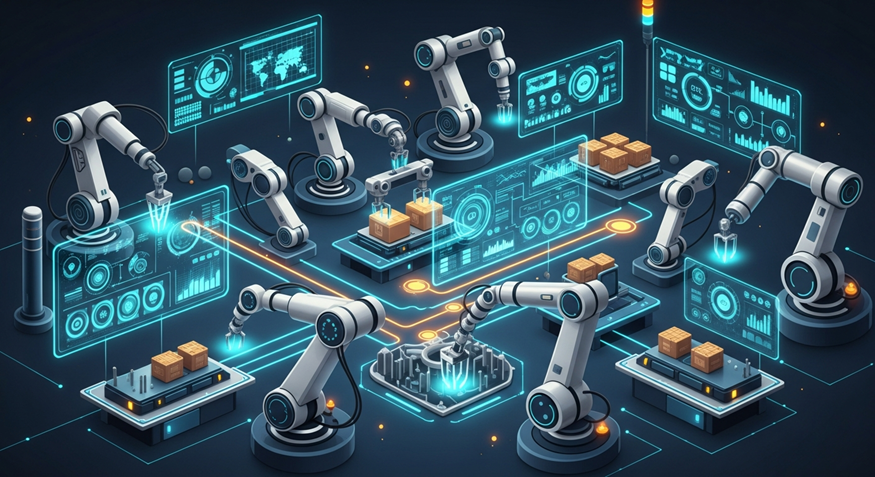
One of the most significant advantages of the Industrial Automation Sector is the dramatic increase in operational efficiency. Automation systems can work 24/7 without breaks, holidays, or fatigue. This continuous operation allows manufacturing plants to achieve a much higher output than would be possible with human labor alone, directly boosting productivity.
Many companies traditionally use multiple shifts of workers to keep their production line running, but even then, the plant must close for holidays and maintenance. Automation systems bypass these limitations, leading to a substantial increase in the company's overall productivity and throughput.
This nonstop operation translates directly into cost savings. With higher output from the same facility, the cost per unit decreases. Furthermore, by optimizing workflows and reducing bottlenecks, automation helps streamline the entire process, making every aspect of the operation more efficient.
Enhancing Consistency, Quality, and Safety
The Industrial Automation Sector plays a critical role in improving product quality and consistency. Unlike humans, robots don't get tired and can perform the same task with the same precision every time. This consistency eliminates the variations associated with human error, ensuring that every product meets the same high quality standards.
Effective quality control is built into automated systems. They can detect deviations from standard procedures in real time and make immediate corrections, minimizing waste and ensuring that finished products are flawless. This leads to greater customer satisfaction and a stronger brand reputation.
Furthermore, automation significantly enhances workplace safety in industrial environments.
- Robots can take over hazardous or physically demanding tasks.
- Automated systems reduce accidents related to manual material handling.
- Workers are moved away from dangerous machinery and environments.
- A safer workplace leads to higher morale and lower costs associated with accidents.
Market Size and Adoption Trends in the Industrial Automation Sector
The industrial automation market is experiencing rapid expansion. Fierce competition in the global marketplace is pushing businesses to find ways to streamline operations, cut costs, and increase productivity. Automation solutions are becoming essential for companies looking to stay competitive and meet evolving market demands.
This growth is also fueled by technological advancements that make automation more accessible and powerful. As more industries recognize the benefits, the global industrial automation market continues to grow, reflecting a major shift in how modern manufacturing and logistics are managed. We'll now examine some specific statistics and growth forecasts for this dynamic sector.
Global and U.S. Industrial Automation Sector Statistics
The statistics surrounding the industrial automation market underscore its immense scale and rapid growth. The global market size reflects a strong and growing demand for automation solutions across various sectors. This trend is driven by the need for greater efficiency and the pressure to keep up with technological advancements.
In 2021, the global industrial automation market was valued at an impressive $196.6 billion. This figure grew to $213.49 billion in 2022, demonstrating a significant year-over-year growth rate of 8.59%. This highlights the increasing investment businesses are making in this transformative technology.
The industrial automation industry is not just growing; it's accelerating. As companies look to optimize their processes and respond to market demands, the adoption of automation continues to climb.
| Market Snapshot | Value/Rate |
|---|---|
| Global Market Value (2021) | $196.6 Billion |
| Global Market Value (2022) | $213.49 Billion |
| Year-over-Year Growth (2021-2022) | 8.59% |
Forecasted Growth of the Industrial Automation Sector Market by 2033
Looking ahead, the future of industrial automation appears incredibly bright. The industrial automation market is projected to continue its strong growth trajectory over the next decade. Projections indicate that the market could reach a staggering $395.09 billion by 2029, growing at a compound annual growth rate (CAGR) of 9.8%.
This forecasted growth is a clear indicator of the increasing importance of automation technology in the global marketplace. As technologies like AI and IoT become more integrated into industrial processes, the capabilities and accessibility of automation will expand, driving even wider adoption.
Companies that embrace these advancements will be better positioned to compete and succeed. The continued expansion of the market shows that automation is not just a trend but a fundamental shift in how industries will operate for years to come.
Major Innovations Shaping the Future of the Industrial Automation Sector
The future of industrial automation is being defined by a wave of powerful innovations. Technologies such as artificial intelligence, machine learning, and advanced robotics are pushing the boundaries of what automation solutions can achieve. These advancements are making systems smarter, more adaptable, and more efficient than ever before.
From connected factories powered by the Internet of Things (IoT) to robots that can work alongside humans, these trends are paving the way for the next generation of manufacturing. Let’s explore some of the most important innovations driving this change.
Artificial Intelligence and Machine Learning in the Industrial Automation Sector
Artificial intelligence (AI) and machine learning (ML) are becoming game-changers in industrial automation. These technologies give automation systems the ability to learn from data, adapt to new situations, and make intelligent decisions without human programming for every scenario. This allows for a higher level of optimization and efficiency.
AI-powered systems can analyze vast amounts of data in real time to identify patterns and predict outcomes. For instance, ML algorithms can be used for predictive maintenance, where sensors on equipment detect potential issues before they cause a breakdown. This helps reduce downtime and extend the life of machinery.
Key applications of AI and ML in automation include:
- Optimizing production schedules for maximum efficiency.
- Improving quality control by detecting defects with greater accuracy.
- Enabling robots to handle complex, non-repetitive tasks.
- Enhancing decision-making through real-time data analysis.
Robotics and Advanced Sensor Technologies
Modern robotics and advanced sensor technologies are at the heart of today's automated factories. Industrial robots, including sophisticated robotic arms, are capable of performing tasks with a level of speed and precision that far exceeds human capabilities. They handle everything from welding and painting in automotive manufacturing to assembling tiny components in electronics.
The effectiveness of these robots is greatly enhanced by advanced sensors. These sensors provide the robots with the data they need to perceive their environment, handle objects correctly, and work safely. They can detect position, pressure, temperature, and visual information, allowing for more complex and delicate operations.
Innovations in this area are leading to:
- Collaborative robots ("cobots") that can work safely alongside human employees.
- Robots with enhanced vision systems for complex inspection tasks.
- More agile and mobile robots for logistics and material handling.
- The ability to automate tasks that were previously too intricate for machines.
Internet of Things (IoT) and Connected Factories
The Internet of Things (IoT) is revolutionizing the Industrial Automation Sector by creating fully connected factories. In an IoT-enabled environment, machines, sensors, and control systems are all interconnected, allowing them to communicate and share data seamlessly. This creates a "smart factory" where processes are monitored and optimized in real time.
This constant stream of information from IoT devices allows for unprecedented levels of data acquisition. Systems like SCADA systems can then use this data to provide a comprehensive view of the entire operation. This enables managers to make informed decisions, identify bottlenecks, and improve efficiency across the board.
The impact of IoT on automation solutions includes:
- Real-time monitoring of equipment health and performance.
- Improved supply chain and inventory management.
- Enhanced data collection for better process optimization.
- The foundation for integrated automation and smart manufacturing initiatives.
Sustainability and Environmental Impact in the Industrial Automation Sector
As industries evolve, sustainability has become a critical focus within industrial automation. Companies are increasingly looking for ways to reduce their environmental footprint, and automation offers powerful tools to achieve this. By optimizing processes, automation can significantly reduce energy consumption and material waste.
This shift towards eco-friendly solutions is not just good for the planet; it's also good for business. Efficient use of resources leads to lower costs and can improve a company's public image. Let’s look at how automation is driving energy efficiency and other green initiatives.
Eco-Friendly Solutions and Energy Efficiency Initiatives
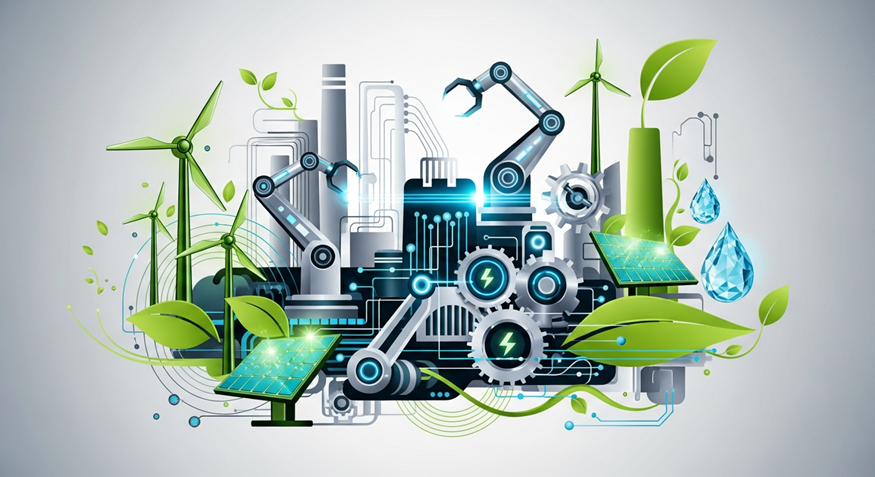
The Industrial Automation Sector provides numerous opportunities for implementing eco-friendly solutions and promoting energy efficiency. Automated systems can be programmed to optimize the use of resources, ensuring that energy is not wasted during idle times and that raw materials are used with maximum precision.
For example, smart automation can control the flow of materials in the production process, minimizing waste and ensuring that every bit is used efficiently. This precision reduces the amount of scrap material that ends up in landfills. Similarly, by optimizing machine operations, automation can lower overall energy consumption.
Key sustainability benefits driven by automation include:
- Reduced energy consumption through optimized machine usage.
- Minimized material waste due to higher precision.
- Longer equipment life, reducing the need for new manufacturing.
- Improved process control that leads to less rework and fewer rejected parts.
Challenges and Opportunities Within the Sector
While the industrial automation industry is full of promise, it also faces significant challenges. As automation technology becomes more connected and complex, issues like cybersecurity have become a major concern. At the same time, the shift towards automation creates a need for workforce adaptation and the development of new skills.
However, these challenges also present opportunities. Addressing digital risks can lead to more robust and reliable systems, while investing in employee training can create a more skilled and valuable workforce. Next, we will explore the specific challenges of cybersecurity and workforce development.
Addressing Cybersecurity and Digital Risks
As automation systems become more interconnected, they also become more vulnerable to cybersecurity threats. Highly connected industrial environments rely on networks to transmit data in real time, but this connectivity can create entry points for cyberattacks if not properly secured. A breach could lead to production shutdowns, data theft, or even physical damage.
Addressing these digital risks is a critical challenge for the industry. It requires a proactive approach to cybersecurity, including securing networks, protecting control systems, and regularly monitoring for threats. Manufacturers must treat cybersecurity as an integral part of their automation strategy, not an afterthought.
Key measures to mitigate these risks include:
- Implementing robust firewalls and network segmentation.
- Regularly updating software and patching vulnerabilities.
- Training employees to recognize and report phishing and other social engineering attacks.
- Developing a response plan for potential security incidents.
Workforce Adaptation and Skills Development
One of the most discussed aspects of automation is its impact on the workforce. While industrial automation can lead to the displacement of jobs involving repetitive manual labor, it doesn't necessarily mean fewer jobs overall. Instead, it creates a need for workforce adaptation, as human workers are needed for new, higher-level roles.
This shift requires a focus on skills development. Companies that invest in automation solutions also need to invest in training their employees. Workers must learn to operate, maintain, and manage these new systems. Reskilling programs are essential to help employees transition into roles that involve robotics, data analysis, and system management.
Opportunities for workforce development include:
- Training programs to upskill the existing workforce.
- Creating new roles in automation maintenance and programming.
- Shifting human workers from dangerous tasks to safer, supervisory roles.
- Fostering a culture of continuous learning to keep up with new technologies.
Applications of Industrial Automation Across Different Industries
The impact of industrial automation extends far beyond the traditional manufacturing industry. Process automation is being adopted across various industries to improve efficiency, quality, and safety. From healthcare to logistics, automation systems are revolutionizing how work is done.
The flexibility of modern automation allows it to be tailored to the unique needs of different sectors. Let's look at some specific examples of how automation is being applied in manufacturing, logistics, and healthcare, as well as its potential in other emerging areas.
Manufacturing, Logistics, and Healthcare Examples
In manufacturing, industrial automation systems are at the core of the modern production process. Robotic arms assemble products with high precision, while automated guided vehicles (AGVs) handle the movement of materials around the factory floor, streamlining the entire workflow.
Logistics and warehousing have been transformed by automation. Smart sorting systems and autonomous mobile robots manage inventory and fulfill orders with incredible speed and accuracy. This has been crucial for meeting the demands of e-commerce. In healthcare, automation is used for tasks like dispensing medication, managing lab samples, and even assisting in surgery, improving accuracy and patient safety.
Examples across these industries include:
- Manufacturing: Welding and painting robots on automotive assembly lines.
- Logistics: Autonomous forklifts and conveyor systems for material handling.
- Healthcare: Robotic systems used for high-precision surgical procedures.
- Food & Beverage: Automated filling and packaging machines.
Future Potential in New Industry Verticals
The potential for industrial automation is continually expanding into new industry verticals. As new technologies emerge, automation solutions are becoming more adaptable and cost-effective, opening up possibilities in sectors that have traditionally relied on manual processes. Industries like construction, agriculture, and even mining are beginning to see the benefits.
Beyond the well-established applications in the automotive industry and consumer goods, we can expect to see automation play a larger role in areas that require high customization or operate in challenging environments. For example, autonomous drones could be used for site inspection in construction, or robotic systems for harvesting crops in agriculture.
Future growth areas for automation include:
· Construction: Automated bricklaying and 3D printing of building structures.
· Agriculture: Precision farming with autonomous tractors and drones.
· Mining: Self-driving trucks and automated drilling equipment.
· Pharmaceuticals: Automated systems for drug discovery and testing.
Conclusion
In conclusion, the future of industrial automation is bright, driven by groundbreaking innovations and a commitment to sustainability. With advancements in artificial intelligence, robotics, and IoT, industries are becoming more efficient and productive while ensuring quality and safety. As businesses adapt to these changes, they will not only enhance their operational capabilities but also address crucial challenges like cybersecurity and workforce development. Embracing these technologies will enable organizations to thrive in an ever-evolving landscape. If you're ready to explore how these innovations can transform your operations, reach out today for a free consultation and take the first step towards a smarter future in industrial automation.
Frequently Asked Questions
How do industrial automation systems work and what are their benefits?
Industrial automation systems use hardware and software to control a production process with minimal human intervention. They work by using sensors to gather data and controllers to make decisions. The key benefits of automation include increased productivity, improved quality, enhanced safety, and significant cost savings over time.
What are the most important innovations in industrial automation right now?
The most important innovations shaping automation solutions today are artificial intelligence, machine learning, advanced robotics, and the Internet of Things (IoT). These technologies are making systems smarter, more connected, and capable of handling complex tasks with greater efficiency and flexibility than ever before.
How is sustainability being integrated into industrial automation?
Sustainability is being integrated through eco-friendly solutions that optimize the production process. Automation helps reduce energy consumption by running machines more efficiently and cuts down on material waste by increasing precision. This leads to a smaller environmental footprint and more sustainable operations.
You might also like