How the Industrial Automation Industry Serves Food and Beverage
How the Industrial Automation Industry Serves Food and Beverage
Key Highlights
- Industrial automation helps food and beverage companies improve speed, safety, and product quality across production.
- Modern automation solutions reduce human intervention in repetitive tasks while supporting stronger process control.
- Different systems, from fixed setups to flexible platforms, fit different food and beverage production needs.
- Tools like PLCs, SCADA, industrial robots, and smart sensors support more reliable operations.
- Automation also helps address labor shortages, lower waste, and improve resource use.
- New trends are pushing faster, smarter, more connected manufacturing environments.
Introduction
Industrial automation plays a growing role in the food and beverage sector because it helps companies run a cleaner, faster, and more consistent manufacturing process. From moving ingredients to packaging finished goods, automation technology supports better control with less manual effort. If you want more output without sacrificing quality, this shift matters. It is no longer a future idea. It is a practical way to improve how production works every day across busy facilities.
Industrial Automation Industry Applications Across Manufacturing
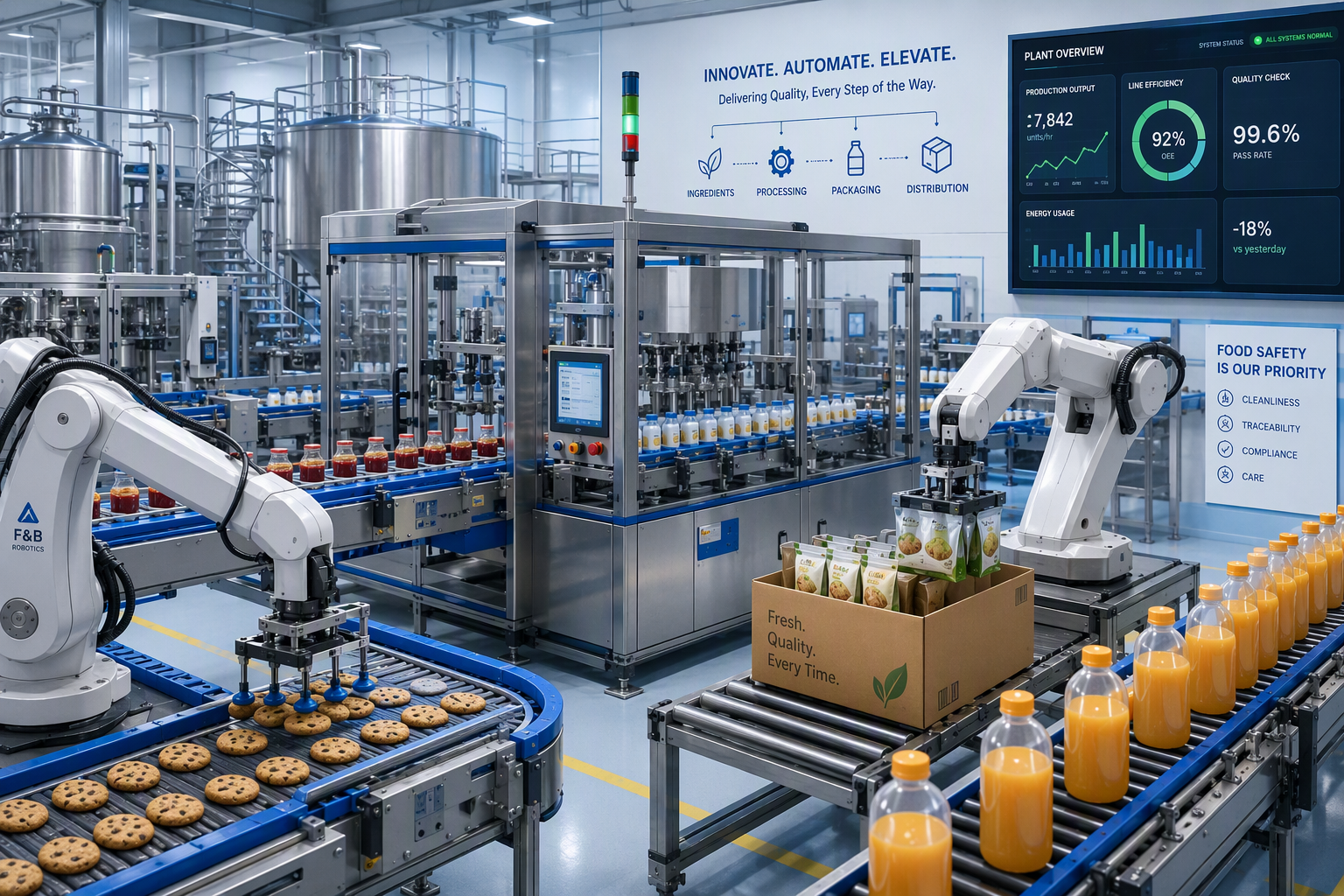
Understanding Industrial Automation in the Food and Beverage Industry
At its core, industrial automation is the use of machines, sensors, software, and automation systems to handle tasks in the manufacturing process with reduced manual input. In food and beverage plants, this can include mixing, filling, labeling, packing, and material movement.
It works through process control, feedback, and optimization. Sensors track conditions, control systems respond, and equipment adjusts as needed. To see how this fits your operation, it helps to understand the principles, uses, and types of industrial automation in more detail.
Definition and Core Principles of Industrial Automation
Industrial automation means using advanced machinery and software to perform industrial tasks more efficiently and with less human intervention. In a food plant, that can mean automated conveyors, filling equipment, or systems that monitor temperature and flow during production.
The way it works is fairly direct. Automation systems gather input from sensors and other devices, apply control logic, and then trigger equipment actions. This creates a loop where the system monitors conditions, reacts to changes, and keeps operations moving within set targets.
Three core ideas shape industrial automation: control, feedback, and optimization. Control manages system behavior. Feedback helps the system detect changes in its environment. Optimization uses operating data to improve performance over time. Together, these principles support steadier output, safer operations, and more reliable production in demanding settings.
The Role of Automation in Modern Food and Beverage Production
Food and beverage production depends on consistency, speed, and safety. That is why industrial automation has become so important in modern plants. It helps companies standardize work across different stages, from ingredient handling to final packaging.
In practical terms, automation solutions take over repetitive and physically demanding jobs, allowing human operators to focus on oversight and higher-value work. This shift can improve throughput, reduce common errors tied to fatigue, and support a steadier production pace throughout the day.
Just as important, automation strengthens product quality. Machines can repeat the same actions with consistent precision, which helps maintain uniform output. Continuous monitoring also makes it easier to catch process deviations early. For food and beverage companies, that combination of efficiency and dependable quality is a major reason automation keeps expanding.
Key Components of Industrial Automation Systems
Most automation systems rely on a connected set of hardware and software working together. In food and beverage plants, these components help manage process control, equipment response, and production visibility from the field level up to supervisory systems.
Common components include:
- Field devices such as sensors that detect changes in temperature, flow, or position
- Programmable logic controllers that execute control instructions and respond to production conditions
- SCADA systems that support monitoring, supervisory control, and data collection
- Connected machinery such as conveyors, fillers, and packaging equipment tied into a wider control setup
When these parts are integrated well, operators gain better oversight and faster response times. That means less guesswork on the floor and more dependable output. For facilities handling large volumes, these building blocks create the structure needed for safer, more efficient daily production.
Brief History and Evolution of Automation Technologies
Industrial automation started with simple mechanization of repetitive tasks, especially in assembly line environments. Early systems were designed to repeat a fixed action over and over, which helped speed up work but offered limited flexibility. That early stage laid the groundwork for broader use in the manufacturing process.
Over time, the evolution of automation technologies brought smarter controls, better sensing, and more adaptable equipment. As computing improved, automation moved beyond isolated machines and into coordinated systems that could monitor conditions and respond more effectively.
Today, industrial automation connects advanced software, robotics, and information technology in ways that were not possible before. Artificial intelligence, machine learning, and connected devices are pushing systems to become more responsive and data driven. This shift is changing how manufacturers plan, run, and improve production across many industries.
Types of Industrial Automation Used in Food and Beverage
The main types of industrial automation used in food and beverage include fixed, programmable, flexible, and integrated systems. Each one supports a different operating need, depending on volume, product mix, and how often a plant changes from one run to another.
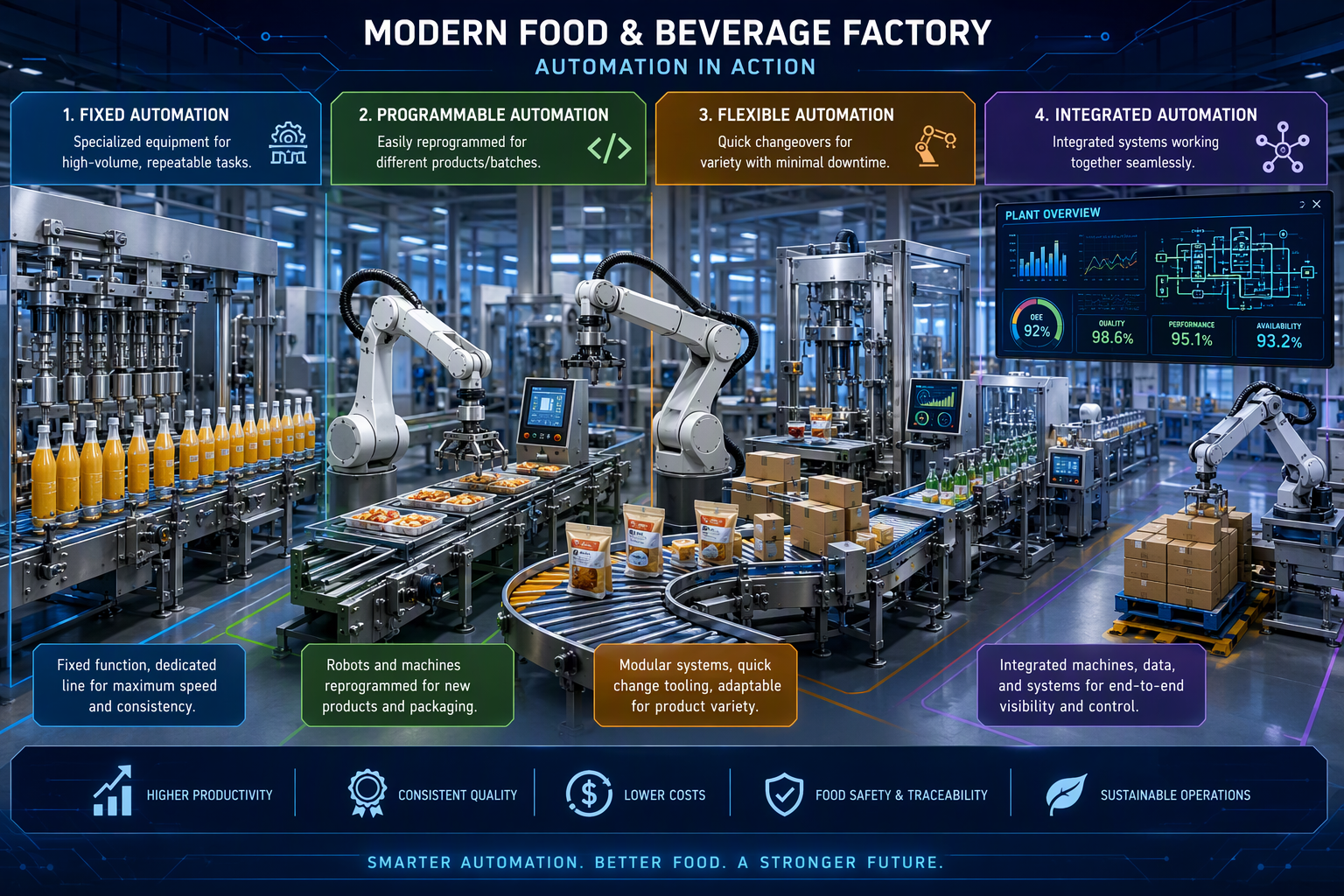
Some automation solutions are best for stable, repetitive work, while others suit batch production or facilities making different products. Understanding these automation systems helps you match the right setup to your plant. The next sections break down how each type works in practice.
Fixed and Programmable Automation Systems
Fixed automation is built to perform a specific task repeatedly and at high speed. In food processing, that can fit lines where the same product moves through the same steps every day. Because the equipment is designed for one routine, it is efficient but not easy to change.
Programmable automation offers more flexibility. Instead of being locked into a single function, the control system can be updated to support a range of tasks. This makes it better suited for operations that need to switch products or adjust settings based on changing production demands.
That is why programmable automation often fits batch production better than fixed setups. By changing the control logic, manufacturers can adapt machinery for new runs without replacing entire lines. If your operation handles multiple recipes or packaging formats, that added flexibility can be a strong advantage.
Flexible and Integrated Automation Solutions
Flexible automation is designed for environments where production needs change often. In food plants, that matters when facilities make different products, respond to shifting demand, or update workflows. These systems are easier to reconfigure than traditional fixed lines.
Unlike simpler setups, flexible automation can combine adaptable hardware and software to support multiple tasks with minimal interruption. This makes it valuable for manufacturers that need speed without giving up variety. It is one of the more advanced types of industrial automation because it handles change more smoothly.
Integrated automation goes a step further by connecting multiple systems into one coordinated process. It can bring together robots, conveyors, controls, and monitoring tools under a unified platform. That connected approach supports smart factories, where data and equipment work together to improve flow, visibility, and operating performance.
Process Control Automation for Consistency
Process control is one of the most important forms of automation technology in food and beverage manufacturing. It helps plants maintain the right conditions during production, which is critical when consistency affects taste, texture, safety, and shelf stability.
With strong process control, equipment can monitor operating conditions and make timely adjustments with minimal human intervention. That reduces variability on production lines and keeps performance closer to target. Instead of waiting for a problem to become visible, the system can react while the process is still running.
This improves operational efficiency because fewer errors move downstream. It also supports better quality control by catching deviations earlier and keeping output more uniform. For companies trying to balance speed with consistency, process-focused automation creates a reliable foundation for everyday production.
Robotics and Their Applications in Food and Beverage
Industrial robots are a practical part of automation technology in many production settings. In food and beverage facilities, they are especially useful for jobs that are repetitive, physically demanding, or time sensitive. They support stable output while helping reduce worker fatigue.
You will often see industrial robots used for:
- Material handling between workstations or storage areas
- Packaging tasks such as loading, sorting, or placing products
- Repetitive tasks that need the same motion and timing each cycle
- Transport support in facilities using autonomous vehicles or guided systems
These applications matter because they keep work moving with consistent precision. They also allow teams to shift away from routine motions and toward supervision or problem solving. For food plants looking to improve flow without adding strain to staff, robotic support is becoming a clear use case.
Major Benefits of Industrial Automation for Food and Beverage Companies
Industrial automation gives food and beverage companies clear operational gains. It helps raise production efficiency, improves product quality, and supports steadier output across daily runs. When lines are under pressure, that kind of reliability matters.
It also changes how human labor is used. Instead of spending time on repetitive or risky work, teams can focus on higher-value tasks. These automation benefits show up in throughput, consistency, labor support, and costs. The sections below explain where companies often see the biggest impact.
Enhanced Production Efficiency and Throughput
One of the strongest reasons companies invest in automation technology is better efficiency. Automated equipment handles repeated actions faster and with less interruption, which helps the production process move at a steadier pace. That directly supports higher output.
In busy facilities, automation solutions reduce delays tied to manual handoffs or inconsistent work speed. Machines do not get tired or lose focus during repetitive tasks, so throughput becomes easier to maintain over long shifts. This can make a major difference when demand is high or schedules are tight.
Operational efficiency improves because fewer small mistakes slow the line down. A more controlled process also means less rework and better use of plant time. For food and beverage manufacturers, improved throughput is not only about speed. It is about producing more dependable results with fewer disruptions.
Improved Product Quality and Repeatability
Consistent output is a major priority in food and beverage manufacturing, and automation systems help deliver it. When machines repeat the same task with the same settings, repeatability improves. That makes products more uniform from one cycle to the next.
Another key benefit is tighter control over production conditions. Through built-in control logic, automated equipment can maintain more stable performance and support timely corrections when conditions drift. This allows quality checks to happen with more consistency than in purely manual environments.
Better product quality is the result of that precision and stability. Automated processes help reduce the variation that can come from fatigue, distraction, or uneven work methods. If your goal is dependable results across large volumes, repeatable automated production gives you a much stronger base to work from.
Labor Utilization and Addressing Workforce Challenges
Many manufacturers are dealing with labor shortages, and food production is no exception. Industrial automation helps by taking over repetitive tasks that consume time and energy. This does not remove the need for people. It changes where their effort is most valuable.
With the right automation technology, companies can assign human labor to monitoring, improvement work, and other tasks that need judgment. That matters in a tight labor market, where skilled employees are hard to replace and burnout can affect retention.
There is also a safety benefit. Automation can handle dangerous tasks or work in environments that are physically demanding for long periods. That can improve working conditions and reduce strain on teams. Sectors with high-volume production, logistics movement, and continuous processing are seeing especially strong impact from this shift.
Cost Reduction and Resource Optimization
For many companies, automation is as much about cost reduction as it is about speed. By improving precision and cutting avoidable errors, automated systems can reduce waste tied to raw materials, rework, and unplanned interruptions in the manufacturing process.
Resource optimization is another major advantage. Automation solutions can help control how materials move and how equipment runs, which supports more efficient use of labor, inputs, and machine time. Better control usually leads to fewer losses across the line.
Energy use also matters. When processes are better managed, operations can avoid unnecessary running time and other inefficiencies. Over time, those savings add up. For food and beverage manufacturers working with tight margins, a more disciplined process can improve both daily performance and long-term profitability.
Key Automation Technologies Powering the Industry
Several core tools are driving automation technology across food and beverage operations. These include PLCs, SCADA platforms, industrial robots, smart sensors, and connected systems built around industrial iot. Each one supports a different part of plant performance.
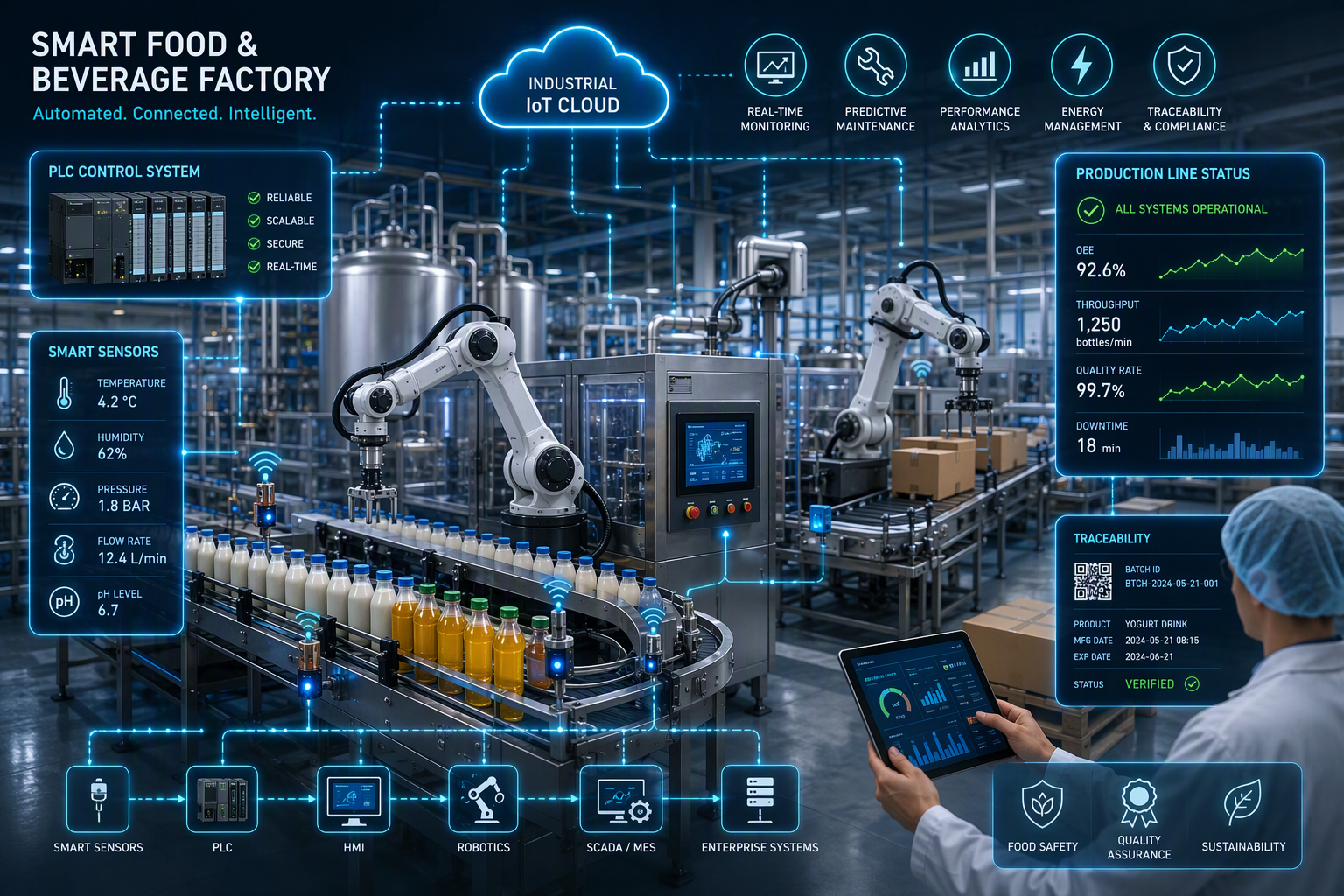
As AI and machine learning become more useful in industrial settings, automation is also getting smarter, not just faster. These technologies help companies monitor equipment, improve decisions, and respond sooner to issues. The following sections explain how each technology contributes to better results.
PLCs (Programmable Logic Controllers) and SCADA Systems
Programmable logic controllers are a core part of many automated facilities. They are used to control machinery, automate tasks, monitor equipment status, and respond to changing production conditions. In food and beverage plants, they help keep the control system running in a predictable way.
SCADA systems add a broader layer of visibility. They support supervisory control and data acquisition, giving teams a way to monitor processes across equipment and production areas. This helps operators see what is happening in real time and react before small issues become larger problems.
Together, programmable logic controllers and SCADA systems form a practical backbone for industrial automation. PLCs manage local machine actions, while SCADA systems provide plant-wide oversight. That combination helps improve coordination, strengthen monitoring, and support faster decisions in busy manufacturing environments.
AI, Machine Learning, and Smart Sensors
Artificial intelligence and machine learning are becoming more important in modern automation technology. They help systems learn from operating information, adapt to changing conditions, and support better decisions. In food and beverage production, that can improve planning, monitoring, and equipment performance.
Smart sensors make this possible by gathering detailed operating data from machines and processes. With better data analysis, companies can identify patterns, spot issues sooner, and improve performance over time. This is one reason the industrial automation industry keeps evolving with new technologies.
Key roles include:
- Smart sensors collecting operating information from equipment and processes
- Artificial intelligence supporting more accurate detection and decision making
- Machine learning identifying patterns that help improve future performance
- Data analysis helping teams optimize schedules and monitor equipment health
Industrial Robots for Material Handling and Packaging
Industrial robots are widely used for material handling and packaging because those jobs often involve speed, precision, and repeated motion. In food and beverage settings, that can mean moving goods between stations or supporting end-of-line packing work.
These automation solutions are valuable because repetitive tasks can wear down employees and introduce variability over time. Robots help stabilize performance by repeating the same motion cycle with consistent timing. That keeps operations moving and reduces strain on the workforce.
Packaging is a strong fit because accuracy matters and production volumes can be high. Material handling is another key area, especially where products or supplies move constantly through the plant. If you are looking for proven examples of automation in industry, these robotic use cases are among the clearest.
Traceability and Real-Time Data Monitoring Solutions
Traceability and real time data monitoring give food and beverage companies stronger visibility across production and the supply chain. When equipment and systems are connected through industrial iot, teams can follow process activity more closely and respond faster when something changes.
That visibility improves operational efficiency because problems can be identified earlier. Instead of waiting for manual reports, companies can use data monitoring to see trends while production is active. This supports quicker action and more dependable control over daily operations.
| Solution Area |
Operational Value |
|---|---|
| Traceability |
Helps track production flow and supports visibility across the supply chain |
| Real time monitoring |
Shows current equipment or process status for faster response |
| Data monitoring |
Helps identify deviations and improve ongoing process oversight |
| Industrial iot connectivity |
Links devices and systems to improve information flow across operations |
Current Trends Shaping Industrial Automation in Food and Beverage
Several trends are shaping industrial automation in food and beverage right now. Companies are moving toward smarter, more connected operations that improve visibility, flexibility, and uptime. This includes wider use of automation technology tied to the internet of things.
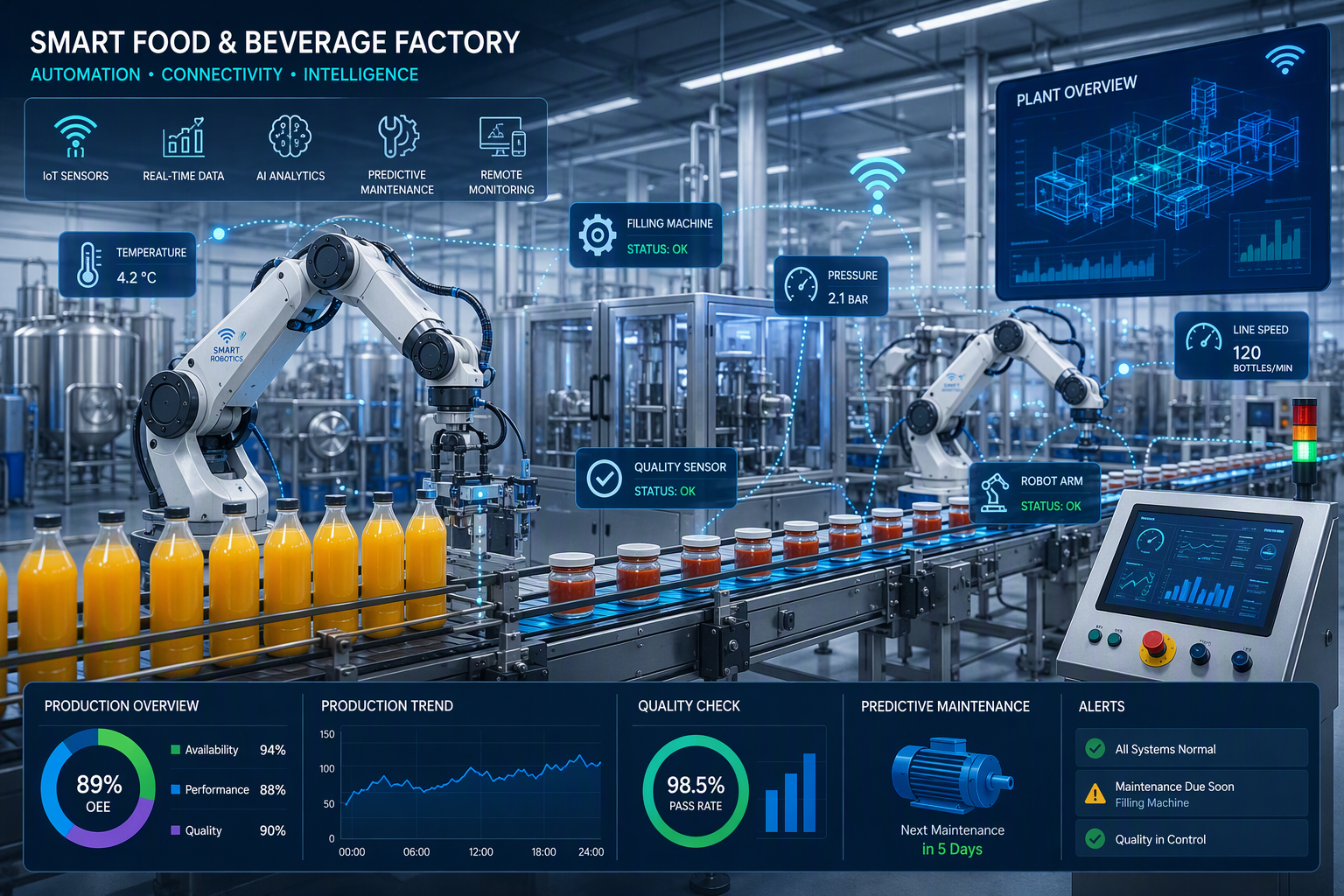
At the same time, smart factories, predictive maintenance, digital modeling, and better data handling are changing how plants are designed and managed. These trends matter because they help companies respond faster and operate with more control. The next sections look at the major shifts in more detail.
Digital Twins and Simulation in Process Design
Digital twins are virtual versions of physical assets or processes. In industrial automation, they allow companies to test ideas in a digital setting before making changes on the floor. That can reduce risk and support smarter planning.
Simulation adds value by helping teams model process design choices in advance. Instead of relying only on trial and error in live operations, manufacturers can explore different scenarios and make better-informed decisions. This is especially useful when workflows, layouts, or production demands are changing.
As smart factories continue to grow, digital twins are becoming more relevant. They support a more connected and analytical way of working, where production improvements can be evaluated before rollout. For food and beverage plants, that means better preparation and more confidence when changes are introduced.
Edge Computing and Data Integration
As automation technology advances, plants are handling more information from more connected devices. That makes data integration increasingly important. When systems share information effectively, teams can gain clearer insight into operations and react faster to changing conditions.
Edge computing supports this shift by helping process information closer to where it is created in industrial networks. That can improve speed and reduce delays between detection and response. In food and beverage settings, faster insight can help maintain continuity and reduce avoidable disruptions.
This trend supports industrial automation by improving:
- Data integration between equipment, software, and monitoring tools
- Response speed within industrial networks
- Coordination between automation technology and information technology
- Visibility across connected production systems
Green Manufacturing and Sustainable Automation
Green manufacturing is becoming a more visible focus as companies look for better ways to manage resources. Industrial automation supports this effort by helping manufacturers reduce waste, improve efficiency, and use materials more carefully during production.
Sustainable automation is closely tied to resource optimization. When automation solutions improve process control, they can help limit unnecessary use of raw materials and reduce avoidable losses. This creates a cleaner and more disciplined operating model.
Energy use is part of the same picture. Better-managed systems can avoid inefficient running conditions and support steadier performance over time. For food and beverage plants, this trend is not only about cost. It is about building operations that are more efficient and more responsible at the same time.
Predictive Maintenance and Downtime Prevention
Unplanned stoppages can be expensive, especially in fast-moving production settings. That is why predictive maintenance is becoming a key trend in automation technology. It helps companies spot warning signs before equipment failures interrupt operations.
With stronger data analysis, manufacturers can monitor equipment health and identify patterns that suggest a problem is developing. This makes downtime prevention more practical because teams can act before a breakdown forces the line to stop. In industrial environments, that timing matters.
The benefit is not just fewer disruptions. Predictive maintenance also supports better planning and more efficient maintenance work. Instead of reacting late, companies can make decisions earlier and with more confidence. For food and beverage operations, that can protect both output and schedule stability.
Key Challenges and Considerations for Adoption
Industrial automation brings real value, but adoption challenges still matter. Food and beverage companies often need to think about integration with existing equipment, security, quality expectations, and how systems will grow over time.
Scalability and alignment with industry standards are also important when planning investment. A strong solution should fit today’s operation and still support future needs. The next sections cover the main issues companies should weigh before moving forward with broader automation adoption.
Integration with Legacy Equipment and Systems
Many manufacturers do not start with a blank slate. They already have legacy equipment in place, which can make industrial automation harder to implement. New systems must work with existing machines, workflows, and plant layouts that were not designed for modern connectivity.
Integration becomes a practical challenge because older assets may not easily connect to a newer control system. In industrial environments, even small mismatches between systems can create delays, added costs, or operating complexity during rollout.
That does not mean automation is out of reach. It means planning matters. Companies need to consider how new tools will fit into current operations and whether changes can happen without disrupting output. A thoughtful integration strategy helps reduce risk and improve the chances of long-term success.
Cybersecurity and Data Protection in Automated Environments
As industrial automation becomes more connected, cybersecurity becomes more important. When automation systems share information across machines and software platforms, companies need to protect those connections and the data moving through them.
This is especially relevant in facilities that rely on industrial control systems for critical operations. A connected environment can improve visibility and performance, but it also increases the need for careful data protection and secure system design.
For food and beverage manufacturers, the concern is practical. If systems are not properly protected, operational reliability can suffer. That is why cybersecurity should be treated as part of the automation plan, not an afterthought. Strong security supports safer operations and helps protect the value of connected production.
Regulatory Compliance and Quality Standards
In the food and beverage sector, regulatory compliance and quality standards are always central concerns. Automation can help support these goals, but only if systems are designed and managed in a way that aligns with operational requirements.
Quality control benefits from automation because processes can be monitored more consistently and deviations can be corrected sooner. Even so, companies still need to make sure their automation solutions fit the standards their products and facilities must meet.
This is one reason adoption requires careful planning. It is not enough to automate for speed alone. The system also has to support reliable quality practices and stable documentation of operations. When compliance and quality are built into the setup, automation becomes much more effective.
Scalability and ROI (Return on Investment) Concerns
Scalability is a key consideration when choosing automation technology. A system that works for one production area today may need to support a broader rollout later. If it cannot grow with your operation, the long-term value may be limited.
ROI is another major concern. Companies want to know whether automation solutions will improve efficiency, reduce waste, and justify the investment over time. That question becomes even more important when budgets are tight or plant upgrades compete with other priorities.
The growth outlook for the market suggests why this decision matters. Industrial automation was estimated at $196.6 billion in 2021, grew to $213.49 billion in 2022, and is expected to reach $395.09 billion by 2029. As adoption expands, solutions that scale well and align with industry standards will be better positioned to deliver lasting returns.
Conclusion
In summary, industrial automation is revolutionizing the food and beverage industry by enhancing efficiency, improving product quality, and addressing workforce challenges. As companies adopt advanced technologies like AI, robotics, and real-time monitoring solutions, they become better equipped to meet consumer demands while maintaining compliance with regulatory standards. However, as you consider integrating these automation solutions, it’s crucial to be aware of the challenges such as compatibility with existing systems and ensuring data security. Embracing these innovations not only streamlines production but also positions businesses for sustainable growth in a competitive market. If you’re curious about how automation can transform your operations, feel free to reach out for a free consultation!
Frequently Asked Questions
How does industrial automation benefit small and medium food and beverage businesses?
Industrial automation helps small and medium businesses improve efficiency, reduce repetitive work, and support more consistent product quality. With the right automation solutions, these companies can use labor more effectively, limit waste, and build a steadier production process without relying only on manual methods.
What are some real-world examples of automation in food and beverage plants?
Common examples include automation technology used for packaging lines, ingredient movement, and internal transport. In food and beverage plants, industrial robots support material handling and repetitive packing work, while connected control systems help monitor production conditions and keep operations running more consistently.
What is the future outlook for industrial automation in the food and beverage industry?
The outlook is strong. Industrial automation is growing as more companies adopt smarter automation technology, connected systems, and predictive maintenance tools. As smart factories expand, food and beverage manufacturers are likely to invest more in flexible, data-driven operations that improve uptime, quality, and long-term industry growth.
You might also like