Industrial Automation Industry Applications in Automotive Manufacturing
Industrial Automation Industry Applications in Automotive Manufacturing
Key Highlights
- Industrial automation helps automotive manufacturing reduce delays and improve product quality.
- Modern plants use programmable logic controllers to manage machines and control logic.
- Smart factories connect equipment, systems, and people for faster decisions.
- Predictive maintenance helps teams catch equipment issues before they stop production.
- Automation supports safer work by reducing human exposure to repetitive tasks.
- Flexible systems let manufacturers adapt production lines for different vehicle models.
Introduction
Industrial automation has become a core part of the manufacturing process in the automotive industry. Instead of relying on manual labor for every step, car makers now use connected machines, control systems, and software to improve speed, consistency, and safety. You can see its value from welding and painting to material handling and inspection. As demand changes and labor shortages continue, automation gives automotive manufacturers a practical way to strengthen output, improve quality, and stay competitive.
Industrial Automation Industry Applications Across Manufacturing
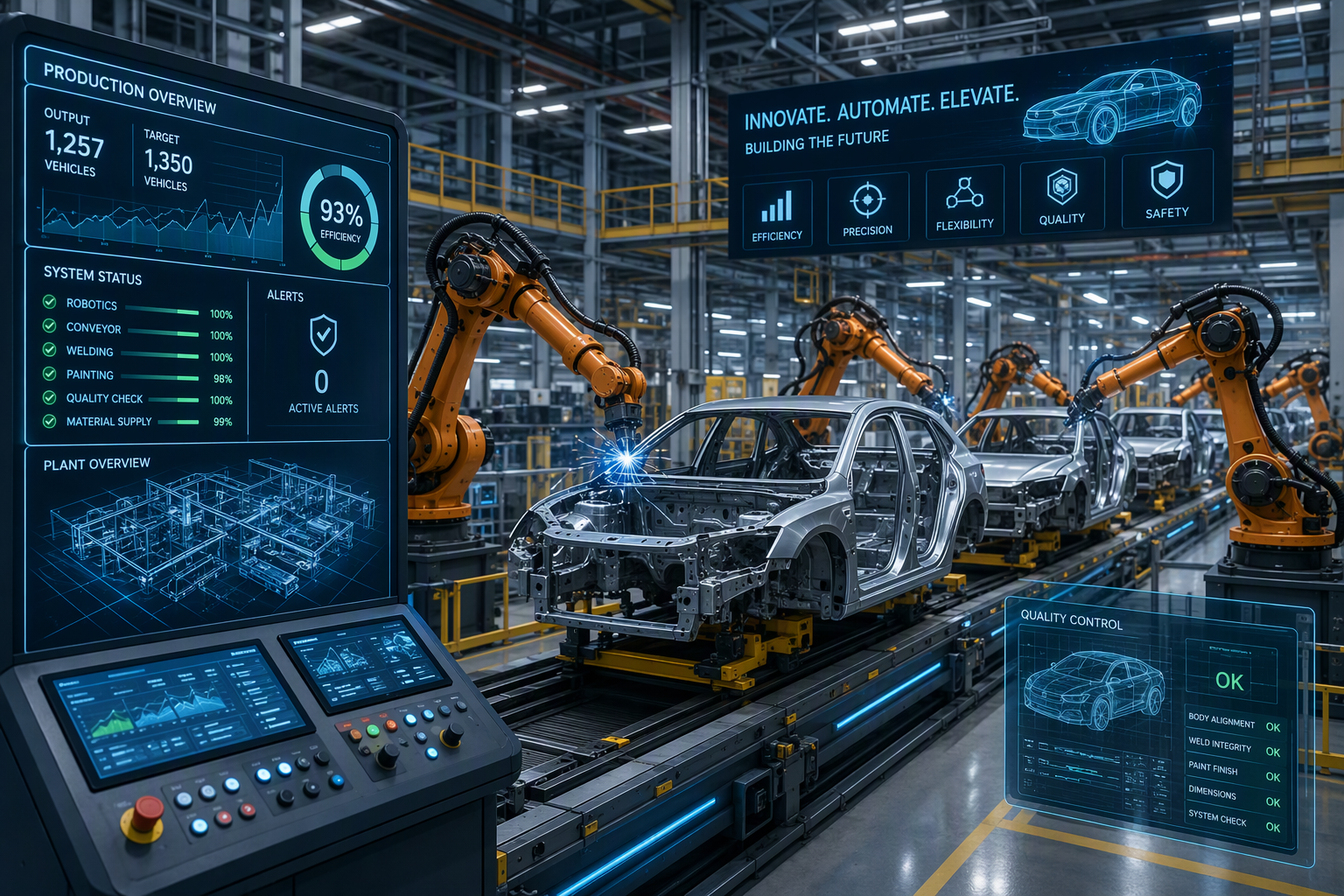
Overview of Industrial Automation in Automotive Manufacturing
Industrial automation is the use of automation technology, machines, sensors, and software to complete parts of the manufacturing process with less human intervention. In automotive plants, these automation solutions handle tasks like welding, painting, and moving parts across production areas.
This approach improves product quality, raises output, and supports safer operations. The automotive sector is one of the industries most affected by the growth of industrial automation because vehicle production depends on precision, repeatability, and fast cycle times. To understand this better, it helps to define the concept, trace its growth, and review market direction.
Defining Industrial Automation for the Automotive Sector
At its core, industrial automation means using advanced machines and digital tools to run tasks with minimal human intervention. In the automotive sector, it supports the manufacturing process from material handling to final assembly. This is not just about machines moving on their own. It is about coordinating equipment, sensors, and software in a structured way.
A control system sits at the center of this setup. It monitors inputs from sensors, reacts to feedback, and adjusts actions in real time. That is how industrial automation works in many industrial environments. The system measures, responds, and keeps production stable.
For automotive manufacturers, this matters because vehicle production involves high volumes, strict quality demands, and repetitive steps. Automation reduces variation, limits direct manual input, and helps plants maintain a reliable flow across different stages of production.
Evolution and Growth of Automation in Car Production
Automation evolution in car production started with simple mechanization. Early systems focused on repetitive tasks on the assembly line, where specialized machine tools handled one fixed job again and again. This reduced manual labor in areas where speed and consistency mattered most.
Over time, automation technology became more flexible. Plants moved beyond single-purpose machines and began using programmable systems, industrial robots, and software-driven controls. That change made it easier to switch between tasks and support different products without rebuilding the entire line.
Today, the industry is moving even further with artificial intelligence, machine learning, and connected systems. These tools help manufacturers analyze performance, adapt faster, and improve decisions. In short, automation is no longer limited to physical movement. It now includes smarter coordination, monitoring, and optimization across the full production process.
Understanding the U.S. Industrial Automation Market Size and Outlook
The industrial automation market has grown quickly in recent years, and that matters for the automotive industry. The compiled information shows strong expansion, driven by wider use of robotics, connected systems, artificial intelligence, and machine learning across manufacturing and other sectors.
Here is a simple text table that summarizes the figures and growth outlook mentioned:
| Metric |
Value |
|---|---|
| Global industrial automation market, 2021 |
$196.6 billion |
| Global industrial automation market, 2022 |
$213.49 billion |
| Growth rate from 2021 to 2022 |
8.59% |
| Expected market value by 2029 |
$395.09 billion |
| Expected CAGR through 2029 |
9.8% |
For you, the takeaway is clear. The growth outlook remains strong, and automotive manufacturers are among the major users shaping that demand. As plants invest in smarter systems, the market is likely to keep expanding alongside broader digital transformation.
Types of Industrial Automation Systems in Automotive Manufacturing
There are several types of industrial automation used in automotive manufacturing, and each automation system serves a different purpose. The main types include fixed, programmable, flexible, and integrated automation. These models help plants balance speed, variety, and control.
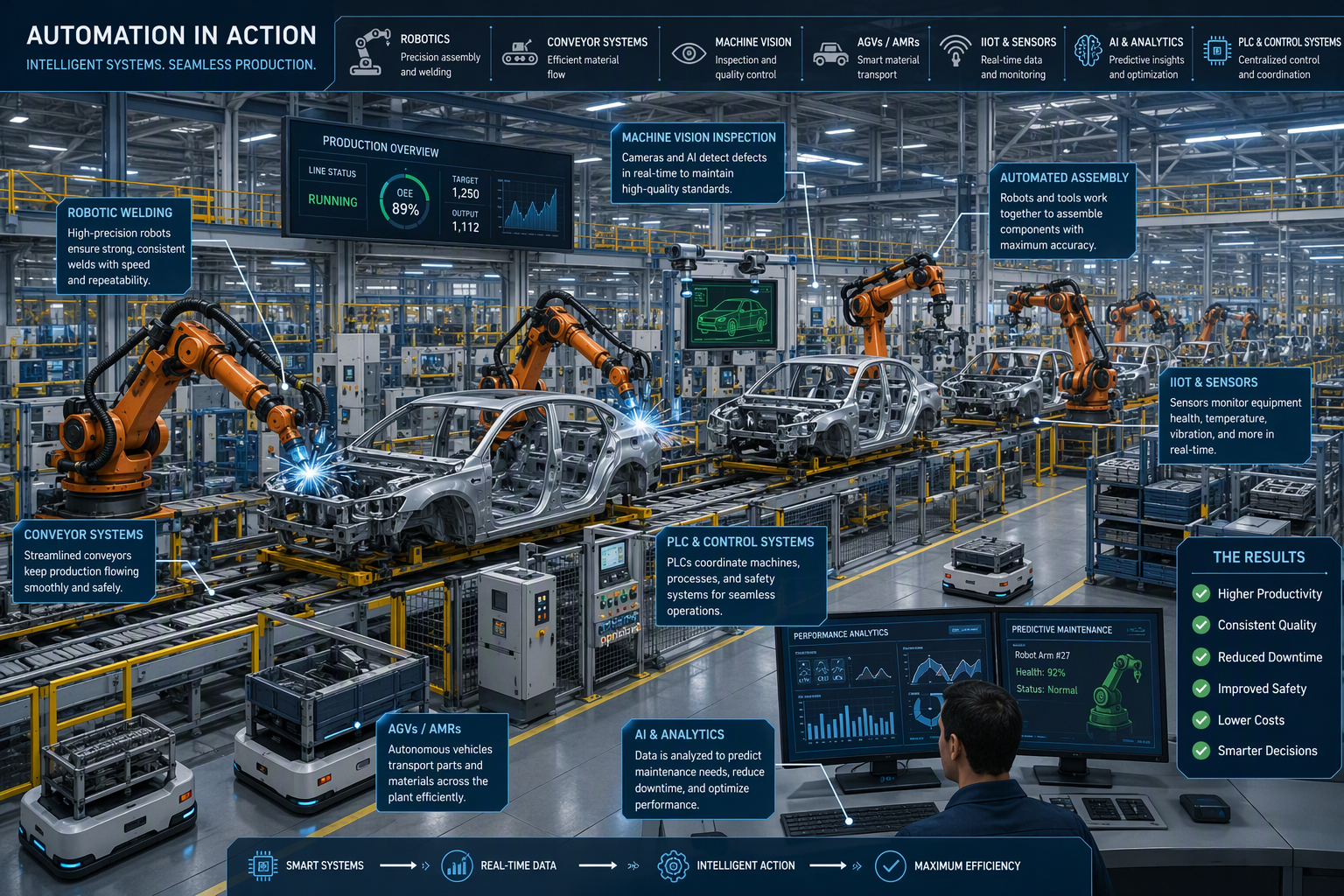
Some are best for repetitive, high-volume work. Others support changing product needs and more adaptive production. Industrial robots often play a role across all of them, but the type of automation chosen depends on output goals, product mix, and plant design. Let’s look at how each one fits automotive operations.
Fixed Automation Applications on Assembly Lines
Fixed automation is the oldest type of automation and still plays an important role in automotive plants. It uses specialized equipment to perform repetitive tasks at high speed with very little variation. This makes it a strong fit for an assembly line where the same operation happens again and again.
In car production, fixed automation supports mass output more than custom work. While batch production may need greater changeability, fixed systems are built for stable, repeated cycles. Field devices and dedicated machines work together to keep each station moving at a predictable pace.
Common fixed automation solutions in automotive manufacturing include:
- Welding stations that join body components in the same sequence
- Painting systems that apply the required finish on each vehicle
- Dedicated transfer equipment that moves vehicles between line stages
- Single-purpose machines that perform one set task continuously
Programmable Automation for Flexible Production
Programmable automation gives automotive manufacturers more control when product requirements change. Unlike fixed systems, it can be reprogrammed to perform different tasks. That makes it useful when the production process must handle different parts or moderate variation.
This approach is a good match for batch production and lower-volume, higher-variety work. By changing software instructions and control logic, manufacturers can switch from one part or operation to another without replacing the entire setup. That flexibility supports changing market demand more effectively.
The main benefit for you is adaptability. Programmable automation helps plants respond faster, reduce setup delays, and maintain more consistent output across changing runs. It also supports better use of equipment by allowing one system to perform more than one job when production needs shift.
Integrated and Flexible Automation Solutions
Flexible automation is designed for quick adjustment. It uses advanced equipment that can handle multiple tasks and adapt when workflows change. In automotive settings, this is useful when manufacturers need to manage different vehicle models or update production lines without long disruptions.
Integrated automation takes this further by combining multiple automation solutions into one coordinated environment. It links machines, conveyors, robots, and industrial control systems through software so process control happens across the full operation, not just one station.
Examples include smart factories, computer-integrated manufacturing systems, and cyber-physical systems. For automotive manufacturers, these setups improve coordination between stages, make changes easier to manage, and help production lines operate as one connected system instead of isolated pieces of equipment.
Core Technologies Powering Automotive Industrial Automation
Automotive plants depend on several core tools to make automation technology work smoothly. Industrial robots handle physical tasks, programmable logic controllers direct machine actions, and SCADA systems give teams visibility into process performance. Together, they form the backbone of the control system.
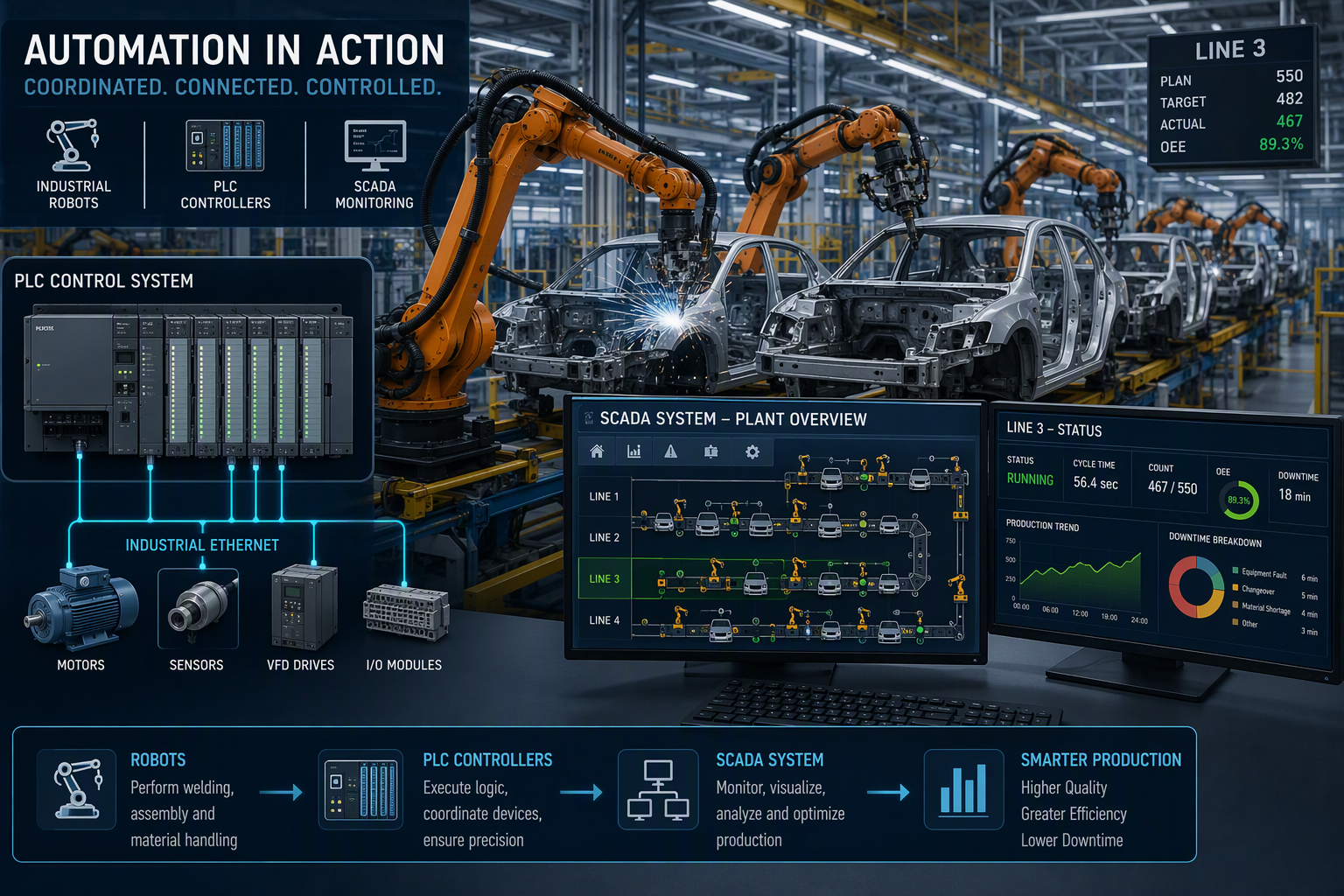
Field devices such as sensors provide the data these platforms need to respond quickly. This connected structure improves operational efficiency because machines can run with better timing, fewer errors, and faster feedback. The next sections break down the technologies you see most often in automotive manufacturing.
Robotic Arms and Collaborative Robots in Car Making
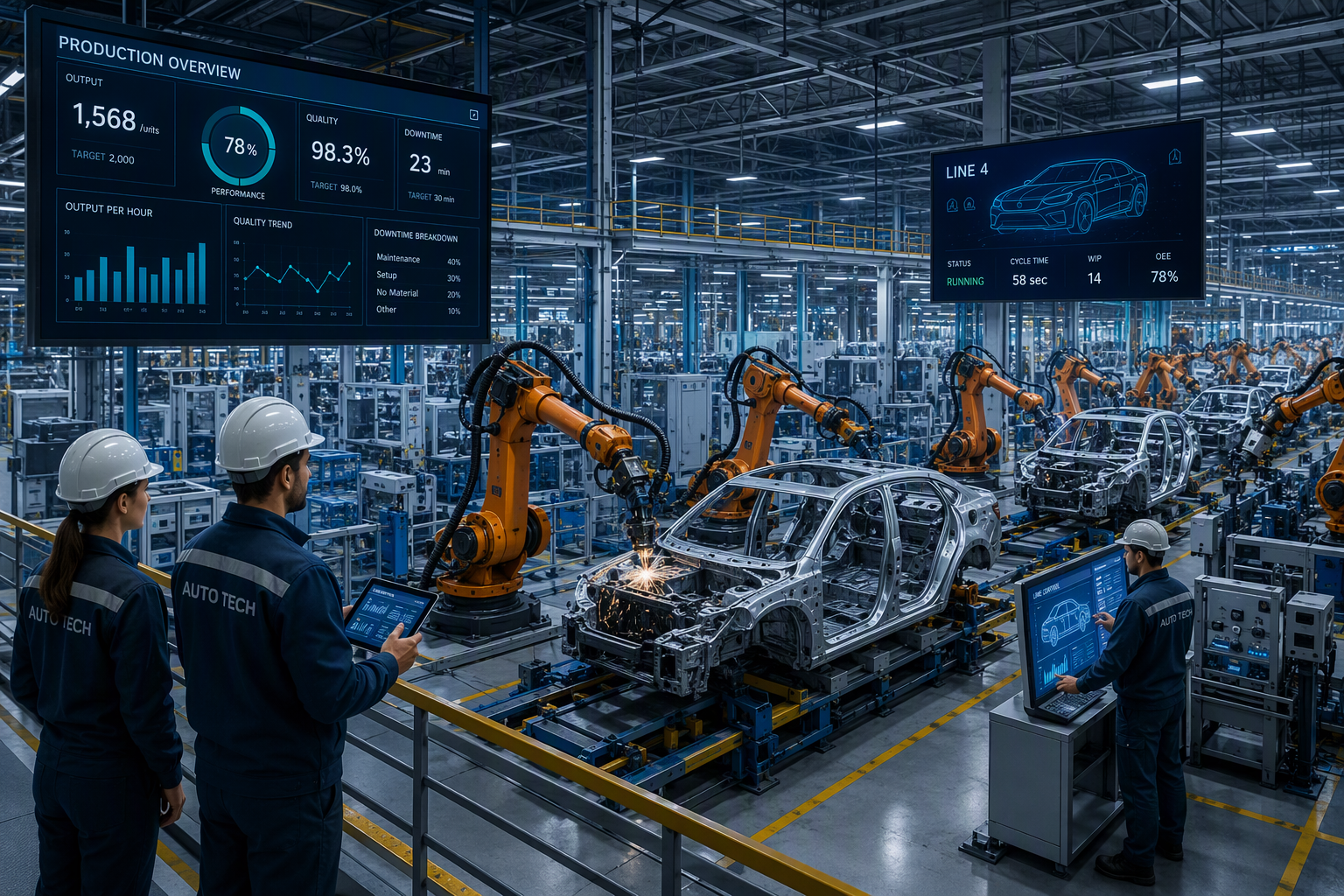
Industrial robots are among the clearest examples of automation technology in car manufacturing. Robotic arms are used for tasks that require speed, precision, and repeated motion. They are especially valuable where repetitive tasks can create fatigue or inconsistency in human labor.
Collaborative robots, or cobots, add another layer of support. They are designed to work alongside people and assist with physically demanding or dangerous work. This helps plants keep employees focused on higher-value activities while automation handles the most repetitive motion.
You often see robotic arms and cobots used for:
- Welding body structures with consistent positioning
- Painting surfaces with steady coverage
- Assisting with assembly steps that require repeated movement
- Supporting quality-focused work where product quality must stay uniform
Use of Supervisory Control and Data Acquisition (SCADA)
SCADA systems help manufacturers monitor and manage automated operations from a central point. The name stands for supervisory control and data acquisition, and that describes the role well. These systems collect information from equipment and give operators a broad view of plant activity.
At the field level, sensors and machines send status updates, measurements, and alerts. SCADA then brings that information up to the control level so teams can watch performance, respond to issues, and support process control across multiple stations.
In automotive manufacturing, this matters because production depends on constant coordination. SCADA systems help connect what is happening on the floor with what managers and engineers need to see. That visibility improves response time, supports stable output, and keeps operations aligned across the plant.
Programmable Logic Controllers (PLCs) and Industrial PCs
Programmable logic controllers are central to many industrial control systems. In automotive plants, PLCs manage machine actions by following pre-set control logic. They automate processes, monitor equipment status, and react when conditions change on the production floor.
This makes them a key part of any automation system that needs reliable, repeatable control. They are especially useful in programmable automation, where the same equipment may need to handle different jobs over time. By updating instructions, manufacturers can change operations without replacing hardware.
Industrial PCs often support broader computing and interface functions alongside PLCs. CNC machines are another example of programmable equipment tied to this kind of control structure. Together, these technologies help automotive manufacturers run equipment more accurately, coordinate tasks better, and support flexible production demands.
Digital Transformation and Smart Factories in the Automotive Industry
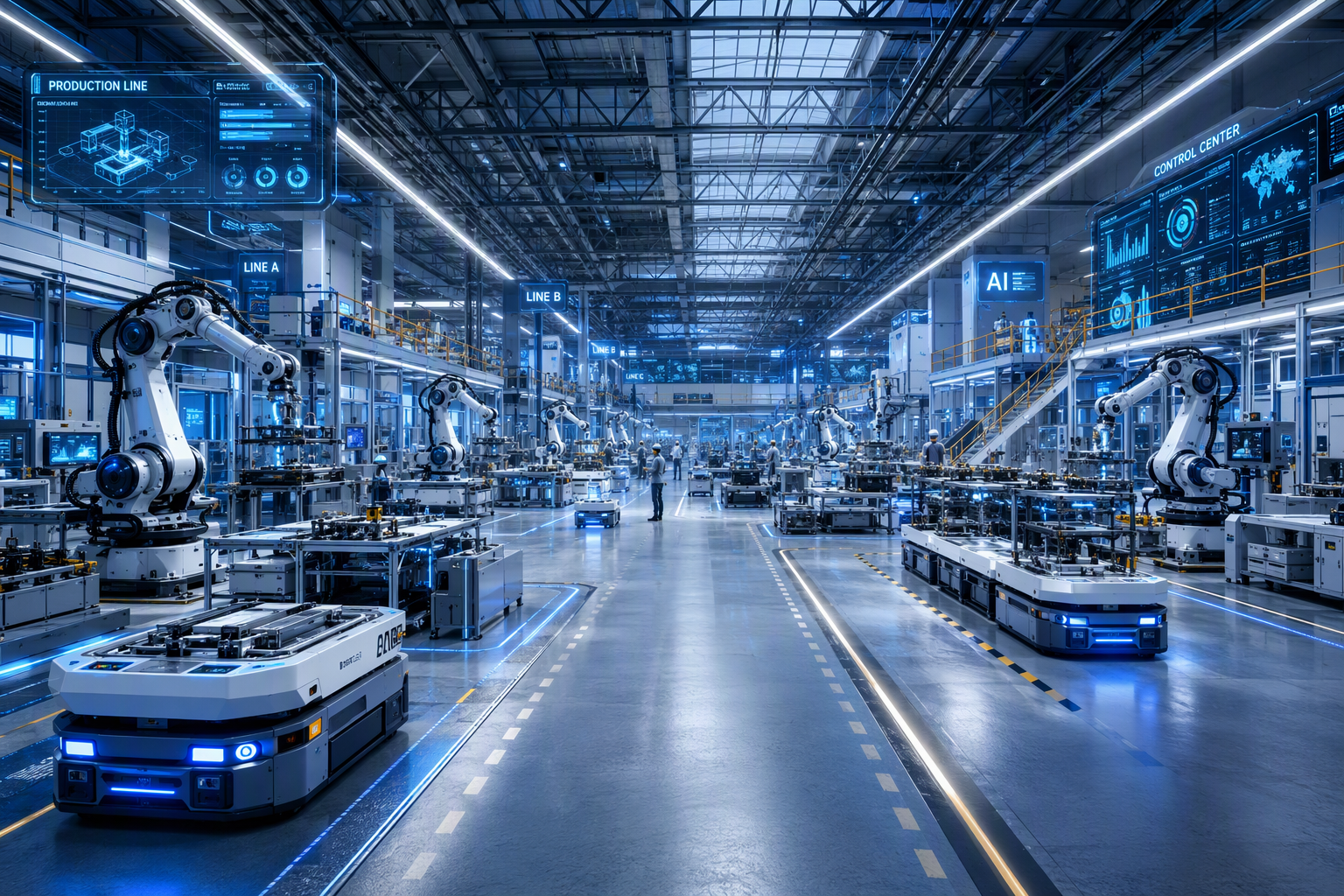
Digital transformation is changing how automotive plants operate. Instead of isolated machines, smart factories use connected systems, software, and sensor-driven feedback to improve visibility and control. The industrial internet of things and industrial iot make that connection possible across equipment and workflows.
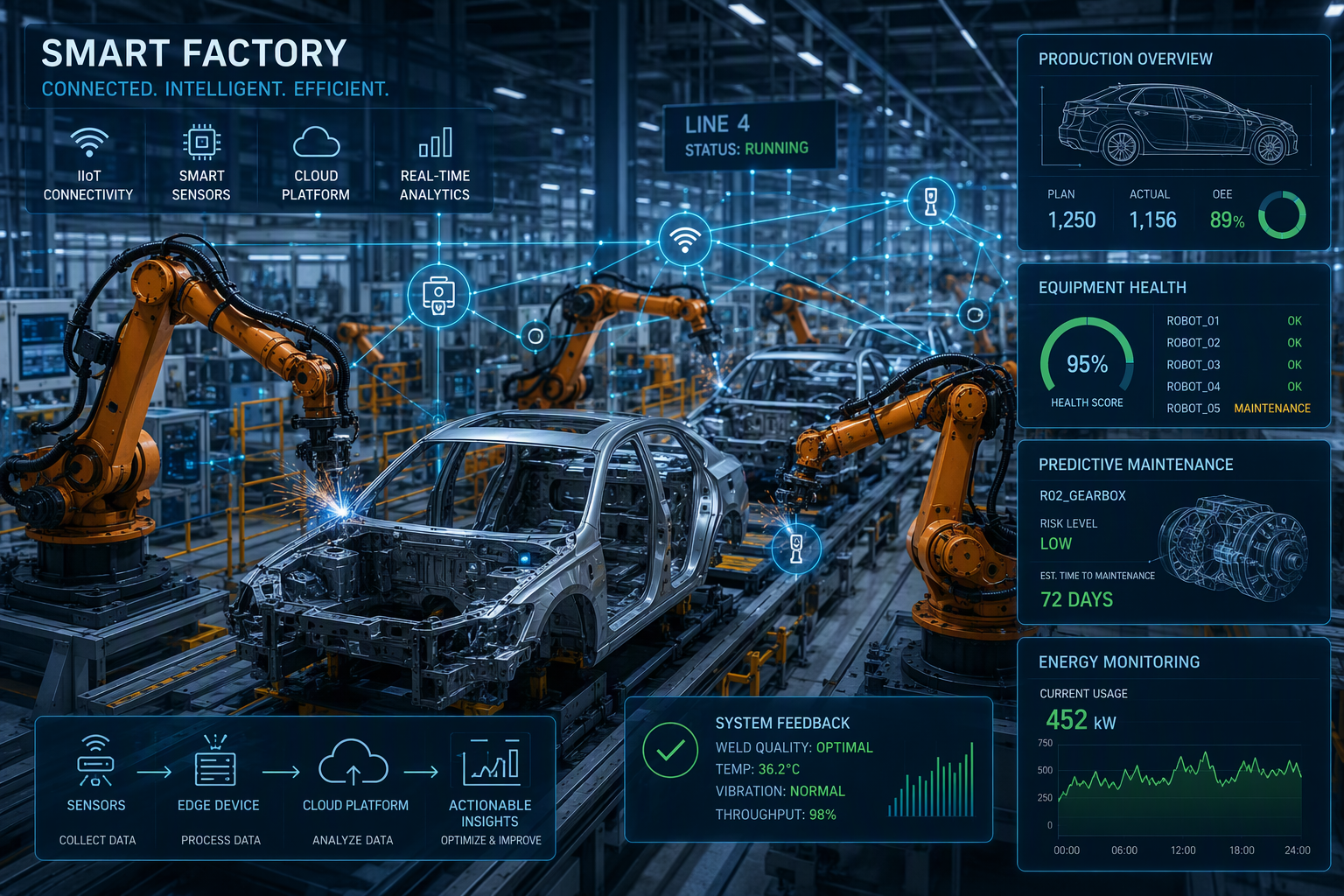
As more data becomes available, plants can use data analysis and edge computing to react faster and make better decisions. This shift is one of the biggest trends shaping industrial automation today. The following areas show how connected technologies are pushing automotive manufacturing forward.
Internet of Things (IoT) and Connected Automotive Plants
The internet of things connects machines, sensors, and systems so they can share information during production. In automotive manufacturing, this creates connected plants where equipment no longer works in isolation. Instead, systems communicate and provide clearer visibility into plant performance.
Industrial iot extends this concept to the factory floor. It uses sensor data from machines and field devices to track conditions, output, and status changes. That data helps teams understand what is happening across lines, stations, and support equipment at any given moment.
For you, the value is practical. Connected plants can improve coordination, reduce blind spots, and support faster decision-making. As automation technology advances, the internet of things is becoming a key part of how automotive manufacturers manage operations, maintain flow, and respond to production changes more effectively.
Role of Edge AI and Advanced Analytics
Edge computing helps manufacturers process information closer to where it is created. In automotive plants, that means systems can react faster instead of waiting for data to move through longer paths. When combined with artificial intelligence and machine learning, this supports better real time decisions.
Advanced analytics turns production data into useful insight. It helps teams spot patterns, predict issues, and adjust operations before problems grow. This is a major part of how industrial automation is evolving with new technologies.
Key uses of edge computing and analytics include:
- Real time monitoring of equipment conditions
- Faster response to changing production events
- Better data analysis for maintenance planning
- Improved decision-making through artificial intelligence models
Digital Twins for Virtual Simulation and Testing
Digital twins are virtual replicas of physical assets or processes. In automotive manufacturing, they let teams model equipment, workflows, or plant setups before making changes in the real world. That makes virtual simulation a valuable planning and testing tool.
Instead of relying only on trial and error on the floor, manufacturers can test scenarios digitally first. This helps reduce disruption, improve quality checks, and support better decisions before money and time are committed to a change.
Digital twins also support predictive maintenance by showing how systems may perform under different conditions. That can help teams identify weak points earlier and improve efficiency across operations. When you can simulate, test, and refine in advance, production becomes more stable and less reactive.
Key Benefits of Automation in Automotive Manufacturing
The automation benefits in automotive manufacturing are clear. Plants can improve product quality, increase productivity, and create safer working conditions. They also reduce errors tied to repetitive work and keep output more consistent across shifts.
Beyond daily efficiency, automation can give manufacturers a real competitive advantage. It helps them respond to labor shortages, reduce waste, and manage operations with more control. If you are looking at why manufacturers invest in these systems, the next sections cover the biggest gains in quality, throughput, and worker safety.
Improving Quality and Consistency of Vehicles
One of the biggest gains from automation is better product quality. In manual operations, fatigue and inconsistency can lead to variation between vehicles. Automated systems repeat tasks with the same motion and timing, which helps reduce those differences.
That consistency strengthens quality control across the manufacturing process. Automated inspection and other quality checks help detect deviations faster, so teams can respond before problems spread through a run. This is especially helpful in batch production, where repeatability matters from one unit to the next.
Operational efficiency improves because fewer defects mean less rework, fewer delays, and more stable output. For automotive manufacturers, that means vehicles are built to more uniform standards while plants spend less time correcting preventable issues after production has already moved forward.
Boosting Productivity and Throughput Rates
Automation helps plants increase productivity by taking over repetitive tasks that slow people down or create fatigue. Machines can work continuously, keep cycle times steady, and reduce the number of small interruptions that affect output on busy production lines.
This leads to stronger throughput rates because an automation system can maintain a more reliable pace. The compiled information also notes that automation reduces errors and downtime while improving operational efficiency. Those gains support more finished vehicles moving through the plant in less time.
You can see the impact in several ways:
- Faster completion of repetitive tasks
- More stable flow across production lines
- Reduced delays caused by human error
- Better throughput rates through continuous operation
Enhancing Worker Safety and Ergonomics
Automation improves worker safety by moving people away from dangerous tasks and demanding environments. In manufacturing, that can include high-temperature zones, areas with moving vehicles, or jobs that require constant heavy motion. Reducing exposure lowers the risk of accidents and strain.
It also helps ergonomics. When machines take over repetitive lifting, transport, or positioning work, employees face less physical stress from manual labor. That can improve comfort, reduce fatigue, and support better retention in a labor market already affected by shortages.
Better process control adds another safety layer. Automated systems respond quickly to changes and keep tasks running within expected limits. For you, that means a plant can protect workers while still improving output, making safety and performance work together rather than compete.
Current Trends Shaping Automotive Industrial Automation
Several industry trends are reshaping how automotive manufacturers use automation technology. Plants are investing in smarter systems to deal with labor shortages, improve flexibility, and make better use of data across operations.
At the same time, companies are paying closer attention to energy use, sustainability, and the connection between shop-floor equipment and information technology. These shifts are not separate from production goals. They are becoming part of how modern plants stay efficient and competitive. The next trends show where that change is most visible.
Rise of Electric Vehicle (EV) Production Automation
Electric vehicles are pushing automotive plants to rethink the production process. As manufacturers expand EV output, they need automation solutions that can support new assembly requirements, different components, and changing plant workflows.
This is where flexible automation becomes important. EV manufacturing may require frequent adjustments as product designs, volumes, and part requirements evolve. Systems that can adapt more quickly help plants manage those changes without stopping output for long periods.
The impact extends beyond final assembly. It also affects upstream handling of raw materials and related components. That is one reason the automotive sector remains one of the most impacted by industrial automation growth. As EV demand rises, automation is helping manufacturers build capacity, consistency, and responsiveness across the full production environment.
Adoption of Predictive Maintenance and Condition Monitoring
Predictive maintenance is becoming a major trend in automotive plants because unplanned downtime is expensive. Instead of waiting for a failure, manufacturers use condition monitoring to track machine health and identify issues earlier.
This approach depends on sensor data from field devices and connected equipment. Machine learning helps analyze that data, spot patterns, and signal when maintenance may be needed. That allows teams to act before a minor issue becomes a major shutdown.
Common elements of predictive maintenance include:
- Sensor data collected from operating equipment
- Condition monitoring of performance changes
- Machine learning models that identify warning patterns
- Maintenance planning based on actual equipment condition
Convergence of Operational Technology (OT) and Information Technology (IT)
A major shift in industrial automation is the growing connection between operational technology and information technology. Operational technology manages machines and physical processes, while information technology handles software, data, and business systems. In modern plants, these worlds are increasingly linked.
That connection helps manufacturers move information more effectively across industrial networks. Data from machines can support broader data analysis, giving teams better insight into performance, maintenance needs, and production trends across the plant.
In industrial environments like automotive manufacturing, this convergence supports faster decisions and stronger coordination. It also reflects how automation is evolving with new technologies. Plants are no longer just automating equipment. They are connecting operations and information so decisions become more informed, timely, and useful.
Challenges and Considerations in Implementing Automation
Automation brings clear value, but implementation is not always simple. Manufacturers must think about cost, system integration, and cybersecurity before expanding automation technology across a plant. These issues affect how smoothly new systems fit into existing operations.
Labor shortages also create a second challenge. While automation helps fill gaps, workforce adaptation is still necessary because employees need new skills to work with automated systems. If you are planning investment, the biggest considerations usually come down to people, connected systems, and return on spending.
Addressing Skills Gaps and Workforce Adaptation
One challenge in automation is the skills gap. As plants shift away from manual labor and bring in more automation technology, workers need training to manage, monitor, and support new systems. The work changes, even if the need for people does not disappear.
This makes workforce adaptation essential. Automation can take over repetitive and dangerous jobs, but employees still play an important role in oversight, maintenance, and higher-value tasks. Without the right preparation, plants may struggle to get the full value from new equipment.
Manufacturers often need to focus on:
- Training teams to work with automated systems
- Shifting human labor toward higher-value roles
- Reducing dependence on physically demanding manual labor
- Supporting workforce adaptation during technology changes
Managing System Integration and Cybersecurity Risks
System integration can be difficult because automotive plants often have a mix of older and newer equipment. Connecting robots, sensors, software, and machines into one control system takes planning. If systems do not communicate well, automation benefits can be reduced.
Cybersecurity is another serious concern. As more equipment connects through industrial networks, there are more points that need protection. This matters even more in industrial environments where disruptions can affect safety, uptime, and output all at once.
For you, the key issue is balance. Manufacturers need connected operations, but they also need reliable protection and careful integration. Strong planning helps ensure that new automation fits the plant well, shares information correctly, and does not introduce unnecessary operational risk.
Balancing Cost, Investment, and Return on Automation
Cost is one of the first concerns companies face when considering automation. New equipment, software, and implementation work can require a sizable investment. For some manufacturers, that can delay adoption even when the long-term value is clear.
Still, the compiled information shows that delaying automation may carry its own penalty. Automation solutions can reduce labor costs, improve productivity, lower waste, and help avoid expensive downtime. Those gains shape the return on automation over time.
The right view is not just the purchase price of an automation system. It is the total effect on output, quality, and operating cost. When manufacturers weigh investment against saved time, lower error rates, and stronger efficiency, the business case often becomes easier to justify.
Industrial Automation Impact on the Broader Automotive Ecosystem
Industrial automation affects more than the plant floor. It also changes how the broader automotive supply chain works, from suppliers and raw materials to logistics and material handling. When production becomes faster and more connected, surrounding operations must keep pace.
That wider impact improves operational efficiency because parts, information, and finished goods move with better coordination. Automotive manufacturing is one of the sectors most shaped by automation growth, and the effects can be seen across suppliers, warehousing, and transport support functions.
Effects on Suppliers and Parts Manufacturing
Suppliers feel the impact of automotive automation in a direct way. When vehicle plants demand higher consistency and faster delivery, suppliers must improve their own parts manufacturing processes to match those expectations. That often leads to greater use of industrial robots and automated equipment.
Automation also helps suppliers handle different products with better precision. If a manufacturer needs multiple parts variations, programmable and flexible systems make it easier to switch production while maintaining quality and timing.
This is why the supply chain is deeply affected by industrial automation growth. It is not limited to final vehicle assembly. The pressure for speed, repeatability, and dependable quality moves upstream to suppliers, making automation important across the broader automotive production network.
Transformation in Logistics and Supply Chain Management
Automation is also changing logistics inside and around automotive plants. Material handling systems, guided transport, and connected tracking tools help move parts where they are needed with less delay. That keeps production supplied and reduces bottlenecks.
Information technology plays a bigger role here because movement data can be shared across systems. This helps teams coordinate deliveries, support batch production, and improve flow from receiving to line-side supply. Better timing leads to better timing.
You can see the transformation in several areas:
- Faster material handling between storage and production
- Better logistics coordination through connected data
- Improved timing for parts movement during batch production
- Stronger supply chain visibility through information technology
Conclusion
In conclusion, the industrial automation landscape in automotive manufacturing is transforming rapidly, offering remarkable benefits such as enhanced productivity, improved vehicle quality, and greater worker safety. As technologies like IoT, AI, and digital twins redefine how we approach assembly lines and production processes, it’s essential for manufacturers to stay informed and adaptable. The future of automotive manufacturing is brighter with automation at its core, paving the way for innovative solutions and sustainable practices. If you're curious about how automation can specifically benefit your business, don’t hesitate to get in touch for a free consultation. Your journey toward a smarter, more efficient manufacturing process starts now!
Frequently Asked Questions
What are some real-world examples of automation in automotive assembly plants?
Real-world examples include industrial robots welding and painting on the assembly line, SCADA systems monitoring plant operations, and automated inspection tools supporting quality control. These forms of automation technology help manufacturers keep output steady, reduce errors, and maintain consistent vehicle standards across production.
How does industrial automation support sustainability in car manufacturing?
Industrial automation supports sustainability by improving process control, reducing waste, and making better use of energy use and raw materials. Predictive maintenance also helps avoid breakdowns and unnecessary downtime. These automation solutions make the production process more efficient while limiting avoidable resource loss.
What is the future outlook for industrial automation in the U.S. automotive industry?
The growth outlook is strong as manufacturers continue adopting automation solutions, smart factories, industrial iot, and other advanced technologies. As plants push for more flexibility, better data use, and safer operations, industrial automation is expected to remain a major part of the U.S. automotive industry’s future.
You might also like