Industrial Automation Industry Use Cases in Pharmaceutical Manufacturing
Industrial Automation Industry Use Cases in Pharmaceutical Manufacturing
Key Highlights
- Industrial automation uses automation technology to manage the manufacturing process with less human intervention.
- In pharmaceutical plants, automation systems support tighter control, steadier output, and stronger product quality.
- Programmable logic controllers help monitor equipment, adjust steps, and keep production running with fewer delays.
- Different system types, from fixed automation to flexible setups, serve different pharma needs.
- New tools such as AI, machine learning, and digital twins are changing how plants improve performance.
- Pharma teams also face challenges around cybersecurity, legacy equipment, and workforce training.
Introduction
Industrial automation is changing the pharmaceutical manufacturing process from raw material movement to final packaging. At its core, it uses automation systems, sensors, software, and machines to complete tasks with greater consistency and less manual effort. For pharma manufacturers, that means better control, safer operations, and stronger output. If you want a broader view of industrial automation applications in manufacturing, this planned page should be verified when published. In pharma, the impact is especially clear because accuracy matters at every step.
Industrial Automation Industry Applications Across Manufacturing
Overview of Industrial Automation in Pharmaceutical Manufacturing
Industrial automation in pharmaceutical manufacturing means using automation technology to manage and improve the manufacturing process with reduced human intervention. It connects machines, sensors, and software so each stage works in a more controlled and repeatable way.
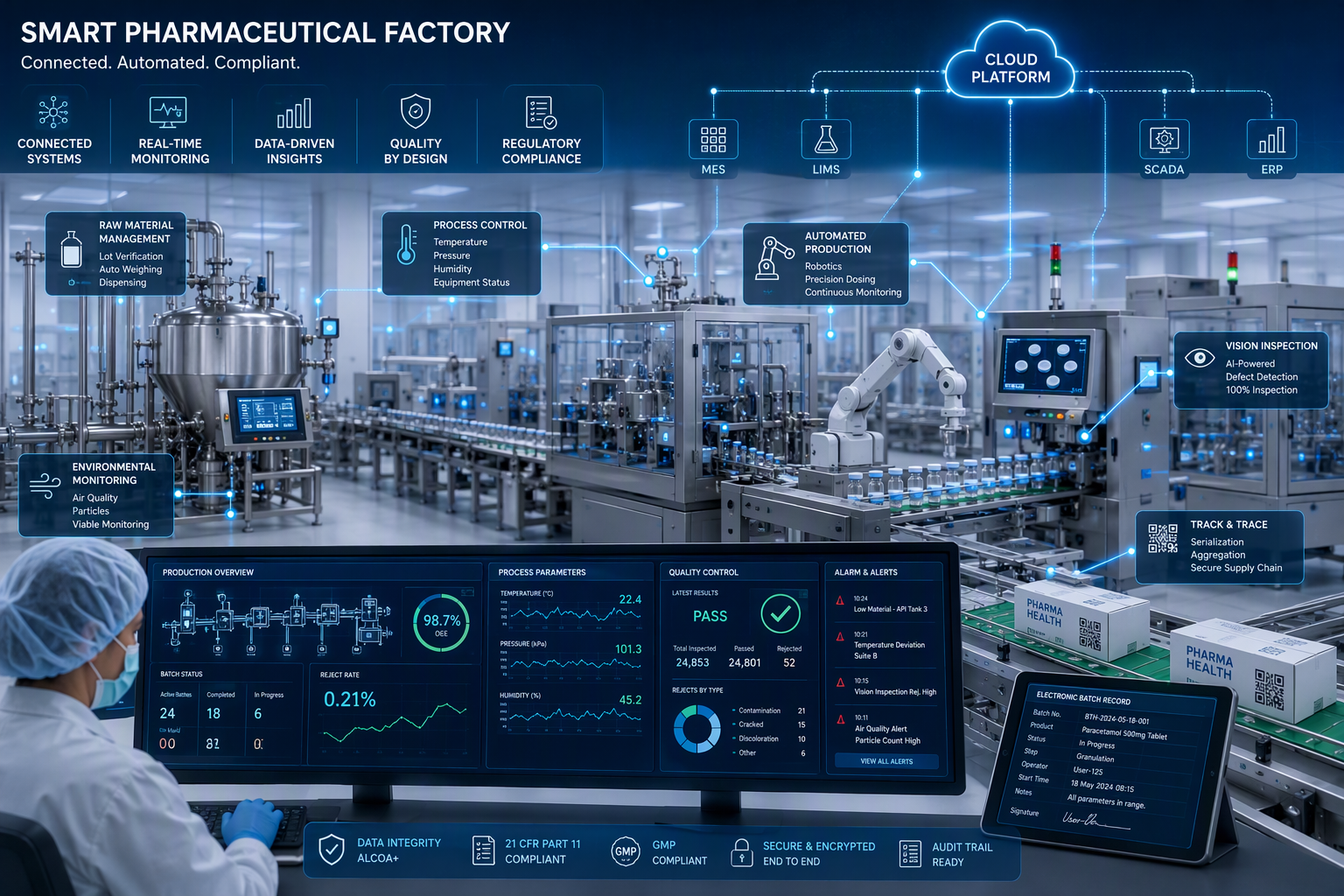
That matters in pharma because a single control system can help regulate mixing, packaging, monitoring, and quality checks. As new tools such as AI, machine learning, and connected devices spread across plants, the industry is moving beyond simple mechanization toward smarter operations. The next sections explain what that looks like in practice.
Defining Industrial Automation and Its Core Principles
Industrial automation is the use of advanced machinery and software to complete industrial tasks more efficiently and with less human intervention. In pharmaceutical production, it supports repeatable actions that would otherwise depend heavily on manual labor. That can include moving materials, running equipment, and checking output.
At a practical level, automation systems work by linking machines, sensors, and software into one coordinated setup. These systems gather feedback, compare it to programmed targets, and respond through control logic. That response can adjust speed, timing, or machine behavior to keep operations stable.
The core principles are simple. First, process control keeps each step within defined limits. Second, feedback helps the system detect changes. Third, optimization uses operating data to improve performance over time. Together, these functions help pharma manufacturers reduce variation and run more dependable production lines.
Evolution of Automation in the Pharmaceutical Industry
Automation in pharma did not begin with advanced software. It started with simple mechanization, where machines handled repetitive work that once relied fully on people. Early equipment supported basic tasks on packaging lines and production floors, especially where the same motion happened again and again.
Over time, automation technology grew far beyond those fixed tasks. Manufacturers began using smarter automation solutions that could support batch production, monitor operating conditions, and respond to changes during the manufacturing process. This shift gave plants more control without requiring every adjustment to come from an operator.
Today, the industry is moving into a more connected stage. Artificial intelligence, machine learning, and Internet of Things tools are expanding what automation can do. Instead of only repeating steps, systems can now help predict issues, improve scheduling, and support better decisions across the plant.
KeyTerms: Robotics, SCADA, MES, Quality Control
Various technologies play a pivotal role in enhancing the efficiency of the industrial automation industry. Robotics aids in executing repetitive tasks with precision, reducing the need for extensive human intervention. SCADA (Supervisory Control and Data Acquisition) systems monitor and control manufacturing processes in real-time, ensuring seamless communication between different components. Meanwhile, MES (Manufacturing Execution Systems) integrates the production process, allowing for better tracking and analytics. Quality control mechanisms leverage these technologies to maintain product quality, minimizing defects and ensuring compliance with industry standards. Exploring industrial automation applications in manufacturing can reveal further advancements and use cases.
Main Types of Industrial Automation Systems
There are several main types of industrial automation, and each one fits a different production need. In pharma, the best choice depends on output volume, product variation, and how much change the process must handle.
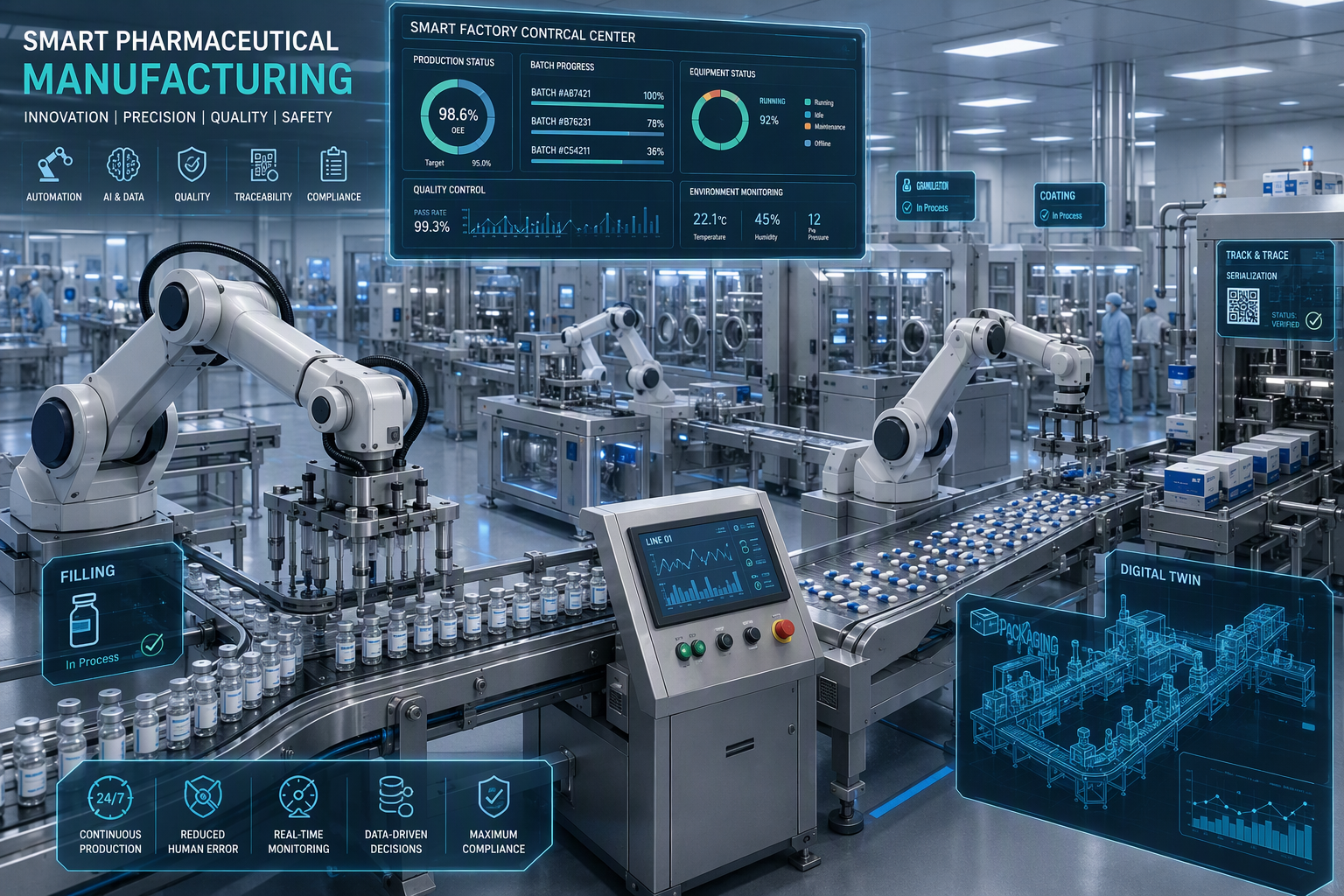
Most automation systems fall into fixed, programmable, flexible, or integrated categories. A control system built around programmable logic controllers may support one type or combine several. Understanding these categories helps you match the right setup to the right application. The following sections break down how each type works in pharmaceutical manufacturing.
Fixed Automation Solutions in Pharmaceuticals
Fixed automation is built for one specific job. It uses specialized equipment to perform the same action again and again with little or no need for change. In pharmaceutical operations, this works best where the production process is stable and highly repeatable.
You often see fixed automation in tasks that resemble an assembly line approach, even in regulated environments. A machine may fill the same container, apply the same seal, or move products through the same station at high speed. Because the equipment is designed for a narrow purpose, it can deliver strong output and dependable timing.
This kind of automation technology is useful when volume is high and product variation is low. Industrial robots or dedicated machines can keep work moving with minimal interruption. The tradeoff is flexibility. Once installed, fixed automation is not easy to reprogram for new products or frequent process changes.
Programmable Automation Applications
Programmable automation gives manufacturers more room to adapt. Instead of being locked into one task, the equipment can be reprogrammed to perform different operations. That makes it useful in pharmaceutical settings where batch production changes based on product, dosage, or schedule.
A key part of programmable automation is the use of software-driven control logic. Systems such as programmable logic controllers help manage equipment behavior, monitor conditions, and respond when the process changes. In other industries, machine tools and CNC machines show the same principle, even if the pharma equipment looks different.
For pharma manufacturers, this approach supports industrial automation solutions that balance consistency with adjustment. You can switch between product runs without replacing the whole system. That helps improve operational efficiency, especially in low-volume, high-variety environments where flexibility matters but control still has to stay tight.
Flexible and Integrated Automation Technologies
Flexible automation is designed for change. It allows equipment to adapt more easily when manufacturers need to switch between different products or modify workflow. In pharmaceutical manufacturing, that matters when production needs shift across formulations, packaging styles, or output requirements.
Compared with other types of automation, flexible automation supports faster changeovers and easier reconfiguration. These automation systems often use advanced hardware and software that can be adjusted without fully rebuilding the setup. A control system can coordinate multiple tasks while still allowing process updates when demand changes.
Integrated automation takes this a step further. It combines several types of automation into one connected environment, linking robots, conveyors, software, and monitoring tools. For pharma plants, that creates a more unified operation where each area supports the next. The result is a production flow that can be both coordinated and adaptable.
Collaborative Robotics and Adaptive Systems
Collaborative robotics brings automation closer to the people doing the work. Unlike isolated machines that stay behind barriers, cobots are designed to support human operators in shared spaces. In pharmaceutical environments, that can improve flow without removing people from every step.
Adaptive systems add another layer of value. These setups can respond to changing conditions, layout shifts, or new production demands. Instead of forcing the plant to stay fixed, they help automation fit the workflow more naturally. That makes them useful where tasks, schedules, or material paths change often.
Common benefits include:
- Reducing repetitive tasks that lead to fatigue and errors.
- Supporting human operators in jobs that require both judgment and consistency.
- Taking on dangerous tasks or physically demanding movements.
Used well, collaborative robotics can improve throughput and safety at the same time. They do not replace every role. They help people focus on higher-value work.
Major Benefits of Industrial Automation in Pharma Manufacturing
Industrial automation brings clear gains to pharmaceutical manufacturing because it improves consistency, control, and speed across the plant. When automation systems handle routine and demanding tasks, manufacturers can reduce variation while keeping output more stable.
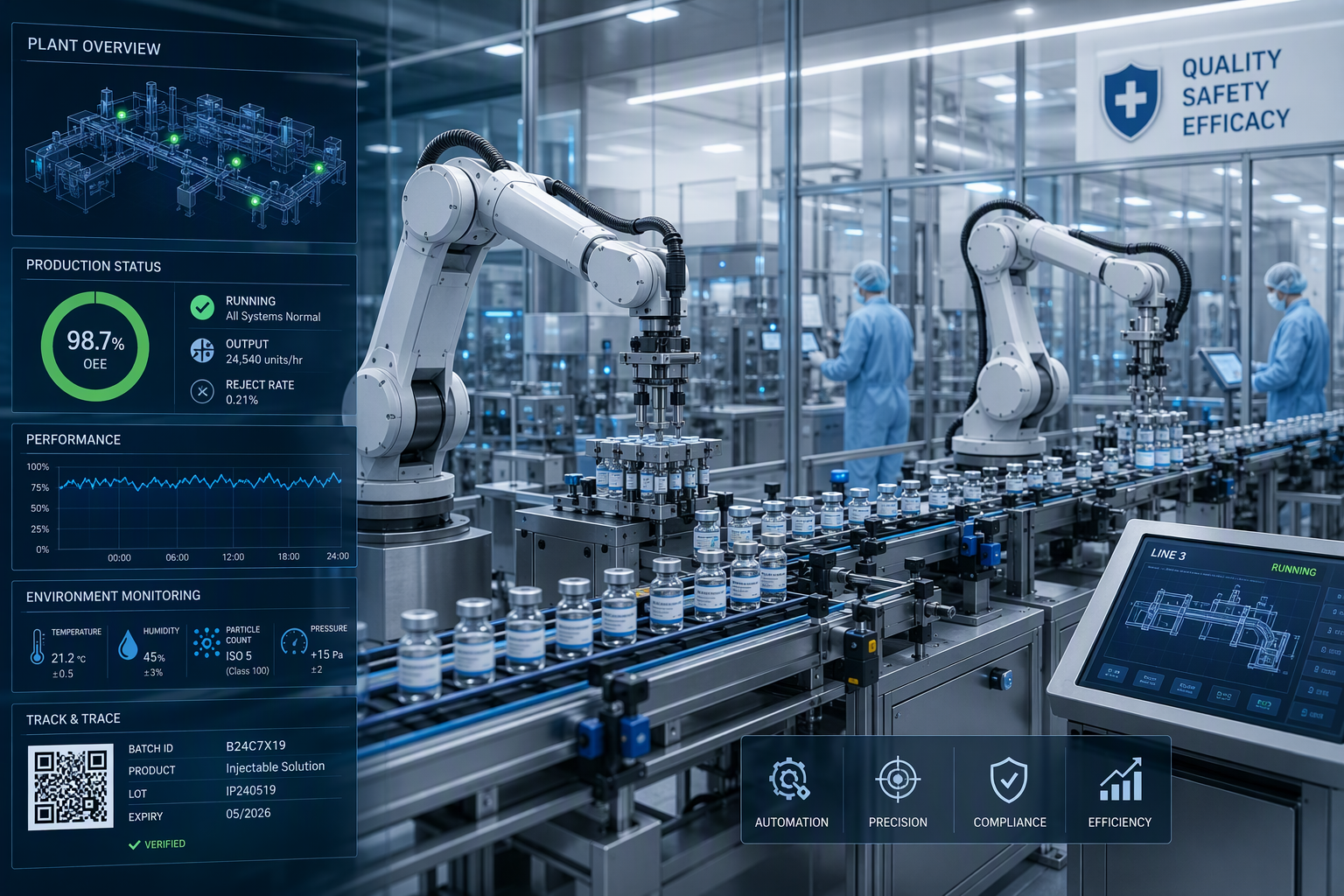
That translates into better product quality, stronger operational efficiency, and less dependence on human labor for repetitive steps. It can also support safer working conditions and lower costs over time. If you are weighing the value of automation, the benefits become easier to see when you break them into specific business outcomes, which the next sections cover.
Enhanced Product Quality and Consistency
One of the biggest reasons pharma manufacturers invest in automation is product quality. In manual work, results can vary from shift to shift because people get tired, distracted, or inconsistent. Automation reduces that variation by repeating tasks the same way each time.
This matters throughout the manufacturing process. Automated equipment can keep timing, movement, and output within tighter limits than many manual methods. With minimal human intervention, plants can reduce the small changes that often lead to waste, rework, or uneven production results.
Quality control also improves because automated systems support continuous oversight. If something starts to drift from the expected range, the system can detect it faster and help correct it sooner. For pharma companies, that means more consistent batches, more dependable standards, and greater confidence that every run meets the intended target.
Increased Operational Efficiency
Automation improves operational efficiency by removing delays tied to manual steps and uneven pacing. When machines handle routine actions without slowing down from fatigue, production can move with greater consistency. That is especially useful in pharma, where time, accuracy, and sequencing all matter.
Automation systems also help teams use labor more effectively. Instead of assigning people to repetitive tasks, manufacturers can shift human labor toward monitoring, oversight, and problem solving. That creates a better use of skill while keeping the process moving.
Key efficiency gains often come from:
- Faster completion of repetitive tasks across production lines.
- Fewer interruptions caused by manual handoffs or avoidable mistakes.
- Better use of automation solutions to keep output steady over longer runs.
The result is not just more speed. It is a smoother workflow with fewer slow points and more reliable day-to-day performance.
Reduced Production Costs
Industrial automation can help reduce spending across the production process. When machines perform tasks with greater precision, manufacturers often use raw materials more efficiently and create less waste. Over time, that supports reduced production costs in ways that go beyond labor alone.
Another cost advantage comes from steadier use of equipment and resources. Better control can improve energy use, reduce downtime, and keep production moving with fewer disruptions. In a tightly managed pharmaceutical setting, even small improvements in process stability can add up.
This also matters because many manufacturers face labor shortages. Automation helps plants maintain output without depending on large numbers of workers for repetitive work. That does not remove the need for skilled staff, but it can ease pressure where hiring is difficult. For many companies, the savings come from better utilization, lower waste, and fewer costly interruptions.
Improved Worker Safety and Ergonomics
Safety is one of the strongest arguments for pharma automation. Some plant activities involve dangerous tasks, high-speed equipment, or physically demanding motion. When automation technology takes on those duties, workers spend less time in situations that increase injury risk.
That benefit is not limited to major hazards. Repetitive tasks can also wear people down, leading to strain, fatigue, and mistakes. Automating those motions helps improve ergonomics and makes the workday less physically taxing. In many settings, this can also improve morale and retention.
Reduced human intervention in hazardous areas does not mean workers become less important. It means their role shifts toward oversight, decision-making, and higher-value responsibilities. Better worker safety and better process performance often go together. When people are removed from the riskiest activities, plants can create a safer and more sustainable operating environment.
Evolving Technologies in Pharmaceutical Automation
Pharmaceutical automation is moving fast because newer tools now do more than repeat programmed steps. Modern automation technology can collect data, respond to changing conditions, and support smarter decisions across the plant.
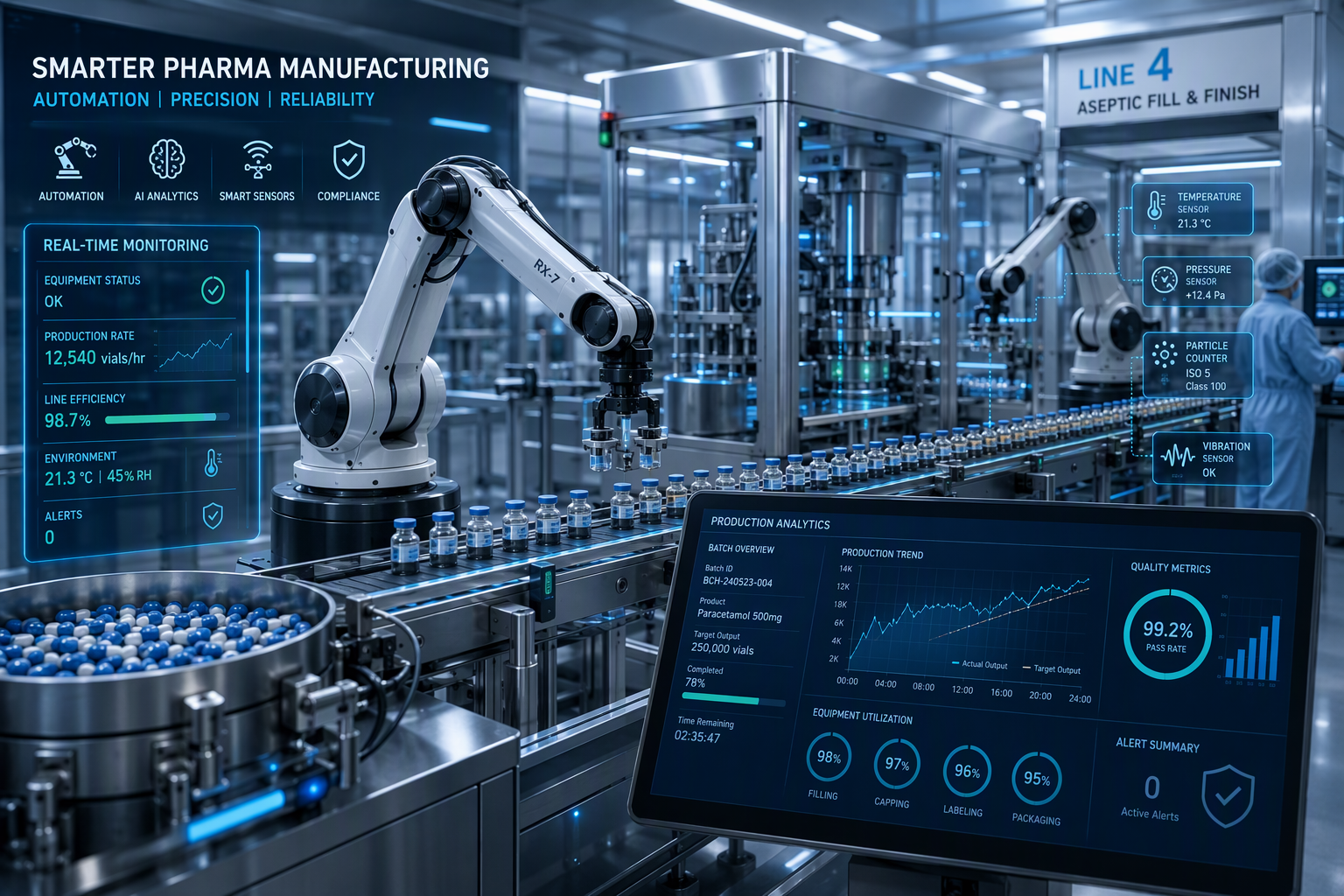
That shift is being driven by advanced technologies such as the industrial internet of things, artificial intelligence, and digital twins. These tools help manufacturers connect equipment, monitor operations in real time, and improve reliability. If you want to understand where the industry is headed next, these are the technologies shaping that future and expanding what industrial IoT can deliver.
Industrial IoT and Real-Time Data Monitoring
The industrial internet of things connects equipment, sensors, and software so plants can monitor operations more closely. In pharmaceutical manufacturing, this allows data to move from field devices into broader automation platforms without waiting for manual reporting. That stronger visibility supports faster decisions.
Real time monitoring matters because pharmaceutical processes depend on stable conditions. If temperature, flow, timing, or machine status starts to shift, connected systems can show the change as it happens. Data acquisition becomes more useful when teams can act on fresh information instead of reviewing issues after the batch is complete.
This is one reason smart factories are becoming more practical. With industrial IoT tools in place, manufacturers can build a clearer view of plant performance across multiple assets and stages. Better information does not solve every problem on its own, but it gives teams a stronger basis for process control, adjustment, and daily oversight.
Artificial Intelligence and Machine Learning Integration
Artificial intelligence and machine learning are expanding the role of automation systems in pharma. Instead of only following fixed instructions, systems can now learn from patterns in operating data. That helps manufacturers identify issues, improve scheduling, and respond more intelligently to changing conditions.
The value comes from stronger data analysis. When large volumes of plant information are reviewed quickly, manufacturers can spot trends that would be hard to catch manually. As edge computing becomes more common, some of that analysis can happen closer to the equipment, which supports faster action.
These technologies can help with:
- Detecting operating patterns that suggest future problems.
- Improving process decisions based on historical and live data.
- Supporting quicker responses through local edge computing resources.
In short, artificial intelligence does not replace process knowledge. It strengthens it by turning more plant data into practical insight.
Digital Twins and Advanced Simulation Models
Digital twins are virtual versions of physical assets or processes. In automation, they let manufacturers study how equipment or workflows behave without changing the live system first. For pharmaceutical plants, that creates a safer way to review changes before applying them to production.
These advanced technologies support simulation of process conditions, equipment behavior, and possible adjustments. Instead of guessing how a modification will affect throughput or stability, teams can test scenarios in a digital model. That helps reduce uncertainty when improving automation solutions.
Digital twins are especially useful for process control because pharma operations depend on precision. A better model helps engineers understand where bottlenecks, weak points, or hidden risks may exist. While the physical plant still does the work, the digital version gives teams a clearer view of what to change, what to avoid, and how to plan smarter improvements.
Predictive Maintenance and Automated Asset Management
Predictive maintenance helps manufacturers act before equipment fails. Rather than waiting for a breakdown, automation systems can track operating signals and point to patterns that suggest wear or trouble ahead. In pharmaceutical settings, that can reduce unplanned downtime and protect production schedules.
This approach works best when it is tied to a stronger maintenance process. Data from machines, sensors, and connected devices can help teams decide when service is needed instead of relying only on fixed schedules. In industrial environments where uptime matters, that leads to better planning and less disruption.
Automated asset management supports the same goal from a broader angle. It helps manufacturers monitor equipment condition, usage, and service needs across the plant. Together, predictive maintenance and automated asset management improve reliability, support operational efficiency, and make maintenance work more targeted instead of reactive.
Current Trends Shaping Industrial Automation in Pharmaceuticals
Automation in pharmaceutical manufacturing is no longer focused only on speed. Current priorities include smarter control, stronger documentation, and better visibility across the full production cycle. That is why automation technology is now closely tied to analytics, validation, and traceability.
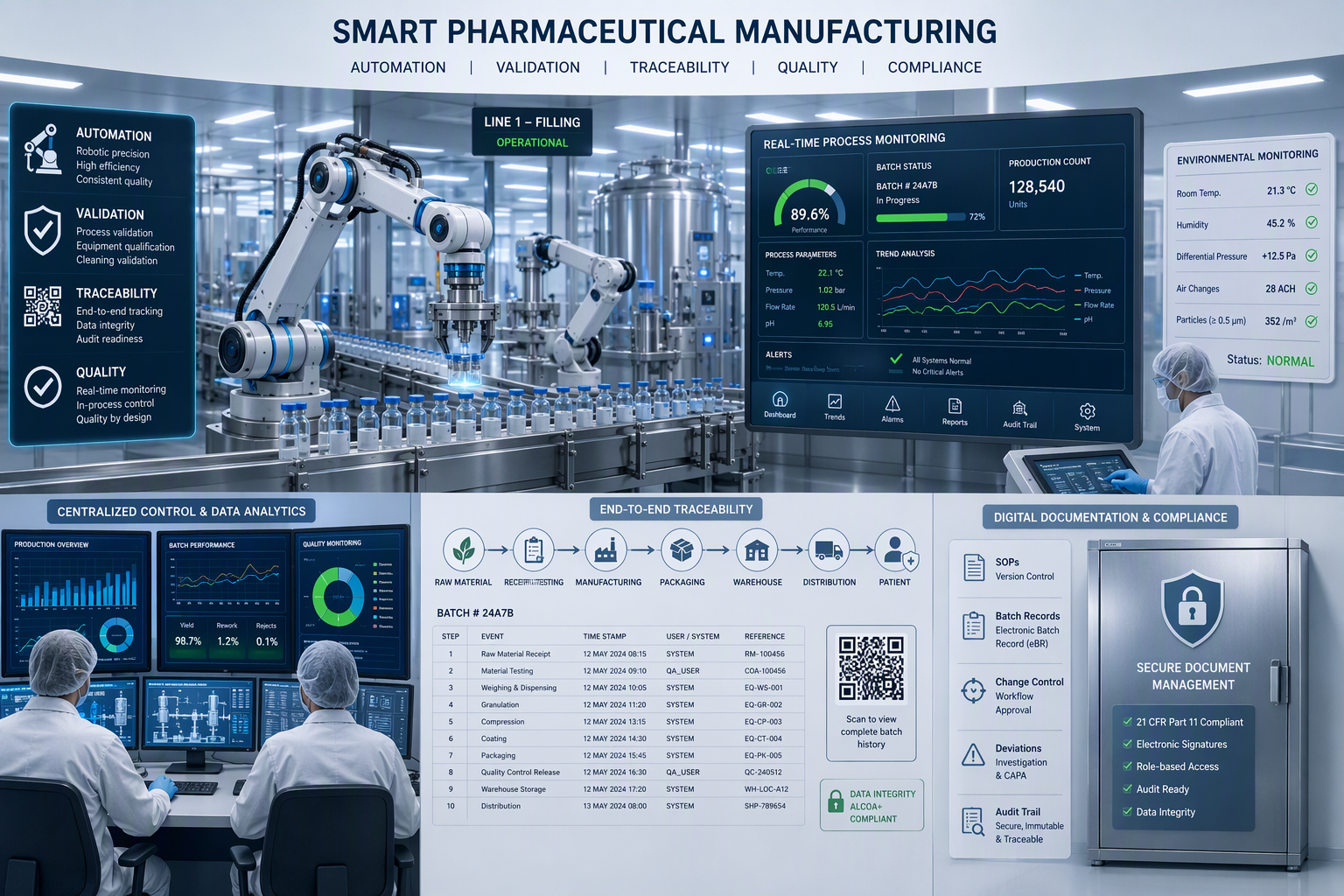
Manufacturers are using data-driven process optimization to improve results while strengthening quality checks and recordkeeping. At the same time, end-to-end traceability is becoming more important across production and supply movement. The trends below show how pharma plants are using automation to become more responsive, better documented, and easier to manage.
Automation for Personalized Medicine Production
Personalized medicine changes the demands placed on pharmaceutical production. Instead of focusing only on large, uniform runs, manufacturers may need to handle smaller volumes and more variation. That makes traditional fixed setups less practical in some cases.
Flexible automation helps address this challenge. Because it can adapt more easily to different products and changing requirements, it supports a manufacturing process that must be more responsive. Automation solutions that allow quicker reconfiguration are especially useful where product changeovers happen more often.
This trend points toward more agile batch production. Rather than building systems for one unchanged output, manufacturers are investing in tools that support precision and adjustment together. In pharma, that matters because personalized medicine still requires strict consistency, even when production volumes are smaller. Automation helps close that gap by making variety easier to manage without giving up control.
Data-Driven Process Optimization
Data is becoming a bigger part of how pharma plants improve performance. Instead of relying only on fixed assumptions, manufacturers can use information from automation systems to understand how equipment and processes behave during live production. That makes improvement efforts more focused and practical.
Data-driven process optimization depends on strong data analysis and timely visibility. When teams can review trends in real time, they can detect slowdowns, drift, or waste sooner. This supports better operational efficiency because changes can be based on actual plant behavior, not guesswork.
Common areas of improvement include:
- Adjusting process settings based on real time operating feedback.
- Finding hidden inefficiencies across connected automation systems.
- Using data analysis to support steadier throughput and lower variation.
For pharma manufacturers, this trend is about smarter control. Better information leads to better process decisions.
Regulatory Compliance through Automated Validation
Regulatory compliance is a constant concern in pharmaceutical manufacturing. Plants need reliable records, repeatable operations, and clear evidence that systems perform as intended. Automation technology can help by making processes more structured and easier to document.
Automated validation supports this need by reducing inconsistency in how checks are performed and recorded. When process control is built into the system, manufacturers can monitor whether equipment and workflows stay within expected limits. That strengthens quality control and helps teams identify deviations earlier.
This does not remove the need for oversight. It makes compliance work more manageable inside the manufacturing process. Instead of relying heavily on manual tracking, automated tools provide a more consistent framework for checking, recording, and reviewing performance. In regulated pharma environments, that consistency is valuable because it supports both operational control and audit readiness.
End-to-End Traceability in Manufacturing Processes
End-to-end traceability gives manufacturers a clearer picture of what happens to a product from start to finish. In pharma, that visibility matters because each step in the manufacturing process can affect quality, compliance, and batch confidence. Automation makes it easier to collect and connect those records.
When production lines are digitally linked, teams can track product movement, operating status, and process events more reliably. That helps quality checks happen with better context and supports faster review when something looks wrong. Traceability is not only about documentation. It also improves control.
Strong traceability often helps manufacturers:
- Follow batch movement across connected production lines.
- Support more reliable quality checks at key stages.
- Use automation solutions to connect records across the process.
For pharma plants, this trend improves transparency. It makes the process easier to monitor, review, and manage.
Critical Use Cases of Industrial Automation in Pharmaceutical Manufacturing
The value of industrial automation becomes easier to see when you look at specific use cases inside pharmaceutical plants. Automation technology supports more than one part of the manufacturing process. It can improve formulation, packaging, tracking, and storage in ways that strengthen both speed and control.
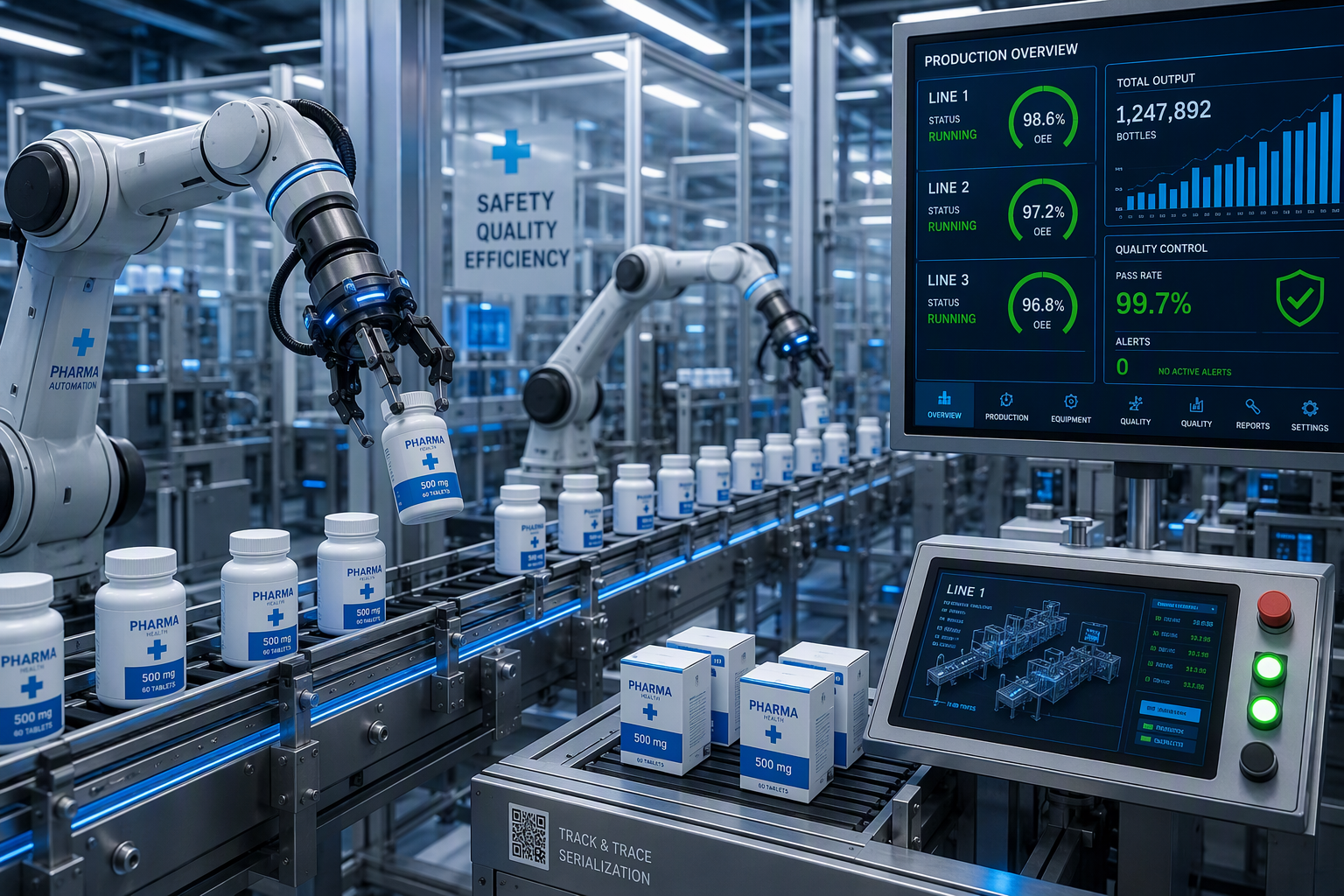
These use cases are especially important in batch production, where repeatability and documentation matter. From mixing ingredients to monitoring inventory, automated systems help manufacturers reduce variation and manage work more consistently. The following examples show where automation has the strongest practical impact.
Automated Drug Formulation and Mixing
Drug formulation requires accuracy because even small variations can affect the final result. Automation helps by controlling the mixing process more consistently than manual methods. In pharmaceutical manufacturing, that means ingredients can be handled with greater precision and timing.
Control logic plays a key role here. Automated systems can manage sequence, speed, and duration in a repeatable way, which helps reduce variation across batches. If process conditions begin to shift, the system can respond faster than a fully manual setup. That makes formulation more stable and easier to oversee.
Automation solutions also support quality control during and after mixing. By keeping the process within defined parameters, manufacturers improve the chances of producing consistent output every time. For pharma operations, automated drug formulation is a strong example of how industrial automation reduces avoidable error while improving repeatability in a critical production step.
Packaging and Labeling Automation
Packaging is one of the most visible automation areas in pharmaceutical plants. It often involves fast, repeatable actions where small mistakes can create major problems. Packaging automation helps keep output moving while reducing inconsistency in sealing, sorting, and product movement.
Labeling automation is just as important because accuracy matters at the final stage. Automated systems can apply labels more consistently and support checks that reduce misidentification risks. When linked to material handling steps, these processes become part of a smoother and more controlled workflow.
Key advantages include:
- Faster and steadier packaging automation across repetitive line tasks.
- More reliable labeling automation with fewer manual errors.
- Better coordination between material handling and quality control checks.
For pharma manufacturers, automation in packaging and labeling improves both line performance and confidence in the finished product.
Real-Time Batch Tracking Systems
Batch tracking gives pharmaceutical manufacturers a clearer record of what happens during production. When systems capture information in real time, teams can monitor progress, identify delays, and review conditions without waiting until the end of the run. That improves control across the manufacturing process.
SCADA systems often support this visibility by giving operators a broad view of plant status. Combined with data acquisition tools, they help collect and organize operating information from different stages of production. That makes it easier to connect what happened, when it happened, and where action may be needed.
Real-time batch tracking can support:
- Faster visibility into batch status across production stages.
- Better use of SCADA systems for plant-wide monitoring.
- Stronger data acquisition for review, alarms, and process decisions.
In pharma, these systems improve oversight and help connect production events to a clearer operating record.
Inventory and Storage Management Automation
Inventory and storage play a bigger role in pharma than many people realize. If materials are not available, tracked, or stored correctly, the rest of production suffers. Automation helps by making inventory management more reliable and less dependent on manual updates.
Storage management also improves when systems can monitor movement and status more consistently. Industrial automation solutions support better visibility into where materials are, how they are used, and when replenishment may be needed. That helps reduce confusion and supports smoother internal flow.
There is also a broader supply chain benefit. When inventory management is tied to automated asset management, manufacturers can make better decisions about material availability and equipment usage. In pharmaceutical operations, that stronger coordination helps reduce avoidable delays and supports a more stable production environment from storage through release.
Challenges Facing Industrial Automation Adoption in Pharma
Industrial automation offers clear value, but adoption in pharma is not always simple. Manufacturers must balance performance gains with practical concerns around integration, cost, and highly regulated operations. That can slow projects even when the long-term case is strong.
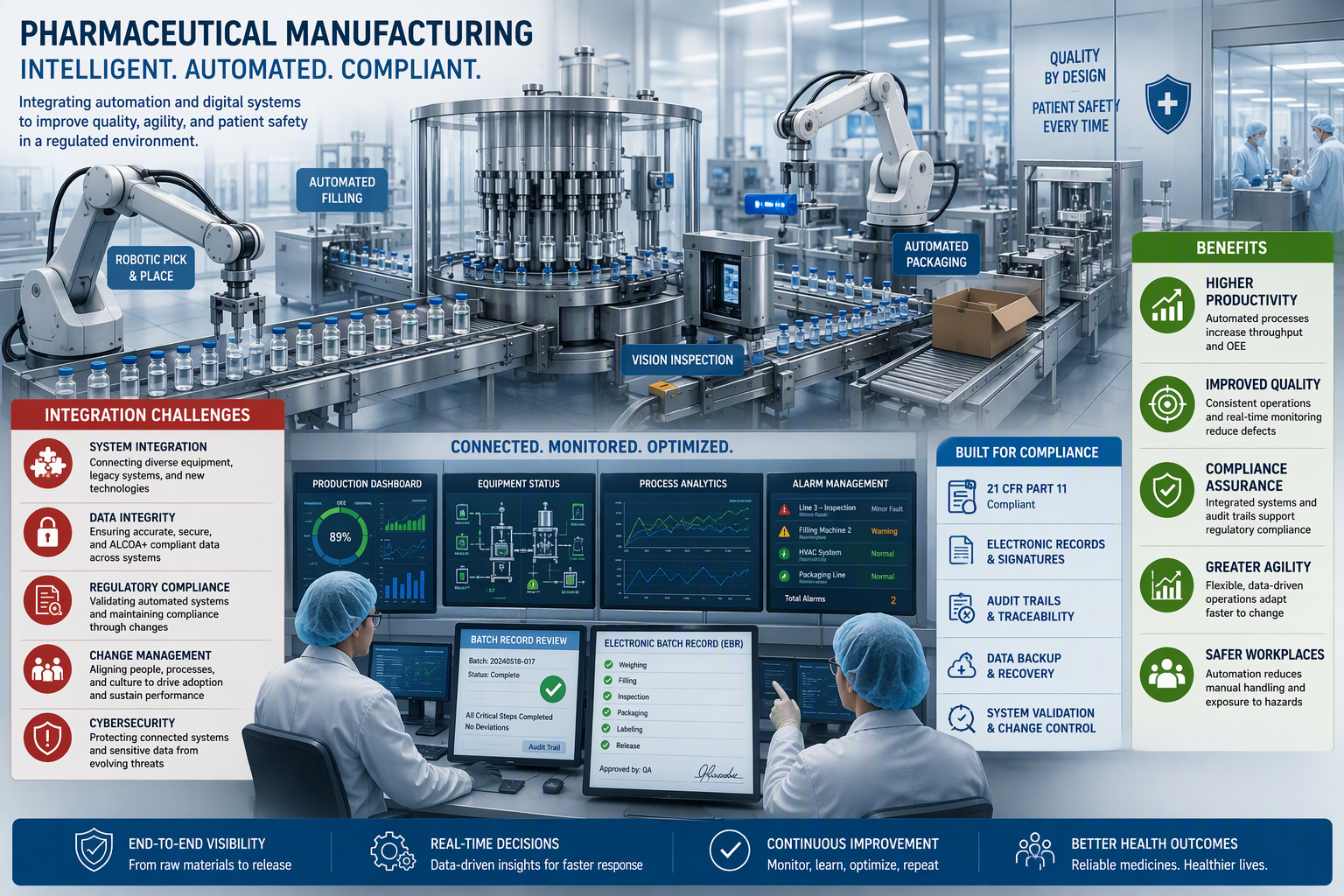
Common barriers include older equipment, upfront spending, workforce readiness, regulatory compliance demands, and cybersecurity risks. Human operators also need to adapt to new workflows and responsibilities. Understanding these obstacles helps you see why successful automation is not only about buying technology. It is also about managing change across the full plant environment.
Integration with Legacy Equipment
Many pharmaceutical facilities still rely on legacy equipment that was not designed for modern connectivity. That creates a challenge when manufacturers want to add newer automation systems without replacing every existing asset. In real industrial environments, full replacement is often too disruptive or too expensive.
Integration becomes difficult when older machines use different controls, limited interfaces, or outdated control logic. Even if the equipment still performs well mechanically, connecting it to newer monitoring and process tools may require added engineering work. That slows projects and increases planning demands.
Common issues include:
- Limited communication options in legacy equipment.
- Extra work needed to align old control logic with newer platforms.
- Greater complexity when integrating mixed automation systems.
For many pharma manufacturers, the question is not whether automation matters. It is how to add it without breaking what already works.
Cybersecurity and Data Protection
As pharmaceutical plants become more connected, cybersecurity becomes harder to ignore. Systems that once operated in relative isolation may now share data across industrial networks, software platforms, and connected devices. That wider access improves visibility, but it also creates more points of risk.
Data protection matters because automation increasingly depends on digital records, operating history, and connected control functions. If those systems are interrupted or exposed, manufacturers can face operational problems as well as compliance concerns. In pharma, where process integrity is critical, security cannot be treated as a side issue.
This challenge also sits between operations and information technology. Plants need automation solutions that support production goals while fitting into stronger security practices. That requires planning, not just equipment. As automation expands, cybersecurity becomes part of the basic foundation needed to keep connected manufacturing reliable and protected.
Cost of Initial Implementation
Upfront spending is one of the biggest reasons companies delay automation. Even when the long-term benefits are clear, the implementation cost can feel hard to justify in the short term. Pharma manufacturers must often weigh new systems against other pressing capital needs.
That hesitation is understandable because automation technology may require equipment, software, integration work, and training at the same time. The initial investment can look large before the gains in efficiency, quality, and labor use are fully visible. Still, delay also has a price, especially when labor shortages continue to affect operations.
Businesses often weigh costs such as:
- Equipment and software purchases tied to the initial investment.
- Engineering and setup work that increases implementation cost.
- Training needs before the plant reaches a competitive advantage.
For many manufacturers, the real decision is whether waiting costs more than moving forward.
Workforce Upskilling and Change Management
Technology alone does not make automation successful. People have to understand it, trust it, and know how to work with it. That is why workforce upskilling is a major part of any industrial automation effort in pharma.
Human operators often move from hands-on repetitive work into roles focused on oversight, response, and coordination. That shift can improve job quality, but it also requires training. Teams need to understand new automation systems, new expectations, and how their responsibilities are changing day to day.
Change management matters just as much as technical training. If people are not included in the transition, resistance can slow adoption and reduce results. Pharma manufacturers that approach automation as both a technology project and a workforce project are usually better positioned to make the change stick and get stronger performance from the systems they install.
Market Outlook and Growth of Industrial Automation in Pharma
The industrial automation market continues to grow as manufacturers invest in better control, stronger efficiency, and more connected operations. The compiled information points to major expansion across industries, with automation solutions becoming a core part of modern production strategy.
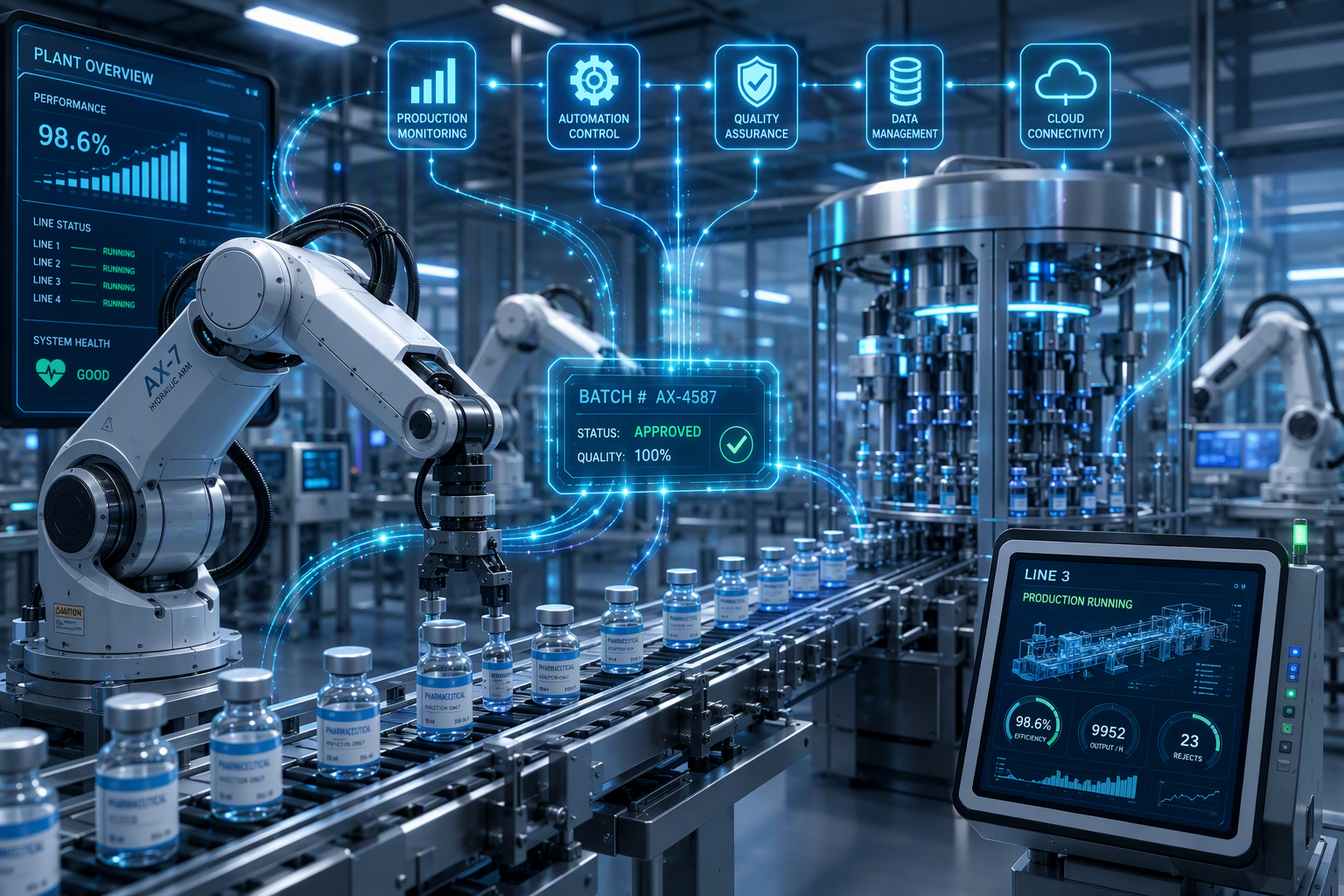
That broader momentum also shapes pharmaceutical manufacturing. As market size increases, more companies are adopting systems that support output, quality, and flexibility. Growth is being supported by new technologies, rising demand for smarter plants, and the push for global expansion. The following sections look at what this outlook means in practical terms.
Market Size and Forecast in the United States
The compiled information shows strong growth in the wider industrial automation market, which gives useful context for pharma manufacturers in the United States. Global figures indicate that automation technology is moving from a niche investment to a core part of industrial strategy. That trend supports a positive growth outlook for companies evaluating new systems.
While the source does not isolate a United States pharma-only figure, it does show broad market expansion over time. That matters because the same drivers affecting global adoption also influence investment decisions in the United States, especially in regulated manufacturing sectors.
| Market Measure |
Reported Figure |
|---|---|
| Global industrial automation market, 2021 |
$196.6 billion |
| Global industrial automation market, 2022 |
$213.49 billion |
| Expected market by 2029 |
$395.09 billion |
| Reported compound annual growth rate |
9.8% |
For U.S. pharma manufacturers, this forecast suggests continuing momentum as automation becomes more central to plant modernization and competitiveness.
Driving Factors Influencing Market Expansion
Industrial automation is growing because manufacturers want better performance and more resilience. Companies across sectors are seeing that automation technology can improve output, support quality, and reduce dependence on manual processes that are harder to scale. Those benefits are pushing market expansion forward.
There is also a strategic reason behind adoption. Early users often gain a competitive advantage by improving productivity, reducing waste, and creating steadier operations. As those gains become more visible, other manufacturers feel pressure to keep up. That broadens demand for automation in pharmaceutical manufacturing and beyond.
Key driving factors include:
- The need for greater efficiency and consistency in production.
- Pressure to gain a competitive advantage through smarter operations.
- Interest in newer automation technology such as AI and connected systems.
Taken together, these forces help explain why the market outlook remains strong and why more manufacturers are moving toward automation now.
Leading Companies and Solution Providers
The compiled information does not provide a ranked list of pharma-specific vendors, but it does make one point clear: solution providers are expanding what industrial automation can offer. Companies in this space are developing systems that combine robotics, analytics, AI, and connected monitoring into more complete automation solutions.
For manufacturers, the market now includes providers focused on specialized equipment as well as broader plant-wide integration. That means choosing among leading companies often depends on the problem you want to solve, not just the size of the vendor. Some focus on physical automation, while others emphasize software, fleet tools, or integrated controls.
Manufacturers often look for providers that offer:
- Automation solutions tailored to specific production needs.
- Support for integration across equipment and software.
- Experience delivering industrial automation in complex facilities.
In a growing market, solution fit matters as much as provider recognition.
Potential for Global Expansion
Industrial automation is not growing in just one region or one market segment. The compiled information shows adoption across various industries, from manufacturing and logistics to healthcare, automotive, and pharmaceuticals. That broad base supports strong potential for global expansion.
Automation technology travels well because many industrial environments share similar goals. Companies everywhere want better productivity, more stable quality, safer operations, and lower waste. Even when local regulations or plant designs differ, the pressure to improve efficiency remains consistent. That makes automation relevant across many countries and sectors.
Areas supporting global expansion include:
- Demand for better performance across various industries.
- Growing use of automation technology in complex industrial environments.
- Broader recognition that connected systems can improve competitiveness.
For pharmaceutical manufacturers, this wider growth means automation is becoming part of the global standard for modern production.
Sectors Most Impacted by Industrial Automation within Pharma
Industrial automation does not affect every part of pharma in the same way. Some areas see faster adoption because their manufacturing process depends heavily on precision, repeatability, or controlled handling. In those settings, automation systems can deliver especially strong value.
The most impacted sectors are usually the ones where errors are costly and process stability matters most. Different types of pharma production, from small molecule manufacturing to biologics and aseptic work, each benefit from automation in different ways. The sections below highlight where automation is having the clearest effect.
Small Molecule Drug Manufacturing
Small molecule drugs are often produced through highly structured batch production steps that depend on repeatability and control. That makes them a strong fit for automation. When the same actions must be performed consistently over time, automation systems can reduce variation and improve output stability.
The manufacturing process for these products often benefits from automated sequencing, monitoring, and handling. Systems can help keep operations within defined parameters, which is especially useful where timing and consistency affect product quality. Even small improvements in control can make a meaningful difference across repeated runs.
Because the workflows are often well defined, small molecule drug manufacturing can adopt automation in practical, scalable ways. It is one of the clearest examples of where industrial automation supports both efficiency and consistency. For many manufacturers, this sector shows how automation can strengthen daily execution without changing the core production model.
Biologics and Vaccine Production
Biologics and vaccine production place heavy demands on consistency, oversight, and contamination control. These products often involve more sensitive processes than standard solid-dose manufacturing, so automation solutions can play an important role in reducing variation and supporting steadier operations.
Automation is especially valuable where quality control must be maintained across tightly managed steps. In biologics and vaccine production, the margin for inconsistency is small. Better monitoring and repeatable machine actions help teams maintain stronger control while reducing reliance on manual handling in critical zones.
Automation often helps this sector by:
- Supporting more consistent process execution in biologics workflows.
- Reducing manual exposure in vaccine production environments.
- Improving quality control in areas linked to aseptic processing.
Because of these demands, this sector is among the most impacted by industrial automation growth within pharma.
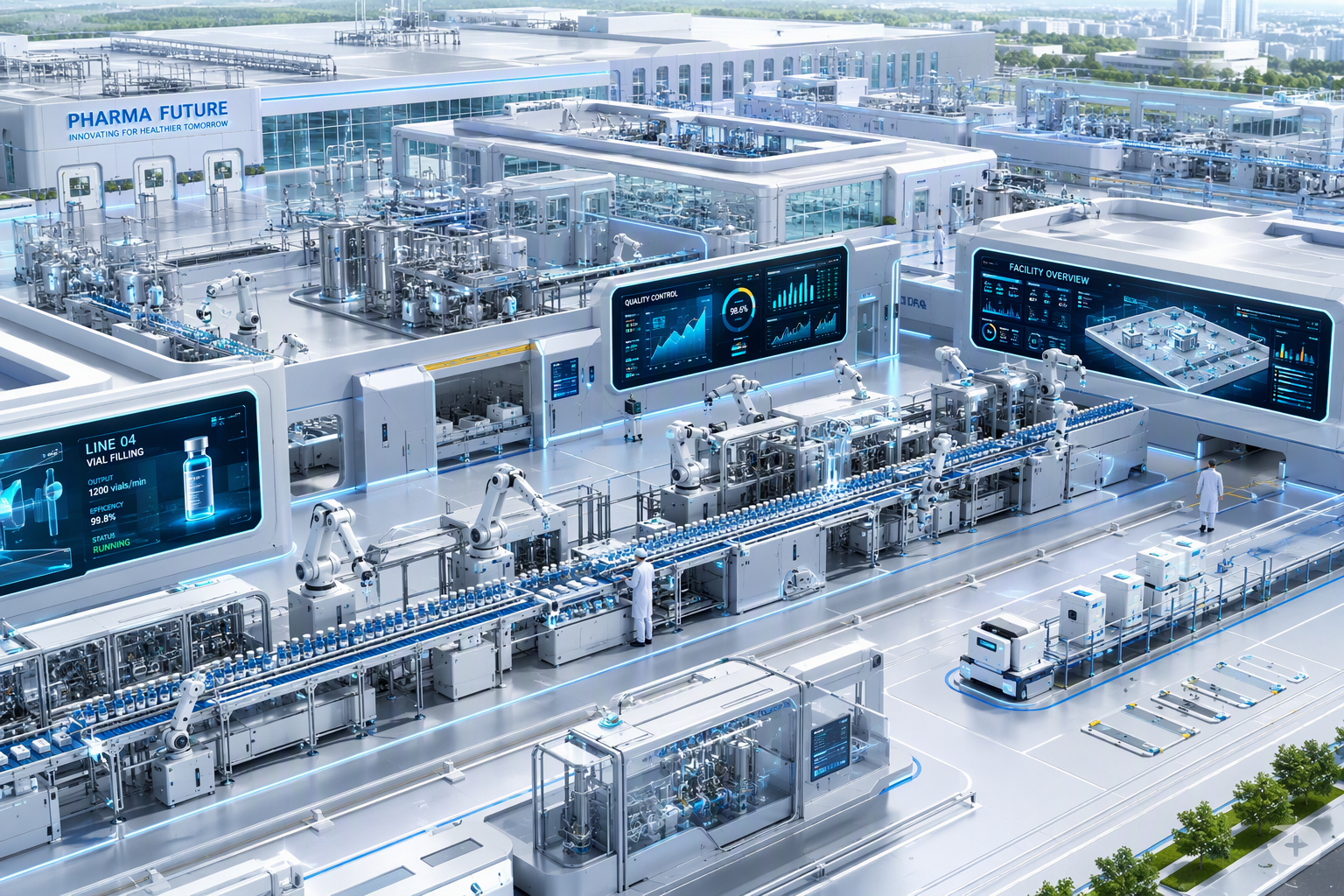
Aseptic Processing and Fill-Finish Operations
Ensuring product quality in aseptic processing and fill-finish operations relies heavily on advanced automation systems. Robotics and programmable logic controllers streamline the repetitive tasks associated with these processes, minimizing human intervention. Utilizing SCADA systems enhances supervisory control and data acquisition, ensuring real-time monitoring of production lines. Quality checks are automated through machine learning and predictive maintenance, contributing to efficiency and consistency. For a deeper understanding of how these technologies apply across various manufacturing sectors, explore the industrial automation applications in manufacturing. This integration enhances the efficiency and reliability of critical operations in pharmaceutical environments.
Conclusion
In conclusion, the advancements in the industrial automation industry provide an exciting glimpse into the future of manufacturing, particularly within pharmaceutical applications. By leveraging technologies such as machine learning, SCADA systems, and robotics, manufacturers can enhance product quality and streamline their production lines. Emphasizing minimal human intervention allows for improved efficiency and reduced labor costs, making it possible to adapt quickly to the evolving market demands. For more insights, explore the various industrial automation applications in manufacturing that contribute to this transformative wave.
Frequently Asked Questions
How does industrial automation improve pharmaceutical manufacturing?
Industrial automation enhances pharmaceutical manufacturing by optimizing processes, increasing efficiency, and ensuring consistent product quality. Technologies like robotics and SCADA streamline operations, reduce human error, and facilitate real-time monitoring, ultimately leading to faster production cycles and adherence to regulatory standards.
What are the risks and regulatory considerations for automation in pharma?
Automation in pharma entails risks like data integrity issues, equipment malfunctions, and compliance failures. Regulatory considerations include adherence to FDA guidelines, ensuring system validation, and maintaining documentation that demonstrates consistent quality control throughout the manufacturing process to prevent potential recalls and ensure product safety.
Where can I learn more about industrial automation applications in manufacturing?
You can explore various online platforms, including industry-specific webinars, courses from organizations like ISA or SME, and resources such as research papers and trade journals. Additionally, engaging with automation communities on forums and social media can provide valuable insights.
You might also like