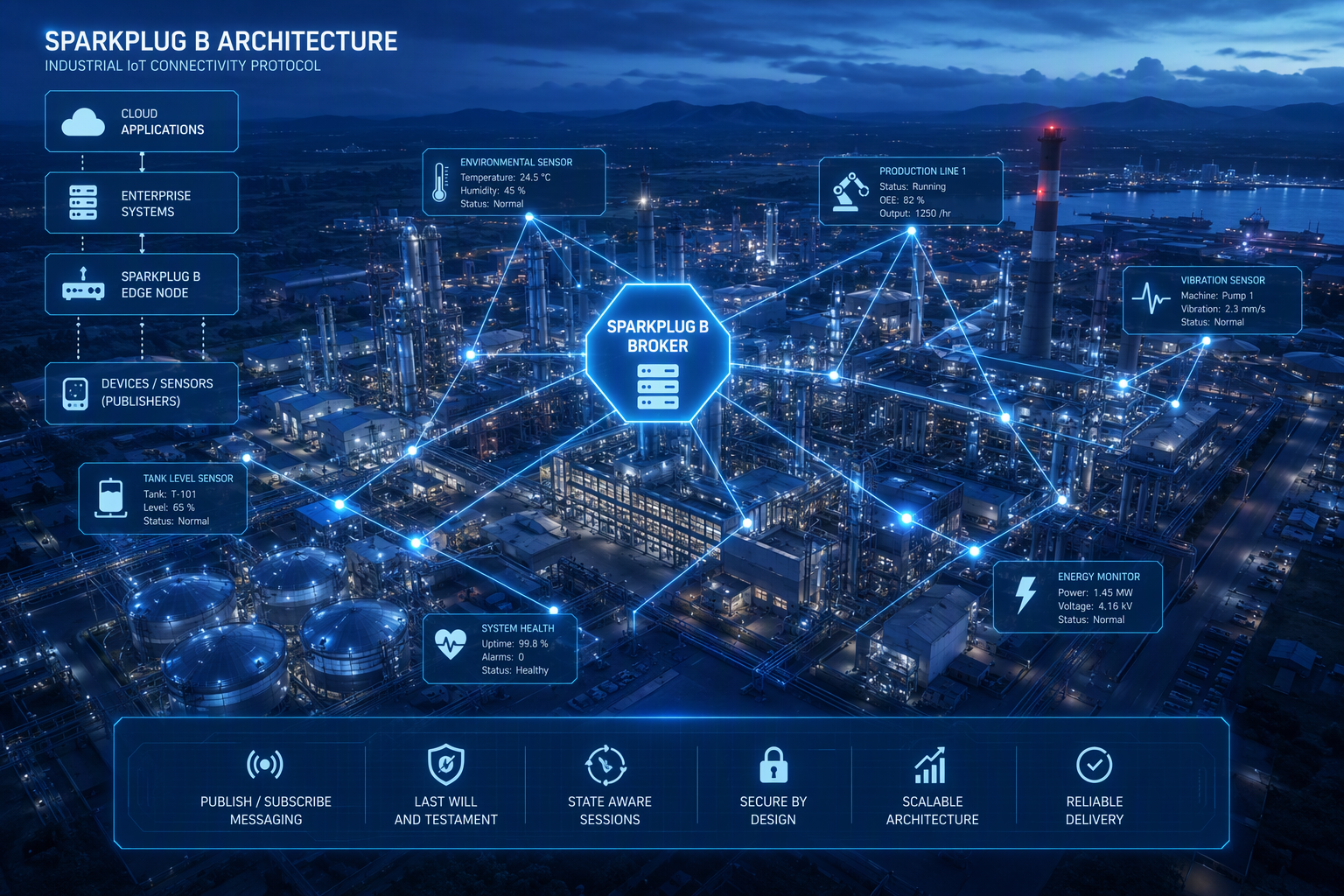
Sparkplug B Topic Structure and Payloads Explained
Sparkplug B Topic Structure and Payloads Explained
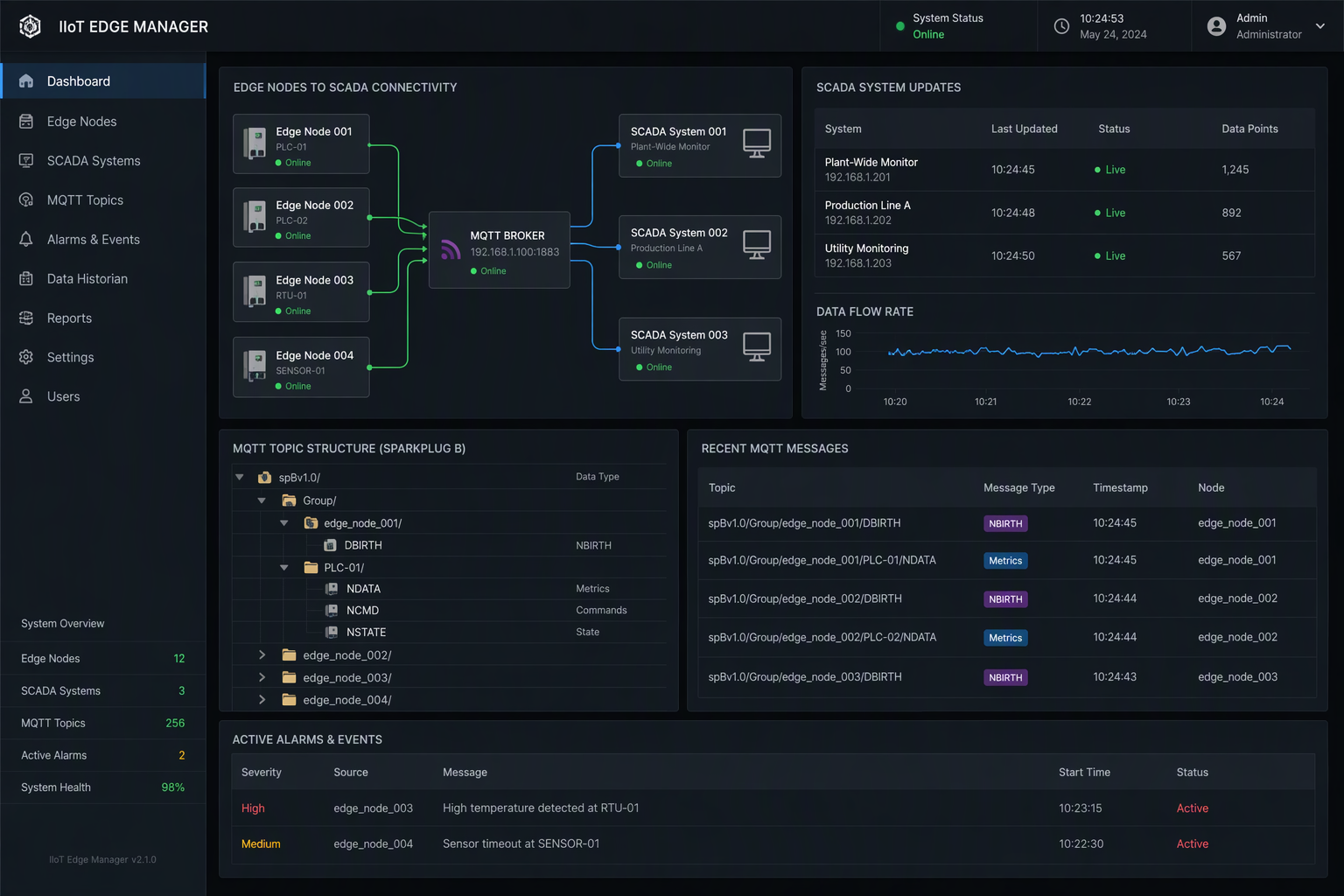

Key Highlights
- Sparkplug B gives your MQTT data a fixed topic namespace, so every edge node and device follows the same structure.
- Its payload format uses protocol buffers, which keep messages compact, typed, and easier to process across vendors.
- Birth and death messages add state management, helping SCADA systems know what is online, offline, or stale.
- The standard supports a unified namespace, simpler device integration, and cleaner data exchange in industrial IoT.
- In practice, Sparkplug B works well for plant dashboards, commands, and Node-RED flows.
Introduction
Sparkplug B matters because plain MQTT moves messages but does not tell every device how to name topics or package data. In industrial IoT, that gap creates extra engineering work. Sparkplug B solves it with a standard topic namespace and a defined payload specification for industrial data. If you are a controls engineer or plant manager, that means less custom parsing, better state awareness, and a cleaner path from machine data to SCADA, HMI, and analytics tools.
Foundations of Sparkplug B for IIoT Communications
Sparkplug B is an open standard built on top of MQTT for IIoT and control systems. It adds a defined topic namespace, a fixed payload format, and state management that plain MQTT does not provide on its own. In industrial environments, that structure gives your MQTT broker a more usable source of truth for device data.
Just as important, Sparkplug B adds birth certificate and death certificate messages, sequence numbers, and protocol buffers. That gives SCADA systems, edge of network gateways, and other applications state awareness, cleaner message delivery, and better handling of historical data after a network event. The next sections break down how that works.
Role of MQTT and Industrial Automation
MQTT became popular in industrial automation because it is lightweight and reliable for moving messages between systems. Your PLC-facing gateway, historian connector, or SCADA client can publish and subscribe through an MQTT broker without heavy overhead. That is useful when you have many control systems and remote assets sending frequent updates.
Still, plain MQTT leaves the mqtt topic namespace up to each vendor or programmer. One machine builder may publish to one pattern, while another uses something completely different. That makes integration slower because every system needs custom logic to understand where data lives and what it means.
MQTT Sparkplug B fixes that by giving each edge node and device a known topic structure. Messages are organized by protocol version, group, message type, edge node, and sometimes device. So instead of guessing topic meaning, your applications can subscribe and act on predictable message paths.
How Empowered Automation Uses Sparkplug B in the Midwest
In real projects, the value of Sparkplug B shows up when plant data needs to move cleanly from machines to operators, engineers, and business systems. Empowered Automation, a Chicago-area systems integrator, uses Sparkplug B to simplify device integration and create a unified namespace that plant teams can actually maintain.
On the floor, that usually means practical improvements such as:
- Clear naming tied to an edge node id, line, or machine so data is easier to trace.
- Standard message flow for alarms, counts, and process values across mixed equipment.
- Better handoff to a primary application like SCADA, where state and data are easier to trust.
For Midwest manufacturers, the takeaway is simple. Standardized topics reduce engineering time and help your team scale data collection without rebuilding every connection from scratch. If you want a broader primer, see What is Sparkplug B.
What Makes Sparkplug B Unique?
What sets Sparkplug B apart is not the transport layer alone. It uses standard MQTT, but it adds rules that matter in control systems. The sparkplug specification defines topic names, message types, payload structure, and device lifecycle behavior, so your applications are not forced to interpret every vendor’s custom approach.
It is also an open standard governed through the Eclipse Foundation process. That matters because mqtt sparkplug is meant for interoperability. Instead of isolated integrations, you get a common model that different vendors and industrial software can follow.
Defining Sparkplug B – Standardization and Interoperability
Sparkplug B is an open standard for industrial IoT that defines how devices publish data over MQTT in a consistent way. It is governed through the Eclipse Foundation specification process, which gives the market a shared reference instead of a private vendor format. That is a big step for standardization.
Why does that matter to you? In many plants, different vendors publish different topic names and payloads. Plain MQTT allows that flexibility, but it also creates integration work. Sparkplug B reduces that problem by defining standard topics and standard message content for industrial data exchange.
The result is stronger interoperability. A SCADA client, edge gateway, or analytics tool can connect faster because the expected structure is already known. That does not remove all engineering effort, but it makes multi-vendor systems far more predictable and much easier to support over time.
Comparing Sparkplug B to Basic MQTT Messaging
At first glance, Sparkplug B and plain MQTT look similar because both use the same transport. The difference is purpose. Plain MQTT focuses on message delivery, while Sparkplug B defines how industrial data should be named, typed, and tracked. That distinction becomes important fast when your system grows.
Here is a simple text table that shows the practical difference:
| Category | Plain MQTT | Sparkplug B |
|---|---|---|
| Topic syntax | Fully custom | Standardized mqtt topic namespace like spBv1.0/group/message_type/edge_node_id/device_id |
| Payload structure | JSON, text, or custom binary | Structured binary payloads with protocol buffers |
| Message type | User-defined | Defined types such as NBIRTH, DBIRTH, NDATA, DDATA, NDEATH, DDEATH, NCMD, DCMD |
| State awareness | Limited | Built-in lifecycle and state handling |
| Device discovery | Manual | Birth messages describe device capabilities |
For industrial environments, that added structure pays off. You spend less time interpreting custom tags and more time using reliable data. Sparkplug B is stricter than plain mqtt, but that is exactly why it scales better in production.
Core Components of the Sparkplug B Topic Namespace
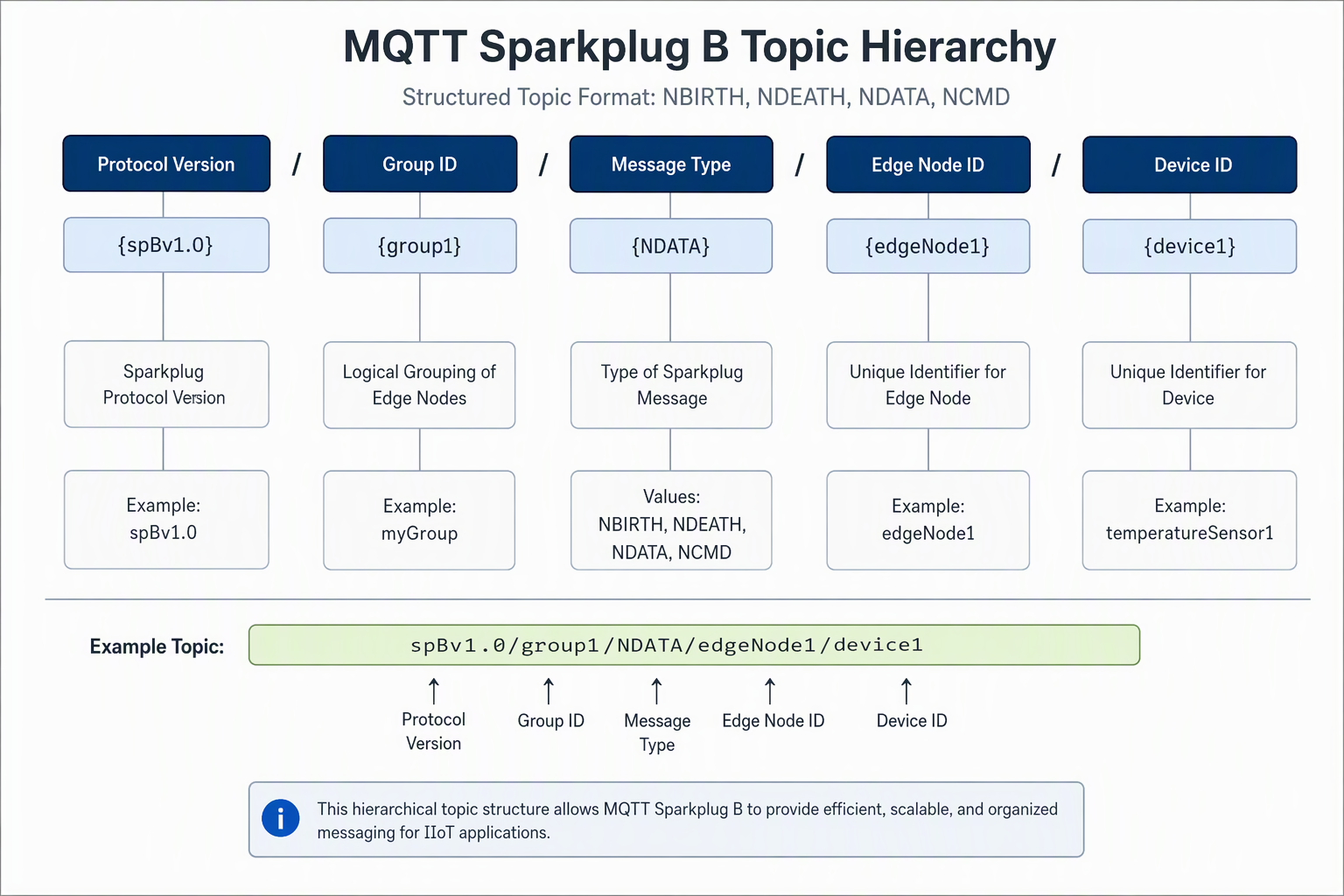
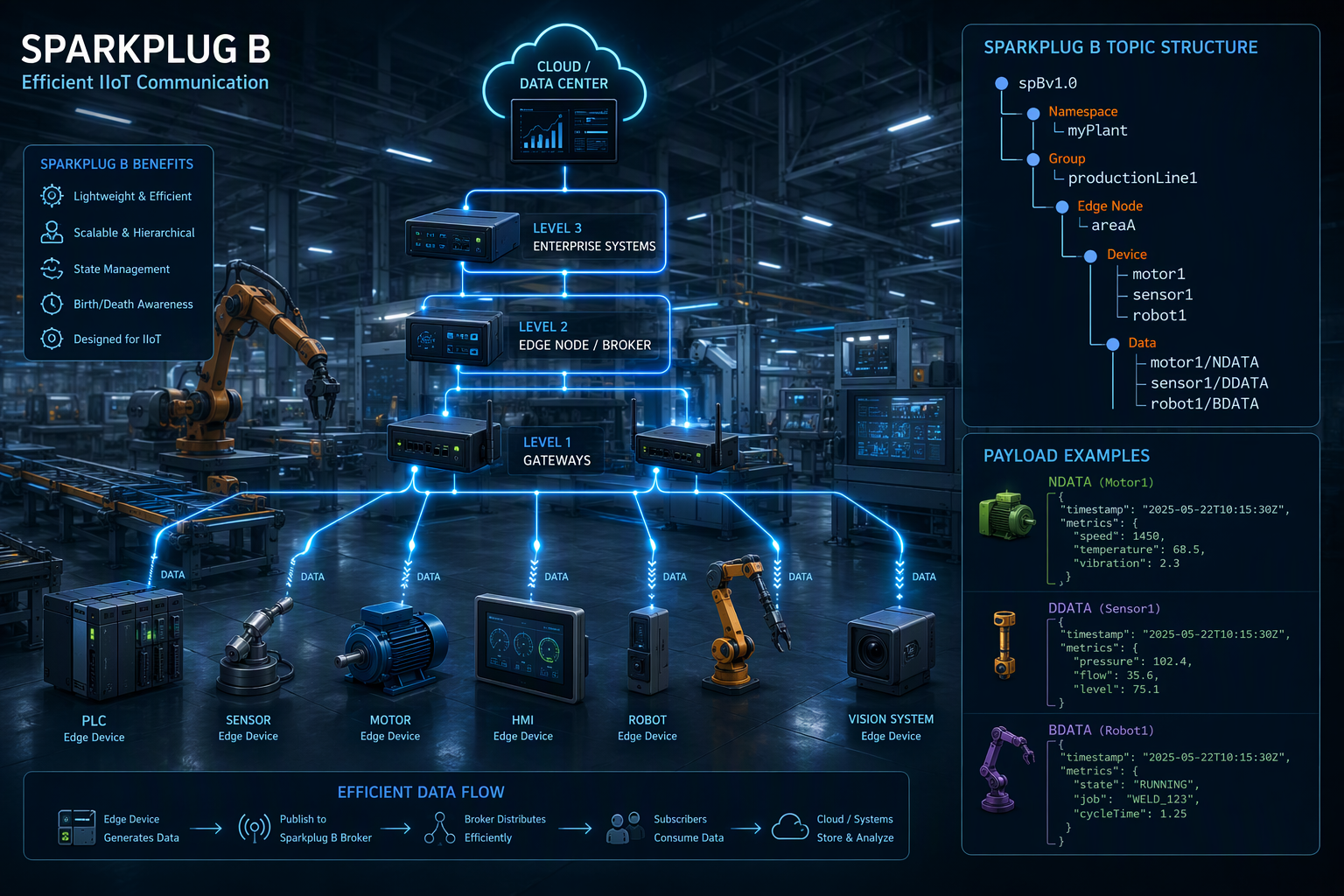
Every Sparkplug B topic follows a layered pattern. The topic namespace starts with the protocol version and then adds the group id, message type, node id or edge node id, and sometimes a device id. This gives your plant data a fixed address that applications can read consistently.
That structure is important because each level has a job. One level identifies the site or logical group, another identifies the message purpose, and another points to the specific source. Next, we will break down the hierarchy in plain English.
Overview of Topic Levels and Hierarchy
Sparkplug B uses a fixed topic structure that organizes MQTT messages into predictable levels. A common pattern is spBv1.0/group_id/message_type/edge_node_id/device_id. Not every message needs all parts, but the order matters. That is how subscribers know whether they are looking at node data, device data, commands, or lifecycle state.
The main identifiers are:
- group id: the logical plant, area, building, or enterprise grouping.
- edge node: the gateway or edge source publishing data for attached assets.
- device id: the optional specific device under that edge node.
Once you understand those levels, the topic namespace becomes much easier to use. Your applications can subscribe by plant area, message class, or specific machine. That is the core answer to how Sparkplug B topics organize industrial device data in a scalable way.
Breakdown of Edge Node, Device, and Group Identifiers
Think of the group id as the business or plant context. It might represent a factory, a building, or a production area. In the sparkplug specification, this field helps segment data cleanly so subscribers can separate one site from another without guesswork.
Next comes the edge node. This is often the gateway, industrial PC, or software service sitting near the equipment. The edge node publishes node-level messages and may also manage several downstream devices. A clear edge node name makes maintenance easier when you troubleshoot message flow.
Then there is the device id, which points to a specific device under that node. For example, a temperature sensor, meter, or machine subsystem can have its own device id. Consistent names across these identifiers improve data consistency and reduce confusion when different teams build or consume the data model.
The Importance of Topic Structure in IIoT Networks
Topic structure matters because industrial IoT systems do not stay small for long. Once you have many machines, cells, and software consumers, loosely named topics become hard to manage. A fixed topic structure keeps data exchange organized and helps every subscriber know what kind of device data is arriving.
It also improves operations during abnormal events. When state messages, commands, and normal values follow known patterns, your team can troubleshoot faster and scale with less rework. The next two sections look at consistency, growth, and integrity.
Organizing Industrial Data for Consistency and Scalability
A good topic structure gives your data format a repeatable pattern across the whole plant. That means one machine line does not publish counts one way while another line publishes them another way. For controls engineers, that lowers integration effort. For plant managers, it means reports and dashboards are easier to trust.
The benefits show up quickly:
- Better consistency when adding new devices or lines.
- Easier scalability because subscriptions can target groups, nodes, or device classes.
- Cleaner handling of historical data after store-and-forward events.
This is why topic structure is so important in Sparkplug B for IIoT applications. It helps future-proof device integration. As your plant adds more equipment, the same rules keep working, which cuts down on one-off code and long commissioning cycles.
Impact on Security and Data Integrity
Topic structure does not replace broker security, but it supports cleaner and safer data exchange. When topics are predictable, you can apply access rules with more confidence at the MQTT broker. You know which paths carry commands, which carry state messages, and which carry normal telemetry.
That clarity also helps with state management. Birth and death events tell subscribers whether a node or device is online. If a network interruption occurs, the system can flag missing sources instead of silently accepting stale values. In plant operations, that makes a real difference.
Data integrity improves because message context is clearer. Sequence numbers can expose lost messages, and lifecycle events show whether a source dropped offline. During network events, subscribers can separate valid live data from delayed or historical values instead of treating every message the same.
Sparkplug B Topic Naming Conventions and Specifications
Sparkplug B topic naming is strict by design. The topic namespace begins with the protocol version and then follows the required order for group, message type, edge source, and optional device. These naming conventions are not cosmetic. They are part of how subscribers understand what a message represents.
That matters when you maintain a live plant system. With a stable sparkplug specification and known protocol version, your team can build subscriptions, alarms, and consumers that do not break every time a new machine gets added. Let’s look at what is required and what is optional.
Required vs. Optional Fields
The Sparkplug B specification defines topic naming rules through the required order of fields in the topic namespace. Some fields must always be present, while others depend on whether the message applies to an edge node or a device. That distinction helps subscribers interpret messages correctly.
The required fields are:
- protocol version, such as spBv1.0
- group id
- message type
- edge node id
The optional field is usually the device id, used when the message refers to a specific downstream device. That flexibility is useful because not every Sparkplug B message is device-specific. Node-level lifecycle and data messages may stop at the edge node level, while device-level messages extend one level further.
Best Practices for Topic Naming
Strong topic naming starts with clarity. Use names that match your actual plant layout and control strategy. If your team already uses standard line, area, and equipment naming in SCADA or maintenance systems, carry that into Sparkplug B. That makes the data model easier to support.
A few best practices help:
- Do use stable names for groups, nodes, and devices that match plant reality.
- Do keep names readable and consistent across every device type.
- Do not rename topics casually after applications are built around them.
These topic naming best practices support device integration and future growth. Clear naming reduces confusion during startup, troubleshooting, and expansion. If a new line comes online next year, your structure should accept it without forcing a redesign of subscriptions or dashboards.
Real-world Examples of Sparkplug B Topic Hierarchy
On a plant floor, topic hierarchy should mirror how your operation is actually organized. You may group data by site, line, skid, or area, then publish from an edge node and add a device id for the specific asset. That turns topic hierarchy into a practical map of operations.
Once that map is in place, data messages are easier to route, filter, and troubleshoot. The following examples show how location and machinery-based organization can make daily plant work simpler.
Organizing Plant Floor Devices by Location or Machinery
A common pattern is to organize the topic namespace by location or by machinery. For example, your group could represent a facility, your edge node could represent a production line gateway, and your device id could represent a filler, oven, mixer, or test stand. That creates a direct link between the topic and the physical asset.
This approach helps in day-to-day operations:
- Faster troubleshooting because you can trace data back to the exact location or machine.
- Easier maintenance because subscriptions can target one area without touching the rest of the system.
- Better control because commands can be aimed at the right device id.
If your plant adds another production line, you can extend the same structure. That keeps the hierarchy clean and helps optimize expansion without rethinking how every machine publishes data.
Case Studies from Chicago-area Manufacturing
In one Chicago-area manufacturing case study pattern, mixed equipment from different vendors needed to feed a common monitoring layer. A standardized sparkplug b topic layout let the team organize device data by area and node id rather than by each vendor’s custom naming. That made subscriptions much easier to manage.
In another typical scenario, an edge gateway buffered values during a brief outage and then republished them with historical data indicators after reconnection. Because the topic structure stayed consistent, downstream applications could still sort and process the backlog correctly without losing context.
The broader lesson is practical. Good topic organization is not just theory. It improves analysis, reduces custom parser work, and gives plant teams a cleaner operating model. That is why structured naming is worth deciding early, before the system grows.
Understanding Sparkplug B Payloads
Topics tell you where a message belongs. The Sparkplug B payload tells you what the message contains. Its payload format is built around an array of metrics, with each metric carrying a name, value, timestamp, and type information. That is a major reason Sparkplug B is useful in plant systems.
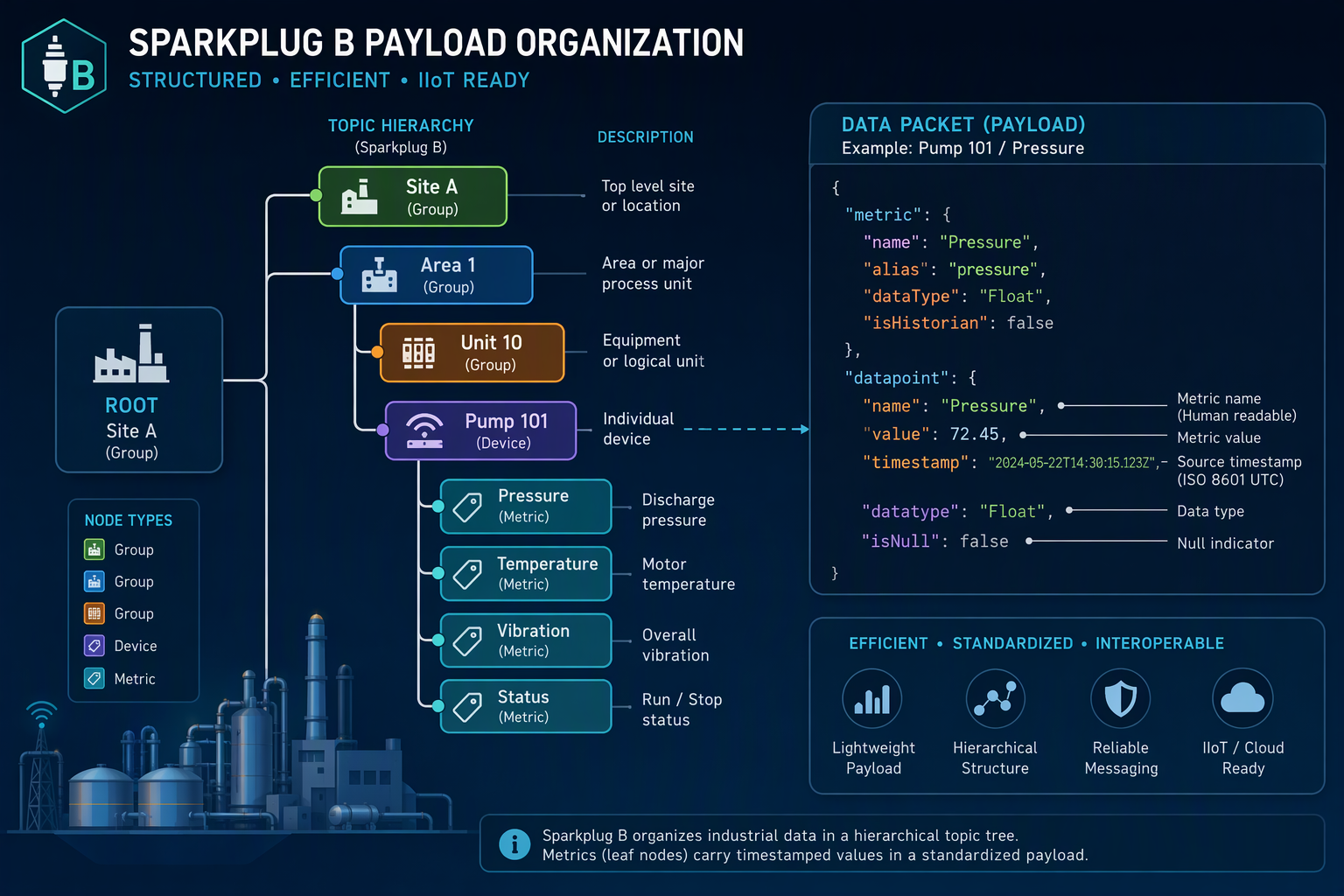
Instead of loose text payloads, Sparkplug B uses protocol buffers for compact binary encoding. That helps with performance, consistency, and typed data exchange. Next, we will look at encoding and supported data types.
Use of Protocol Buffers for Efficient Data Encoding
Protocol buffers are the data encoding method used inside the Sparkplug B payload. In simple terms, they package structured data into a compact binary format instead of verbose text. That makes messages smaller and faster to move, which is useful when many devices publish often.
For industrial systems, the benefit is not only size. Protocol buffers support strongly typed fields, which reduces ambiguity when applications parse values. A float, Boolean, string, or dataset is defined clearly. That makes the payload more reliable for SCADA, HMIs, and analytics consumers.
This works together with topic structure to organize industrial device data. The topic says where the data came from and what kind of message it is. The sparkplug b payload then describes the metrics in a standardized way, giving subscribers both context and content they can trust.
Data Types Supported in Sparkplug B Payloads
Sparkplug B supports a wide range of data types, which is important in real plant systems. A payload structure can hold integers of different sizes, floating-point values, Boolean states, strings, timestamps, UUIDs, binary data, and even more complex structures such as datasets and templates. That gives your system room to model more than a simple temperature reading.
Typical examples include:
- temperature, pressure, or flow values as Float or Double metrics
- machine state, run status, or permissives as Boolean metrics
- IDs, labels, and event text as String metrics
Because the payload uses an array of metrics, each metric can carry its own name, type, and timestamp. That makes device data exchange flexible without becoming messy. You keep standard formatting while still supporting many different industrial signals.
Lifecycle Messages: Birth, Death, and Data Transmission
Lifecycle messages are one of the biggest reasons Sparkplug B works well in industrial systems. A birth certificate announces that a node or device is online and describes available metrics. A death certificate tells subscribers that the source has disconnected, even during an unexpected failure.
These state messages support reliable data transmission because subscribers know whether data is live, stale, or missing. Sequence numbers add another check by helping detect lost messages. The next two sections explain how this plays out at the node and device level.
Device and Edge Node Lifecycle Management
Sparkplug B manages device lifecycle through a clear set of message types. When an edge node connects, it sends an NBIRTH message. When a downstream device connects, it sends a DBIRTH message. These birth certificate messages declare available metrics, types, and initial values, so subscribers can discover capabilities automatically.
If the connection ends, the system publishes NDEATH or DDEATH messages. This death certificate behavior is tied to MQTT last will support, so an unexpected disconnect still produces a visible status change for subscribers. That is a major advantage over systems where missing data is the only clue something failed.
For state management, this is powerful. Operators and applications can see whether a source is active, disconnected, or returning after a fault. Combined with structured topics, these lifecycle messages help organize and trust industrial device data much more effectively.
Handling State Changes and Fault Conditions
Plants do not run in perfect conditions. Networks drop, brokers restart, and devices power cycle. Sparkplug B handles these state changes with defined lifecycle behavior. Death messages show that a source went offline, and new birth messages show when it comes back. That gives subscribers a clear event trail.
A rebirth command is especially useful after a fault condition or application reset. It tells a node or device to resend its birth information so subscribers can rebuild state cleanly. In practice, that helps SCADA or other consumers recover without manual reconfiguration.
Data messages continue to carry live updates, but they now sit inside a broader state-aware system. Instead of treating every value as equal, your application can factor in connection state, message order, and recent lifecycle events before acting on the data.
Working with Node-RED and Sparkplug B Topic Structures
Node-RED is a practical tool for building and testing mqtt sparkplug b applications. With Sparkplug-aware nodes, you do not have to hand-code every topic or binary payload. That lowers the barrier for quick proofs of concept and structured plant-side integrations.
It also helps you visualize topic structures and message flow. For controls engineers, that means faster testing of edge logic. For plant managers, it means quicker demonstrations of value before a larger rollout. The next section shows what that looks like.
Node-RED Integration for Visual Data Flows
Node-RED interacts with Sparkplug B topic structures through dedicated nodes that publish and subscribe using the expected Sparkplug format. Instead of manually building protobuf payloads and every sparkplug b topic, you configure the broker, group, edge node, device metrics, and message behavior in the flow editor. That speeds up testing.
Useful features include:
- publishing DBIRTH, DDATA, and other Sparkplug message types from configured nodes
- subscribing to a specific mqtt topic namespace or wildcard topic for debug and validation
- sending commands like rebirth or death through simple inject nodes
These visual data flows are valuable in demo systems and pilot projects. You can simulate machine data, view lifecycle messages, and validate topic hierarchy before going live. That makes Node-RED a strong fit for early-stage integration and operator-facing proofs of concept.
Conclusion
In conclusion, understanding Sparkplug B topic structures and payloads is essential for optimizing IIoT communications within your industrial network. By mastering the organization of topic hierarchies and effectively managing payload data, you can enhance efficiency, improve security, and ensure seamless interoperability among devices. Each component plays a critical role in the lifecycle management of edge nodes and devices, ultimately driving better performance on the plant floor. For those interested in diving deeper into this innovative protocol, explore more about What is Sparkplug B and see how Empowered Automation, a trusted Chicago-area systems integrator, can help you leverage its benefits in your operations.
Frequently Asked Questions
How do Sparkplug B topic structures organize industrial device data?
Sparkplug B uses a fixed topic structure such as protocol version, group, message type, edge node, and optional device. That topic namespace gives device data clear context. Your subscribers can separate data messages from lifecycle events, which improves routing, filtering, and state awareness across the plant.
What challenges might a plant manager encounter with Sparkplug B topics?
A plant manager may face challenges around naming discipline, device integration across older equipment, and troubleshooting after a network failure. The sparkplug b specification is structured, which helps long term, but teams still need Sparkplug-aware tools and some familiarity with protocol buffers to support commissioning and debugging.
Where can I learn more about Sparkplug B and its applications?
A good place to start is material based on the Sparkplug B open standard under the Eclipse Foundation process. You can also review practical guides from industrial integrators. For plant-focused context, Empowered Automation explains how sparkplug specification and standardization support industrial IoT projects.
You might also like