OPC UA PubSub Explained: Publish-Subscribe for Industrial IoT
OPC UA PubSub Explained: Publish-Subscribe for Industrial IoT
Key Highlights
- OPC UA PubSub extends OPC UA for publish-subscribe data exchange in Industrial IoT and automation.
- The OPC Foundation created implementation standards to improve interoperability across devices, systems, and facilities.
- Unlike one-to-one connections, OPC UA PubSub supports one-to-many and many-to-many communication.
- It works at deep machine levels and in cloud-connected architectures.
- Key features include low-latency messaging, vendor compatibility, and support for real-time automation.
- It can use UDP, MQTT, and other transport options for flexible deployment.
Introduction
If you want plant data to move faster and reach more systems without building point-to-point connections everywhere, OPC UA PubSub is worth understanding. As part of OPC UA, or Open Platform Communications Unified Architecture, it helps Industrial IoT projects share data across machines, software, and cloud tools more efficiently. For controls engineers and plant managers, that means fewer integration headaches, better visibility, and a more practical path to connected operations on the shop floor.

Understanding OPC UA PubSub in Industrial IoT
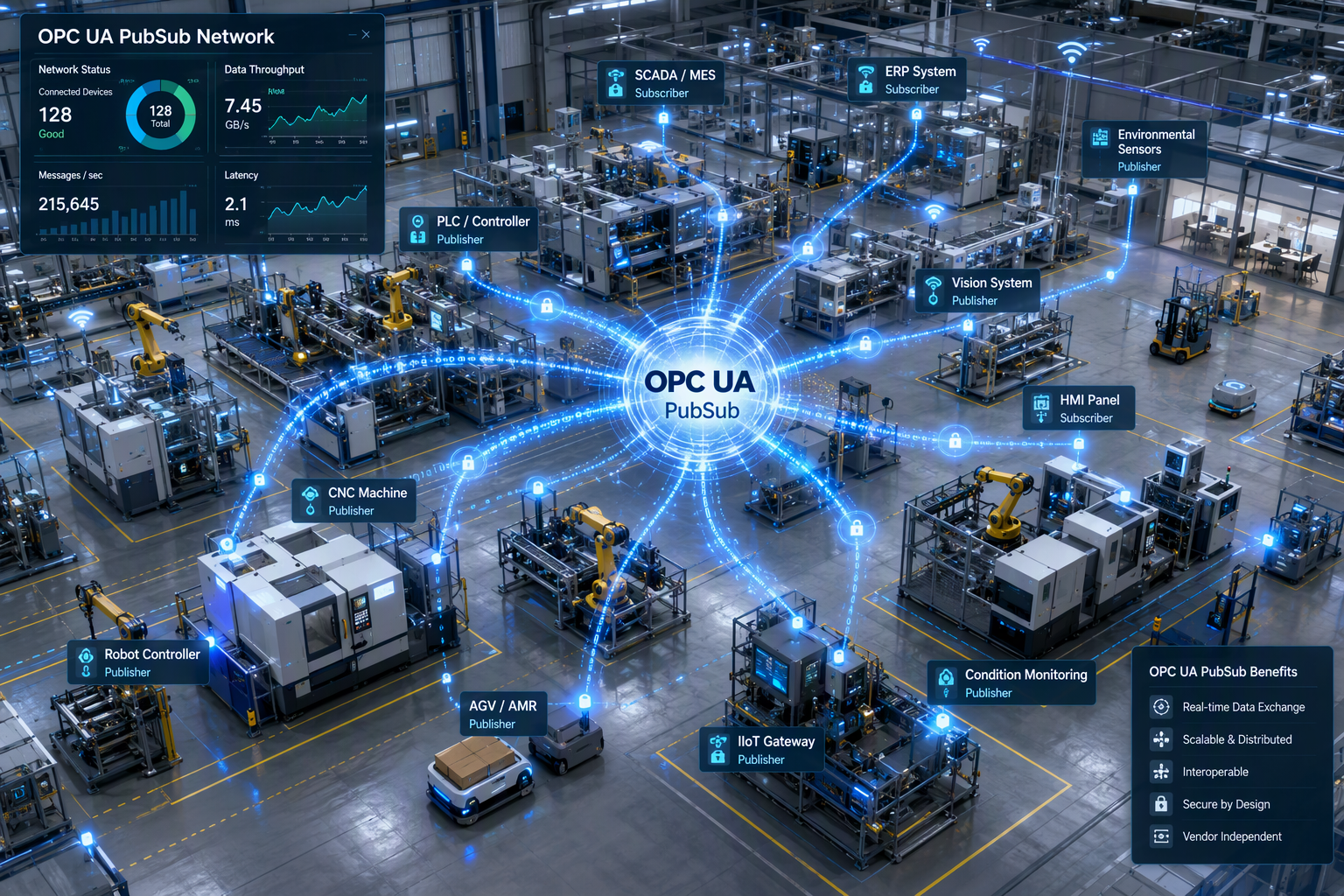
OPC UA PubSub is the publish-subscribe part of the OPC UA specification released by the OPC Foundation to expand how industrial data moves. It was built to support the exchange of data in places where classic request-response methods can be limiting, especially in Industrial IoT and time-sensitive automation.
In simple terms, OPC UA servers no longer need every consumer to ask for data directly from the address space. Instead, data can be published once and received by many subscribers. That shift, backed by implementation standards, is what makes PubSub useful for both embedded devices and larger connected systems. The next sections break down the model and its core parts.
What is OPC UA PubSub?
OPC UA PubSub is a messaging model inside OPC UA that lets one device or application send industrial data to a network or middleware without waiting for a direct request. In this setup, the OPC UA publisher pushes data out, and any approved subscriber can receive it.
That is different from the traditional pattern where one client connects to one server and asks for values. PubSub removes much of that back-and-forth. For a plant, that matters when the same machine data needs to feed an HMI, a controller, a historian, and a cloud tool at the same time.
It was designed to deepen automation and make OPC UA practical in more places, from low power embedded devices on local networks to scalable cloud-connected systems. In short, OPC UA PubSub broadens where OPC UA can be used and how fast data can move.
OPC UA PubSub vs Traditional Client/Server Model
The traditional client/server approach works well when one OPC UA client needs direct access to one of several OPC UA servers. It is familiar and useful, but it can become heavy when many systems need the same values or when fast cycle times matter.
PubSub changes that exchange of data. A publisher sends once, and many subscribers can consume the same message. That makes one-to-many and many-to-many communication possible, which fits modern plant networks and IIoT applications better than strict client/server links.
| Model | How it works | Plant-floor impact |
|---|---|---|
| Client/Server | A client requests data from a server | Good for direct access, but scales less easily |
| PubSub | A publisher broadcasts data to subscribers | Better for shared data and broad distribution |
| Client/Server | Connections are usually one-to-one | More configuration as systems grow |
| PubSub | Data can reach many users in the same cycle times | Helps support real-time automation needs |
Basic Concepts and Components of OPC UA PubSub
At the most basic level, OPC UA PubSub has a publisher side, a communication path, and one or more subscribers. The publisher collects values and sends them out as OPC UA pub messages. Subscribers listen for the data they need and use it in their own applications or control functions.
Those values come from an information model, which keeps the data structured and understandable across vendors. That is important when you are moving different data types from controllers, sensors, HMIs, or software systems and still want consistent meaning.
You also need clear configuration parameters. These include what data is sent, how often it is sent, and which monitored item or variables are included. In practice, the goal is simple: define the right data set, publish it reliably, and let multiple endpoints use it without custom one-off integrations.
How the Publish-Subscribe Mechanism Works
The PubSub mechanism works by having a publisher send messages on a defined schedule instead of waiting for requests. Each message can include header information, sequence numbers, and the payload data needed by subscribers. That structure helps receivers process messages in order and react within expected cycle times.
On the plant floor, this supports industrial automation procedures where timing matters. A defined publishing interval keeps data moving for control, monitoring, and business logic applications. To make that easier to picture, let’s look at the data flow and transport options next.
Data Flow in OPC UA PubSub
Think of the data flow as a repeated cycle. A device or application gathers values from each monitored item, packages them, and sends them out at the chosen publishing interval. Subscribers do not poll for updates. They simply receive the message when it arrives.
Each packet can carry sequence numbers and other message details so subscribers can track order and freshness. That matters when your exchange of data supports machine coordination or reporting. If a message misses a time slot, the system can still continue with the next cycle instead of waiting on a direct request path.
This is one reason PubSub helps business logic and control stay aligned. A conveyor application, for example, can keep using current data from upstream equipment, while other subscribers use the same stream for dashboards or analytics. One publish action supports many uses at once.
Supported Protocols for Transmission (UDP, MQTT, etc.)
OPC UA PubSub supports different ways to move messages depending on where the data needs to go. The right transport protocol depends on your network, latency needs, and whether you are staying on the plant floor or sending data toward the cloud.
For local networks and low-latency communication, UDP is a practical choice. For broader connectivity, OPC UA PubSub can work over MQTT, which stands for Message Queue Telemetry Transport, and AMQP. These options make it easier to connect embedded devices, controllers, and cloud-based applications in one architecture.
- UDP is useful for fast communication on local networks.
- MQTT supports message-based delivery to cloud or broker-based systems.
- AMQP is another middleware option for scalable messaging.
- Security remains important, so deployments should account for a secure channel and protected data exchange.
OPC UA Companion Specifications for PubSub Integration
OPC UA Companion Specifications matter because they define shared models for industries, machines, and device types. When you are planning the integration of OPC UA PubSub, those models help data keep the same meaning as it moves between equipment and software.
That is where OPC UA information models become practical. Instead of every vendor naming and structuring data differently, companion specifications give you a more consistent way to represent machine states, values, and events. This supports interoperability, which was one of the major reasons the standards effort began.
For many manufacturers, this is the next step after basic connectivity. You do not just want messages moving. You want them understood the same way by every subscriber. Combined with implementation standards, OPC UA companion work makes PubSub more useful across mixed-vendor environments and multi-system automation projects.
Benefits and Key Features for Automation and Manufacturing
OPC UA PubSub is important because it supports industrial automation where timing, scale, and system flexibility all matter. It is part of the evolution of OPC standards and gives manufacturers direct benefits by improving how data is shared across the manufacturing process.
Just as important, it supports the integration of IoT from cloud applications down to the deepest levels of machines. That helps with vendor compatibility, broader business logic use, and better coordination between systems. To see why plants care, look at scalability first, then a real plant-floor example.
Enhanced Scalability and Flexibility
As systems grow, one-to-one connections become harder to manage. OPC UA PubSub improves scalability because the same published data can be consumed by many subscribers. You do not need to build a separate path for every application that wants access to the same machine values.
That also improves flexibility. A controller, HMI, historian, or cloud service can subscribe to the data it needs without tightly coupling every endpoint. For many plants, these are major reasons PubSub fits the future of production better than older communication patterns.
- It supports one-to-many and many-to-many communication.
- It helps maintain vendor compatibility across mixed systems.
- It can improve response in applications with tight cycle times.
- It works from embedded devices to cloud-connected architectures.
When your plant expands or adds analytics, this flexibility can save time and reduce integration friction.
Real-World Example: Plant-Floor Data Collection
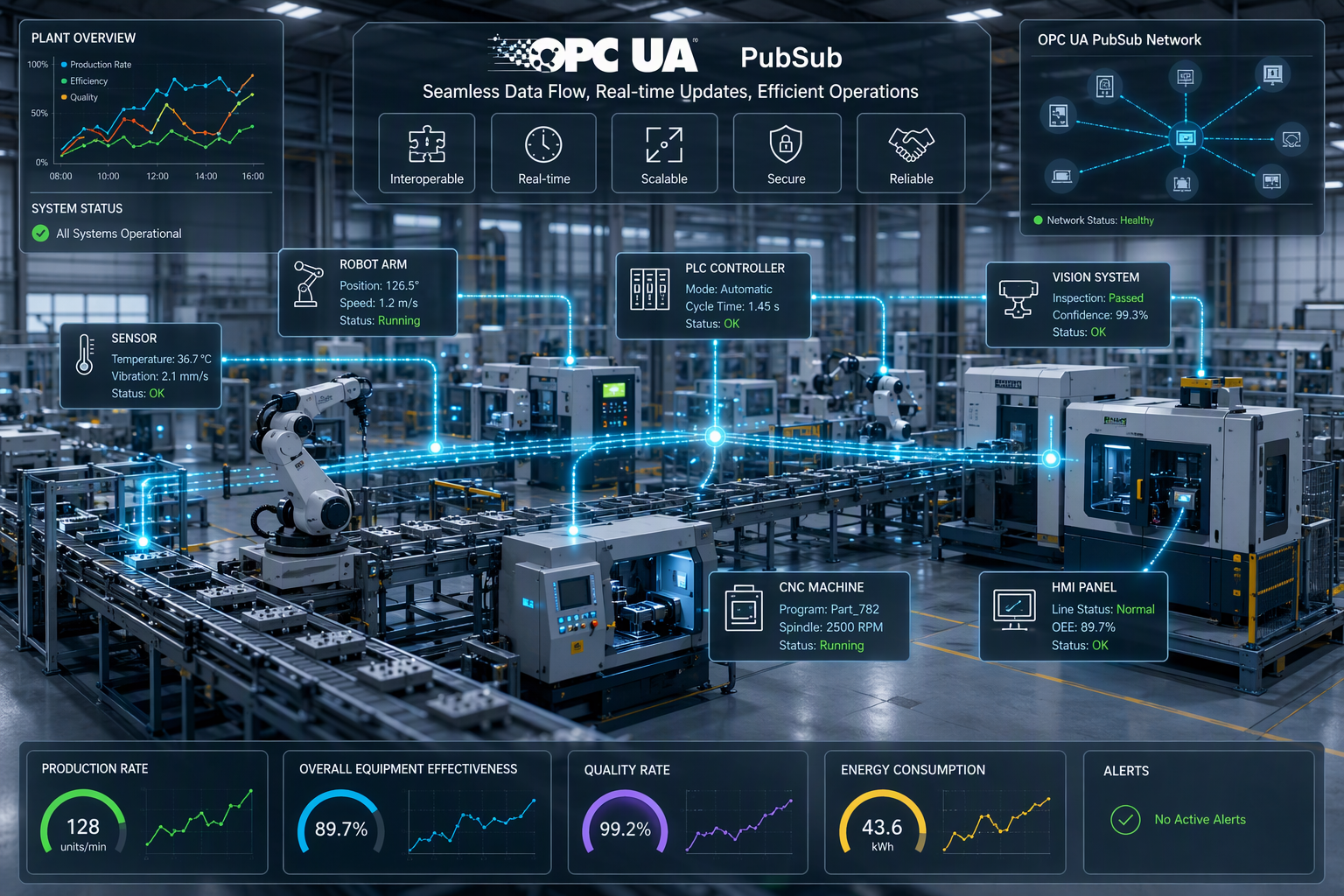
Picture a packaging line in one of your manufacturing facilities. A controller on the line needs to share plant-floor data with an HMI, a supervisory application, and a cloud dashboard. At the same time, a temperature sensor on nearby equipment also needs to report status without adding more one-off connections.
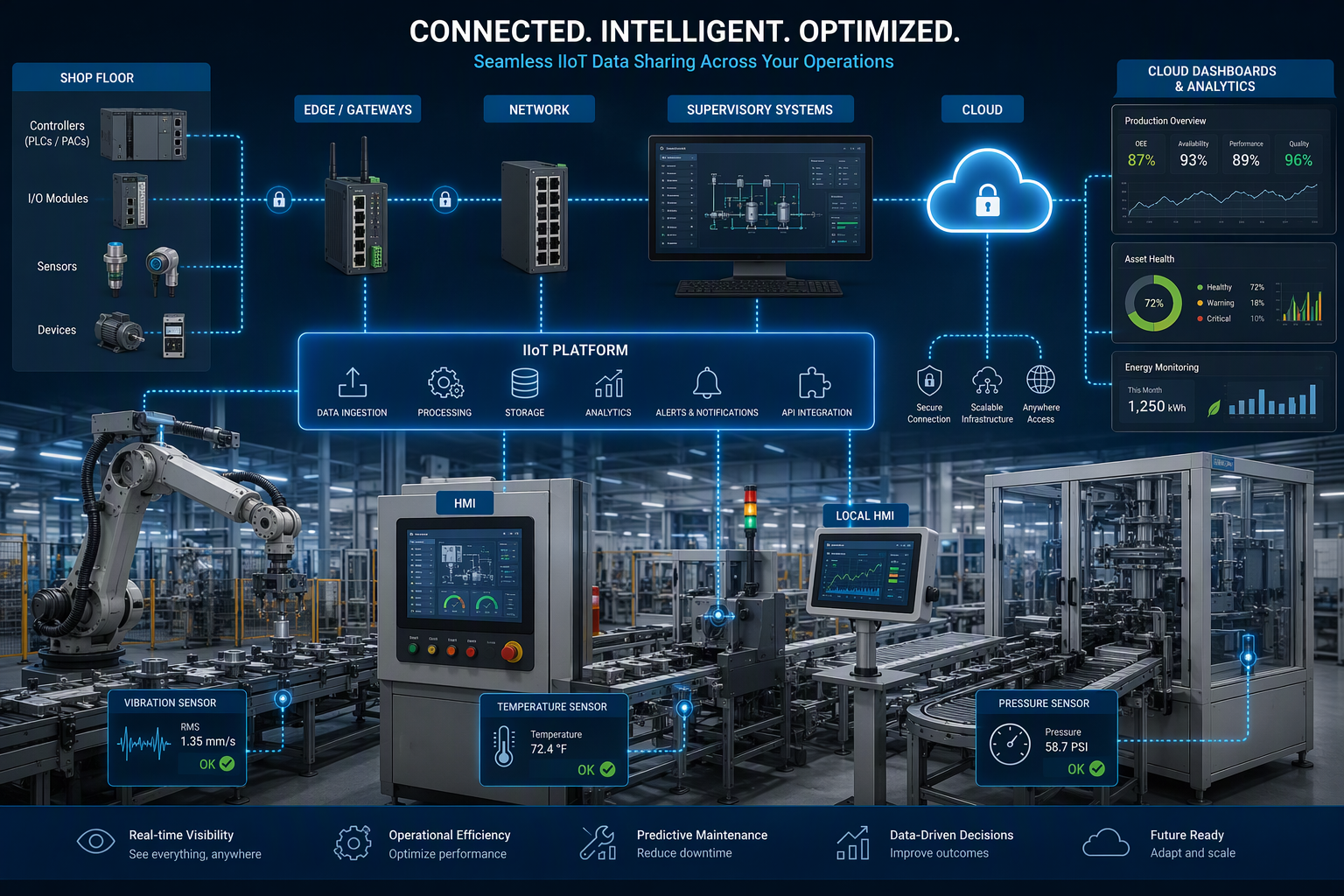
With OPC UA PubSub, that data can be published once over local networks and received by each subscriber that needs it. This is especially useful in the deepest levels of manufacturing facilities, where timing and low-latency communication affect machine coordination.
A strong example of the importance of PubSub is conveyor belts. If movement depends on current machine status, delayed data can create downtime. PubSub helps keep information flowing through each time cycle, so connected systems stay updated and operations keep moving even in demanding environments.
Empowered Automation’s Experience in Chicago Area
For manufacturers in the Chicago area, practical implementation is where strategy becomes results. Empowered Automation works as a systems integrator with a plant-floor view, helping clients connect controls, software, and data flows in ways that operators and managers can actually use.
That matters because the integration of OPC UA PubSub is not only about enabling a protocol. It is about choosing where publish-subscribe fits, how each client application will consume data, and how to keep the architecture manageable over time. Experienced IT system integrators can help turn standards into working production systems.
The broader market has already shown why this matters. EXOR International has highlighted PubSub with TSN as an example of an OPC Foundation solution for time-critical communication. In that same spirit, Empowered Automation helps manufacturers in the Chicago area apply these ideas in real operations, not just in theory.
Conclusion
In summary, OPC UA PubSub is revolutionizing the way data is collected and managed in industrial environments. By utilizing a publish-subscribe mechanism, it enhances scalability and flexibility, making it easier for plant managers and controls engineers to stay ahead of the competition. The ability to seamlessly integrate with various protocols and companion specifications allows businesses to optimize their operations efficiently. With real-world examples showcasing its benefits, it's evident that adopting OPC UA PubSub can significantly improve plant-floor data collection processes. For those interested in a deeper comparison between OPC UA and MQTT, check out our article on OPC UA vs MQTT for plant data collection. Embrace the future of Industrial IoT today!

Frequently Asked Questions
How does OPC UA PubSub compare to MQTT? (link to https://www.empoweredautomation.com/opc-ua-vs-mqtt-for-plant-data-collection-how-to-choose/)
MQTT, or Message Queue Telemetry Transport, is a messaging method, while OPC UA PubSub is an OPC UA communication model for structured industrial data. PubSub can use MQTT for transport. If you are comparing them for plant use, read OPC UA vs MQTT for plant data collection: https://www.empoweredautomation.com/opc-ua-vs-mqtt-for-plant-data-collection-how-to-choose/
Are there open source tools for OPC UA PubSub?
Yes, open source tools exist for OPC UA PubSub work, but success still depends on following OPC Foundation implementation standards and setting the right configuration parameters. In practice, tool choice should match your devices, transport needs, and how closely you want to align with production-ready integration requirements.
How do I implement OPC UA PubSub in my industrial system?
Start by defining what data your industrial system needs to publish, who needs to subscribe, and which transport fits the job. Then apply OPC UA implementation standards, configure publishers and subscribers, and test each client application. For many plants, the integration of OPC UA works best with an experienced systems integrator.
You might also like