Building a Unified Namespace with MQTT
Building a Unified Namespace with MQTT

Key Highlights
- A unified namespace MQTT approach gives your team one shared source of truth for industrial data.
- An MQTT broker supports event-driven data exchange without heavy point-to-point connections.
- This model improves data integration across machines, SCADA, MES, and enterprise applications.
- MQTT fits industrial iot because of its lightweight design, topic structure, and scalability.
- Good topic governance, payload rules, and state management keep the namespace usable over time.
- Practical UNS design helps manufacturing teams move digital transformation from pilot to plant reality.
Introduction
If you work in manufacturing, you already know how hard it is to connect industrial iot data across different systems. A unified namespace creates a shared structure where data producers and data consumers exchange information through an MQTT broker instead of building one-off links everywhere. That matters because better data flow means faster decisions, cleaner integration, and less maintenance. When you build a unified namespace MQTT architecture well, your plant gets a clearer path from connected assets to business value.

Understanding Unified Namespace in Modern Manufacturing
Manufacturing teams often deal with fragmented industrial data spread across machines, applications, and departments. A unified namespace changes that by creating one shared structure for publishing and subscribing to information.
In practice, it becomes a source of truth for data integration across the entire enterprise. Instead of passing data through brittle point-to-point paths, you organize it in a consistent namespace structure. To understand why this matters in smart manufacturing, it helps to first define what a unified namespace really is.
Defining Unified Namespace and Its Role in IIoT
A unified namespace in industrial iot is a shared, structured data layer where systems publish and subscribe instead of connecting directly to each other. It acts as a single source of truth for your plant and enterprise, giving every authorized system a consistent place to find data.
At a practical level, the unified namespace uses a hierarchical structure, often aligned to ISA-95, so your data model reflects how the business actually operates. That can include enterprise, site, area, line, cell, and asset levels. This makes the data ecosystem easier to navigate and scale.
If you want a broader introduction to unified namespace basics before implementation, see https://www.empoweredautomation.com/what-is-a-unified-namespace-uns-in-manufacturing/. From there, MQTT becomes the messaging layer that keeps this shared structure live and useful.
How Unified Namespace Supports Seamless Data Integration
Many manufacturing environments still struggle with data silos. A unified namespace improves data integration by giving data producers and data consumers a shared topic namespace for data exchange, rather than forcing every system to maintain separate interfaces.
Here is how that works in practice:
- Data producers publish once into a shared namespace instead of sending to many endpoints.
- Data consumers subscribe only to the branches they need through MQTT topics and wildcards.
- The topic namespace provides context about location, asset, and data type.
- New applications can join the data exchange without changing existing publishers.
That structure reduces integration complexity and supports real-time visibility across different systems. Your SCADA, MES, historians, and analytics tools can all work from the same data flow. Once that foundation is clear, the next step is understanding why MQTT is such a strong fit.
The Basics of MQTT and Its Relevance to Manufacturing
MQTT is a lightweight messaging protocol built for reliable communication between distributed systems. It uses publish-subscribe messaging, where clients send data to an MQTT broker and other clients receive it through MQTT topics. That simple model is one reason the MQTT protocol is common in the Internet of Things.
For manufacturing, the fit is practical. Industrial systems need efficient messaging, low overhead, and easy filtering by topic. MQTT delivers that while supporting scalable industrial data exchange. To see why many teams choose it over other IIoT protocols, a direct comparison helps.
What Sets MQTT Apart from Other Communication Protocols
Companies should consider the MQTT protocol for unified namespace work because it is simple, scalable, and built for efficient event-driven communication. Its lightweight design came from demanding use cases like monitoring oil pipelines over limited networks, so it handles industrial iot traffic with very little overhead.
Unlike many traditional IIoT protocols, MQTT decouples each data source from each consuming application. That means your architecture grows by adding publishers and subscribers, not by multiplying custom connections.
| Protocol | Strength in manufacturing data architecture |
|---|---|
| MQTT | Lightweight design, publish-subscribe messaging, easy scaling, low bandwidth use |
| OPC UA | Strong information modeling and interoperability across industrial systems |
| Sparkplug B over MQTT | Adds standardized topic namespace, state management, and defined payload behavior |
For many plants, MQTT is not replacing every protocol on the floor. It is becoming the messaging backbone that connects them.
Why MQTT Aligns Well with the Unified Namespace Approach
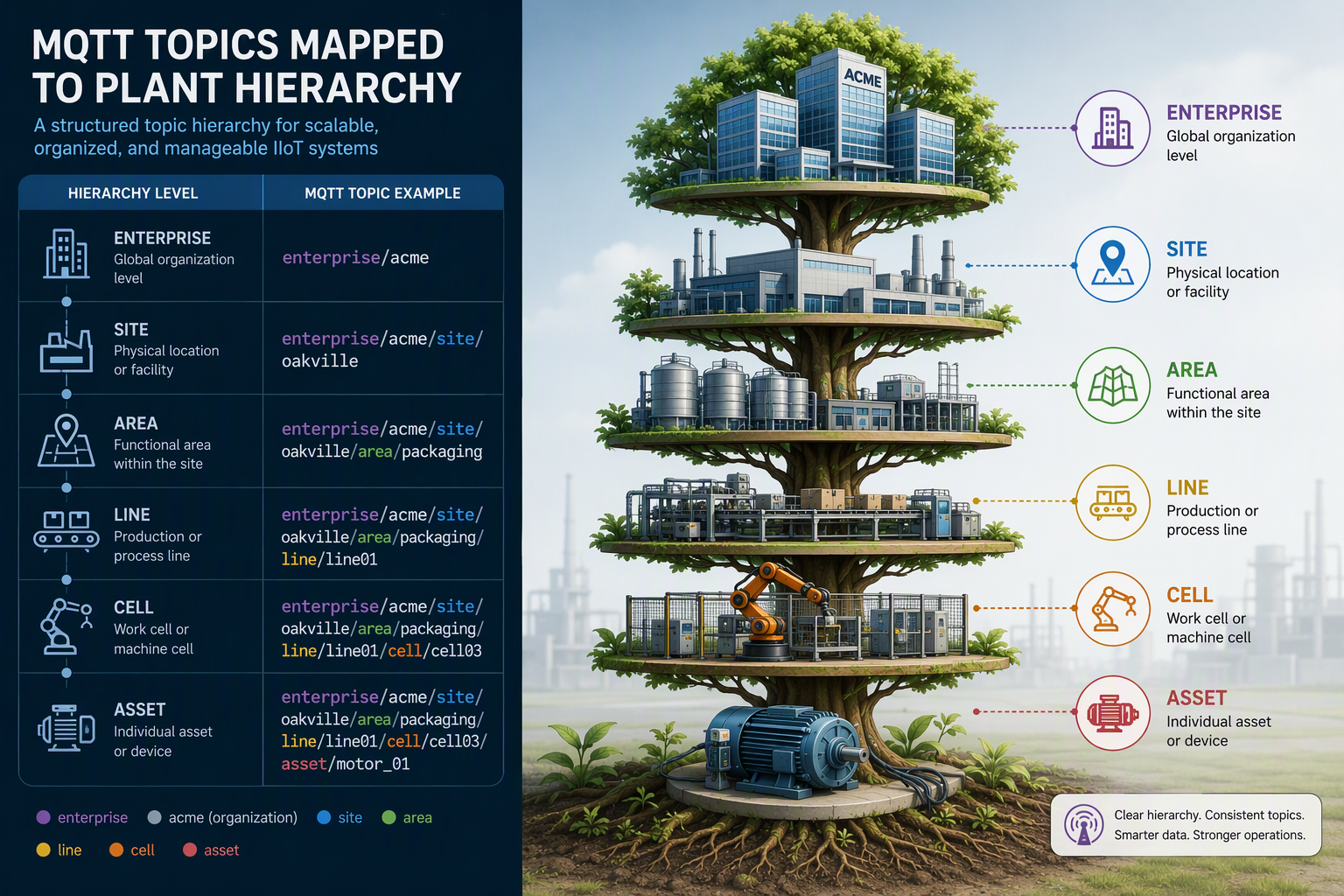
MQTT aligns well with a unified namespace because its topic namespace is naturally hierarchical. You can map MQTT topics to your plant structure, then organize data by enterprise, site, area, line, cell, asset, and data type. That gives your data model clear routing context.
Just as important, MQTT supports event-driven publishing. Data can be reported only when something changes, which reduces noise and keeps the current state visible without constant polling. In industrial iot, that matters because networks and systems should not carry unnecessary traffic.
A simple example looks like this: acme/chicago/packaging/line-3/filler-01/state/mode or acme/chicago/packaging/line-3/filler-01/telemetry/temperature. With topics like these, different systems can subscribe to exactly what they need. That makes MQTT a practical foundation for the core benefits covered next.
Core Benefits of Building a Unified Namespace with MQTT
Building a unified namespace with MQTT gives manufacturing teams a cleaner way to move data across operations. Instead of scattered integrations, you use an MQTT broker as a central hub for structured, event-driven messaging.
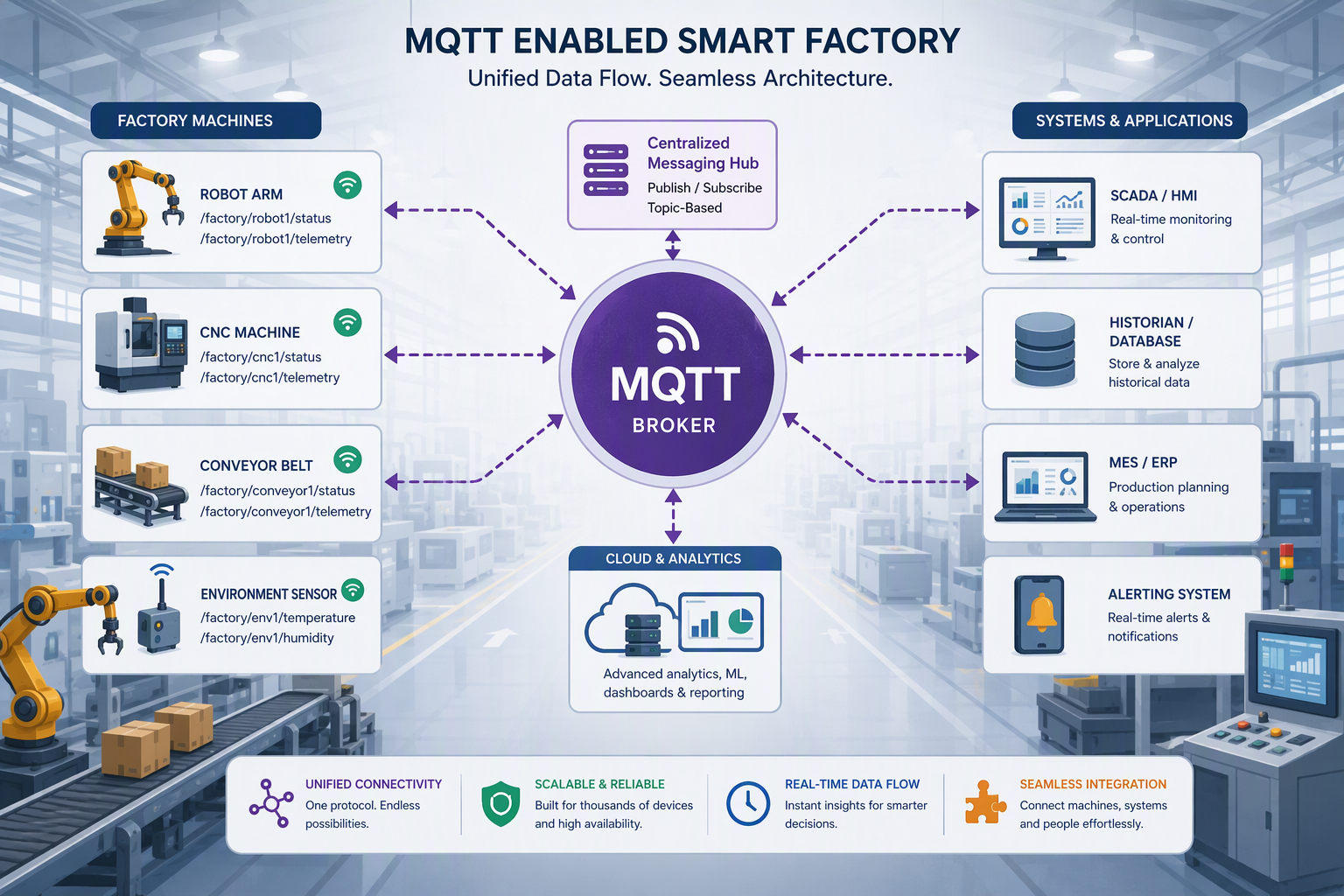
That improves visibility into the current state of equipment, processes, and operations while reducing integration effort. It also supports digital transformation by making data integration easier to expand over time. Two benefits stand out on the plant floor: faster real-time flow and greater long-term flexibility.
Streamlining Real-Time Data Flow Across the Plant Floor
On the plant floor, a unified namespace simplifies data flow by turning many separate handoffs into one shared messaging path. Machines, gateways, SCADA, MES, and enterprise tools publish and subscribe through the MQTT broker, so real-time data moves without direct point-to-point dependencies.
That helps your team see the current state faster. Instead of polling every data source, systems receive changes as they happen. Report-by-exception patterns reduce unnecessary traffic, while retained messages help late-joining applications get the latest known values right away.
Consider a practical example. A filler publishes state/mode, telemetry/temperature, and event/alarm_raised topics. Quality dashboards, maintenance apps, and planning tools each subscribe to the relevant data points. No republishing chain is required for every consumer. This makes state management more consistent and keeps smart manufacturing decisions closer to real time.
Improving Flexibility and Scalability in Smart Manufacturing
As manufacturing systems grow, brittle integration methods become expensive. A unified namespace built on MQTT supports scalability because publishers and subscribers stay decoupled. You can add a new application, line, or site without redesigning the whole data architecture.
This also supports open architecture. MQTT and Sparkplug specifications are publicly available, so organizations can mix tools and vendors more easily. That lowers lock-in risk and makes it simpler to expand a smart manufacturing environment over time.
There is another advantage: less operational overhead than maintaining countless custom links. A reusable namespace structure and shared data contracts help teams onboard new use cases faster. Whether you are adding analytics, maintenance systems, or enterprise reporting, the architecture can grow in a more controlled way. That makes the design choices behind the namespace even more important.
Key Components Needed for an Effective Unified Namespace MQTT Architecture
An effective unified namespace MQTT design needs more than a broker and a list of tags. Strong UNS architecture depends on a clear topic structure, a practical data model, and rules for how systems publish, consume, and govern information.
Some teams use flat MQTT with their own conventions, while others use MQTT Sparkplug for more standardized behavior. Either way, the building blocks stay similar: naming clarity, payload consistency, state handling, and access rules. The next two sections focus on the components that keep the namespace usable.
Topic Structures and Naming Conventions for Clarity
A good topic structure should mirror how your plant works. Many teams align the topic hierarchy to ISA-95, then add asset and data type segments. This makes the namespace structure easier to search, filter, govern, and reuse across teams.
Use naming rules that stay stable over time:
- Base the topic hierarchy on enterprise/site/area/line/cell/asset.
- Add a clear data source or data type branch such as telemetry, state, event, or kpi.
- Use a consistent naming convention with lowercase and stable identifiers.
- Avoid packing too much meaning into topic names when it belongs in the payload.
For example, acme/chicago/packaging/line-3/filler-01/telemetry/temperature is clearer than a flat tag dump. With predictable topics, teams can subscribe using wildcards and still know what they are getting. After structure comes the harder part: keeping data trustworthy and secure.
Ensuring Governance, Security, and Data Quality
Most unified namespace problems are not caused by MQTT itself. They usually come from weak governance, unclear ownership, and inconsistent data management. If nobody controls topic growth, schema changes, or branch ownership, the namespace quickly becomes hard to trust.
Security needs the same discipline. Good access control means using topic-level permissions, separating command paths from telemetry, and limiting access by role. Shared credentials and flat permissions create risk, especially when operational and control topics are mixed together.
Data quality matters just as much. Keep required payload fields consistent, including timestamp, value, unit, quality, and source. Versioning should be explicit so consumers are not forced into defensive parsing. When governance, security, and data quality are handled early, UNS implementation becomes far easier to scale.
Step-by-Step Guide to Setting Up a Unified Namespace Using MQTT
A strong UNS implementation starts with design choices, not software alone. Before you deploy an MQTT broker, decide how your hierarchy, payloads, and ownership rules will work. That gives data consumers a predictable environment and reduces rework later.
From there, focus on repeatable best practices. Map plant structures first, then standardize data structures, clients, and message formats. These steps help solution architects build a namespace that supports current needs without blocking future expansion. The practical setup starts with hierarchy planning.
Planning Your Hierarchies According to ISA-95 and Plant Needs
Start by planning the hierarchical structure around how your plant operates. ISA-95 is a strong reference because it gives you a common way to organize enterprise level, site, area, line, and cell information. That makes topic design more consistent across teams.
Still, the model should serve your operation, not the other way around. Many plants map physical assets and control boundaries first, then align them to ISA-95. This avoids over-modeling and keeps the namespace easier to maintain as production lines change.
After the structural levels are defined, add a clear data type segment. Separate state, telemetry, events, and KPIs instead of blending everything together. For example, line data and machine alarms should not live in the same branch without context. Once the hierarchy is planned, you can choose the broker, clients, and payload standards that support it.
Implementing Brokers, Clients, and Payload Standards
After hierarchy planning, deploy the MQTT broker as the central message hub, then connect edge gateways, applications, and other clients. Your goal is interoperability, so topic routing, retained state, and session handling should work consistently across the namespace.
Keep payload standards simple and enforced:
- Define required fields like timestamp, value, unit, quality, and source.
- Choose one schema approach and apply it consistently across clients.
- Use binary format options such as Sparkplug payloads when efficiency and standardization matter.
- Avoid custom parsing mechanisms for every asset or team.
A practical example is publishing retained machine mode topics, heartbeat health topics, and event-by-exception telemetry from gateways. Common challenges appear when payloads drift, clients publish inconsistently, or teams mix command and telemetry paths. Those issues can be managed, but only if the architecture is governed from the start.
Overcoming Common Challenges When Integrating Unified Namespace and MQTT
Even a well-designed UNS architecture will face real-world friction. Many plants still have data silos, legacy barriers, and equipment that was never designed for modern event-driven messaging. That does not make unified namespace adoption impossible, but it does require planning.
Long-term success also depends on maintenance and change management. As more teams, sites, and use cases join, the namespace must stay consistent and manageable. The following sections cover how manufacturers can address both old-system integration and future growth.
Breaking Down Information Silos and Legacy Barriers
One common challenge is that valuable production information already lives inside SCADA systems, historians, PLC networks, and older enterprise applications. These environments often create data silos because each system was built for a narrow purpose, not broad data exchange.
A unified namespace helps by creating a shared layer where those systems can publish or expose data through gateways and adapters. Instead of replacing everything at once, teams can bridge legacy barriers and bring key signals into a common structure. That makes data integration more realistic for active plants.
The shift is as much architectural as technical. When multiple systems contribute to the same namespace, information becomes easier to find, subscribe to, and reuse. Your teams move from isolated sources toward shared operational context. Once those silos are addressed, attention usually turns to scale, upkeep, and organizational change.
Addressing Scaling, Maintenance, and Change Management
Scaling a unified namespace is not just about adding broker capacity. It also means keeping the data architecture consistent as more assets, applications, and sites join. Without standards, the MQTT protocol can become a dumping ground of inconsistent topics and payloads.
That is why maintenance needs ownership, reviews, and versioning. Topic branches should have clear owners. Schema changes should follow a process. Wildcard subscriptions and enterprise naming rules should be reviewed before rollout, especially in large multi-site deployments.
Change management matters just as much. Teams need a shared understanding of how the namespace will be used, what belongs in it, and who can modify it. Reusable templates for asset classes, payloads, and hierarchy patterns make growth easier. With those controls in place, scalability becomes manageable instead of chaotic.
Conclusion
In conclusion, building a unified namespace with MQTT is essential for modern manufacturing environments aiming to enhance data integration and streamline operations. By understanding the core principles of unified namespaces and the unique advantages that MQTT brings, manufacturers can significantly improve real-time data flow and scalability. Implementing a structured approach will not only eliminate information silos but also ensure the governance and security of data. As the manufacturing landscape continues to evolve, prioritizing a unified namespace is crucial for staying competitive. If you're interested in exploring how a unified namespace can transform your operations, don't hesitate to reach out for a free consultation. Let's embark on this journey to smarter manufacturing together!
Frequently Asked Questions
What is the role of Sparkplug in a unified namespace with MQTT?
Sparkplug B adds more structure to MQTT by defining a standard topic namespace, payload behavior, and lifecycle messaging. In a unified namespace, MQTT Sparkplug can improve consistency in data exchange and state handling, though some teams still prefer more flexible flat MQTT designs depending on their data model needs.
Are there best practices for topic hierarchies in unified namespace MQTT setups?
Yes. Best practices include aligning the topic hierarchy to ISA-95, using a stable naming convention, separating state, telemetry, and events, and keeping MQTT topics readable but not overloaded with meaning. A clean topic structure improves subscriptions, governance, and long-term maintainability across teams and sites.
Which platforms are commonly used for deploying unified namespace MQTT solutions?
Common deployments use an MQTT broker as the messaging backbone, with edge gateways, OPC UA connections, and IoT platforms feeding data into enterprise applications. Some architectures also use multiple brokers and republishing layers. Solution architects typically choose platforms based on interoperability, governance needs, and operational complexity.
You might also like